
Most companies in Bangladesh are built slowly. The startup conversation rarely reflects that. While funding rounds and sudden growth make the news, a company that has spent ten or twenty years growing on its own revenue almost never does. Even the successful startups take a long time to build.
Patience is an underrated business strategy. A founder playing the long game makes decisions that compound: earning trust one customer at a time, hiring only when the work is there, adding a branch or a product only when the last one works. Progress looks slow for years. Then the accumulated reputation, relationships, and know-how start to pay off.
Patience alone is not enough. It needs commitment: the willingness to stay with an idea through the slow years, when quitting would be easier. And it needs the founder's whole self. The founders in this collection bring their upbringing, their values, and their character into how they build. Our conversation with Sohel of Muspana makes the point plainly: founders build what they are.
Self-funding often makes patience a necessity. Founders who build on their own savings and customer revenue cannot outspend a problem. They have to outlast it. That discipline has real upsides: ownership, control, and a business that answers to its customers.
The long game has costs too. Growth can lag behind the opportunity. Teams stay stretched. Founders carry the risk personally, and the years when nothing seems to move test their conviction.
In Bangladesh, the long game is often the only one available. Startup investment here is thin and concentrated; one tracker put first-half 2026 funding at about US$6 million. For most founders, time and customers are the most reliable capital.
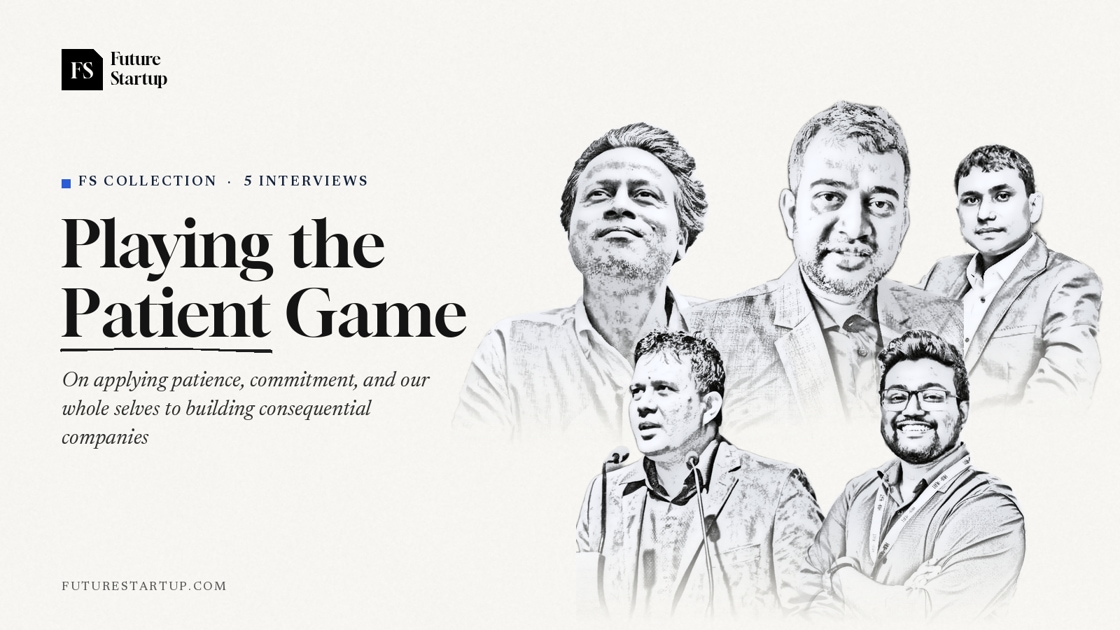
This collection brings together 05 Future Startup conversations with founders who applied patience, commitment, and their whole selves to building consequential companies. Each one shows a different side of what that kind of company building demands. Most of these interviews come from our archive, and some are several years old. Many of these companies have changed since we spoke with them. The stories and the lessons remain relevant.
This piece builds on our previous collection, How to Build a Company That Lasts, which brought together six conversations on building for the long term. You can find all our past collections here.
Atiqur Rahman Sarker Sohel started building and selling IPS units in 2008 while working at Grameenphone, from a single room in Mohammadpur rented for 6,000 taka. The 2010 Dhaka flood put that office underwater and wiped out nearly all its stock. His partners left. Sohel kept going and paid his one employee by flipping IPO allocations. He left corporate life in 2012, exactly five years after joining, as he had planned on day one. Today, Muspana spans solar, intelligent street lighting, Bangladesh's only round conical pole factory, and government infrastructure work. The conversation is a close look at trust, diversification, and building a company on its own earnings.
Originally published: July 22, 2026
Disclosure: Muspana is a Future Startup client.
Ashraf Kaiser spent seven years as an investigative journalist at Bichitra before moving into advertising and PR. In 2000, at 30, he left a secure corporate role and started Benchmark from home. The first team was Ashraf writing copy, a part-time art director, and an office assistant carrying work between clients. Benchmark took almost any work that came its way, and Ashraf let the quality of that work do the marketing. It grew into one of Dhaka's leading communication agencies and became one of the first Bangladeshi agencies to expand abroad, into Nepal. The interview is a close look at starting a service business with no capital and a beginner's mind.
Originally published: May 8, 2019
Shariful Islam left Unilever without a plan, spent a year on voluntary work, then started a small brand consultancy. After attending a brand forum in Singapore, he launched Bangladesh Brand Forum in April 2007 with a two-day conference, helped by the event firm he was working with and an unexpected endorsement email from Philip Kotler. He worked mostly alone at first. BBF then added a magazine, the Best Brand Award, communication awards and leadership summits, one project at a time, using the profitable ones to carry the important ones. Shariful is candid that money was the hardest part of the early years. Nearly two decades on, BBF still runs its Best Brand Award every year.
Originally published: August 6, 2017
Mentors' began in 1996 as an IBA admission program near Dhaka University. Anindya Chowdhury joined as a teacher that year, became a partner in 2004, and took over the operation when both founders moved to the UK in 2006. The company has grown one step at a time: a new branch only when the last one was full, a new program only when the team could run it well. Anindya explains how Mentors' picks about 30 teachers from 150 applicants every year, why it caps its branch count to protect quality, and why doing one thing at a time is how a small business lasts. Thirty years on, Mentors' is one of the country's best-known names in IELTS preparation and study abroad.
Originally published: August 6, 2019
Ratul Rahman started Hubxpert in April 2023 with about 10 lakh taka of his own savings and a handful of people he trusted. He turned down general marketing work to stay focused on HubSpot, and gave the plan six months before he would consider a change. The first clients came through referrals, cold emails, Upwork and recorded demo videos. After joining HubSpot's partner program in 2024, Hubxpert reached Platinum status in seven months. Ratul is candid about the hard part of growing on revenue alone: hiring teams three months before the projects arrive.
Originally published: March 17, 2025
The five companies in this collection sit in different markets. One sells software services abroad. One is a communications agency. One runs events, awards and a magazine for the business community. One manufactures and builds infrastructure at home. One is an education company.
The same pattern runs through all of them. Customers were the first investors. Each founder earned trust early, then built the company around keeping it.
Patience mattered more than speed. Ratul refused work outside his niche. Anindya opened a new branch only when the last one was full. Shariful added one project at a time. Ashraf let the quality of Benchmark's work do its marketing. Sohel rebuilt after a flood took almost everything his first office owned.
The long game is slower. It is also how a company builds the trust, skill, and reputation that money cannot buy, and how it survives the years when no one else is paying attention.
More from our collections: