
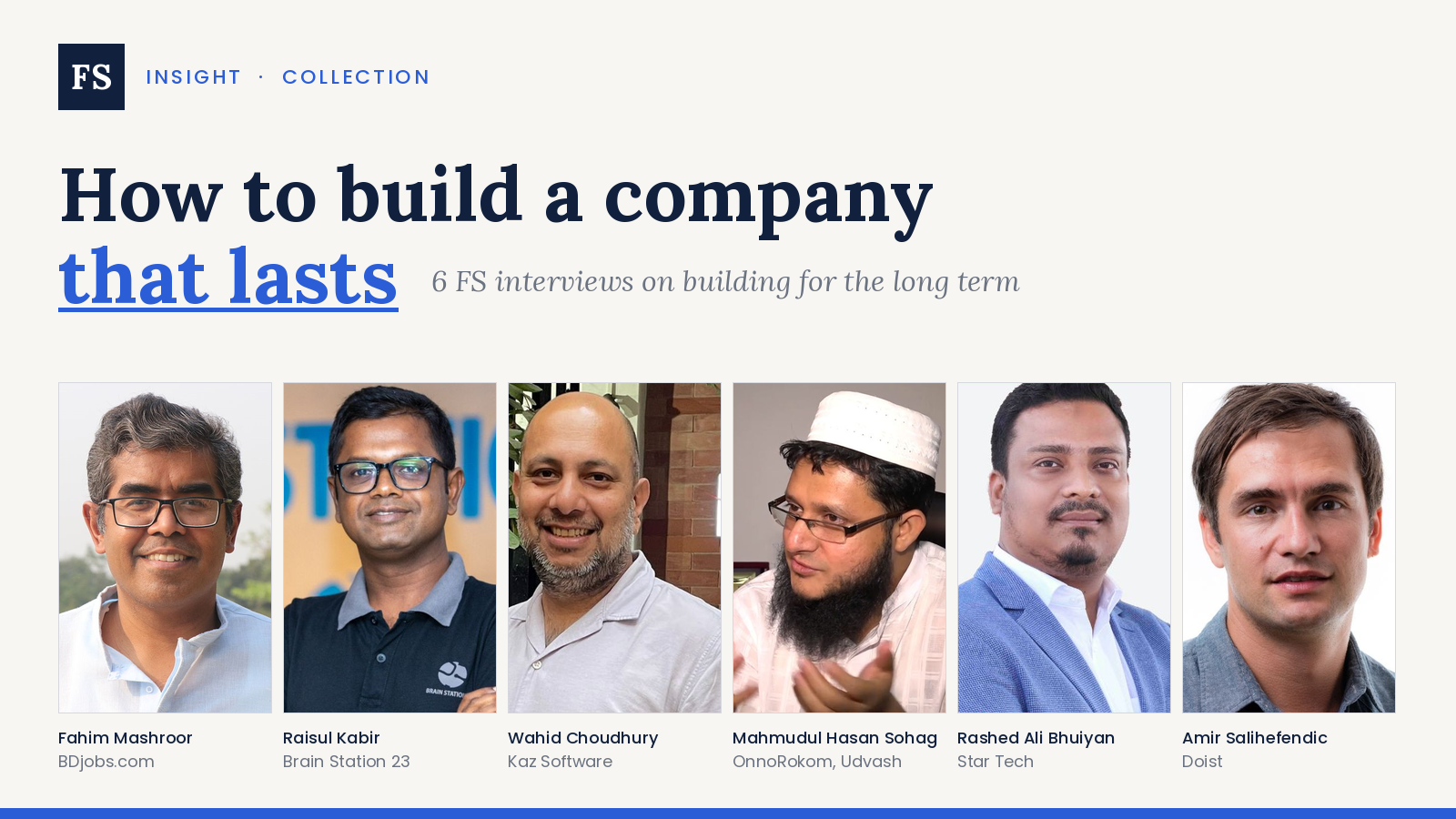
Building a company that lasts takes something different from building one that grows quickly. Growth and durability are two different challenges. However, that is not to say one is more desirable than the other. Rather, these are two different problems that demand different skills and strategies. Growth is important, but if your company doesn’t last, growth doesn’t make any sense at the end of the day. At the same time, if you are not growing, it is not possible to build a lasting organization. A durable organization has to be equally good at growth. Because, as the saying goes, stasis is death. It means that, instead of arguing over what is more desirable, it is more useful to spend time figuring out both. In this collection, we focus on the problem of building something enduring.
Sources for each are also different. Growth can come from a good product, a favorable market, or a timely opportunity. Durability is built over years. It comes from sound judgment, strong people, operational discipline, the ability to change when circumstances demand it, and the patience to keep going.
This collection brings together 06 Future Startup conversations with founders who offer different perspectives on that problem.
Brain Station 23 is a story about moving from founder-led execution to institutional scale. Raisul Kabir's conversations explore how the company grew from a small software operation into a large technology organization, and what had to change in leadership, structure, sales, people, and culture along the way.
Kaz Software offers a different kind of technology company story. Founded in 2004, it has survived multiple cycles in the software industry without chasing every new trend. Wahid Choudhury talks about stability, craftsmanship, leadership, and the less visible work required to build a company that can keep operating for decades.
Mahmudul Hasan Sohag's conversation offers a broader view of company building than a single-business story. He talks about OnnoRokom's ambition, the evolution of Udvash and Pi Labs, and the principles he believes matter for entrepreneurial success. It is a useful look at how a founder thinks about building businesses, institutions, and a larger organization over time.
Star Tech began in 2007 as a small technology retail outlet. Its subsequent journey shows how a business can expand its scope without losing sight of its core market. Rashed Ali Bhuiyan discusses the company's transition into a broader retail, distribution, and services business and the structures needed to support that expansion.
Fahim Mashroor's story provides a look at what it means to build before an ecosystem exists. Bdjobs became one of Bangladesh's earliest successful internet companies at a time when the country's digital market was still taking shape. The early years were difficult. It took years before the company found its footing. Mashroor’s story is therefore less about a brilliant launch than about staying with an idea long enough for the market to catch up. His philosophy is straightforward: building a meaningful company takes time. Passion, patience, focus, honesty, and dedication matter more than the promise of getting rich quickly.
Amir Salihefendic offers a very different model of company building. Todoist began as a side project and eventually became the foundation for Doist, a global software company built around remote work, product craftsmanship, and a long-term mindset. His story asks what happens when a founder deliberately chooses independence and sustainability over the conventional venture-backed path.
There is no single formula for building a company that lasts. Some founders build patiently within one market. Others reinvent their businesses. Some prioritize independence. Others build for scale. Some start with a clear commercial opportunity. Others begin with a mission and discover the business model along the way.
But a common idea runs through the collection: lasting companies are built through repeated good decisions.
The founders featured here kept making those decisions as their circumstances changed. They learned to build systems, develop people, understand their customers more deeply, and reconsider assumptions that had once worked.
Longevity, in the end, is less about refusing to change than knowing what to change and what to protect.