
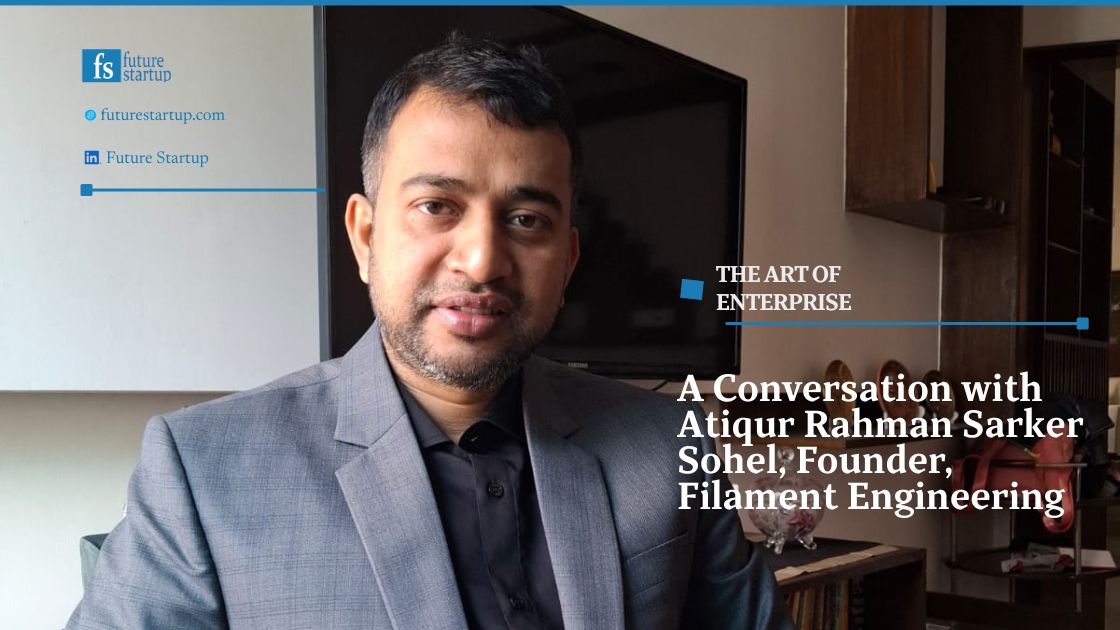
Atiqur Rahman Sarker Sohel is the founder and Managing Director of Filament Engineering Ltd (Muspana), a diversified conglomerate with business across solar, electronics products, and electrical infrastructure. Under his leadership, Muspana has become the country's only manufacturer of round conical electric poles, a pioneer in intelligent street lighting, and one of the top two or three names in public sector solar, and a diversified conglomerate with businesses across manufacturing, import, and public sector work.
Mr. Sohel started Muspana in 2010 with his elder brother out of a single room in Mohammadpur for 6,000 taka in rent, after spending two years building and selling IPS units while holding down a full-time job at Grameenphone and then Robi. He left corporate life exactly five years after joining in 2012. That deadline was set on day one. We first covered Muspana in 2017. This conversation is the return visit, and the distance between that visit and this one tells its own story.
Mr. Sohel grew up in a village in Comilla where a car still can't reach his house. His father was a teacher who did all kinds of work outside of his profession, from agriculture to carpentry to masonry, not because he needed to, but because this is how he moved through the world. He cultivated a sense in his children that there is no small task and work is sacred. Sohel wired the family house himself the year electricity arrived, sold gourds in the market beside his father, and cut grass for the cows before school. His father died during Hajj, midway through his first year at BUET.
The most fascinating part about Sohel is that he has never separated who he is from how he builds. Something that I think is true about almost all consequential founders. At the end of the day, we build what we are. For Sohel, the work ethic, the refusal to stay idle, the belief that every form of labor has its own dignity--these values were built into him early, and they run through everything he does.
In this interview, you will learn:
I found this one of the most fascinating conversations I have had about what it takes to build something from nothing, and what kind of person that requires you to be. I am delighted to share it with you. Happy building. Enjoy!
Mohammad Ruhul Kader: We interviewed you once before when we did a series on Muspana a few years back. That interview didn't cover your formative early years. Tell us about childhood and youth. What was it like, and what were the major influences in your early life?
Atiqur Rahman Sarker Sohel: I grew up in Comilla, in a village called Mahalaxmipara, about four kilometers from Brahmanpara Thana. Even now, a car can't reach my house. A cycle or rickshaw can manage with difficulty; an auto-rickshaw can get through, but a car still can't.
When there were floods — the flood of '88, '98, and the ones after — we suffered a lot. We had to commute by boat. During the rainy season, sometimes the boats wouldn't run, so we'd leave the boat and walk to school.
My childhood was very colorful. I cut grass for cows and weeded the fields. I know and have done all kinds of farming. My elder brother, who is now Chairman of our company, did all kinds of agricultural work too. And my father used to do it despite being a teacher — an English teacher of our local senior fazil madrasha. He had a real passion for agriculture, and my own long-standing interest in it comes from him.
I worked on the economic side of it as well. I regularly sold gourds and beans in our village bazaar in those years. Gourds and papayas were our main items. At the time, I felt very shy whenever my father took me to the bazaar to sell these. But he never felt any hesitation.
My father thought that if he cut the cow's grass and drank the cow's milk, there was a certain joy and honor in that. His perspective on work was different from most people.
I consider my father one of the philosophers of my life. He was a uniquely hardworking and visionary man.
I attended Bhagaban Government High School in Brahmanpara, Comilla, from where I passed my SSC in 1998.
In school, I was the 'first boy', the top student in my class. But my father still made me do these small household things. I used to feel shy, wondering what others would think. As I said, I didn’t like it. My father loved me, but he would also make me do it. It was never that he needed my help. He could have managed without me doing any of it. It's not as though we were in some financial difficulty. He was a teacher, which was his main profession. We had agricultural income, which is common in rural areas in Bangladesh. But we worked as though we were needy farmers, and I understand now why he wanted that.
Ruhul: Tell us more about your lessons from your father.
Sohel: Agriculture was our great inspiration. We grew most of our vegetables ourselves. We grew mustard ourselves and all types of it. We grew sesame and linseed. Father did a whole fenugreek field once, which was unusual. We grew it regularly. Radishes were always there. Cucumbers, snake melons. Potatoes of every kind: small, large, sweet. Jute, which we sold. Chilies every year, which was a significant cash crop for us.
My father had another quality I didn't recognize as special until much later. He used to go to Bhairab from time to time; he had some friends there. I guess in Bhairab, you could buy lungis for cheap. On his return, he would often bring some lungis and sell them in our local area. A lungi used to sell for 200 taka in the local market. My father might buy a lungi at tk. 100 and sell at tk. 180. Since he was coming back empty-handed anyway, he would do it. I think he had a businessman side to him, and we subconsciously learned these traits from him.
Father also had a quality of doing several things in parallel. His main profession was teaching. He was also a 100% farmer. Alongside both of those, he was a mason and could do every masonry task. He had all the tools for carpentry, too. I learned some of these things from him. I can install tiles, do masonry work, and do carpentry. I learned these three skills from him. He made cots, clothes racks, and chairs, and they are still at home.
Walking four kilometers to school was not easy. While we didn’t realize it at that time, we now understand what a blessing it was. It was an education in itself. I feel that this is something our children would never get a chance to learn. The feeling of striving for things. Enduring challenges and hardships. Hardship is a great teacher.
I couldn't pass this learning on to my children even if I wanted to. Because our modern life is so cushioned. I walked to school most days. Before leaving for school, I usually did some farm work to help my father or someone else in the family. Cut some grass for the cows. Weeded fields. Then I went to school.
In the dry season, we didn't even take the road to school. We walked straight across the fields, which meant we came to know almost every woman in the area — their trees, their ponds, their habits. We ate most of their pomelos and mangoes along the way. Eating mangoes on the way to school was just ordinary life. They kept litchi branches tied for us. I remember someone once broke their hand falling from a litchi tree.
Even now, when I hear that an elderly person has passed away in our village, I can instantly recognize them. I realize how many hundreds of uncles and aunts I have. They get very happy when I visit. Many of them would send messages asking, “Tell Sohel to come home during Eid.” We no longer build that kind of connection.
Any memorable story from those days?
One day, we were on our way to school when a friend just sat down in the middle of the road. I asked him what happened. He said a duck was about to lay an egg — he could tell — and he planned to sell that egg and buy ice cream with the money. He waited until the duck laid the egg. While he missed two or three classes because of that, he accomplished the mission. There are many such stories.
Life was very beautiful. We knew how to ride a bicycle, and acquired every skill the village had to teach.
While in school, did you think you would go into business later? What did you want to be?
I never wanted to be a businessman. My father wasn't one either. We had a desire to study — we must study. Not a teacher; I never wanted to be a teacher either. At different times, I thought I'd be a government officer or that I'd go abroad. But I always had the desire to create some impact that drove me throughout my life. That's why I can’t stay idle without doing anything. A trait I got from my father.
Was the environment at home strict, given that your father was a teacher?
We had a very happy childhood. I don’t recall any instances where my father scolded me. My mother would do that to make sure I stayed on line. I was a bit of a daredevil with friends. We had a very active childhood. We missed no sports. We were into fishing, swimming, this and that. A five-minute bath became two hours of swimming, eyes turned red, and a fever the next day. That's the kind of thing I got scolded for. Otherwise, we had ample freedom.
One lesson from your father, in my reading, is that all work is respectable and valuable. Work is prayer.
Exactly. My father used to come home from the Madrasa in the late afternoon and would immediately attend to his farm work. If there was no farming, he would either be doing woodwork or masonry. If there was nothing to do at home, he would go to other people's houses to do some productive work. Even if it was for free, he would do it. The old beds in my house, my father made them. They are still there.
What did you learn from your mother?
My mother is a different kind of person. Her grandfathers were zamindars — landlords. She carries that largeness of heart and thoughts. Still now, she never thinks small, is visionary, and decisive. Whenever we struggle with a certain decision and can’t decide what to do, she solves it for us. She is very good at making decisions.
My mother came from India. When her family came to Bengal, around '61 or '62, they left a large property on the other side. They had to migrate mainly because of the Hindu–Muslim troubles around partition. They exchanged their property with Hindus here. However, they couldn't fully keep all of it, and there were many complications around the land. As I mentioned, my grandfather had been quite wealthy and had status. When they came here, that wealth and status slowly unraveled. That story of loss is also part of our family's fabric.
How was the relationship among your siblings?
We are two brothers and one sister. I am the youngest. And there is a big gap between my sister, who is my immediate elder, and me. My brother is the eldest, two or three years older than my sister. I’m nine years younger than her. Naturally, I received a lot of pampering and affection growing up from everyone. Everyone adored me. Since I was also a good student, there wasn't much room for real discipline.
Did you think back then that you'd leave the village after school?
While I was in school, my brother was already studying at BUET, and once I understood what that meant, it acted as a big inspiration. When he came home during vacations, he'd show us what he was working on. I felt it was almost my natural route, that I must study at BUET. There was certain pressure, too. Not just getting into BUET, but excelling in studies. There was that kind of expectation.
Then you passed your SSC and came to Notre Dame College in 1998. Tell that story.
I came in 1998 and stayed with my brother in Ahsanullah Hall at BUET. He was toward the end of his studies there.
The intermediate years were critical for me. In my SSC, I got 859 marks. In intermediate, 825. I studied just as hard, but I suffered mostly because of the difficulty of adjusting. Coming from Comilla, the adjustment was very hard. At first, I couldn't accept the whole thing. Until SSC, I don't remember ever having a fever. After coming to Dhaka, in the first three or four months, I had fevers seven or eight times. Almost every kind of illness in the world visited me in those two years. I had an eye operation. I had pox. My lifetime's quota of illness arrived all at once in that period.
Although I didn't recognize it at the time, I was terribly homesick. Since I was the youngest, I'd always stayed with my parents. Now they were alone at home. The separation affected my father too, who used to love me a lot. Staying at BUET came with its own challenges. Daily commute to Notre Dame. Food. And so on. Still, there were days I wished the day were longer. There was too much to do and not enough hours. There were other minor inconveniences as well. Combinedly, coming from outside Dhaka, being homesick, although I lived with my brother, they took a toll on my studies.
To go to college, I would take a tempo to Gulistan from BUET that cost two taka, then the number 6 bus from the corner of the Hockey Stadium to Notre Dame for eight annas, sometimes the full one taka. We had a real love affair with that number 6 bus. The bus assistants liked Notre Dame boys for some reason. Even though the bus said 'Half Pass Not Allowed,' they never objected to eight annas from us.
Crossing Gulistan every day for two years means I knew all the pickpockets there. Some I still recognize today. They'd pick other people's pockets and run, but they always left us alone.
Back then, there were no traffic jams in Dhaka. There were fewer cars on the street. Traffic jams started after the 2000s. Before that, you could go anywhere in the city without stopping once.
I had some of the best times and education of my life at Notre Dame College. It was a complete education, extremely demanding, but also very rewarding, as you realize later in your life. Since Notre Dame made sure we studied properly, I didn't have to seek private tuition outside of the college. And since I lived in a Hall at BUET, I could ask my brother’s friends for help if I didn’t understand something.
Over the years, we have had the opportunity to interview many people doing fascinating work, many of whom studied at Notre Dame College, and many of them speak very highly of Notre Dame. In your view, what made Notre Dame special?
An institution like Notre Dame is rare. Its ethics, its standards, the values it instills, the way it operates — that's hard to replicate. It has a particular way of operating. It is also quite a strict institution. It has rules that everyone adheres to. For example, you couldn't be late. Now, anyone could be strict. A more important thing is whether you could enforce it productively. Notre Dame could make sure it does. In our time, we not only got used to it, but it was natural to do so.
Then there are other interesting things. For instance, one beautiful thing is that they have a certain percentage of reserve seats for students from rural areas. I got in because I came from a village. With those same marks as a city student, I likely wouldn't have made it. A village boy who gets into Notre Dame tends to be genuinely ambitious, which is part of what they were selecting for. That might be partly why more students from Notre Dame go on to BUET or medical college than you might expect from a single institution.
The teaching structure is also designed in a particular manner. The system of two exams every week, worth 25 marks each, means you have to perform consistently. You couldn't be absent without a medical certificate. Every week matters; there's no room to slack. I would say one of the real achievements of Notre Dame’s approach is establishing consistency. Consistency is more important than intensity. Notre Dame understood this, and it manages to inculcate it in its students. You learn to work hard and deliver on a demanding schedule. It becomes a habit that becomes a lifelong advantage.
The worst boy in our class still got into a government medical college, because there is simply no room for truancy at Notre Dame. At that age — sixteen to eighteen or nineteen — this kind of structure matters enormously. In that critical window, Notre Dame plays an irreplaceable role. It made sure we stayed on track, gave us the structure to manage our lives that we couldn’t figure out, helped us raise our ambition, and ensured we enjoyed working hard.
As you mentioned, institutions like Notre Dame are rare. From a company-building perspective, what can entrepreneurs learn from institutions like Notre Dame in terms of building excellent and enduring organizations?
Systems like two exams every week are a useful structure if you want to generate results. I think entrepreneurs could adopt similar approaches where you establish a structure that forces you to work and deliver. Something that you can measure after a certain time. Not because passing any single exam takes you far; that's not the goal. The goal is consistency and accountability.
In building any company or brand, in doing anything of real significance, consistency is the foundational thing.
That age, sixteen to nineteen, is very important. Young people first step away from their parents’ house; they can do many things, and they can also damage their lives in many ways.
The structure Notre Dame provides at exactly that window is what I'd want any company-builder to try to replicate: the habit of showing up, every week, to a standard, without exception.
After Notre Dame, you sat for the BUET admission exam. Tell that story.
I got into BUET twice and belong to two batches; many people in either one don't know that about me. I'm batch '00. I gave my intermediate exam in 2000 and sat the BUET admission test that same year. I didn't do especially well and got Mechanical Engineering. After attending classes for a few days, I didn't like it.
I wanted to study Electrical or Computer Science. With Electrical, there's something closer to a soul connection. I worked constantly with batteries and electronics as a child. We didn't have electricity in my house growing up. I used to collect old bulbs and rig them up with whatever I could find. When the electricity connection finally reached our house in 1997, about seven or eight months before my SSC, I did the entire wiring of the house myself. That's how I learned electrical work. I can do any wiring. So I wanted to study Electrical.
The day of the 2000 exam, it rained heavily. Water rose to knee height across the BUET campus. We sat the exam in wet clothes. BUET question papers are usually printed just a day or two beforehand, on campus, by the professors themselves. And because of this, the questionnaires often contain printing errors. On the exam day, I started with math, solved the first three problems, and found the next page of the questionnaire entirely blank. Questions four through six weren't there. I went to the professor overseeing the hall, a Civil Engineering sir, may Allah grant him Jannah, and told him what I'd found. Instead of fixing it quickly, he scolded me for not checking at the start. He kept me waiting for five or six minutes before handing me a fresh copy. By then, I was badly rattled. You can understand the pressure of the admission exam. Interestingly, of those first three math problems I'd already done, I couldn't reconstruct two of them afterward. My exam was effectively over. That's why my result suffered, and I got Mechanical.
After attending class for a while, I told my brother I wouldn't continue in Mechanical. I would take the admission test the next year and see if I could get one of my favorite majors. If it didn't work out the following year, I had a scholarship offer for China, and I would take it. As it turned out, the next year I sat again, got Electrical, and stayed.
Tell the story of your BUET years.
I already knew the campus well since I lived in the campus throughout my HSC years with my brother. By the time my own classes started in 2002, many professors and students were familiar. My brother lived in Ahsanullah Hall; I lived in Sher-e-Bangla Hall.
In my first semester — Level 1, Term 1 — I had a fairly average result. It shouldn't have been merely average. I would put some of the blame on the teaching methods at BUET, not just on myself. BUET's teaching has real problems, and I say this with responsibility. Our teachers there are often not approachable. I came across this in the admission exam hall, as I mentioned before, and I continued to see it in the classroom. Many of our teachers don't realize that each BUET student is truly exceptional and could be a genuine asset to the country. In our office, when I see a BUET graduate come in for an interview, I still treat them differently. Their aptitude and their quality of thinking are exceptional.
Anyways, that result left me a bit demotivated. Every BUET student carries from the start some ambition to study abroad, and that requires a CGPA of 3.8 or 3.9. BUET's CGPA is respected everywhere in the world. Anyone with 3.75 from BUET can get into virtually any university across the world. Falling slightly short of that was difficult to sit with.
Then after that first semester, the greatest tragedy of my life happened. We lost our father. My father went for Hajj. He died during the pilgrimage. His grave is in Saudi Arabia, and we never got to see his body. Since he loved me very much, and I was the youngest, this created a real problem for me and a disruption for the whole family. I didn't give up. But things changed.
Rather than chasing a top result, I tried to maintain a steady pace and spent my time building other things. I studied German for a year at the Dhaka University Language Institute. Later, I learned French at Alliance Française. I took many art appreciation courses. I did a course on interactive storytelling with the poet Shamimy Azad that I still remember. The people from that training remain a real asset to me. I attended nearly every art exhibition in Dhaka. I collaborated with friends on different projects, worked with various organizations outside the university, and developed skills I didn't yet have names for. I also did one or two tutoring jobs, just enough to manage some of my expenses.
The friend circle I found in that Hall, Alhamdulillah, is doing very well. One friend was remarkable in programming, another in hardware, and another so immersed in game design that software companies from IUT would hire him specifically to find flaws in their games. We learned to play the flute together. It took me four months to learn three songs. During the same period, one friend had mastered the whole of Rabindra Sangeet on the flute. Many members of Shironamhin, the band, were our seniors and lived in our hall. Before they were well-known, we barely paid attention to them. They became famous around the time we graduated.
BUET students are introverts. They don't seek the spotlight. But there are genuine gems and geniuses among them, and their influence on how I came to build things has been enormous.
In all of this, one feeling never left me: I want to create some kind of impact. I couldn't sit still.
This is another pattern we see. Many of the successful founders and executives we interview come from BUET. What makes BUET students particularly good at business?
One of the things essential in business above all else is fast decision-making. And how fast you can decide depends on how fast you can calculate.
Watch a fish seller in the market. Katla fish, 340 taka a kilo. A customer says the fish weighs 1,750 grams. 'Brother, what is the price?' Does the fish seller reach for a calculator? Most fish sellers answer it by mental calculation, instantly. If it took someone ten minutes to say it, would his business survive?
You have to do it instantly. This is true for everyone in business, not just fish sellers. The one who can answer instantly is the real businessman. The one who can't, however intelligent in other ways, simply can't keep up. The moment passes. The business is gone.
There's a canal next to the house where I grew up. Most days, nothing happens. Then one morning, my cousin Mizan Bhai would come running: 'Sohel! Come quick! The fish are running today!' And two hundred people would be lined up along that canal, everyone carrying fish home. Because that was the day the fish were moving through that particular line. My cousin fished, and I carried it on my head.
Business is just like that day at the canal. When your moment comes, if you don't have your net ready, it doesn't matter how intelligent you are. The opportunity is there, and then it's gone. You need preparation, and you need to be able to make instant judgment.
The reasoning of BUET graduates is better. Their judgment is sharper. Bangladesh's most rigorously filtered young people come through that pipeline. An entrepreneur with a business mindset who can hire ten BUET graduates and knows how to use them — that company is almost bound to do something great.
Rather than going abroad, I very much want BUET graduates to stay in the country. Many say there's nothing in this country. I don’t believe in that pessimism. Even if it seems so, staying twenty years gives you something real to build. The impact a BUET graduate can have here is several times greater than what they could create anywhere in the world. I'm doing this now, today.
When did you first start thinking seriously about starting a business?
In my fourth year at BUET. But then I felt I didn't have the capital. After graduation, I decided I'd take a job, save from my salary, and use that to eventually start a business.
What was your first idea?
I had an interest in power and energy. I wanted to build something around that. I joined Grameenphone on June 17, 2007, with a plan. I would work for five years and then go full-time on my business. My last working day at Robi was June 16, 2012, exactly five years.
Starting a business was not easy. It was a real risk. No one in my family had ever been in business.
But you had already started on the side by then.
I had. I began in 2008 with IPS units, power backup systems, and various electrical devices. By February 1, 2009, we had a trade license under the name Filament. Three of us--myself, a friend named Sonnet who was studying at IBA, and another friend, Imtiaz, who was working at Grameenphone and now lives in Australia, we started it together.
We worked out of a single room in Mohammadpur, with 6,000 taka rent. It was actor Zahid Hasan Shovon's mother’s house. We put our money in. In 2010, a major flood hit Dhaka. Water entered the Prime Minister's office. Our office went completely underwater, drowning everything from visiting cards and office documents to charge controllers, converters, and batteries. Our combined assets went almost to zero.
My friends said they couldn't continue. If I wanted to carry it forward, I could. I decided to move forward.
I formally opened Filament Engineering Limited in October 2010, together with my elder brother, while both of us were still full-time job holders. I stayed in my job until 2012, then moved full-time.
What did those early years feel like?
I had one employee at the time, a very dear person to me from my village. Officially. He was our first employee. His salary was 5,000 taka a month. Paying that, plus 6,000 in office rent, was difficult.
The share market was active in those days with regular IPOs. I used his name and eight or ten others' to apply for IPO allocations. When I got one, I would immediately sell the shares, making 40,000 to 50,000 taka each time. That's how I covered his salary. He put in tremendous effort during that period. Eventually, he said, 'Bhaiya, I want to grow, I want to do some training.' I encouraged him to go.
During this period, I also made and sold IPS units on a larger scale. Our manufacturer was a man named Hiron Bhai. He built excellent units; we had over a thousand in the market. His IPS units are still running in homes today, sixteen or seventeen years later. If that first year's flood hadn't knocked us back, the IPS business alone could have become something very large. Rahimafrooz was the market leader, and their head of service, Tanvir Bhai, used to sit with us to understand what we were doing.
Around 2010, CFL bulbs entered the market, the generation before LEDs. Without fully understanding it at the time, I made a move that I now see as a genuinely important one: we launched our CFL line focused entirely on the Savar market and became the market leader there. Philips couldn't compete with us in that pocket of the market. We were contract-manufacturing through a senior of mine who happened to make CFLs; he branded them exclusively for us. His quality was good. That's how our lighting business began.
After 2012, I took a partnership in a lighting fixture factory alongside five or six other directors, named Emec, based in Mirpur Beribadh. I stayed a year and a half, then exited. I couldn't be in too many places at once and needed to concentrate on my core business.
Then came solar. We started manufacturing charge controllers, off-grid inverters, and battery chargers. We now have around four hundred thousand solar charge controllers in the market. Solar is still running.
The transition from employment to business is one of the hardest passages anyone makes. How did you make that transition? Where did the challenges actually come from, and where did you find your ground?
A big part of business challenges comes from family. And I have been unusually fortunate in that regard. My elder brother is my business partner. We lost our father a long time ago. My mother, however, spends most of her time at my house, and the two of us run this business with our mother quietly in the middle of it all. It's a beautiful arrangement. The trust is already there. The communication is already there. And it also reduces challenges that would otherwise be significant.
My father-in-law is a businessman himself and a deeply religious man. His conviction has always been that the Prophet (PBUH) spoke of barakah — blessing — in business. He thinks that there is something in a business that a salary, however large, simply cannot carry. He encouraged me from the beginning. My brother's father-in-law, even from his hospital bed, once told me: 'Sohel, you can do this. You can do that.' I learned a great deal from him, and he helped me in many ways.
My sister's mother-in-law had a litchi tree with one particular branch that bore the best fruit. She kept it tied, and she wouldn't let her own sons touch it. 'Don't touch this one. If Sohel comes, he will eat it.' I'm telling you this because it says something about the kind of support I had. The kind that goes underneath finances and holds it up.
People have relied on me and trusted my judgment since I was young. They ask my opinion on serious matters. My family has always trusted me. I think this is one of the great blessings of my life. Of course, I also came across people who didn't support me. But my family and close people have always been there. This helps, particularly in the early days.
Once, a senior relative told me business is simple at its heart. You bought potatoes for 10 taka, sold for 12 taka — 2 taka profit. This is business. If you make it complex, like engineering, it won't work. If you can sell potatoes, you can sell chips. If you can sell chips, you can sell many things. Business is simply buying and selling, and you make a profit in between. Profit is essential. I learned this from the very beginning.
I'm not yet a hugely successful entrepreneur. But I think I understand business. And I've never wanted to do business that has no benefit for society. Whenever I get involved in a business, I try to do something that helps the world. That's not separate from business. For me, that is the business.
When we last covered Muspana in 2017, you had a small factory in Mohammadpur and were doing meaningful work. How has the journey evolved from there to today?
Since 2017, a lot has changed. The big strategic turn started in 2013. However, from 2017 onward, we started thinking seriously that the kind of work we do needs Government involvement. The question became: could we work with the Government?
Until then, my plan was always to do retail, directly working with customers. I never enjoyed B2B business. I always want to know people's perception. If someone is using a light or a solar system, I want to know how it feels. You can't ask the Government how something feels. The Government is a vast, impersonal thing.
But in Bangladesh's private sector, payment is a real problem. Suppose someone made a net profit of two crore taka this year. Their receivables might be two and a half crore, with one crore of that already becoming bad debt — gone, not coming back. For people who started from nothing or, more accurately, from negative, this is a serious structural problem.
I have done many types of businesses over the years; I even had two tea shops at one point, around 2011-12, under the name "Tea-Box" in Lalmatia. It was an investment with a few of my friends who wanted to open a tea shop. You know the "Cha and Chill" these days, similar to that. We had two shops, and it was doing well. But the thing is, since I wasn't the main entrepreneur, I was part of the business, a co-founder, you might say, scaling that up became a problem. Anyways, I always enjoyed working directly with people, giving something to the end customer.
But in the private sector, the payment issue never fully goes away.
So at some point, we felt that, parallel to our private sector work, we should move toward Government work. The first challenge was tenders for which you need experience to bid. To win a ten-crore-taka tender, you need to show seven crore taka worth of prior work experience. Initially, we faced some challenges. However, slowly, we built up something. We started small, built up our credentials steadily, and eventually got listed with Military Engineering Services (MES) and then PWD, Roads and Highways, LGED, Coast Guard, Navy's NSSD, Radio Betar, and many others.
In Government solar, if you name the top two or three companies, Muspana comes up. That position was built over years of showing up, consistently delivering quality work, and never making promises we couldn't keep.
Parallelly, we moved into Street Lights, especially Intelligent Street Lights, where we are a pioneer.
And more recently, Agriculture Drones, which felt like a return to where I started. Agriculture without technology has no future in Bangladesh. And drone spraying specifically addresses something that troubles me deeply. Farmers in Bangladesh often spray pesticides with no face protection, absorbing chemicals directly that eventually lead to many debilitating diseases. The drone sprays and returns without any human exposure. It is not only efficient, but it could also save lives.
Can you give an overview of the business today — different verticals of your business, what you manufacture, what you import, and where the Government work sits?
We have consumer business, retail, B2B, and government. Some of our major verticals are solar, street lighting, lightning protection systems, electric poles, lighting solutions, waste management, and canal excavation. And underneath each of those is a mix of import, local manufacturing, and Government contract work.
In Solar, the honest answer is that manufacturing at scale isn't feasible for us in Bangladesh. China's volume is simply incomparable. What China installs in Solar in a single year, around 90,000 megawatts last year alone, is six times Bangladesh's total power generation capacity. Competing in manufacturing with that kind of scale is not realistic. So for Solar, we largely import and focus on application and installation.
The electric pole factory is different. We have established the first of its kind in Bangladesh. We do round conical poles. No other manufacturer of this type exists here. We set it up because we were already importing these poles, and it made no sense to keep doing that when we could make them locally. The factory is running well, Alhamdulillah. Poles are bought by City Corporation, Government bodies, and occasionally private factories. We now do 90% local manufacturing on poles.
For lights, we are currently importing finished products, but with the intention of manufacturing locally. The COVID-19 pandemic, the Ukraine war, and the dollar crisis disrupted our plans. However, we are slowly moving forward.
In the near term, we are already locally manufacturing a motion sensor holder, and we'll be bringing extension sockets — multi-plugs — into local production within two years. Various lighting fixtures and electrical products will follow.
We also do a range of Government civil works — canal excavation, waterlogging management, and infrastructure. We have laid fiber optic cables for BTCL. And we are doing Waste Management work with the Government, which we see as a long-term opportunity.
Bangladesh's canals are dying. If they are not excavated, the flooding we saw last year will keep returning.
Waste Management will be a significant challenge for the country, and we are positioning ourselves there now.
One of your core ambitions when we first spoke was import substitution — manufacturing locally what Bangladesh was importing. How has that landscape changed?
I'm genuinely hopeful now in a way I wasn't then. When my import registration certificate, Industrial IRC, needed renewal this year, the process felt meaningfully easier than before. There's a sense that the Government organ wants local manufacturing to happen. Before, there were perhaps ten obstacles in the path. Now there are seven. Problems remain, and I won't pretend otherwise. But the direction is right.
Everything we have done in manufacturing until now is import substitution, making things locally that we used to bring from outside. Poles: 90% local. Some lighting products: 50% local value added. We expect that our capabilities will keep growing, and we'll do more and more.
For Solar specifically, I still think Bangladesh cannot realistically compete with China on manufacturing. The better play is to focus on application. For instance, converting the 15 lakh diesel pumps currently running on Government subsidy over to solar water pumps. The subsidy that the government provides on diesel is massive. That entire spend could be reduced dramatically by switching to solar. The economics are already there. The distribution and installation work is where the opportunity sits for a company like ours.
Bangladesh's light market is now estimated at over 3,000 crore taka yearly. A significant portion of that market is still not being served by local manufacturing. The gap is where we intend to go.
You operate across trading, manufacturing, import, B2B, B2C, and government tenders. How do you manage quality and focus across all of this?
An organization like ours is unusual in Bangladesh, working across trading, manufacturing, import, retail, B2B, and Government tenders across multiple sectors simultaneously.
People ask why we do so many things.
The answer is: to survive as a financially viable company in Bangladesh, this is what the environment requires. Becoming Apple or Samsung is not possible yet.
We are where Samsung was fifty years ago. What we need to do now is manufacture what is viable to manufacture, trade what is viable to trade, and import what is viable to import.
The key to managing this is the team structure we've built. Our core payroll team is around 120 people. But our actual operating team is closer to 500, when you count the subcontractors who have been working exclusively with us for ten to fifteen years. I've intentionally kept them off direct payroll — they run their own operations — but they work solely with Muspana, follow our values, and have been doing so for over a decade. This network is a major strategic asset for us. When a large Government project comes in, breaking it into segments and getting the work done is something we can now do very well, precisely because of this structure.
The multi-stream approach also acts as a natural hedge. If one stream has a difficult period, another carries through. The diversification isn't a lack of focus; it allows us to be resilient.
This also means you need a certain organizational culture to make everything work. What do you think about organizational culture — the way people work, how you build and hold the team together, and ensure quality of work?
One of the things I took from Grameenphone is this: a person is not a 'worker.' Every person in my organization, I feel uncomfortable calling them an 'employee'; I call them a colleague, brother, friend. Since it's a local office setting, they call me 'Sir' — but what I personally want is for every one of them to live very well.
We have built a beautiful culture. I say so because I see the evidence of it constantly. Last Friday, one of our engineers got married. The wedding was in Faridpur, in Madhukhali. Forty of us went from the office. When we reached there, his father held me, and I saw tears in his eyes. He was so happy that so many of us had come. That kind of moment is what I am building toward.
I also run annual retreats at my village home every year where we stay several days, bathe, catch fish, cook, and eat together. And at our annual event, at least twenty of our former colleagues attend — people who left the company but stayed in a relationship with us. We have never let a departure damage a relationship.
One of our practices that I feel strongly about is work-life balance. We encourage everyone at the office to leave by six in the evening. You come at nine, you leave early. You go home and spend time with your family. I've seen organizations where people sit for twelve hours and produce very little. I'd rather have focused, bounded hours and people who have full lives outside the office.
You are very good with people. What have you learned about working with people and building lasting collaborations? At the end of the day, this might be the ultimate business skill.
What people seek, above everything else, is trust.
Money has never been the main motivation for me. This has become truer the closer I've gotten to forty. It's increasingly about value generation. If you offer value to people, they will work with you.
Bangladesh has more than enough capital looking for a home. Many people with excess capital are simply searching for opportunities to invest it with reliable partners. If you build the credibility that you can help them, that you are reliable, that they can do business with you, and make a healthy return without losing money, you will never be short of capital.
I have some businesses where I barely show up operationally. I meet with the person, we talk, and they feel the value of that time because they trust my judgment. The relationship does the work.
When I work with someone, I give them 100% freedom. When I trust, I trust completely. I offer suggestions and feedback, but I don't override their judgment. And this trust changes everything. When people feel genuinely believed in, they rise. I have seen this again and again.
We have a partner who works with us on BTCL fiber optic cable laying. He works solely with me, looks after that operation entirely, and at the end of the year gives me my share of profit. I once told him I didn't want to take on a particular big job; I didn't have the capital. He said, "You don't need money. Just stay." This is the kind of person I mean when I say that, by Allah's grace, angel-type people have ended up working with me.
The lesson I'd pass on: begin by being a good human being. People have to believe in you as a person. Then build the processes and systems. But the soul has to come first. You can't reverse that order.
In our earlier conversations, you also talked about creating opportunities for engineering graduates. What do you think about that now?
I say with a mixture of regret, pride, and humor that Muspana has become something of a training center. A BUET graduate joins and tells me he'll go to America in a year. Fine — give me that year fully. I'll take it. Because in our environment, which is genuinely diverse, he will learn things that he can't learn in most places. How an LC works, how to write a challan and a bill, how Government tenders operate, and how to manage subcontractors across different wings of a project.
Just this morning, I spoke with someone who is now a successful businessman. He was an intern at Muspana.
We run our business very openly, where people get higher learning opportunities. I don't hide the business from the people inside it. If you are here, you will understand how the whole thing works. That openness is intentional. It helps our people. It also helps the business because people take ownership and learn quickly.
Has there been a real low point in the business, a period you had to fight through?
Ups and downs are constant. But because we now work across multiple streams, a difficult period in one is usually offset by another doing well. The diversification was partly deliberate risk management.
The structural challenge I keep coming back to is the alignment between Government policy and business reality.
Entrepreneurs are the bloodline of any economy. From the smallest grocery shop owner to the largest conglomerate, these people make real contributions. When Government policy shifts abruptly, it disrupts the whole chain. If that predictability can be maintained, most other problems become manageable.
When I face a specific challenge, my instinct is to share it and consult widely. "What is the problem? What can be done?" I believe in consultation, the way some people believe in calculation. You bring a problem to ten people, and the answer usually emerges. We have well-wishers, people who believe in us. That belief is itself a form of capital.
A common complaint from businesspeople is that Bangladesh's regulatory environment is difficult, inconsistent, and full of obstacles. After all these years, how do you see it?
I think Bangladesh is one of the best countries in the world to do business. I say this having thought about it carefully, not out of sentiment.
The regulatory environment here is, if anything, loose — and looseness, in a country with this many problems to solve, is actually an advantage.
Every unsolved problem is a business. I can sit here and give you twenty viable, profitable business ideas without pausing. I don't know if I could do that anywhere in the Western world, where most problems have already been solved, and the markets are saturated.
Yes, there are unforeseen costs. There are frictions. In a mature market, a business might take two to three years to find its footing. In Bangladesh, that timeline is closer to ten years.
If someone asks why their business didn't grow in five years, the answer is usually that they haven't yet fully learned the terrain. Ten years of genuine effort without growth, then you can start asking deeper questions. Before that, keep going.
The informal flexibility that people complain about is also what makes things move. A residential plot becomes commercial, something that's impossible in America, impossible in Germany. But it happens here. The work gets done.
That's the other side of a regulatory environment that is frustrating precisely because it's human rather than mechanical.
I believe we need to improve our taste, which we call ‘ruchi’ in Bangla.
From the guard at the gate to the top of any organization, the standard of what we expect, what we demand, and what we accept needs to rise. Not just in business. Across everything. If we improve our collective taste from 50% to 60%, then to 70%, everything else follows.
What are your plans for Muspana going forward?
My personal ambition is to step back from active involvement when we reach 500 crore taka in turnover. That's the milestone I'm working toward. I've already reduced my involvement in day-to-day operations and shifted toward strategy and long-term sustainability. When we reach that milestone, I'd like to move to a passive role.
In the meantime, I want to manufacture and launch a new product every six months. That is one of my core ambitions for the next ten to fifteen years.
Beyond the business targets, the thing I think about most is whether this culture we've built can survive as the organization grows. The connectedness, the ownership people feel, the fact that forty colleagues drove through the night to attend a wedding in Faridpur, I'm not sure that's replicable at 500 crore. That's one of the honest reasons I've kept the organization at its current size for as long as I have.
I want to see whether this beautiful thing can scale, or whether it fundamentally requires staying small. That question is still open.
What I know is that the work has to matter. Canal excavation matters. Agriculture drones matter. Giving engineers a year of real experience before they go abroad matters. Every business I enter, I want it to do some good. That's not separate from the business. For me, that is the business.
What are the ten most important things you've learned from your journey so far?
First: Be careful with the authority and trust you extend to people. Think clearly about how much freedom you give and to whom. And once it is given, give it fully.
Second: Know where every taka is going. As the owner, track every expense personally. Even now, I maintain that discipline.
Third: Manage your time well — both its quality and its timing. Be mindful of how you spend your hours, and be equally mindful of when to act. You have to strike when the iron is hot.
Fourth: Stay out of political entanglement. People in business get drawn into these circles. In most cases, the chatter is not productive, and the cost is high.
Fifth: As mentioned above, taste matters in everything, from products to culture to business. Bangladesh has a problem of ruchi, of aesthetic and quality standards. This is something we must actively work to raise.
Sixth: Manage your family relationships as seriously as you manage your business. If your home is not working, your business will absorb that dysfunction. A functioning family life is a foundation that lets you fight the external world effectively. Whoever comes to me for advice, the first thing I say is: solve the family problem first. Sacrifice whatever is needed. If there is a problem with your spouse, do everything in your power to align her with your values and your vision.
Seventh: Let people set their own targets. In our office, people come up with their own goals and appraise themselves. I don't get involved unless it's necessary.
Eighth: Stay silent and observe more than you speak. Much is visible when you stop talking.
Ninth: Maintain your relationships with people who leave. We have an excellent relationship with our former colleagues. At our annual retreat, at least twenty former team members attend. When people leave, I don't let the relationship end.
Tenth: Begin with being a good human being. Build the processes and systems second. The soul has to come first. Everything else follows from that.
A Note from the FS Team