
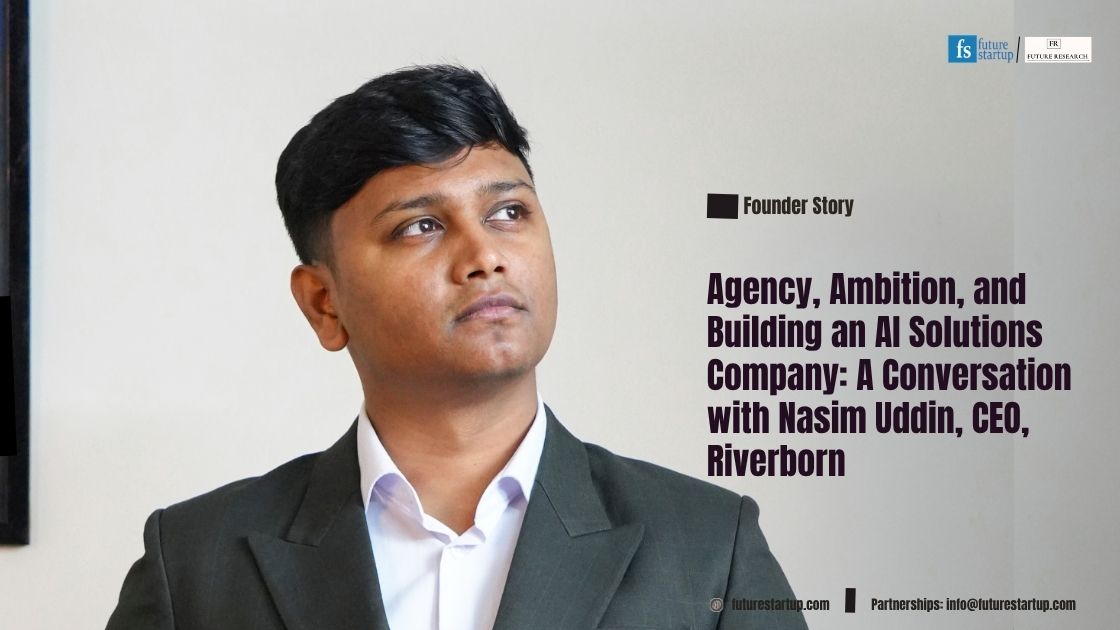
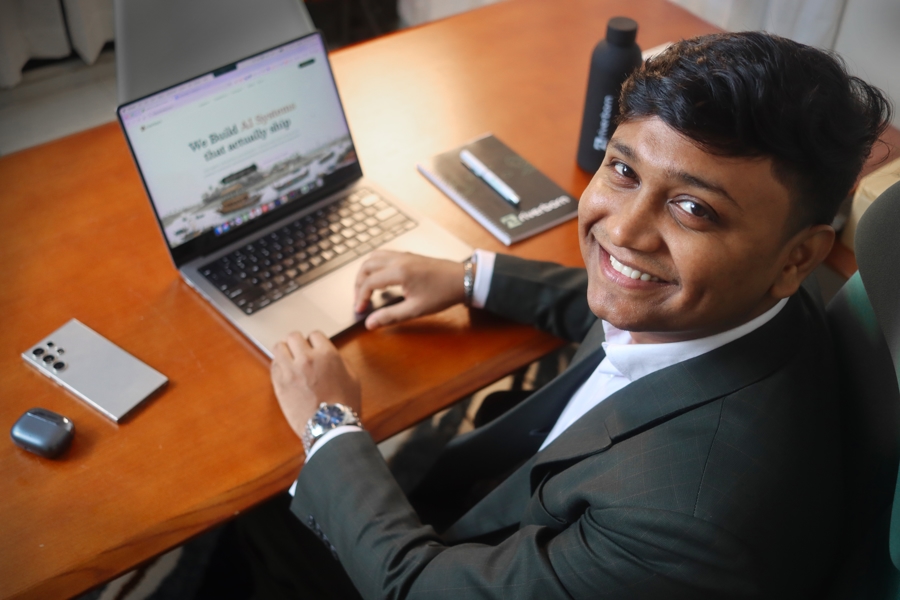
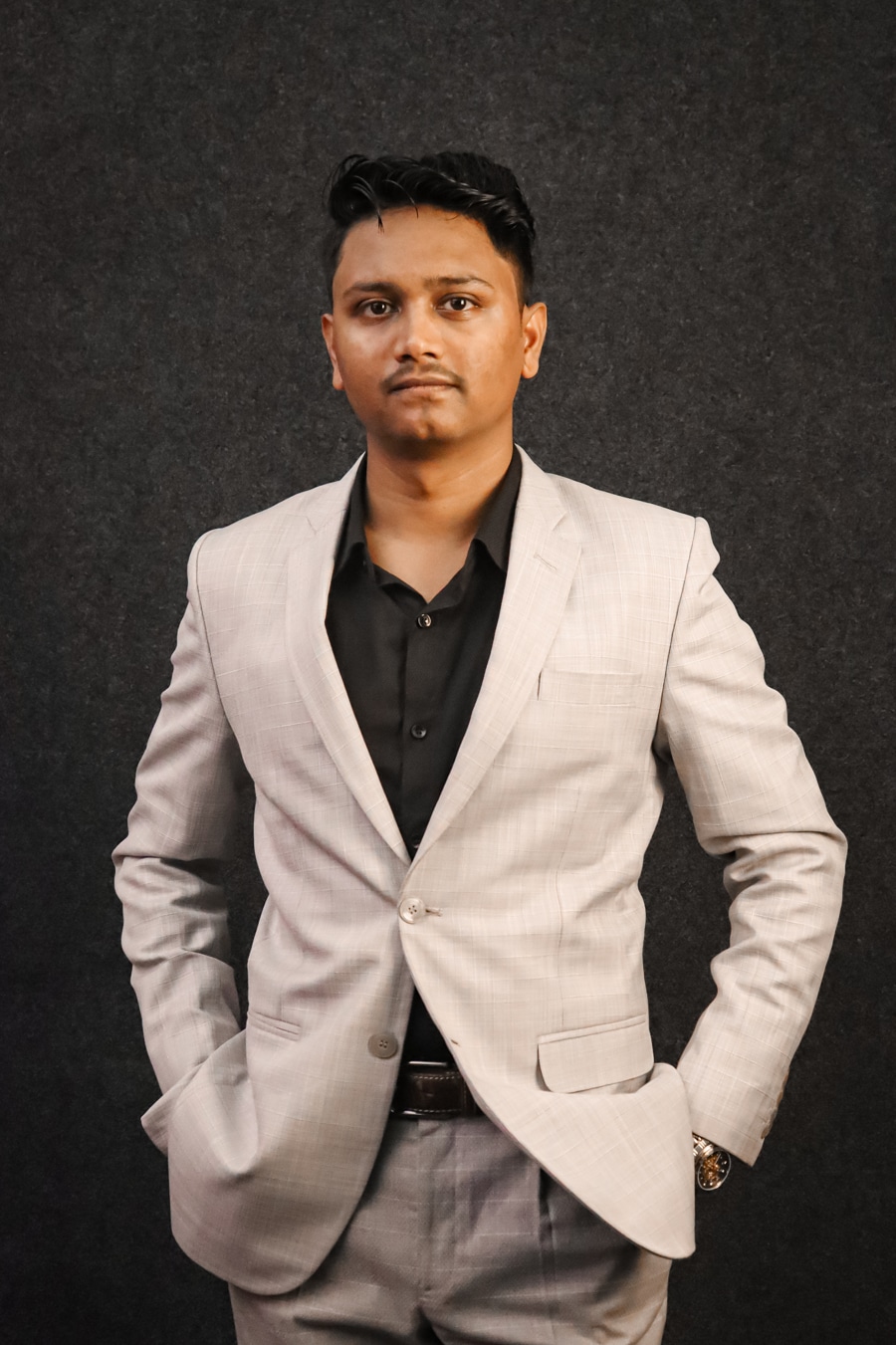
Nasim Uddin is the co-founder and CEO of Riverborn, a Dhaka-based AI solutions company that builds and ships production-grade AI systems for clients across the US, Canada, and Europe. He is also co-founder and CTO of Agenton, a Finland-based AI voice company serving the automotive industry.
We have been following Nasim’s work for a while. He has been doing some fascinating work, and he has an equally fascinating story. He started with nothing that conventionally predicts this kind of outcome: no CS degree, no university degree, no notable family background, born and raised in a village in Sirajgonj where they had no electricity in the house until he was in Class 10. He taught himself to code and got his first international job through a Twitter DM. Started as an experiment on the side, his company Riverborn is now profitable and eyeing expansion.
In this fascinating conversation, we talk about his childhood in Sirajganj and how curiosity formed early, the science fairs and district competitions that expanded what he thought was possible, his decision to skip university and teach himself software engineering, the Twitter DM that changed his trajectory, his first company, Connekt Studio, which has since been rebranded to Riverborn, the failure of Mullokoto and what it clarified, the pivot to AI and what it actually means to build AI systems that work in the real world. We discuss what Riverborn does, the state of its business today, the decision to move his entire team from Bogra and Sirajganj to Dhaka, how the company operates, and its future plan. We end the conversation with his thoughts on AI and Bangladesh and his reflections on his journey so far and life.
This is one of the most honest conversations I have had about what self-directed learning actually looks like when the stakes are real, and what it takes to build something world-class from Bangladesh. I am delighted to share it with you. Happy building. Enjoy!
Mohammad Ruhul Kader: Thank you for taking the time. I have been following your work for a while. One of the things that struck me about you is that I feel you have a different sense of ambition than a lot of young people I meet. For instance, you recently moved to Dhaka, and when you wrote about moving to Dhaka, you said you wanted to be at the center of where things are happening, which is an interesting perspective. I once had a chance to ask someone who runs a successful global program supporting exceptional young people about what separates some of the most successful people in his program from those who are not. His answer was less dramatic. He said that people who live in the right places. If you want to build in technology, you better move to Silicon Valley, that type of thing. After reading your post, it came to my mind that you kind of rightly pointed out that it's important to be in the place where things are happening. As such, I want to begin with: where does this ambition of yours come from?
Nasim Uddin: That's a deep question. I sometimes think about it, like where my ambition comes from. I was born in a village where we didn’t have electricity until I reached class ten. Naturally, people don’t expect you to have ambitions or try something different from what everyone else does.
As a child, I was curious. If anything caught my eye, I would keep after it until I got a sense of it. If it was a toy that fascinated me, I would break it apart to see what was inside. This may be a typical childhood story for many people, but I always followed through. I always wanted to see what was inside.
Since my house didn't have electricity, I used to tinker around, making my own charger-powered light, and charger-powered fan. There were even times when I bought a five-watt solar panel, trying to figure out how to fulfill my energy needs, how to keep a light on instead of lighting a kerosene lamp. I had a habit of tinkering from a young age.
So I have always followed my curiosity. If I was curious about something, I would study it or ask people about it. One thing would lead to another, and new things would open up. I think this is how I operate even today.
I went to an upazila-level high school. That opened up a lot of new doors for me. I would not call it a city, but it was not completely rural either. We had access to many different opportunities, like debating, attending science fairs, and entering various competitions—many of them government-backed. I started participating in the science fairs in class seven. Although I didn’t have electricity at home, I was exposed to many of these things. It also gave me the opportunity to meet people, including seniors, and observe what they were doing and how they thought. I had the chance to see these things up close.
In several competitions, after winning at the upazila level, I had the opportunity to advance to the district level and then the divisional level, where I met top students from across the district and division and saw what they were doing.
These experiences exposed me to different ideas and initiatives. I would come across something interesting and realize that I hadn’t known it existed and that something like it was possible. It helped expand my mind.
Let me give you an example. When I was in class nine, we had a science fair in Sirajganj, where I met a boy who brought a beautiful robot he built that could be controlled by a phone. It was absolutely fascinating for me to see. I asked the boy how he had done it. He said something along the lines of “we used code to program these chips”. That was the first time I learned that we could write commands on computers to manipulate hardware. Until that point, I had no computer access and no idea about programming; I didn't know such a thing was possible.
Up to that point, the electronics systems I worked with were mostly manually wired hardware that could perform specific tasks. You couldn’t program them by just changing lines of code. You had to literally redesign the hardware, like changing components and other things, to make it do something else. Naturally, that was an eye-opening experience for me.
And it brought about a kind of shift for me: you could just write a text-based command on a computer to make hardware do what you wanted. That was a fascinating discovery. I was amazed at the thought that you could do this kind of thing just by writing code.
At that time, a few friends and I used to explore various things on the internet, read books, and watch videos. We came across things like TED Talks and talks by various famous people. As a result, I got introduced to new ideas.
Ruhul: How old were you at the time?
Nasim: I was in class nine or ten at the time.
Ruhul: You were very precocious. I don't think people your age usually consume this type of content. Was it common in your circle?
Nasim: No, it was very uncommon at that time. First of all, I still didn't have electricity at home. I had to go to someone else's house to charge the phone. I didn't have a smartphone; I bought one in class 10, towards the end of 2016. Before that, a friend of mine gave me a small, slightly broken Nokia phone, so I would browse the internet on it using that old text-based browser.
It opened the world for me and helped me to follow my curiosity. I got curious about various things. I could search things, watch things, listen to things. When I wanted to learn something, all it took was a simple internet search. But I wouldn’t say I had a role model or other people I was trying to emulate. In fact, my two friends and I were among the handful of people thinking like that.
This was also probably when I first started entertaining the idea that I could become an entrepreneur. I started to think that if you want to do something meaningful, live life on your own terms, or create impact, then you have to become an entrepreneur. I also started thinking about dropping out for the first time around then. I began to feel that you don't need a degree to do what you want to do. This was probably influenced by the kind of content I was consuming, from which I might have formed a random pattern that many successful people are dropouts, and that to be an entrepreneur you don't need to go to university. All these gradually rewired my thinking and kind of made me think differently from others.
This might sound cliché, but young brains function differently. When you start thinking about an idea, it can become an obsession.
I was a decent student. I was the first boy in high school. In college, I had a decent position in the class. I received GPA 5 in both SSC and HSC. As a decent student, I was naturally expected to either become a doctor or an engineer. Typical expectations. As I said, when I was in classes nine and ten, it got into my head that I wanted to become an entrepreneur; I didn’t want to pursue a traditional career. So at some point, I started thinking about how I could enter my career quickly.
I had an interest in hardware from a young age and wanted to work in the sector. However, later I realized that to work at the intersection of hardware and software, I needed to learn more. So I started learning software. But as I continued thinking about my goal of starting a business after HSC and dropping out, I realized I needed money. I knew my parents wouldn't be able to provide it. My father was a farmer, and my mother was a housewife. We didn't even have that much land. That meant I had to be the one to think about the money if I wanted to start something. So I started thinking about where I could get money.
Accordingly, I decided that after HSC I would take a software engineering job. I started thinking about the skills I would need to get one and began practicing those skills. When all my friends were preparing for university admission tests after HSC, I was learning programming full time and preparing for jobs.
Of course, there was a lot of pressure from family, teachers, and well-wishers. They were still insisting that I sit for at least a few university admission exams. So I sat for a few exams without any preparation: Dhaka University, Jagannath, Jahangirnagar, and Rajshahi University. I got into Jagannath and Dhaka University, but later I didn't enroll.
Now that I look back, I think what made me think slightly differently was being introduced to a bunch of ideas at a very early age. It was not any particular individual per se. It was more about ideas. I came across ideas that changed my way of thinking. For instance, I came across a talk by Mahmudul Hasan Sohag bhai of OnnoRokom at that time where he shared some ideas that resonated with me. I could intuitively sense that to move a country forward, entrepreneurship is the most important thing. Those ideas influenced me.
Reading books and learning about different ideas from different people and cultures all over the world helped me think a little differently. And technology, such as YouTube, and reading different blogs, all of these influenced me to become who I am today.
Ruhul: This is very interesting. Where did your interest in science come from? I mean, tinkering with things.
Nasim: I don’t recall any particular influence. I was naturally curious as a child. Then I guess later exposure through science fairs and other things accelerated that curiosity.
Ruhul: What you said about your curiosity from a young age, such as taking cars apart and putting them back together, I think is true for many kids. My mother says I used to break open cars and toys as a kid as well. But I never had this interest in circuits and building electronic devices, etc.
Nasim: I remember the backstory more or less exactly. This is where my interest in electronics and tinkering began, back when I was in Class two. A friend of mine had an older brother who was, I think, a mobile mechanic at the time. He used to bring home old cell phone batteries and rip them open. Inside was a lithium-ion cell with an exposed metal body. The positive point was on top, and the whole body was the negative.
He would take an LED, where one leg is a little longer than the other, and attach the short leg to the positive point on top. The long leg he left bent out like the barrel of a gun. Whenever he touched that bent leg to the body of the battery, the LED lit up with a beautiful glow. I thought it was the coolest thing I had ever seen.
I was in class two. Later, I took some of those batteries from him and started experimenting on my own. From there, I started studying a bit; not serious studying, just buying some wire, LEDs, and motors and trying to make a boat or a fan, or a light with them. Then I would make these lights and give them to my uncle, since they didn't have electricity either, as well as to my grandfather and the people around.
Through this, I developed a genuine interest. In high school, we had a slightly better ecosystem. There was a science fair. I used to see what other older brothers were doing, and then I started joining too. I also attended events at the district, upazila, and then divisional level, where I saw what other students were making. All these experiences helped me develop a mental model of the whole thing. Additionally, I started studying, reading books, and experimenting, I mean, buying different parts myself and building various circuits. That's how the interest formed.
Ruhul: Wonderful. Did your parents encourage you? What was it like in the family? How many brothers and sisters do you have?
Nasim: We are three siblings. You saw Nasir bhai a while ago; he is my older brother. I am the middle one, and we have a younger sister.
It was not directly encouraged or discouraged. My parents allowed me to do these things and supported me as best as they could. They were strict about a few things: as long as I came home before evening, sat down to study until Isha prayer, ate, and went to sleep on time, I could do whatever I wanted. They were strict about not wandering around at night. I had to go to school, attend private tutoring, and study a bit at night at home. As long as those things were taken care of, I wasn't really pushed that much; there was no pressure. I had the freedom to use the rest of my days as I saw fit.
I mean, since I lived in a village, I had quite a bit of time when I was at the primary level. In high school, my high school was 5-6 km from home, so I had to go by bicycle. I had one or two private tuition lessons in the morning and in the afternoon. My whole day was mostly spent outside the house. Time was a little bit structured like that.
Ruhul: You were saying that a major inflection point might be your attending Dhangora High School. There, the exposure was a bit better.
Nasim: Yes, the exposure was better.
Ruhul: How far was that from your primary school?
Nasim: That was fairly close to my primary school. I studied my primary, I mean Kindergarten, too in Dhangora, at the upazila level. It was five kilometers from my home. There is an interesting story about how I got a chance there too. I used to study in a kindergarten next to that school. At that school, you had to go through an admission test to enroll. Although it was at the upazila level, it was a decent school. The quality of education was good. So my goal was to get in.
Even though my village had both a high school and a primary school, my mother and brother, because of their foresight, said, “ Dhangora, an upazila level school, provides better education, you should go there.” Because of that, I studied hard for the admission test.
I was studying so that I could get a chance. What if I didn't get in? Then I would have to be admitted to the village school. I put so much effort into the admission test preparation that I came first in the admission test. My goal was just to pass the admission test. I didn't know that I was that good or something.
That was a big inflection point in life. Since I came first, the teachers knew me. They also knew my financial situation. For that reason, it happened that some teachers taught me private tuition for free.
The school provided funds for the various science fairs and competitions I participated in. If I had needed to pay, maybe it wouldn’t have happened. Or if it had been any other school, it wouldn't have happened. In our school, I would say the teachers, along with the school, were very supportive in these matters.
Ruhul: They encouraged it.
Nasim: Yes, they encouraged it.
Ruhul: That's a good thing. Any particular teacher who played an important role?
Nasim: If I have to name three people, from the science side, I had a teacher, Abdur Razzak Sir. He was our science teacher. He handled these science fair things. He supported me a lot. Another teacher, Mofizuddin Sheikh, who is now my father-in-law. Also encouraged me a lot; he personally helped by managing funds and taking me to various competitions.
Our headmaster at the time, Tofazzal Hossain Khandaker, also encouraged these things. Besides providing funds from the school and guidance on how to move forward, he was very much involved in those initiatives. Because of their special care and support, I was able to move forward.
Ruhul: And then around your SSC exam, you thought hardware is interesting, but if you wanted to do something meaningfully, you would have to do software as well? How did your introduction to that happen?
Nasim: I knew this from before. I studied HSC at Government Azizul Haque College, one of the finest institutions in North Bengal. In our time, it had a very competitive admission process. While there, I had the opportunity to attend college level programming contests. I was the lead of our college programming contest team.
From SSC—I mean classes nine and ten—I started getting familiar with programming. I used to practice on the phone—HTML, then C language; I literally practiced with pen and paper.
Part of this happened when I attended the science fair in class nine. I mentioned the kid who made a robot toy that could be controlled using a mobile phone; that was when I first learned about programming and how you could use it along with your hardware project.
Ruhul: Tell us more. How did you know that there are things like HTML? Did you talk to that kid? Later, did you have regular contact with these kids?
Nasim: I didn't really have regular communication with them. I kind of learned these things myself, you could say, by following my curiosity. Then in the intermediate, we had HTML and C programming in ICT. When I was in classes nine and ten, I collected an HSC ICT book and started studying it. In fact, I finished the whole HTML chapter and C programming.
I could practice HTML on my mobile at that time, on that Nokia phone. I couldn’t practice C programming, so I just practiced on pen and paper and tried to understand the logic.
There was a website at the time called shikkhok.com run by Ragib Hasan, I guess. They had a course on C programming called Programming Hatekhori. I used to follow those blogs and articles and try to learn on my own.
At that time, I wouldn’t say I was learning anything practical; it was more like an introduction—hatekhori, as they called it.
After SSC, my parents bought me a computer. Of course, there were hardships, and I had to be stubborn. That was a turning point. Until that point, what I did was all on the surface level. With a computer, I could now do real work. I started practicing programming on that computer. I also learned bits and pieces of graphic design work. In intermediate, we had C programming, HTML, and databases in the syllabus, which gave me an opportunity to learn these things more deeply. That's when I decided that I would pursue this. In classes nine and ten, I was young and didn't have the conviction that I would definitely drop out. In HSC, I gradually came to the realization that I wanted to do business, so I could drop out. Why did I need to waste another four years? I could learn programming on my own anyway.
In intermediate, I realized that I truly could do programming. I also started working with hardware more deeply. In intermediate, I in fact built a drone, I mean quadcopters. I received small grants from the college as well as Bogra Zila Parishad for innovation. I also attended national-level events. I was also on our college programming contest team. Doing all these things gradually helped me to gain confidence that maybe what I was thinking I could actually do. If I put in enough hours, I might be able to do it and build a real career.
Since I wanted to learn programming and build a career in software and in the long term, I wanted to be an entrepreneur, I felt that going to university wouldn't add much value to my journey. Instead, I thought that if I got a job, earned some money, and used that money to start my company, that would be a better strategy.
In those two years in college, I convinced myself that after HSC I would dedicate full time to building a career in software engineering. Hardware was still very challenging in Bangladesh. Moreover, I used to see people joining companies like Google and Amazon without formal degrees, with just great software skills, which was unheard of in our country. But I believed that if I had the skills, I could make it work.
I was naive to some extent, I would say. I believed it. If I were doing it now, I would make a more informed decision. But I was young and full of ambition. I truly believed that I could do it. Accordingly, I created a syllabus for myself before the end of the intermediate exam. I looked at job descriptions from various places, trying to understand what they were looking for, and built a syllabus for myself to learn those skills. Before that, I had some skills in competitive programming and hardware programming. I found out that the practical world needed other skills as well. So I started learning those things after my intermediate exam.
While I reluctantly attended admission exams at a few places, I also started interviewing for jobs at different places concurrently.
Around this time, I interviewed online with Graaho Technology, a Dhaka-based software company. A while after that interview, I came to Dhaka for a university admission test at Dhaka University. While in Dhaka, I called them and said that since I was in Dhaka, and had done the previous interviews remotely, I could do an in-person interview if they wanted to meet me. They asked me to come to their office. After submitting my documents at Dhaka University, I went to their DOHS office and interviewed in person: a behavioral round with the founders and then a technical round with the engineers. After the interviews, they confirmed my job even before I reached Sirajgonj, my home. So I decided that I wouldn't study at Dhaka University and would instead take the job.
When I joined Graaho, my plan from the beginning was to work remotely, internationally. Since I wanted to optimize capital to start my business, working in Bangladesh wouldn't make sense for me, salary-wise. Bangladeshi companies paid well, but I wanted to earn more so that I could accumulate capital, and compared to international pay, it was low.
At that time, I didn't know many people who were working remotely from Bangladesh. After joining Graaho, when I started telling my colleagues that you could do a remote job from Bangladesh without a formal CSE degree, they used to think I was crazy. Luckily, just a couple of months after this conversation, I met a Canadian programmer of Indian origin on Twitter and started working with him on some small freelancing projects. One thing led to another.
After working at Graaho for five months, I got an opportunity to join his company, where he was the CTO, as a remote software engineer. At Graaho, my salary was BDT 30,000 per month without any engineering degree or job experience. We had people with university degrees who worked as interns and got half my salary. I could immediately see a difference. When I joined the Canadian company, my salary immediately jumped to 3 lakh taka—a 10x jump. Of course, I got lucky, and many of these things were very unusual. I worked hard, but at the same time, I got very lucky. Everything happened step by step within a short period of time.
After HSC, when everyone was preparing for admission tests and I was pursuing a job in software, I thought that if I couldn't make it work, I would be screwed. So I used to spend many hours working hard. My only tasks were eating, working, and sleeping. I was intensely focused during this period.
When my friends were getting admitted to universities, there was immense pressure on me, because I hadn't attended many admission exams, and it was getting late for me. Finally, when I decided to take a job instead of going to university, my family's initial reaction was that it was not a good decision. There was some pressure, and I also felt a certain fear, but somehow I was lucky that everything worked out.
Ruhul: That's a very interesting journey. How did you meet that Canadian CTO on Twitter? How did you discover Twitter at that age, because it was—and still is—not a popular social media platform in Bangladesh?
Nasim: This is also an interesting story. I don't exactly remember how I discovered it, but I was quite active on Twitter.
I was trying to figure out where the international technology community hangs out. That's how I landed on Twitter. Through Twitter, I came across freeCodeCamp, the platform that provides free coding and programming courses. They had a challenge called #100DaysOfCode. People who were learning to code could post updates using the hashtag, and it created a very active community. People used to post their updates. I used to post mine. It was an excellent community. We used to interact on Twitter and learn from each other. That made me return to Twitter regularly. Through it, I met a lot of people on Twitter.
One person I met used to run a magazine called No CS Degree, where he interviewed people who had succeeded in the computer science field without a computer science degree. In that magazine, I read about a person who was working at Google without a computer science degree—a Canadian. I followed him on Twitter, as I did with many people. One day he posted that he was looking for an intern to do some small paid tasks and asked interested people to DM him. I liked his tweet and was about to DM him when he messaged me first, saying, “Hey, I saw you liked my post. I saw your portfolio—you're learning to code. Are you interested in an internship?” This happened just before I reached out to him. This was before COVID. That's how I met him.
I worked on a small project with him for 150 Canadian dollars. I did the project, and he paid me $200 because he was happy with the output. It led to regular interactions. We built a kind of relationship. He learned my story—where I came from and what my ambition was. He got interested and told me he would help me achieve my vision. I stayed in touch with him, doing small freelance projects here and there. Then, after three months, he hired me for a senior position at the company where he was CTO. Although I was quite junior, they still hired me for a senior position. He is still my mentor to this day. I would say this entire thing happened because I got lucky.
Ruhul: You were trying, of course. You were on Twitter—writing, posting updates, interacting with people. Luck had to find you, and you worked hard, so it did. You were interacting with the international community on Twitter; did you have a local community as well?
Nasim: I didn't. Moreover, I didn't know many people. I knew Hasin Hayder bhai, who is also a self-taught programmer, but that was it. I didn't have much exposure to the local community in those days. I didn't have a role model per se. I was mostly learning and doing things on my own.
I didn't have a large friend circle. The friends I mentioned were also preparing for admission tests. In a way, I was working alone to build a career in this field. I was like a lone rider at that time.
Ruhul: What was the psychological side of doing it?
Nasim: Whenever I'm into something, I am obsessed. I have a certain naivety and stubbornness; I get into an idea so deeply that I just do it. I rarely need external validation. At that time, I was very focused on my goal. I truly believed that I could do it.
Ruhul: So you joined that Canadian company as a programmer. How long did you work there? What happened after that?
Nasim: I joined that Canadian company in mid-2020, around July.
I worked there for two years. About a year into working at that company, I started Connekt Studio, an experimental product studio, along with a few of my cousins and friends. The goal was to experiment, build products, launch them into the market, and see what would happen. I was funding the whole thing with the significant salary I was earning at the Canadian company.
After working at that Canadian company for two years, I decided to quit and pursue entrepreneurship full time.
We built a platform called Mullokoto (meaning “How much is the price?”), an e-commerce price comparison site. I started working full time on it and tried to raise some funds. We launched the product, and we had some users too. But we couldn't figure out the business model. I was so naive at the time that I thought I would build the product, pitch a few people, and raise money. But, miraculously, I failed to raise funds. In the meantime, I ran out of my savings and had to go back to a job. Then I joined a US-based software company called Audience Town as a senior software engineer. Even though I returned to another job, Connekt Studio continued on the side.
Ruhul: Connekt Studio was running during all these periods, even when Mullokoto failed?
Nasim: Yes. Mullokoto was one of our better products, but we wanted to build global products—SaaS products. After Mullokoto, we changed our business model and tried to build global products. At the same time, we started getting a lot of attention from people who came to us after seeing our work. Through this, we started getting some clients at Connekt Studio who came to us for services. Connekt was not sustainable at the time—we were making less than our expenses—and I used to finance the gap from my own savings.
When I joined the US company, I used to work mostly at night because of the time zone, and I used to spend my days at Connekt Studio. I continued like this for a while. But at the same time, I was always thinking.
After Mullokoto failed, I started thinking that I was not passionate about these ideas. I thought it was cool, so I built it. I started questioning why I was doing it. I was also building products that were going nowhere. After some time, I realized that I needed to change—that I shouldn't work on anything I was not passionate about. So I decided not to work on anything I didn't enjoy and wasn't passionate about. I realized that the best kind of work would be something I enjoy and also get paid for. The second kind would be work I enjoy so much that I'm willing to do it for free. I decided that if something didn't fall under one of these two categories, I wouldn't do it.
At that time, ChatGPT had just been launched. Stable Diffusion and Midjourney launched diffusion models. When I came across these, it felt like magic. Seeing all these new developments, I jumped fully onto the AI bandwagon. When I started learning programming, part of the reason was that I wanted to build things. At this point, I decided to go back to my old approach: I would only do things I was passionate about and found interesting. This realization then shaped Connekt Studio's business model. We restructured the company and turned it into an R&D-type platform, exploring the latest technologies, mostly AI.
We launched our first product after this change, called Sketch to Image, where you can upload handwritten images and it turns them into realistic images, cartoons, and so on. The product went viral in Bangladesh. Although we had to pay a pretty hefty cloud bill on day one, we were very happy seeing that people were using something we built. I felt good that we were building something I enjoyed building and that people were using it. We continued experimenting slowly. We made another product called Vocalo, where people can practice speaking English with AI. This was designed particularly for Bangladeshi users, who study English their whole lives but can't speak it well when it comes to actually speaking. The app received meaningful traction. We gradually launched and experimented with small products, which over time also changed our image. Now people know us as an AI solutions company. We no longer build typical SaaS and other products like before. My team and I enjoy our work much more now.
Seeing our work online, many international clients started reaching out to us organically. People would come to us and say, “I saw you built this—can you build this for us?” We started to generate some revenue from this. Overall, we started to get into better shape.
This was a transition period. Mullokoto failed to raise money. Some of our small product experiments didn't work. I ran out of money and returned to another job. Then we started working on some AI products, and things slowly started to take better shape. It eventually helped us move in the direction we're currently heading.
Ruhul: Give us a bit of a timeline of these developments. When did you launch Connekt Studio and Mullokoto?
Nasim: Connekt Studio was founded in 2022, and Mullokoto in 2023.
Ruhul: When Mullokoto failed, you ran out of money, went back to a new job, and at the same time, you started experimenting with AI?
Nasim: Yes.
Ruhul: You were building these AI products mostly around local needs?
Nasim: Since we live here, we can usually relate to local problems more, and that informs our efforts in building products as well. So we build products that solve problems for Bangladeshi people. However, many of these products we were building for fun. For instance, our first product, Sketch to Image, was not built to solve any particular problem. We made it for fun.
Ruhul: So you were building these tools on top of AI models?
Nasim: It was a fine-tuned version of the Stable Diffusion model. We are not model builders. Rather, we build architecture on top of existing models, add additional layers, and then turn it into a functional product or system. As we work, our understanding and experience also expand. In those early days, however, the technology was quite primitive—it was still early days for AI systems.
Ruhul: When did you reach a point where you started generating meaningful revenue at Connekt Studio?
Nasim: When we started experimenting with AI, we started attracting international clients through our work. In the first two years of our journey, we had some revenue, but we were losing money. When we started working with AI, however, we made more than we spent.
Ruhul: How big was your team at the time?
Nasim: We were around 8–9 full-time people on the team. We started with five people, then grew from there. We are now a team of twelve.
Ruhul: What was the motivation behind starting Connekt Studio? Did you start it to run experiments, or did you also have a business intention?
Nasim: Initially, the goal was to tinker, experiment, and see if anything stuck. Since I had a full-time job, I was not looking for an immediate hit. However, in the long run, I wanted to be a full-time entrepreneur. So that goal was always there. When I quit my first job around 2023, I did so after working there for two years. Of course, that didn't work, and I went back to another job. But my goal has always been to build my own business.
Ruhul: When Mullokoto failed, you took Connekt Studio back to its original research-and-development roots. You ran out of capital and went back to a job. You started doing some R&D work in AI, and some revenue started coming in.
Nasim: When I started doing R&D, I never thought about money. Money was not a motivation. I wanted to do things I enjoyed. Since I was earning a decent salary from my job, I could fund the operation from my own pocket. And I knew I could keep doing it as long as I wanted.
Since I grew up with so little money, I was content. My needs were limited. Normally, when people earn good money, they worry about how to hold on to it. I never hesitated to spend on my passion projects and things that I enjoyed. Even to this day, I don't feel especially attached to money. I feel like it's a game: whoever can earn more coins wins. So when I first realized that I didn't need to earn money immediately, I decided I wouldn't do things just to earn money. Instead, I would do things that I'm passionate about and enjoy.
Coincidentally, we started earning money as soon as we started following my passion instead of chasing money itself. That year, 2024, when we stopped chasing money, we broke even for the first time. In the first two years, our revenue grew year on year, but we were a loss-making company.
Ruhul: When did you leave your last job?
Nasim: I left my job in early 2025. Since then, I have been working on Riverborn. The other company I am involved with is Agenton, a Finland-based AI voice company, where I am a co-founder along with two other founders. I also work as CTO for that company. Although my time is now split between Riverborn and Agenton, I have the advantage that my team at Riverborn is very capable and our operations are streamlined. So I don't need to spend much time managing operations at Riverborn. The team handles that for the most part. I mostly focus on strategy, long-term planning, and so on.
Ruhul: When did you start Agenton?
Nasim: Although we legally formed the company in 2024, we started working full-time in July 2025. My other co-founders started earlier. We are three co-founders. One is of Bangladeshi origin, one is Finnish, and I am the third. I started working on Agenton in June 2025. That's when I quit my job at that US company. I basically started working full-time when the company raised its first external capital.
Ruhul: You now split your time between Agenton and Riverborn. Do you want to tell us more about Agenton?
Nasim: The reason I joined Agenton was partly that the work was similar to my work at Riverborn. As I said, I work as CTO at the company. We provide a voice AI solution to the automotive industry in Finland, where AI answers customer calls. As CTO, I look after the technical side of the business, where I try to translate our business goals into technical products. At Riverborn, my role is broader: I need to look after strategy and sometimes operations as well.
Moreover, the work at Agenton was similar to what we had been doing at Connekt Studio. I was naturally passionate about it. The logic was this: since I don't want to do a job long term, I was doing Connekt Studio, but it was growing slowly and would take time to grow. What if I took on an initiative that could grow meaningfully in the next two to three years? Of course, this is only a possibility. An entirely different outcome is also possible. That's why I quit my job and joined Agenton.
Ruhul: How did you meet your co-founder?
Nasim: I met Faisal, who is the CEO of Agenton, through Mullokoto. For Mullokoto, I was reaching out to people working in the industry—VCs, angels, and others in tech. I started connecting with these people, and that's how I met Faisal bhai. From then on, I used to reach out to him, share our work, and seek advice on different matters. That's how we built an ongoing relationship. We also tried to work together on Vocalo, which was a collaboration between Connekt Studio and him. Through that, we got connected. He was working at another company as CTO, and he quit that job because he wanted to do something on his own. We then banded together and started Agenton.
Of course, we have financial goals at Agenton that we would like to achieve, whether through an exit or otherwise. Part of the reason I got involved with Agenton was that I enjoy the challenge. I get bored when I'm doing the same thing again and again. That's partly why I left my last job, although my manager there was extremely good and I absolutely loved him. That job was very good, but I got bored. That was partly my motivation for getting involved with Agenton, even though I was making more money at my previous job.
Ruhul: So you are building an AI voice solution for customer support at Agenton.
Nasim: It is one of our products. We have other solutions as well. In broad terms, you can say it’s AI for the automotive industry. We are initially in the Finnish market.
Ruhul: You were doing that and working on Connekt Studio, and then you decided to rebrand Connekt to Riverborn.
Nasim: We were making meaningful revenue. For the first time, we had a profitable year last year. These were mostly international clients. We don’t have local customers. Everything is international—mostly the US, Canada, and Europe.
We have built ten AI systems so far over the years. Last year, we realized that we are good at building things from scratch and launching them. But after a certain scale, we can’t take them any further. Naturally, I am an engineer, and my team is also mostly engineers. We don’t have marketers and distributors, and we realized that we are not good at distribution and scaling things. As a result, we used to build things, and then after a few thousand in MRR, they would die down. I saw that we are good at building things but bad at distribution.
I also found out that we are good at making products for our clients. When clients come to us after seeing our products, we are very good at building their products.
So I thought: what if, instead of focusing on our weakness, which is distribution, we focused on building products for other people, which is our strength? This is what we are good at, so we finally decided to pursue that.
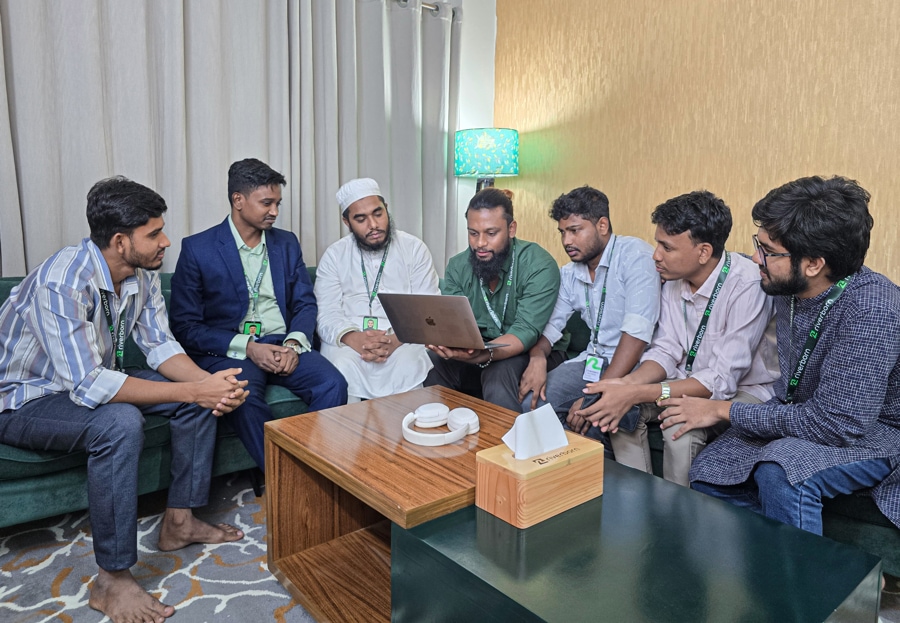
Ruhul: So you decided to become an AI solutions company.
Nasim: Yes, an AI solutions company. We do not want to present ourselves like a typical agency, but rather like an AI solutions company that provides solutions to partners and also has its own products. Previously, our core focus was that I wanted to build a product company like Ollyo—a product company per se, making great software that people love. That was my goal. Later, I realized that we are not that good at distribution.
We are good at building solutions. So what if, instead of focusing on my weakness, I focused on my strength—what we can do? We can build complicated, advanced, cutting-edge products. Let’s just build that.
For this reason, we decided to focus on our strength. We will still build our own products, run experiments, and launch, but our goals and financing will come from consultancy, from customers taking services from us.
Ruhul: When I was looking at your trajectory, I also found the way you make decisions interesting. For instance, your decision to move to Dhaka with your entire team. You and your team worked mostly remotely and lived in Bogra and Sirajganj. Then one fine morning you decided to move to Dhaka. That’s not an easy decision. You had a community there and everything. How did you make this decision to move to Dhaka and then convince your whole team to follow you, because it’s a little strange? All of them are from Bogra and Sirajganj, and they all agreed to come with you. It is not normal, actually.
Nasim: I make decisions more on intuition. We have actually been running Connekt Studio for the last five years remotely. In between, we had a small workspace, but I would not call it an office. Rather, we used to hang out there. So primarily we worked remotely. So of course it’s a genuine shift.
I knew it. If I think about what pushed me, although I make decisions intuitively, I have been thinking about this for a long time. I had a feeling that working remotely made building a brand difficult for us. We were struggling to build a brand. Although some people can, for example, Design Monks in Bangladesh, work remotely and still build a very good brand for themselves. They are good designers. They are good communicators. As an engineering company, I felt that we were not telling our story well. We are very shy. I also felt that being a remote operation, we were not effective in collaboration.
Moreover, I was in Bogra this whole time; I was not well-connected in Bangladesh’s tech community. Although I made some connections on digital platforms, I didn’t talk with that many people. I was happy at that time because I had a job and was earning good money. Overall, I was fine. I didn’t need much. However, I later realized that if I wanted to go to the next level, I needed to make some changes. I felt that we needed to go to a place where things are happening, where people are. Because I don’t know everything, I need people who know better than me or who have gone through the same journey. For this reason, before coming to Dhaka, I started talking to people who are a few steps ahead of me—sharing about my company and asking how we might go from eight to ten employees, where we’ve been for the last two to three years, to a 40-, 50-, or 100-person company. Of course, this is a different journey. The skills I had before were no longer enough; I would need completely different skills and different processes. I started exploring, and finally, I made the decision that we would do it.
I shared these with the team in detail. The team matters. I went to the team and told them about the plan. I shared everything. One good thing about our culture at Connekt Studio/Riverborn has been that we are transparent about our finances, our direction, why we are making certain decisions, and everything else. The team knows. We are very connected with each other—mostly friends and cousins on the team—and most importantly, we have been working together from the very beginning of the company. I trained most of them myself. They know that whatever decisions we make are for our own good. They could see my reasoning, and because of that, they took a leap of faith with me and moved to Dhaka.
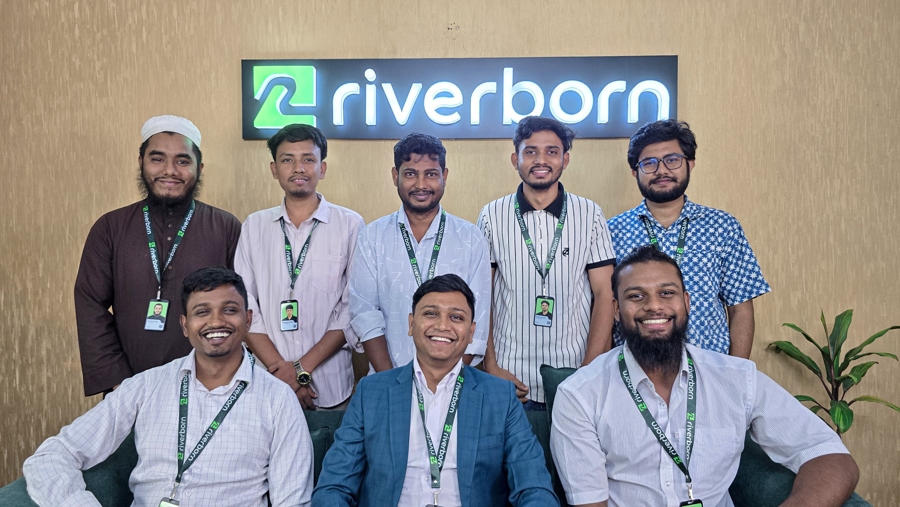
Ruhul: Then you rebranded to Riverborn. You call yourself an AI solutions company. You claim you have your own system, ten different systems around voice and other things. For our readers, can you give a high-level overview of Riverborn—what exactly do you do as an AI solutions company?
Nasim: We introduce ourselves as an AI solutions company because we build systems that can do many things. For example, it can be a mobile app, a web application, a desktop app, or just an API. But under the hood, everything has one thing in common: an AI system that runs in production. By “AI solutions company,” we try to communicate this part, which we feel is the most important part of our work.
For regular people who do not know what we do, I just say we are a software company. But if we want to be specific, we are an AI solutions company. Our main expertise is building production-grade AI systems. We have been doing this for the last two to three years. We have built products that are used by hundreds of thousands of users at the same time. This has made us confident in this specific niche—that we can build AI systems that work in the real world, which is the hard part.
We have seen that many people adopt AI and build some tools. In a demo, it works, but when you run something in production, many edge cases come out. Solving problems in a rule-based system is easy: you just add additional rules. But it is not so in the real world, where things are always unpredictable. Consequently, building something that does not fail in production is extremely hard. And this is our strength, because we have shipped ten-plus AI products in the past and have also built many complex AI systems for clients. As such, we highlight ourselves as an AI solutions company, which means we build AI solutions.
In terms of positioning, we are not a typical agency that is only doing clients’ work. We are also not a typical product company that is only working on our own products. We are a mix of both. We build our own AI systems, and we also work with clients building solutions for them.
Ruhul: What percentage of your revenue now comes from your product versus the client work?
Nasim: Twenty to thirty percent comes from our products, and the rest comes from our consultancy. However, interestingly, for us, business development has been almost entirely inbound. We never had a business development process until now.
Our products have played an important role. Although products only bring twenty to thirty percent of total revenue, indirectly, our consultancy revenue is an outcome of our products. People come to us after seeing our products. In a way, our products became a marketing tool.
Ruhul: Can you talk about how you work with clients? What does the engagement look like when a customer starts working with you? What exactly do you build for your clients? How do you work with customers?
Nasim: At Connekt Studio, we never worked on an outsourcing model where we bill by the hour, because that didn’t make sense to us. We have felt that we should be paid for what we deliver, not for how many hours we have spent. To that end, we used to—and continue to—work on project-based pricing.
We get most of our clients through referrals. Someone saw one of our products, or a demo or POC, and reached out to us asking whether we could build a particular solution for them. They usually share an idea; we generally do some research on it, then give them a proposal or a POC, whichever is appropriate. They come back, we finalize all the details, and then we get started.
In building AI systems, you need in-depth domain knowledge, which requires close collaboration. We are an AI system builder, but we might not be the subject matter expert on the topic or problem. Let me give you an example. We worked with an Irish client to build an AI assistant for golfers. In the project, specific measurements of various aspects were indispensable. We are AI experts, but we didn’t know much about golf and related details. So we had to collaborate very closely with our partner so that we did it right. Our main challenge was understanding the domain and the flow rather than the code. And our partner was the expert on that.
Most problems that come to us are of this nature—domain-heavy, where you need deep knowledge. That’s why we involve our clients every step of the way. We work closely with our partners, from briefing customers about technology to engaging them in the process of building the solution. We are not a typical firm where we simply code and give it to you to figure out. We continue to work with a partner even throughout the launch. Even after launch, we work on user feedback and guide them. We work like a co-founder rather than a typical dev shop. We get invested in the success of our partners, because we know if we help them succeed, we will eventually benefit.
Similarly, we don’t want to be a dev shop where you give us requirements and we just code it blindly. We recommend and share our observations. If a partner comes to us to build a feature, we always ask difficult questions. Why is this feature needed? Is it necessary to build it this way? Is there a better alternative way to build it? Is this feature necessary for you at this stage of the business or product? Although asking these questions may not be immediately profitable for us, we always ask them.
We in fact have a service at Riverborn called an AI readiness audit, where we work with companies to understand their AI readiness. Since we are working with large partners, we want to understand whether a partner is ready for AI before a project. It could be that a partner wants to build AI, but they don’t have data. In that case, we begin with an AI readiness audit, either for free or paid depending on the context. Then we figure out a plan. Once we enter into an agreement, the process is very collaborative.
Ruhul: What is the typical size of these projects?
Nasim: Our minimum project value starts at USD 10,000. Then we also have projects that go as high as $100,000. It depends on the client and needs. Since we used to work with many individuals before, the size varied widely. Now that we are moving up and working with larger and larger customers, project size has also increased.
That said, we still have projects that are small in size, starting from $5,000 and even less sometimes, depending on scope.
For many large clients, we start small to test the feasibility and see the value, and then go accordingly. Start small, see if it works, and come back, where we can then plan a better version of the solution if it is working.
Ruhul: Do you have an industry or company size focus?
Nasim: We are industry-agnostic in a way. But we have more experience in some industries than others. We have worked in sports, SaaS and tech, and real estate. We are now trying to break into FMCG and telecommunications. We believe voice AI can play a huge role in these industries. But you can say we are industry-agnostic. As long as the problem aligns and it is a solvable problem, we are interested.
In terms of size, we generally work with funded startups from pre-seed to Series A, B, etc., and enterprise clients. We also work with mid-market companies.
In the past, we worked mostly with individuals who wanted to take an idea from MVP to product. Now we are working with, and looking to work with, more mature companies who have the vision and now want to make it production-ready and are looking for a serious build.
Ruhul: People can find out about Riverborn on your website. But for our readers, can you give us an overview of the company today?
Nasim: As we discussed, Riverborn is an AI solutions company. We partner with startups and enterprises to build and ship production-ready AI systems. We have so far built ten of our own products. We then extracted the core engine from our products to make it usable for other use cases, using the same architecture to build other solutions.
We mostly work in the generative and agentic AI space. We do multi-agent orchestration, AI chatbots, AI agent development, knowledge bases, and so on. We also have computer-vision-related work, help people integrate AI into their existing products and services, and help people build their AI MVP to test out their idea and then bring that idea into full-fledged products. It could be a mobile app, desktop app, web app—all of it.
We have a few ways of working with us. For example, we start with an AI readiness audit to test the waters and see at what stage your company is, whether it is ready to adopt AI, and in what specific areas it could benefit more. Then optionally, we build AI as an MVP to test out that idea if our hypothesis is correct. Some companies need an AI workflow automation audit.
We now also run AI strategy workshops for non-technical folks so that they can understand where they can add value. That’s for later-stage companies who might not know what’s possible at this moment.
And of course, we have, as I mentioned, several active products such as Vocalo, where we have active customers.
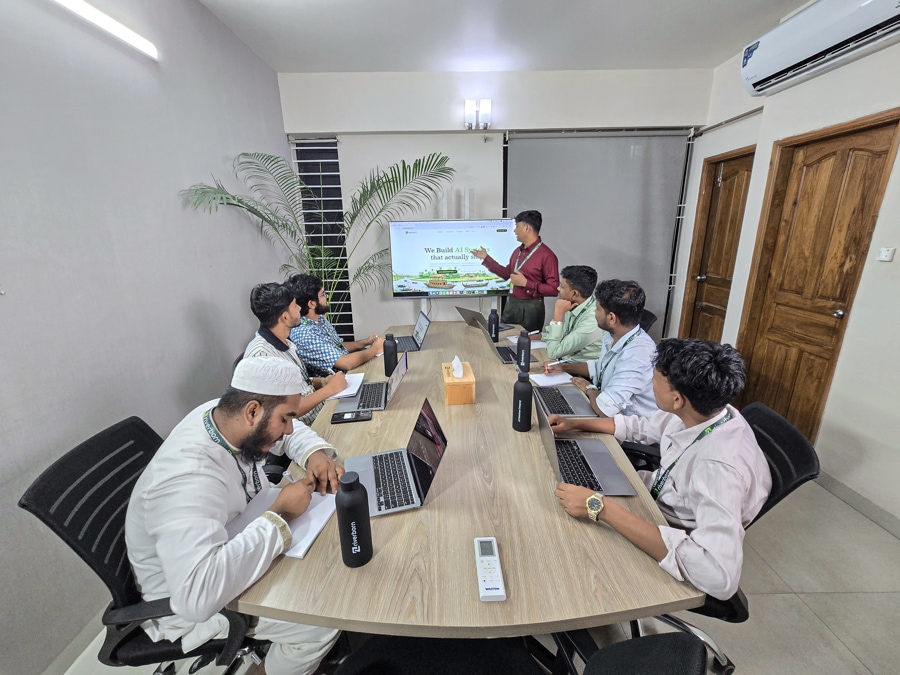
In terms of team structure, our entire team is technical. Only one guy is non-technical, but he is also becoming an engineer day by day. We work more like a lab. We didn’t have different divisions until recently. As we grow, we are now creating these divisions because our team is becoming bigger.
We currently have a core engineering team; we have a leadership team on top that includes Nasir, Raihan, and me.
Each of us focuses on one aspect of the business. Nasir looks after operations, from payroll to day-to-day operations. He also codes himself. I generally get involved in high-level architecture, strategy, direction, and setting up marketing and sales strategy. I also occasionally code because I love this work, and that’s why I tinker as well.
Raihan, our other co-founder, looks after marketing and communication. He creates content as well. We have multidisciplinary people in the team who do different things.
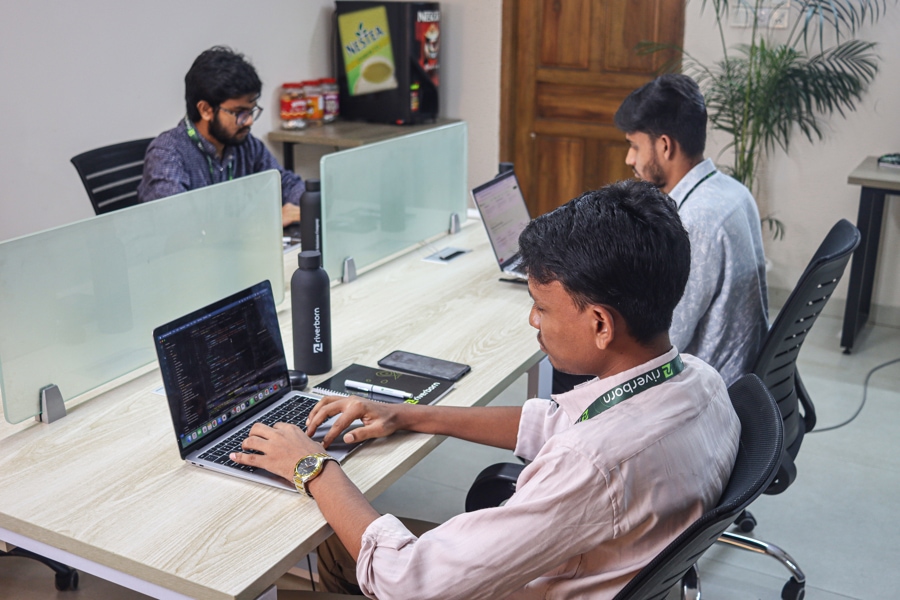
We are a small, nimble team. We are an effective team—more so now that we are working from the office than before, when we were working remotely.
Ruhul: What are the plans going forward? Where do you want to go in the next 5-10 years?
Nasim: The ambition is to build a trusted global AI solutions company from Bangladesh. We believe that you can build world-class companies from Bangladesh.
If we look at our history, we have done it many times in the past. We made muslin, one of the finest fabrics in the world. We have many such examples. We believe the same kind of artistic work can still be done in Bangladesh, and our goal is to establish that by building a world-class AI solutions company.
Ruhul: Let’s briefly talk about AI. You are building an AI solutions company out of Bangladesh, which is fascinating. AI is developing at a breakneck pace. It is hard to get a sense of everything that is happening. Can you talk about AI developments across the spectrum for our readers? If I add a bit for context: there are model companies. There are companies building on top of those models, building layers and specific solutions. There are product companies building specific products. There are research companies and labs that are again doing fundamental research and may be creating models. Then there are model companies building solutions themselves, such as Anthropic and OpenAI. Some of these companies want to be everything. There are all kinds of things happening, and the speed of development is dizzying, as I mentioned. As an insider, give us a sense of what’s happening. At the same time, tell us about where Riverborn sits in this spectrum.
Nasim: You have already explained it quite well. First of all, model companies and research labs that build models. Of course, they can build products, as Anthropic and OpenAI have been doing. Then there are companies that build products or solutions on top of those publicly available models. I would say these are two major types of companies currently.
We currently fall into the second type of companies that are working on available models. We use existing models, maybe fine-tune occasionally, and build an architecture to achieve a particular goal. Although models are powerful, they can’t do everything on their own. So if you want to get certain things done, you need to build proper architecture with proper tool access so that it can access them and also use its judgment to get the work done. We do that kind of work.
I’m not aware of any meaningful foundational AI research work happening in Bangladesh as yet. There are a few works at the individual level, but we don’t see big companies funding ambitious work in Bangladesh as yet.
Compared to that, there are companies doing fascinating work in India. There are companies fine-tuning existing models for the Indian context, languages, and dialects. I think we have a gap in that regard in Bangladesh. You would see that Bangla AI is still very poor in quality. We have a lot of work there. And this kind of work requires a lot of capital. That is a limiting factor for us.
However, we have plans in the coming days to explore work in these areas. Maybe start with fine-tuning models and then building foundational models ourselves.
Ruhul: Do you see model companies eating up the market for other people building on top of models?
Nasim: It is one of the developments we are seeing, where model companies are moving into service layers as well. This is a vast topic that we can talk about at length.
Of course, model companies are eating lots of alpha from other businesses. By alpha, I mean what makes a business different from others, lucrative, and makes the most money. Model companies are now increasingly coming for those alphas.
This is one of the reasons why I think we need to have our own sovereign model. Because without that, whatever we do will be eaten by OpenAI or Anthropic and so on.
That’s why European companies are building their own AI, and many other countries are doing the same. Because if you don’t own the weights of the model, you don’t own the outcome.
If you build an architecture on an existing model, your data is going to them. They will use it to train their model better and replace your work. That’s what we are seeing. A new model comes, and a new class of companies and startups go out of business.
Ruhul: That's all about AI and Riverborn. I now ask a few quick questions. How do you operate as a founder and CEO of the company? You also have a CTO role at Agenton. How do you stay productive?
Nasim: First of all, since I’m involved with two companies, I need to put in more hours. Normally, I don’t even take weekends. Since I now have a family, I try to take a day off every week so that I can give time to my family.
I try to work in fixed chunks of time. I have fixed hours for Agenton and Riverborn. Of course, things can take more time than your estimate. In those cases, I operate accordingly. AI has been helpful. I can do more with less time. With AI, my bottleneck is my judgment, because even if I can do a lot more with AI, I still need to review and evaluate. That’s the main job right now, and it is a lot of work in itself. More so for me, since a lot of my work is strategy and long-term thinking, a lot of my work is about reviewing things and vetting things.
My team is fairly small, and we have been working together for a long time. So they know how to approach me and how to collaborate with me. It makes my work a lot easier. Working out of the office now has made it even easier than before, when we were mostly working remotely.
There is no secret. One thing I try to do is write things down. Since I am into many things, I try to write things as they come. It allows me to remember things.
Ruhul: You are an autodidact in a way. What is your approach to learning?
Nasim: My learning style is applied. I remember things that I need to apply after learning them. If I don’t need to use something, I forget it. I try to design my learning accordingly; I learn based on what I need to do. And I apply everything that I learn. I try to learn by doing. Now, AI has made it even easier. My work has helped me learn throughout my journey. I have progressively moved up in terms of learning skills. As a result, I have had the opportunity to learn many new things. So when something new comes up, I know I can figure it out because I have already done it once.
Ruhul: What are some of your high-level lessons from your journey so far?
Nasim: I have a couple—I would not say lessons, rather more like beliefs.
First, be delusionally optimistic. What I mean by that is that if you don’t believe in yourself and your idea delusionally, then you are not going to make it, because you will always have doubts, and you are not going to work hard toward it.
When I thought I would drop out and start working full-time without having any CS degree, in a US company or Canadian company, to a regular person, that might appear unrealistic. It is, to some extent. Most people wouldn’t believe it. But I believed it delusionally, and I really thought I could make this happen. So that actually helped me do that. Now I also believe that we can do great stuff from Bangladesh that would set ourselves apart. If you believe it, it is possible. That’s why I love the idea: be delusionally optimistic. That’s one.
At the same time, belief alone is not enough. You have to work hard. In fact, it is usually working hard that leads to self-belief. There is no alternative to working hard, because without working hard you are not going to get the result.
That said, it is also useful to remember that even after working hard, there is luck involved. You cannot control that part. You just have to spread your wings enough so that there is enough surface area that you get lucky. That’s what I try to do.
I try to optimize my surface area of success. I am still very young, but I am hopeful. The future will be good.
Ruhul: What have you found particularly useful or advantageous in your journey—could be a book, could be some suggestions, could be a particular way of doing things, anything that you found very useful?
Nasim: It’s hard to point to one specific thing; there are many things. One thing that I feel is that you have to learn to challenge the traditional belief that everybody knows. Because if you are doing the same thing as everybody else, how can you expect different results? That’s one thing that I learned, or realized, throughout the process: challenge traditional knowledge. And then there is some stuff that actually impacted me hugely. For example, I mentioned the talk by Mahmudul Hasan Sohag. His talk introduced me to a bunch of ideas that opened my mind to new ideas. Having an open mind is very useful, and it has helped me learn and grow throughout my journey.
Then, reading books. I have read non-fiction books all my life. I mostly read philosophy, business, and engineering books. For example, Naval Ravikant is someone who influenced me a lot. I love his philosophy around money and wealth. I relate to his philosophy around money because I think I can relate to him very much, because he also came from a poor background. He got to where he is today because of technology, and I believe that has been the case for me as well. He says that if you want to be wealthy, you need to own some kind of business or equity. Otherwise, you cannot. So books helped. I listen to podcasts to find new ideas and learn from people so that I can use this in my life as well.
Ruhul: What do you think about life, given that life is short and transient?
Nasim: First of all, I haven’t figured it out. At this moment, my understanding of a fulfilling life would be if I am not harming anybody and I am helping other people around me. That makes me happy. I have seen how even a couple of thousand taka can help people so much. I don’t have it figured out or anything, but I just try to live in a way that, as long as I am not making someone else’s life harder and also making some positive impact on people’s lives, then that’s good. Like, that’s it.
I try to be moral in my business and everything. I would rather lose my business than do anything immoral. Because in the end there is a thing called bibek (conscience). If you ask something to your bibek (conscience), you will find the answer to whether what you are doing is right or wrong. I try to live by that. I don’t do anything immoral. Otherwise, I wouldn’t be able to look at myself in the mirror.
Ruhul: I think this is a good place to end this conversation. I have been following your work for a while and always wanted to talk. Thank you for being generous with your time and insights.
Nasim: Thanks for listening to me. This has been a pleasure.