
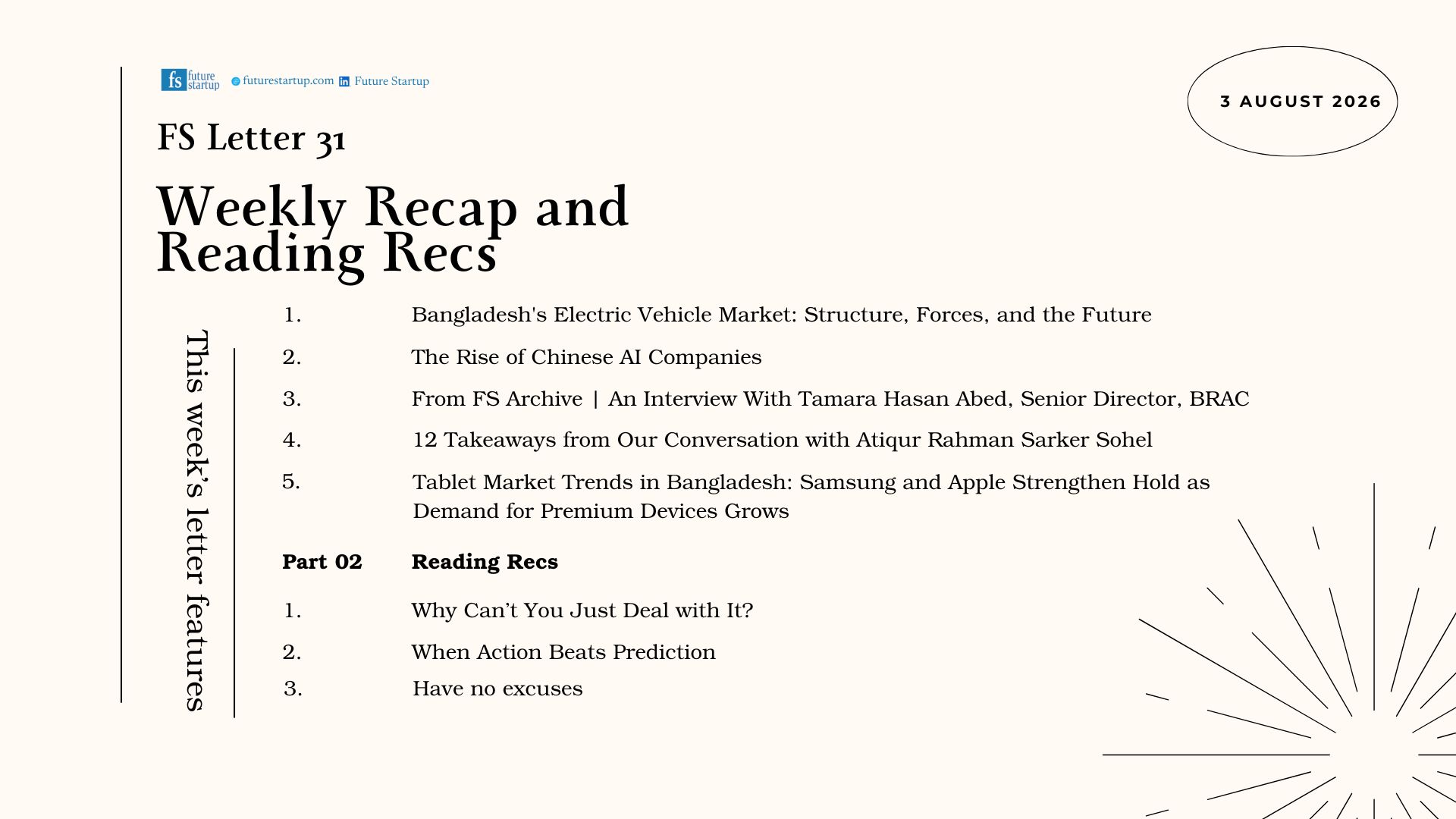
This week’s newsletter features:
Reading Recs
Enjoy!
In many countries, the electric vehicle transition is a policy project, a deliberate push from the government to shift a stubborn incumbent industry toward a cleaner technology. Bangladesh's EV story is different in a way that is easy to misread. Here, the transition at the mass-market level has already happened.
It happened quietly in rural districts and small towns, without subsidies, formal financing, or the involvement of any major automotive brand. It happened because a cheap, functional technology met an unserved need, and the people with that need were practical enough to use it.
Today, somewhere between 2.5 million and 6 million electric three-wheelers operate across Bangladesh, carrying approximately 25 million passengers every day. These are "easy bikes", locally assembled, lead-acid powered, largely unregistered, that evolved from local mobility necessity over the past fifteen years.
The formal EV market, with its registered passenger cars, public charging stations, and policy frameworks, sits atop this much larger informal reality.
Understanding the relationship between those two layers is the key to understanding everything else about this market.
“Sometime around January 2025, a relatively unknown Hangzhou lab called DeepSeek, spun out of a quantitative hedge fund called High-Flyer, released a reasoning model called R1 that performed close to the American frontier at a training cost that made Western AI labs visibly uncomfortable. Nvidia lost roughly $600 billion in market value in a single day. Investors who had priced AI as a capital-intensive, US-controlled category had to reprice it overnight. Commentators reached for the obvious historical comparison and called it China's Sputnik moment for AI.
Even more interesting, eighteen months on, is that DeepSeek did not stay a one-off case. It increasingly appears like a visible tip of an entire industrial base that had been building underneath it for years, that includes chipmakers, cloud platforms, model labs, and a policy regimen to support all three simultaneously.”
Read the full article.
“When I was 7 years old, my mother died while giving birth to my younger brother. Although I was too young to comprehend the magnitude of my loss, it changed my life forever in many ways,” says Tamara Hasan Abed. She continues, “I became very protective of my little brother and tried to take care of him in whatever small way possible for me at that age. From someone who used to receive care, I saw myself as a caregiver instead. As a result, I grew up a lot faster than many other children of my age. I became more responsible and self-reliant out of necessity.”
Read the full interview from FS archive here.
“One of the fascinating parts of the interview is how Mr. Sohel’s early years continue to shape his thinking about business. He speaks about growing up in a village, about his parents, discipline, education, responsibility, and the values that quietly shape how a person approaches work decades later.
This is an important reminder because entrepreneurship literature often focuses on fundraising, product-market fit, or scaling. But founders are ultimately extensions of their backgrounds, character, and habits.
Companies inherit the psychology of their founders.
If you want to understand a company, sometimes it is more useful to understand the formative years of its founder than its cap table.”
Read the full article.
“Bangladesh's tablet market continues to gain momentum as digital adoption expands across education, business, and entertainment. The growing reliance on online learning, hybrid work environments, digital content creation, and mobile productivity has increased consumer demand for high-performance tablets, with Samsung and Apple maintaining their leadership in the country's premium tablet segment.
According to Md. Yousuf Ali Shohag, Deputy Manager, Ecommerce, Web & Media at Star Tech Ltd., customer demand for Samsung Galaxy Tab and Apple iPad models has remained consistently strong in recent years. He noted that sales trends and customer inquiries indicate a growing preference for premium tablets among students, professionals, freelancers, content creators, and families seeking reliable devices for everyday productivity and entertainment.”
Read the full article.
“Ultimately, dealing with difficult things requires getting to know them. It can be hard to really wrap yourself around a quirky and recalcitrant problem; it’s a little like hugging in winter, when people wear big coats and seem to have a lot in their pockets. You often have to contort yourself into an awkward embrace. And embracing something briefly won’t help you really deal with it; you have to stay there, settling in. You need nuance, persistence, flexibility, firmness, attention to detail—almost a love of the problem. You’ll have to become old friends before you can say goodbye.”
“Most entrepreneurial stories are a series of events where the founders bounce from random good thing to random bad thing before falling into something that works.
What is rarer is the linear path of “founder seeks an idea; founder lists a number of possibilities and does some market research; founder picks the best idea from that list and pursues it; the idea works and said founder builds an amazing business.” This type of story fits right into a causal business framework: the entrepreneur decides to make carbonara and then works backwards to do all the things necessary for carbonara and succeeds. It is ridiculous when it does happen: the story falls together so logically, so pleasantly. Most entrepreneurial stories are not like this: what you usually get is a series of events where the founders bounce from random good event to random bad event before falling into something that works. And in fact the more common pattern in successful entrepreneurship is something like “Wow, that seemed to work! Let’s do more of it and see where this leads us!” and “Well, nobody thought that would work, but it did.””
“Except in a very few [tennis] matches, usually with world-class performers, there is a point in every match (and in some cases it's right at the beginning) when the loser decides he's going to lose. And after that, everything he does will be aimed at providing an explanation of why he will have lost. He may throw himself at the ball (so he will be able to say he's done his best against a superior opponent). He may dispute calls (so he will be able to say he's been robbed). He may swear at himself and throw his racket (so he can say it was apparent all along he wasn't in top form). His energies go not into winning but into producing an explanation, an excuse, a justification for losing.”