
We first covered Filament Engineering (Muspana) in 2017, when it was still a small solar and IPS business working out of a modest setup in Mohammadpur. Nearly a decade later, we sat down with its founder, Atiqur Rahman Sarker Sohel, again. The company today operates eight to ten operational wings, manufactures the country's only round conical electric poles, holds a leading position in public-sector solar work, and has built a unique work culture.
Some interviews are about tactics. Others are about stories. Then some conversations have the power to reshape how you think about building. This conversation with Mr. Sohel falls into the third category.
On the surface, it is a story of an entrepreneur who built a fascinating engineering company in Bangladesh, growing from a small solar business into a diversified manufacturing, import, and public sector infrastructure group. The more interesting, however, is the philosophy of building underneath that business. Throughout the conversation, Mr. Sohel repeatedly returns to questions of character, institutions, trust, patience, and the long game.
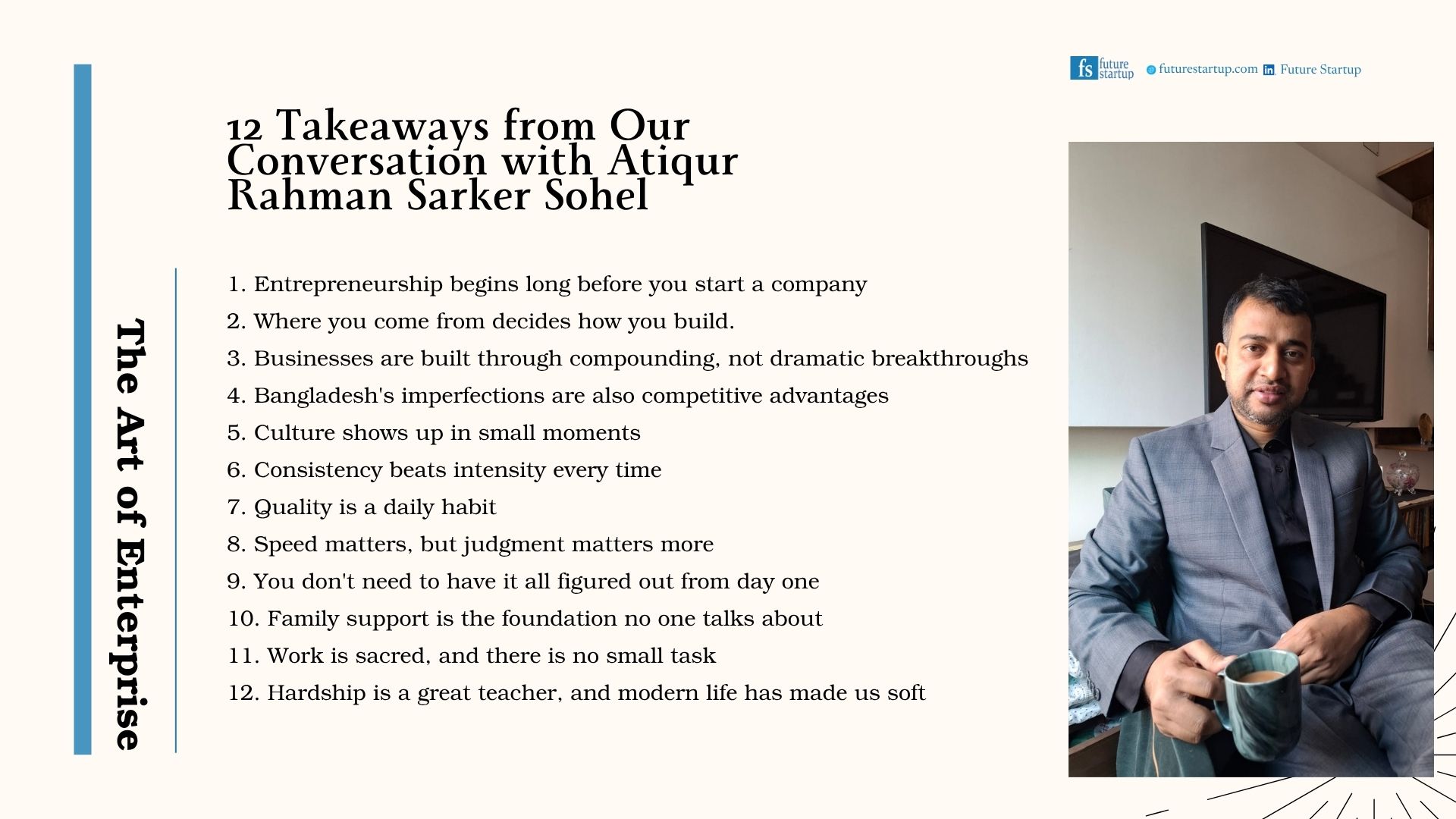
Here are twelve things from that conversation that stayed with us.
One of the fascinating parts of the interview is how Mr. Sohel’s early years continue to shape his thinking about business. He speaks about growing up in a village, about his parents, discipline, education, responsibility, and the values that quietly shape how a person approaches work decades later.
This is an important reminder because entrepreneurship literature often focuses on fundraising, product-market fit, or scaling. But founders are ultimately extensions of their backgrounds, character, and habits.
Companies inherit the psychology of their founders.
If you want to understand a company, sometimes it is more useful to understand the formative years of its founder than its cap table.
An extension of the above point is that we eventually end up building what we are. Sohel grew up in a village in Comilla that a car still can't reach. His father, an English teacher at a local madrasha, farmed, did masonry, and built furniture out of a conviction that no task is small. Sohel cut grass for the cows, sold gourds in the bazaar, and wired his family's house himself the year electricity arrived.
These stories offer a hint at the source code of his approach to running his company today. Ruhul Kader wrote in the introduction of Sohel’s interview that founders build what they are. Sohel's insistence that every form of labor carries dignity traces straight back to a father who drank the cow's milk he had helped produce and considered that a form of honor.
Looking at Filament Engineering today, it is easy to see a diversified company with businesses across manufacturing, solar, electrical infrastructure, and intelligent street lighting. But the interview makes clear that none of this happened overnight. Each new capability built on previous capabilities. Each opportunity created another.
This offers a boring but timeless lesson. People often overestimate overnight breakthroughs and underestimate accumulation over a long period of time.
Great companies are usually the result of hundreds of small decisions that compound over years.
Many entrepreneurs see Bangladesh primarily through the lens of its constraints, such as bureaucracy, regulatory uncertainty, and infrastructure gaps.
Sohel offers a different perspective. He argues that the country's openness and flexibility often create opportunities that would be difficult to find in more mature markets. Problems exist everywhere, but in Bangladesh, many industries are still being formed. That creates enormous room for entrepreneurs who are willing to execute.
It is an optimistic view. At the same time, there is also some truth to it. Markets that appear chaotic from the outside often reward builders who understand how to navigate them.
Perhaps the most memorable story in the interview has nothing to do with revenue or engineering. Around forty colleagues drove overnight to Faridpur simply to attend a colleague's wedding. An unusual story that explains something deeper about the culture at Muspana.
Culture cannot be measured through posters on office walls. It reveals itself in voluntary behavior. When people choose to show up for one another outside work, something meaningful has already been built inside the organization.
Founders often ask how to build culture. Perhaps a better question is: Would your people choose each other when they don't have to?
Notre Dame College, where Sohel studied, runs two exams every week worth 25 marks each. You can't miss a week without a medical certificate. There's no room to slack. The result? The worst student in his class still got into a government medical college.
Notre Dame understood something fundamental: consistency is more important than intensity. Sohel applies this to business too. Build systems that force you to show up, every week, to a standard, without exception. That's how you build something that lasts.
The interview repeatedly returns to craftsmanship. Whether manufacturing electric poles or delivering infrastructure projects, Sohel emphasizes consistency over excitement.
Quality is rarely created by occasional heroic effort. It emerges from systems that make good work repeatable. The companies that endure are often those that become slightly better every single day.
As an engineer, Sohel values fast decision-making. But throughout the conversation, speed never appears as recklessness. Rather, it is informed speed.
The ability to make decisions comes from experience, preparation, and clarity of values. In a world obsessed with moving fast, this distinction matters. Good founders are not simply faster. They become better at recognizing which decisions deserve speed and which deserve patience.
Sohel started Filament in 2010 out of a single room in Mohammadpur with 6,000 taka rent, alongside his elder brother, while both were still working full-time jobs. Before that, he was selling IPS units on the side. Before that, he was applying for IPOs in friends' names just to cover his first employee's 5,000 taka salary. The business evolved from IPS to CFL bulbs to solar to electric poles to intelligent street lighting. None of it was a straight line. The flood of 2010 wiped out everything he had. He kept going anyway. That's the only plan that ever works.
Sohel is refreshingly honest about this. A big part of business challenges comes from family, but he has been unusually fortunate. His elder brother is his business partner. His mother quietly holds the family together. His father-in-law encouraged him from the beginning, believing there is barakah in business that a salary cannot carry. A lot of other people in his family have supported him throughout his journey. The point isn't that everyone needs this kind of support. The point is that Sohel recognizes it as a blessing, and he doesn't pretend he did it all alone. He also acknowledges that without support from your family, it is hard to succeed in a challenging pursuit like business. He advises young founders to figure out a way to fix family issues if they truly want to do something meaningful.
Sohel's father was a teacher who also farmed, did carpentry, masonry, and even sold lungis on the side. Not because he needed to, but because this was how he moved through the world. He cultivated in his children the belief that every form of labor has its own dignity. Sohel grew up cutting grass for cows, weeding fields, and selling gourds in the village bazaar, not out of necessity, but because his father insisted on it. That lesson stuck. You can see it in how Sohel builds today: no task is beneath him, and work itself is a form of prayer.
Walking four kilometers to school through flooded fields, eating mangoes from neighbors' trees, waiting for ducks to lay eggs so you could sell them for ice cream, these weren't hardships to Sohel. They were just life. But looking back, he recognizes them as an education no classroom could replicate. He worries that his own children will never get that education because modern life is too cushioned. There's a quiet melancholy in that observation, and a challenge: how do we build character without hardship?
There is no shortage of startup advice today.
Raise faster.
Scale faster.
Launch faster.
But conversations like this remind us that many enduring businesses are built on older ideas: trust, patience, craftsmanship, responsibility, and character.
These ideas may not produce overnight success.
But they often produce something far more valuable: organizations that continue creating value long after the excitement fades.
If you're building for the long term, our conversation with Atiqur Rahman Sarker Sohel is worth your time. It reminds us what building actually requires.