
Bangladesh already runs one of the world's largest electric fleets, built entirely without government planning. What comes next is harder: turning a massive informal economy into a formal industry while the vehicles keep moving.
In This Brief:
In many countries, the electric vehicle transition is a policy project, a deliberate push from the government to shift a stubborn incumbent industry toward a cleaner technology. Bangladesh's EV story is different in a way that is easy to misread. Here, the transition at the mass-market level has already happened.
It happened quietly in rural districts and small towns, without subsidies, formal financing, or the involvement of any major automotive brand. It happened because a cheap, functional technology met an unserved need, and the people with that need were practical enough to use it.
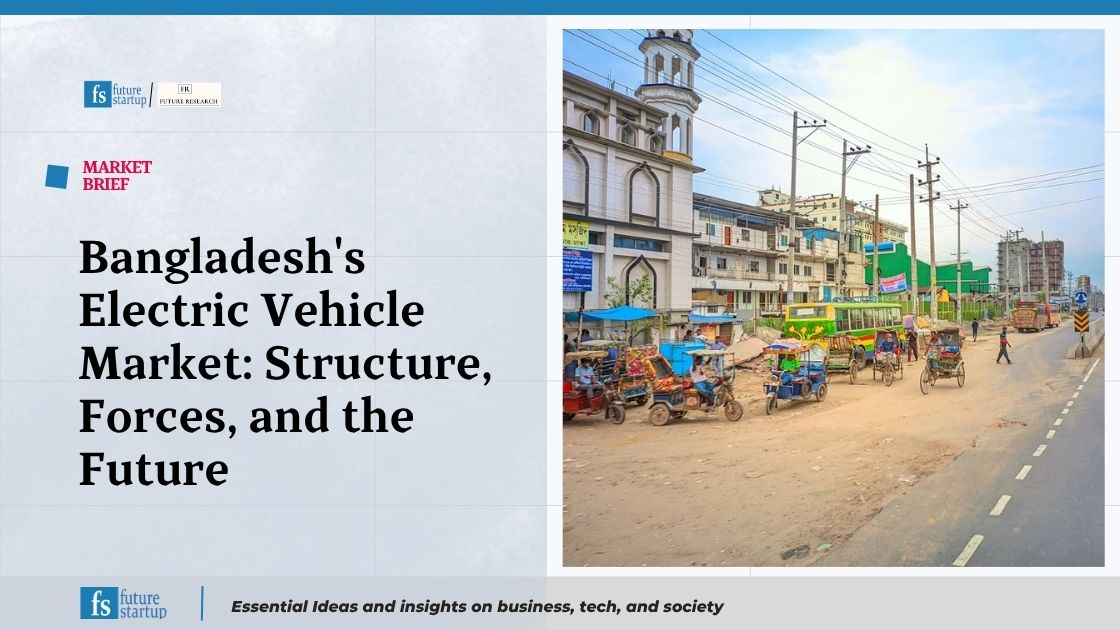
Today, somewhere between 2.5 million and 6 million electric three-wheelers operate across Bangladesh, carrying approximately 25 million passengers every day. These are "easy bikes", locally assembled, lead-acid powered, largely unregistered, that evolved from local mobility necessity over the past fifteen years.
The formal EV market, with its registered passenger cars, public charging stations, and policy frameworks, sits atop this much larger informal reality.
Understanding the relationship between those two layers is the key to understanding everything else about this market.
The transport sector accounts for a meaningful share of Bangladesh's energy consumption and urban air quality problems.
Dhaka's air regularly exceeds WHO guidelines by a factor of ten, with vehicle emissions responsible for roughly 15% of that pollution.
The country has committed, under its Nationally Determined Contributions, to cut transport sector emissions by 3.39 million tonnes unconditionally by 2030. The government positions the EV industry as both an environmental imperative and an industrial development anchor, a sector that should contribute 10% of GDP and generate 75,000 green jobs by 2030.
The foreign investment signal reinforces the industrial ambition. The sector has attracted $650 million in foreign direct investment, and in December 2024, the World Bank signed a $900 million financing package that includes $500 million specifically for green and climate-resilient development. That is institutional capital betting on a trajectory.
The question this brief is interested in is not whether the EV transition in Bangladesh will happen. At this scale of existing adoption, the direction is settled.
The more interesting question is how fast, through which institutional mechanisms, at what cost, and to whom, and with what industrial architecture at the end.
The answers to those questions determine who wins in this market over the next decade.
When people say "the Bangladesh EV market," they are typically referring to something that does not actually exist as a single unified thing.
At least three distinct markets are operating under that label, each with its own economics, its own customer base, its own supply chain, and its own relationship to the formal regulatory system.
Treating them as one market leads to analytical errors that matter when you are making investment or operating decisions.
This is the foundational layer — the one that has been operating for over a decade, and that dwarfs everything else by volume.
Electric three-wheelers come in two main technical configurations: the mishuk, a purpose-built three-wheeled electric vehicle, and the tom-tom (also called the "Bangla auto"), a modified domestic rickshaw or van fitted with an electric motor and lead-acid battery packs.
These vehicles are assembled in small workshops, predominantly in Sirajganj, Jessore, and Bogura and some Chittagong and Dhaka, without standardized quality control or formal certification. They are sold through informal networks, financed through personal savings or informal moneylenders, charged from household electricity connections (often illegally tapped), and operated on routes that may or may not have formal approval.
The market's size is inherently uncertain because most of it is unregistered. Estimates in late 2025 ranged from 2.5 million to 6 million units, a range wide enough to indicate that nobody has a precise count.
However, what is not uncertain is that these vehicles are the primary transit mode for a significant portion of the country's rural and semi-urban population, in areas where formal public transport does not reach. In Dhaka and increasingly other urban centers, Bangla auto continues to replace old pedal rickshaws.
The formal four-wheeler market has undergone a significant shift over the past decade, though not through battery EVs. It shifted through hybrids. Between FY2018 and FY2021, hybrid car imports grew by 154%.
The Toyota Aqua, the Honda Grace, and related Japanese reconditioned models became the dominant choice for the Bangladeshi middle class, driven by lower fuel costs and lower maintenance burdens compared to petrol-only vehicles.
This matters structurally because it means electric propulsion technology is not unfamiliar to the market segment that will be the target customer for the next generation of domestically manufactured passenger EVs.
The hybrid transition was a consumer preference outcome. It has pre-warmed a significant portion of the market for the full shift to battery electric vehicles.
Full battery electric passenger cars remain a small, primarily luxury market. Only 25 were registered nationally in 2023. That number grew to approximately 350–400 by early 2024, and surpassed 4,152 by mid-2025.
BYD, MG, and Audi are the primary brands. Import duties of up to 89% have kept this segment artificially small relative to consumer interest.
As domestic manufacturing scales and tariff structures adjust to support local production, the economics of this segment will change substantially.
A fourth segment worth noting is the electric two-wheeler market, now past 50,000 registered units and expanding quickly, driven by last-mile delivery demand from e-commerce logistics companies. This segment is the most likely to formalize rapidly, because the businesses deploying these vehicles have corporate structures and can absorb compliance costs in ways that individual easy bike operators cannot.
Bangladesh EV Market — Fleet by Segment (2025)
| Segment | Est. Fleet | Primary Customer | Charging Model | Status |
| Electric Three-Wheelers | 2.5M – 6M | Rural / semi-urban commuters | Informal / home | Mostly unregistered |
| Electric Two-Wheelers | 50,000+ | Gig workers, logistics | Mixed | Partial registration |
| Hybrid Passenger Cars | 20,000+ | Urban middle class | Standard stations | Fully registered |
| Full Battery Electric Cars | 4,152 | High-income urban | Public hubs (early) | Fully registered |
| Electric Buses | <100 | BRTC pilot routes | Dedicated depots | Pilot stage |
Source: LightCastle Partners, December 2025
The most consequential development of the past two years in Bangladesh's EV market is not the growth of registered EVs. It is the entry of major domestic conglomerates into manufacturing, and the specific form their bets have taken reveals something about how local capital reads this opportunity.
Runner Automobiles has partnered with BYD to explore local production of both passenger EVs and commercial vehicles, acquiring land in Magura and Mymensingh for dedicated manufacturing facilities.
Runner has one of the strongest distribution networks and brand recognition profiles in the commercial vehicle and motorcycle segments. BYD brings battery technology, manufacturing process knowledge, and a product portfolio that spans the price spectrum. Together, they cover the full value chain that neither could construct alone within a realistic timeframe.
This partnership is the one most likely to produce volume production at competitive price points, and therefore the one most likely to unlock the middle-income passenger car market that currently buys reconditioned Japanese hybrids.
Walton's move is arguably the most strategically significant in the entire sector. The company has established a $120 million lithium-ion battery manufacturing plant. The battery pack accounts for approximately 40% of an EV's total cost. If Walton achieves competitive quality at domestic production costs, it restructures the economics of EV manufacturing in Bangladesh — not just for Walton's own vehicles, but potentially for every manufacturer in the country that might source batteries locally.
Walton already produces electric motorcycles and scooters, giving it downstream market exposure to test and refine what it produces upstream. It is building a vertically integrated position that few companies in the sector are attempting.
Nitol-Niloy Group is developing the "Suvare" brand with a target price of approximately BDT 1.2 million (around USD 14,000) for an electric sedan with 200 km of range. That price point deliberately targets the buyer who currently purchases a reconditioned Japanese hybrid.
If Suvare can hold that price in local production, it represents the first credible attempt to replace the reconditioned import market's dominant segment with a domestically manufactured electric vehicle — the segment where the volume is.
Akij Motors has built a deliberately diversified portfolio — electric two-wheelers, three-wheelers, commercial trucks, and vans — hedging against uncertainty about which segment formalizes fastest and attracts the most policy support.
Bangladesh Auto Industries Ltd (BAIL) is constructing a plant targeting 20,000 units of annual capacity, focused on higher-speed charging compatibility and longer range.
Total tax incidence on a domestically produced EV runs at approximately 33%, compared to 89% for imported units. That 56-percentage-point differential is not a marginal advantage — it is a structural moat that makes local assembly economically viable at volumes far lower than would be required in a market with smaller fiscal distortions. The policy is doing real, heavy lifting for anyone willing to put capital into domestic production.
On the infrastructure side, private operators including CrackPlatoon, Trust Electric Charging, and Mahmud & Brothers are building charging networks in high-traffic corridors — Dhaka's Tejgaon, the Dhaka-Chittagong highway — positioning for what will become an essential infrastructure utility as the registered fleet expands.
These operators are the earliest movers in a space that will eventually look like a utility business: capital-intensive, recurring-revenue, operationally straightforward once permitted and connected to the grid.
Several distinct forces are driving EV adoption in Bangladesh, and they operate at different time horizons and through different mechanisms.
Understanding them separately matters because they have different reliability profiles; some are durable structural forces, others are policy-dependent and could weaken if the political economy shifts.
The economics of operating cost: The primary driver of easy bike adoption was never environmental awareness or government encouragement. It was money. An electric three-wheeler costs significantly less per kilometre to operate than its CNG equivalent. Electric motorcycle conversions in Bangladesh show daily operational cost savings that decisively favour the electric option, a pattern that holds across two-wheeler and three-wheeler segments.
This economic logic is durable. It does not depend on subsidy continuity or policy stability.
As long as electricity is cheaper than petrol per kilometre, a relationship that reflects the fundamental efficiency of electric motors, not just current fuel pricing, the operating cost advantage persists.
Bangladesh's relatively low electricity costs from gas-heavy generation reinforce this advantage.
The logistics and gig economy pull: The rapid growth of e-commerce in Bangladesh: Daraz, Pickaboo, Foodpanda, Pathao, Chaldal, and a growing cohort of quick-commerce players, has created sustained demand for last-mile electric two-wheelers.
Logistics companies operating at scale have both the financial sophistication to model total cost of ownership properly and the vehicle volumes to make fleet electrification an attractive proposition.
This is pulling the formal two-wheeler EV market in a way that is structurally independent of consumer sentiment or household purchasing decisions.
Hybrid normalisation as a bridging mechanism: The 154% growth in hybrid vehicle imports between FY2018 and FY2021 did something that is often overlooked: it normalised electric propulsion technology for the Bangladeshi middle class.
The Toyota Aqua driver is not unfamiliar with an electric motor doing meaningful work in their vehicle. They have experienced lower fuel bills. When a domestically manufactured BEV becomes available at a price they can consider, say, BDT 1.0–1.5 million with financing, the technology barrier that typically slows EV adoption in markets with no hybrid history will be substantially lower in Bangladesh.
Policy and fiscal architecture: Government policy is functioning as an accelerant rather than the primary driver. The 10-year tax holiday for EV manufacturing, the reduction of battery material import duties from 60% to 1%, the 50% registration fee reduction, and the AIT waiver until 2030 all tilt the investment case toward domestic manufacturing and consumer purchase. These are meaningful fiscal incentives. They do not create demand where none exists, but they do make supply investments viable at lower volumes than would otherwise be required.
Climate finance and development institution pressure: The World Bank's $900 million package, ADB financing programmes, and IDCOL's EV financing toolkit collectively create a funding architecture that pulls institutional investment into the sector. This matters particularly for charging infrastructure, where capital requirements are high, and return timelines are long, exactly the profile that development finance is designed to bridge.
The Bangladesh EV market has moved through a recognizable sequence, and understanding the sequence helps clarify where the market is now and what the next phase requires.
The first wave was entirely organic and entirely informal. Starting in the early 2010s, cheap Chinese electric motors and battery packs became available at price points that made it rational for rural workshops to assemble three-wheeled electric vehicles. No government programme launched this. It spread through exactly the mechanism that informal markets use: one driver saw another making more money with lower operating costs, and copied the approach.
Within a few years, hundreds of thousands of these vehicles were on roads where no government had anticipated them, serving routes where no formal transport operator was interested in going.
The second wave, still underway, involves both the formalisation of the first wave and the introduction of the mid-market segment.
This is where the regulatory activity is concentrated — the BRTA registration guidelines, the route approvals, and the safety standards developed with BUET. It is also where the conglomerate manufacturing investments are being made.
The hybrid import boom belongs to this wave: it demonstrated consumer willingness to pay a premium for electric propulsion technology if the economics justified it.
The third wave — local manufacturing at scale, utility-grade charging infrastructure, Vehicle-to-Grid integration, and the mass-market passenger BEV — is the one Bangladesh is trying to pull forward through the 2030–2041 policy window.
The market's evolution shows that demand was never the constraint in Bangladesh. The constraint has always been supply-side: the absence of affordable vehicles, formal financing, and the regulatory legibility that allows these vehicles to be financed, insured, and resold.
Several insights emerge from this sequence that are not obvious from a surface reading of the data.
The direction of technology diffusion in Bangladesh was bottom-up, not top-down. This is the opposite of how EV markets developed in China, the US, or Europe, where the technology first appeared in premium segments and worked its way down the income ladder.
In Bangladesh, electric propulsion was adopted first by the poorest operators in the least-regulated segment. The mass market already has experience with electric vehicles. The premium market is playing catch-up in volume terms, even if it leads in revenue per vehicle.
The informal sector's scale is simultaneously the market's greatest asset and its most significant structural challenge. It is an asset because consumer adoption barriers are low, technical familiarity is widespread, and supply chains for basic components already exist domestically.
It is a challenge because bringing millions of vehicles and their operators into a formal regulatory system is a long, friction-heavy process that requires institutional capacity the BRTA has not yet demonstrated at the required scale.
And the technology that drove the first wave, lead-acid batteries, is now the market's most serious environmental liability.
The path from where the market is to where it needs to go runs directly through the battery upgrade cycle, which in turn requires the financing mechanisms discussed next.
The investment picture at the macro level looks encouraging. $650 million in FDI, a $900 million World Bank package, $120 million from Walton's battery plant alone, and manufacturing facilities under construction from Runner-BYD, BAIL, and others. The formal financing architecture for large-scale investment exists and is growing.
The problem is at the other end of the capital stack, at the level of the individual driver who operates an electric three-wheeler and needs to replace a degraded lead-acid battery pack every twelve to eighteen months. That driver has essentially no access to formal credit.
67% of Bangladesh's financial institutions do not offer tailored EV loans, with the primary stated reason being the absence of formal vehicle registration. The circular logic is punishing: registration requires navigating BRTA processes that are slow and costly for small operators; without registration, formal financing is unavailable; without financing, upgrading to lithium-ion is financially out of reach.
The consequence is that millions of vehicles continue operating on degraded lead-acid batteries, with all of the environmental and safety implications that entail.
The battery replacement cycle is not a marginal cost for a three-wheeler operator; it is a significant recurrent capital event every year or two, absorbed through informal moneylenders at rates of 20–30% or above.
IDCOL's research shows that a combination of concessional interest rates in the 5–6% range and a capital subsidy of 2–8% would make EV ownership viable for most MSME operators in the transport segment.
The refinancing framework that would allow microfinance institutions to provide this lending, a Bangladesh Bank circular channelling concessional capital into MFI EV loan products, does not yet exist. The analytical case is made; the implementation mechanism is absent.
Financing Landscape — Products and Rates (Indicative, 2025–2026)
| Product | Rate | Target Segment | Tenure |
| IDCOL RE / Green Projects | 6% – 10% | Manufacturers, charging station operators | Up to 10 years |
| Sustainable Finance (banks) | ~7% – 9% | Green industry investment | Up to 8 years |
| Commercial Auto Loan | 12% – 14% | Registered private vehicle buyers | Up to 5 years |
| Informal / MFI Credit | 20% – 30%+ | Three-wheeler operators, unbanked | 1 – 2 years |
Source: IDCOL Lending Terms; MFI rates from sector surveys
The Battery-as-a-Service (BaaS) model offers the most structurally elegant solution to the bottom-of-the-pyramid financing problem. Under a BaaS model, the battery is owned by the service provider rather than the vehicle operator.
The driver pays a per-kilometre or per-swap fee rather than a large upfront capital cost, converting what is currently a recurring capital expenditure into an operating cost that can be paid from daily revenue.
Battery swapping stations also solve charging time and range problems for commercial operators who cannot afford to idle their vehicles for hours. No major BaaS operator has yet scaled in Bangladesh, but the conditions, a large, cash-flow-dependent operator base with periodic high capital requirements and essentially no formal credit access, are precisely what the model was designed for.
The first company to build a BaaS network at a meaningful scale in the three-wheeler segment will have a structurally defensible position.
Bangladesh's EV regulatory architecture has developed considerably over the past five years. The core documents are the Automobile Industry Development Policy 2021 and its 2025-26 updates, the Electric Motor Vehicle Registration and Movement Guideline 2023, and the Electric Vehicle Charging Guidelines 2022. Together, they represent a policy framework that is more coherent than Bangladesh typically produces for emerging industrial sectors.
The fiscal incentive structure is the policy's strongest element. The 10-year tax holiday for EV manufacturing, the AIT waiver until 2030, the 50% registration fee reduction, and the reduction of battery material import duties from 60% to 1% collectively create a compelling investment case for domestic manufacturing. These incentives move the economics meaningfully.
The 2023 Registration Guideline addresses the informal sector directly, mandating BRTA registration for all electric three-wheelers, specifying safety and design standards developed with BUET, and prohibiting unregistered vehicle transfers. It also clarifies licensing requirements for two-wheelers based on performance thresholds; vehicles exceeding 50 km/h or 1000W require motorcycle licenses and full registration, creating a sensible performance-based tiering system rather than a blanket categorisation by fuel type.
On charging, the Bangladesh Energy Regulatory Commission has established a dedicated EV charging tariff at BDT 7.64/kWh for low-tension connections — approximately 25% below commercial electricity rates, creating an operating margin for station operators. The government has mandated that 30% of EV charging stations be powered by renewable energy by 2030.
Where the policy falls short is in implementation mechanisms, not intent. The BRTA's capacity to process registrations at the volume the three-wheeler fleet requires is unproven.
Automation of vehicle fitness certification has been announced but not yet deployed at a meaningful scale. Bangladesh Bank has not issued the refinancing framework that would enable MFIs to lend to easy bike operators at concessional rates.
The charging infrastructure rollout, targeting 1,200 stations by 2026 from a base of 14 in mid-2025, requires permitting and grid connection processes to move at a pace Bangladeshi institutions have rarely achieved.
The honest accounting of this market requires sitting with both its considerable opportunities and its genuine structural difficulties at the same time.
Markets at this stage, with a large informal base, policy tailwinds, institutional gaps, and significant capital inflow, tend to reward investors and operators who can navigate complexity rather than those who expect straightforward execution.
The upgrade cycle from lead-acid to lithium-ion is a multi-billion-taka commercial opportunity dressed up as an environmental problem.
There are millions of vehicles operating on technology that will need to be replaced. The replacement decision is driven by pure economics once lithium-ion battery prices reach the right threshold. Any company — manufacturer, BaaS provider, MFI, or financing vehicle — that positions correctly in that upgrade cycle will have access to volume that most markets only dream about.
The charging infrastructure gap between 14 stations today and any reasonable future state is an infrastructure investment opportunity with utility-like return profiles: capital-intensive entry, recurring revenue, long-term contracted cash flows. The BERC tariff structure provides a reasonable operating margin. The World Bank financing provides a capital backstop. What is required is operational competence in permitting, grid connection, and station management, not a uniquely difficult set of capabilities for a company that has built infrastructure businesses before.
Local manufacturing, particularly battery manufacturing, has a structural advantage that will persist as long as the current tariff differential between domestic and imported vehicles remains. Walton's investment in battery production is the most strategically significant move in the sector because it addresses the cost problem at its root. A successfully scaled domestic battery industry changes the economics of every downstream vehicle manufacturer in the country.
The public bus electrification mandate, targeting 25% of Dhaka's bus fleet by 2030, represents a procurement opportunity at scale that is, in practice, a government-guaranteed revenue stream for whichever manufacturers and charging operators win those contracts. This is the kind of anchor demand that justifies significant capital deployment ahead of the broader consumer market maturing.
The lead-acid battery crisis is simultaneously an environmental emergency and a market structure problem.
Approximately 36 million children in Bangladesh have elevated blood lead levels, the result of informal lead smelting operations that recycle batteries from the easy bike fleet.
The National Strategy to Eliminate Lead Poisoning by 2035 addresses this, but execution requires shutting down a large informal industry while simultaneously building replacement infrastructure, a politically and logistically complex undertaking that has historically been difficult for Bangladeshi institutions to execute at pace.
Grid infrastructure at the distribution level is a binding constraint that is difficult to solve quickly. Bangladesh has sufficient generation capacity, 31,452 MW installed, with 99% electricity coverage, but distribution transformers in commercial areas were not designed for the sudden, high-draw loads of DC fast-charging stations.
Upgrading transformer capacity is unglamorous, slow, and not the kind of infrastructure project that generates press releases, which means it tends to be underinvested relative to need. Charging network rollout plans consistently prove optimistic in execution for exactly this reason.
The formalization of the easy bike sector is harder than policy documents acknowledge. These are not simply vehicles awaiting registration.
They are the livelihoods of drivers who operate in an informal economic ecosystem where registration has historically meant cost without clear benefit, where routes are determined by local political arrangements, and where regulatory enforcement has been inconsistent enough to make compliance feel optional.
Converting that reality into a formal, registered, insured, route-licensed fleet requires sustained institutional engagement of a kind that the BRTA has not historically demonstrated.
Bangladesh's EV targets are stated with unusual specificity for a country at this stage of the transition. The 30% EV penetration target by 2030, the 25% electrification of Dhaka's bus fleet, the reduction of 3.4 million tonnes of transport sector CO₂ emissions — these are precise enough to be evaluated and falsifiable, which can be read as a sign of policy seriousness.
The 2030 targets are achievable in principle but require the institutional improvements the policy framework calls for, without yet delivering.
The 5,000 charging stations the plan envisions will require permitting and grid connection to move at a pace not yet demonstrated.
The registration of the informal three-wheeler fleet — the underlying denominator for the "30% EV penetration" figure — will only happen if BRTA's automation programme delivers measurable throughput improvement.
Global EV market trends support the broader trajectory: global EV sales reached 20.7 million units in 2025, growing 20% from 2024, and battery costs continue declining.
By 2035–2040, the price parity argument for ICE vehicles will have collapsed in most segments globally, making Bangladesh's policy targets easier to meet regardless of the pace of domestic implementation.
If you are a business looking at the Bangladesh EV market, as a potential investor, a supply chain partner, a technology provider, or an operator, the summary assessment is this: the market is real, the direction is settled, and the opportunity is large. But the specific form of the opportunity depends entirely on which layer of the market you are engaging with, and the execution risks are institutional rather than technological.
For manufacturing investors, the fiscal arithmetic is compelling right now, and the question is whether you can build quality production capacity before the tax holiday window closes in 2030 and the AIT waiver expires.
The Runner-BYD and Walton approaches, combining local distribution reach with foreign technology partnerships and controlling the battery supply chain, are the templates most likely to produce defensible market positions.
For infrastructure investors, the charging network opportunity is real but requires patience on permitting and grid connection timelines that have historically been slower than announced. The operators who plan for 18-month permitting cycles rather than 6-month ones will be less surprised and more solvent. The BERC tariff structure provides adequate operating margins; the capital cost is the challenge, and development finance is available to help bridge it.
For financial institutions and fintech operators, the largest unmet need in the entire market is the easy bike driver who needs a lithium-ion battery upgrade and cannot access formal credit to pay for it.
The BaaS model and the MFI refinancing framework together define the solution space. The first institution that builds a scalable, compliant lending product for this segment — ideally in partnership with a battery swapping network--will have access to millions of customers with demonstrated creditworthiness as transport operators and genuine need for the product.
For technology and service companies, the digitization of fleet management, route optimisation, battery health monitoring, and BRTA compliance services represents a clean software opportunity with a captive customer base that currently manages all of these things manually or not at all.
The underlying insight that ties all of these together is the same one that explains why the market is where it is: demand for electric propulsion technology in Bangladesh was never the problem. People adopted it without anyone's help, at scale, before any formal support existed.
The problem has always been on the supply and systems side: affordable vehicles, formal financing, regulatory legibility, safe battery technology, and adequate charging infrastructure.
Every significant commercial opportunity in this market is, in some form, a supply-side solution to one of those constraints.
The companies that understand this framing will have clearer investment theses than those who approach it as a straightforward demand capture story.
Bangladesh has built something unusual and underappreciated: a mass-market EV ecosystem that operates at genuine scale, serves a genuine need, and requires not a technology introduction but a system upgrade.
The upgrade is harder in some ways; it must happen while the existing system continues to run, and it must serve people who have limited ability to absorb the costs of transition.
But it is more tractable than a greenfield EV market, because the consumer has already made the technology adoption decision. The work ahead is engineering and institutional.
That is a better problem to have than most countries at this stage of EV development are working with.