
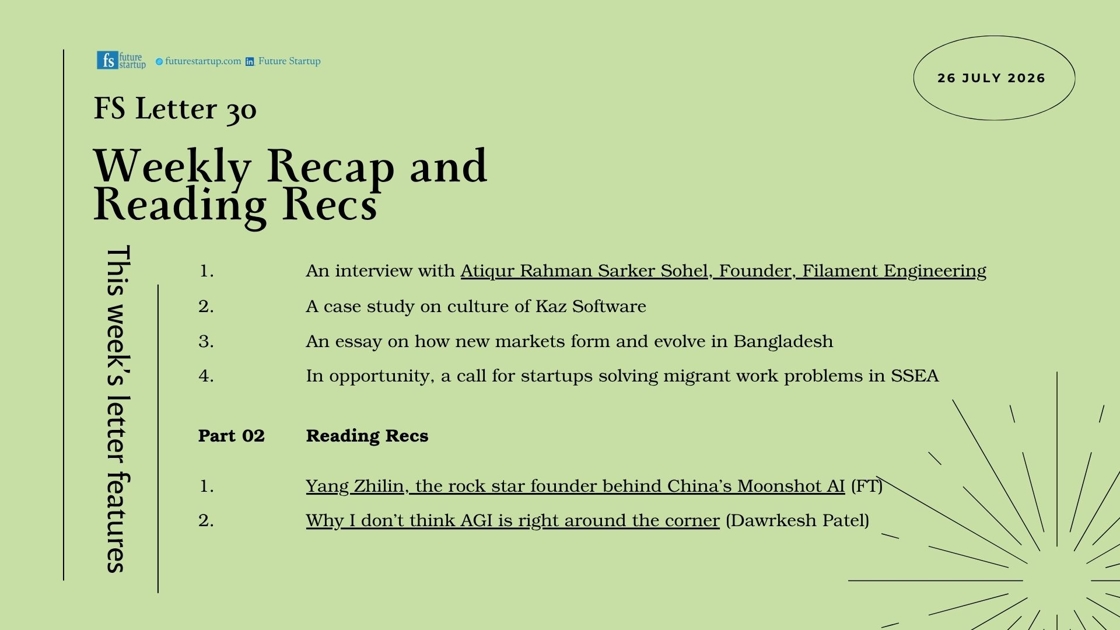
After a long time, we somewhat feel satisfied with this week’s newsletter. After a long break, we are back with a new long-form interview under our Art of Enterprise series. We have published three fascinating original stories, including one case study on organization design. In addition to that, we have brought back reading recs after a long time. The segment features two excellent pieces on AI. To give you a preview, today’s episode features:
Enjoy!
Atiqur Rahman Sarker Sohel is the founder and Managing Director of Filament Engineering Ltd (Muspana), a diversified conglomerate with business across solar, electronics products, and electrical infrastructure. We covered the company first around 2017; at the time, it was a small manufacturing company working in solar and related electronics products. It has since grown meaningfully to become the country's only manufacturer of round conical electric poles, a pioneer in intelligent street lighting, and one of the top two or three names in public sector solar, and a diversified conglomerate with businesses across manufacturing, import, and public sector work.
In this interview, you will learn:
Happy building. Enjoy!
“Walk into any room at Kaz Software's Dhaka office, and you won't be able to see what's on an employee's monitor.
This isn't an accident of furniture or office design. It has been since Kaz’s first year.
Wahid Choudhury, the founder, describes his own desk as an example: a wall sits behind him, and the only way to approach him is from the front. No one can walk up behind his chair and glance at his screen on the way past.
Every workstation in the Kaz head office in Dhaka is arranged the same way. It is, by his account, one of the oldest deliberate decisions in the company's history, older than most of the policies Kaz has, in a company that famously tries to have as few written policies as possible.
The reasoning in Wahid's words: "We wanted to communicate that we don't care what you are doing on your screen at this moment, you are on Facebook, watching videos, or coding. Because in the end, we have a trusting relationship, and we have trust that you will deliver the task. We have built this trust into our culture from day one."
This is a strange decision, and worth sitting with before moving to what it produced.”
“Markets in Bangladesh rarely develop the way economists expect.
In many policy discussions around business and entrepreneurship, we hear that we could develop a policy regime, and it would deliver us a new sector. A kind of attempt at engineering new industries. We would claim this is infeasible. We could find examples of this happening in many markets where policymakers decided to aim for a certain outcome and designed a policy guideline to get there. However, in Bangladesh, there are not many examples of this. The examples of coordinated industrial policy or government pilot scaling into an industry remain few and far between.
Instead, we see that most new markets follow a messy trajectory. A practical solution meets a genuine need, ordinary people adopt it without encouragement, and scale accumulates informally.
Often, these developments happen outside registration systems, beyond formal financing, in regulatory grey zones tolerated because enforcement capacity is thin and the activity is too useful to suppress. To put it differently, entrepreneurial drives of people usually discover and make new markets happen.”
Cross-Border Jobs Startup Competition for South and Southeast Asia, a collaborative initiative by BFA Global, Owl Ventures, Kalibrr, the Global Migrant Workers Network, and Labor Mobility Partnerships (LaMP), is a startup competition looking for the next generation of startups ready to fix the broken labor mobility market in SSEA.
The organizers are looking for startups building ethical platforms and services that make it safer, fairer, and more scalable for workers to move, connect, and work across borders—whether you're a pre-revenue MVP or a startup already scaling.
Applications close August 5.
Moonshot AI has taken over the internet with the launch of its new K3 model. A new Financial Times profile offers an interesting insight into what the company got right. Here is a quite revealing paragraph:
“Wang Tiezhen, an independent consultant and engineer, said Yang’s status as a “leading AI researcher” has enabled him to “build a team of talented engineers all working towards the same goal”. Before founding Moonshot, he was known for research extending models’ context windows, allowing chatbots to retain more information over long conversations.
China’s AI race has been a battle for talent, with deep-pocketed tech groups aggressively poaching from smaller start-ups. Throughout this, Yang has kept one of China’s strongest research teams together. Many of Moonshot’s founding researchers studied alongside him either at Tsinghua University, where he graduated top of his computer science class, or at Carnegie Mellon University, where he completed his PhD. During his CMU years, Yang had stints at Google Brain and Meta.
That cohesion has distinguished Moonshot from Chinese AI groups including Alibaba and Baidu, which have seen prominent researchers depart amid disagreements over balancing frontier research with commercial demands.
Moonshot’s decision to pivot to open source reinforced that advantage. Researchers are attracted by the opportunity to publish papers and receive individual recognition. “Researchers want to be remembered for breakthroughs,” Wang said. “Open source gives them that.””
Dwarkesh Patel is considered, right so, one of the most influential AI insiders. His old piece on AGI from 2025 offers an interesting insight into how to look at the AI acceleration. The following intro paragraph gives an entry point. The entire essay is worth reading.
“Sometimes people say that even if all AI progress totally stopped, the systems of today would still be far more economically transformative than the internet. I disagree. I think the LLMs of today are magical. But the reason that the Fortune 500 aren’t using them to transform their workflows isn’t because the management is too stodgy. Rather, I think it’s genuinely hard to get normal humanlike labor out of LLMs. And this has to do with some fundamental capabilities these models lack.
I like to think I’m “AI forward” here at the Dwarkesh Podcast. I’ve probably spent over a hundred hours trying to build little LLM tools for my post production setup. And the experience of trying to get them to be useful has extended my timelines. I’ll try to get the LLMs to rewrite autogenerated transcripts for readability the way a human would. Or I’ll try to get them to identify clips from the transcript to tweet out. Sometimes I’ll try to get them to co-write an essay with me, passage by passage. These are simple, self contained, short horizon, language in-language out tasks - the kinds of assignments that should be dead center in the LLMs’ repertoire. And they're 5/10 at them. Don’t get me wrong, that’s impressive.
But the fundamental problem is that LLMs don’t get better over time the way a human would. The lack of continual learning is a huge huge problem. The LLM baseline at many tasks might be higher than an average human's. But there’s no way to give a model high level feedback. You’re stuck with the abilities you get out of the box. You can keep messing around with the system prompt. In practice this just doesn’t produce anything even close to the kind of learning and improvement that human employees experience.
The reason humans are so useful is not mainly their raw intelligence. It’s their ability to build up context, interrogate their own failures, and pick up small improvements and efficiencies as they practice a task.”