
South and Southeast Asia are the beating heart of global labor migration. Every year, over 10 million workers from this region pack their bags and cross international borders for work. From the construction sites of the Middle East to the nursing homes of Japan and the factories of Malaysia and many OECD countries, the muscle and talent of this region powers a large part of the global economy.
The money that flows back in the form of remittances plays a critical role in these economies. Remittances to South Asia, a region that includes Bangladesh, India, Nepal, and Pakistan, were projected to hit a record $189 billion in 2025, with Bangladesh's own share at roughly $32.8 billion. Southeast Asian economies like the Philippines and Vietnam lean just as heavily on remittances sent home by their own overseas workforces.
Despite this contribution, the systems and business models supporting these workers haven't kept up. While the demand for cross-border labor is surging, the infrastructure connecting workers to safe, dignified jobs remains stuck in a different era. Migration across South and Southeast Asia today is often a painful and dangerous journey. Exorbitant recruitment fees, opaque contracts, wage theft, and a complete lack of post-arrival support plague the sector. Formal, safe pathways remain the exception, not the norm.
For founders, this isn't just a problem; it's also a massive, meaningful opportunity.
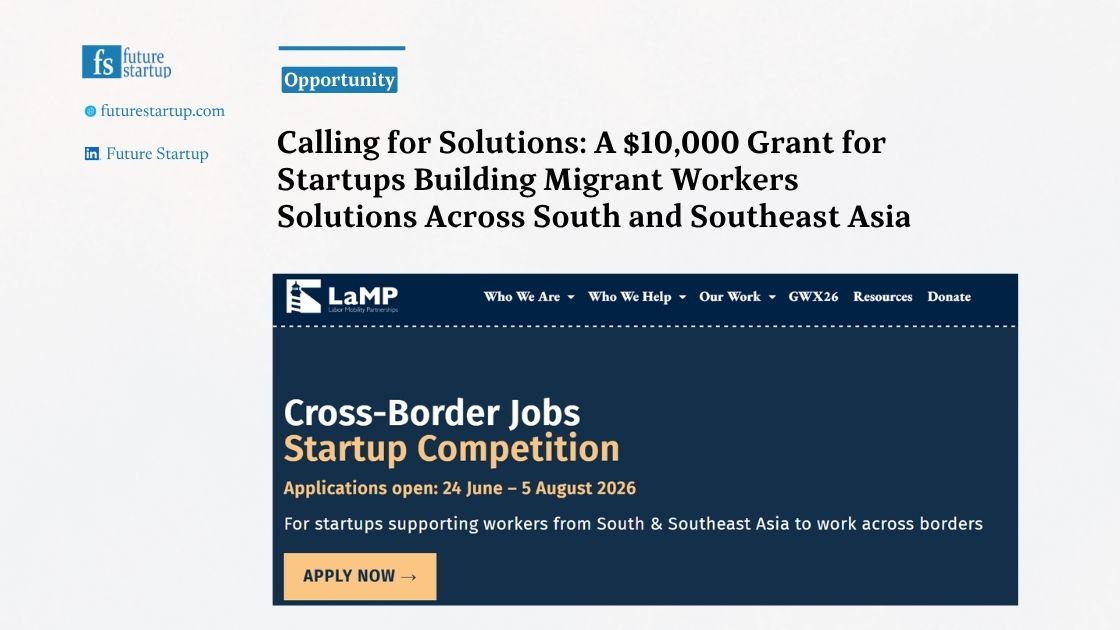
Enter the Cross-Border Jobs Startup Competition for South and Southeast Asia, a collaborative initiative by BFA Global, Owl Ventures, Kalibrr, the Global Migrant Workers Network, and Labor Mobility Partnerships (LaMP). The competition is scouring the region for the next generation of startups ready to fix the broken labor mobility market.
The organizers are looking for startups building ethical platforms and services that make it safer, fairer, and more scalable for workers to move, connect, and work across borders—whether you're a pre-revenue MVP or a startup already scaling.
Applications close August 5.
Three winning startups will each receive a $10,000 cash grant, along with mentorship from sector experts including Amit Patel (Owl Ventures), Prerna Choudhury (LaMP), and Paul Rivera (Kalibrr), visibility across the partner ecosystem, and access to a growing network of founders, investors, and practitioners in labor mobility.
The competition is open to startups working across three areas:
You are eligible if you are a registered startup/business offering cross-border labor mobility solutions for workers from any country in South or Southeast Asia. You can be at any stage, from idea to MVP or beyond — some traction helps, but early-stage status shouldn't hold you back. The judges are looking for responsible, ethical solutions with some evidence of traction and strong execution potential.
Applications close on August 5. Shortlisting happens by the end of August, with final pitches in September and winners announced in early October.
The entire competition will take place online, so applying from Dhaka carries no geographic disadvantage against applicants from Manila or Jakarta.
Roughly one in three international migrants worldwide comes from Asia and the Pacific. According to the IOM, close to 24 million people from the region are engaged in labor migration at any given time. The Philippines alone sent out an estimated 2.3 million overseas workers in 2023.
It is one of the largest structured movements of people on the planet. And, as we noted above, the remittances that flow back from it are a load-bearing wall in every one of these economies.
On the receiving end, aging OECD economies face acute shortages of talent in construction, hospitality, healthcare, and manufacturing. The talent and the demand both exist. However, the infrastructure connecting them remains fragmented, costly, and underinvested. Despite the scale of the benefit, the system that moves these workers abroad has barely changed in decades.
A worker anywhere from Manikganj to Mindanao to East Java still pays a recruiting agent a fee that can run to a year's wages, often on borrowed money, often against a contract he cannot read and will not see honored. Passports get held. Job descriptions get swapped after arrival. The person who took the biggest risk in the transaction has the least protection in it. The pattern repeats, almost identically, across every sending country in the region.
As we’ve noted above, migration has real upsides. A worker moving from a low-income to a high-income country can see a four-to-tenfold jump in income within a year. And the fear that emigration hollows out a country's skilled workforce doesn't hold up consistently. For instance, between 2000 and 2006, three nurses stayed in the Philippines for every one who left to work overseas, because higher wages abroad pulled more people into nursing training at home. Migration that works tends to grow the total talent pool, not shrink it.
Labor mobility, done right, has the potential to become a $25 billion-plus industry. LaMP's stated mission, per its website, is to help half a billion workers move across borders by 2050, reducing poverty and addressing the demographic shortages reshaping OECD labor markets.
This competition, the second LaMP has run, after a first edition in Africa, is a bet that the fastest way to build that infrastructure is to find the founders already building it and put capital, mentorship, and visibility behind them.
That's a meaningful opening for founders in this region passionate about building in the space.
Full details are on the competition page.
Future Startup covers Bangladesh's entrepreneurship and business ecosystem. If you're building in labor mobility, migrant fintech, or workforce development, we'd like to hear your story. Reach out at [email protected] or fill out this form.