
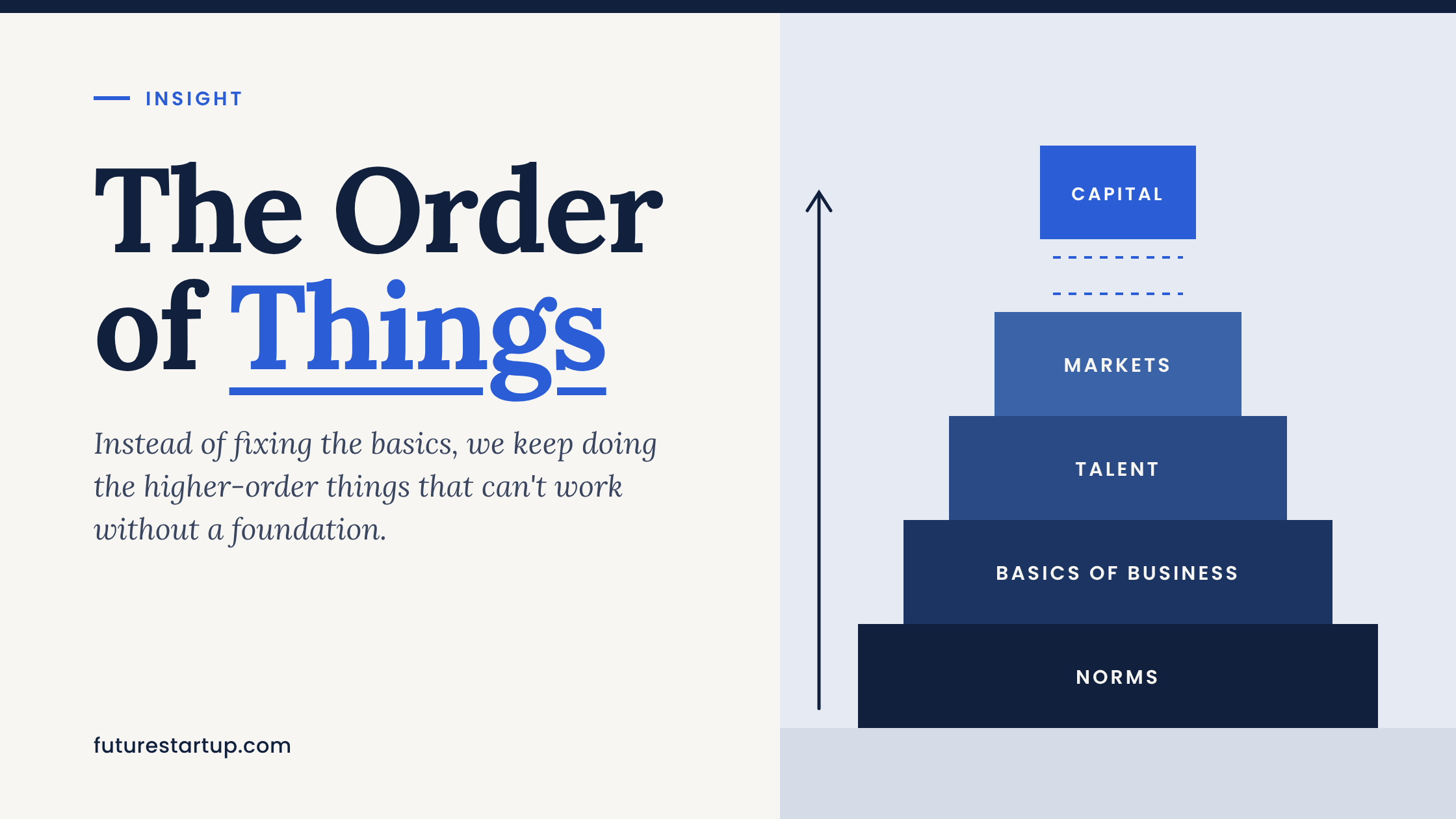
There is an old idea called the order of things. Some people call it the right order of things. The idea is simple. Everything follows a sequence. If you want to achieve anything, you have to follow that sequence.
Think about how a child learns to walk. She first learns to hold her head. Then she learns to roll over. Then she sits, then crawls, then stands holding on to something, and only then takes her first wobbly steps. No child skips crawling to run. There are exceptions, of course. Some children skip a stage or two. But broadly, the pattern holds.
The same is true for all kinds of learning. You learn the number chart before you learn multiplication. You learn algebra before you learn calculus. If you want to learn machine learning today, you can't start with machine learning. You have to start somewhere else. You need linear algebra, probability, statistics, and some programming. These are prerequisites. You can watch a hundred videos on neural networks, but without the foundation, nothing sticks. You end up knowing the vocabulary without the understanding.
I have been thinking about this idea for a while in the context of Bangladesh's entrepreneurship ecosystem, about which I have written a fair bit over the years. I think it explains a lot about why, after fifteen years of trying, we have less to show than we should.
Building a vibrant entrepreneurship ecosystem is no different. There is an order of things. You have to get certain things right first before you get to the things you can call the next steps. It is like learning to walk or learning math. Number chart first. Calculus later.
This is also why innovation policy, and ideas like genius clusters and cluster policy, have been so popular over the years. At heart, they are attempts to understand the order in which places like Silicon Valley, Bangalore, or Shenzhen came together, and whether that order can be repeated elsewhere.
So what does this order look like for us, and what sits at the bottom? As far as I understand, it looks something like this.
At the very bottom sits normative reality. How does a society see business and the people who do it? Does it reward performance? Does it forgive failure? Does it trust strangers? Valentina Assenova's study of 192 countries found that the strongest predictors of entrepreneurial activity are normative. In other words, how a society thinks about business predicts how many companies it starts better than the usual suspects, such as R&D budgets, education, or capital.
Normative reality also lives in policy. Is the policy landscape open? Does it favor the incumbent, or does it offer a level playing field to anyone with an idea and the will to work on it? Does it start from an intention to regulate and control, or from an intention to enable citizens to do more and reach their full potential?
The same question applies to our wealthy. Do local conglomerates and wealthy individuals invest in businesses and people outside their own networks? Mostly, they don't. Capital stays within the family, the group, the school, the circle. It is hard to imagine the Renaissance without the Medici, who backed artists, architects, and thinkers who were not family and not guaranteed to deliver. Every vibrant ecosystem has its version of this: people with money who are willing to bet on strangers. Without it, talent outside the right circles never gets its first chance, and the long tail never forms.
Above that sit the basics of doing business. Can you register a company cheaply and quickly? Can you get a licence without knowing someone or paying someone? Are contracts enforceable? Are the rules stable from one year to the next?
Then comes talent formation. Do young people get to work in world-class organizations early in their careers? Do they see what excellent execution looks like before they try to build something of their own?
Then comes market access. Can a company that wins at home expand easily to the next market? Can money move across borders without months of paperwork?
Only after these come the things we love to talk about: money. Venture capital. Funds of funds. Accelerators. Innovation hubs. Startup competitions. Exits.
The upper layers are real and important. But they rest on the lower ones. Capital flows to places where there are good companies to invest in. Good companies come from a long tail of experiments. A long tail of experiments needs a society where starting a company is cheap, normal, and not shameful when it fails. Take away the bottom, and the top has nothing to stand on.
The problem with the order of things is that the world has hierarchy. Certain things are more prestigious than others. Certain things are more profitable than others. And these things usually sit at the top of an order. To reach them, you have to go through the prerequisites first.
We don't always like that. We get impatient. We want to get ahead. We get lured by the shine of the higher-order things. A ribbon-cutting at a new innovation hub makes a better photo than a quietly revised fee schedule at a city corporation office. A Tk 425 crore fund makes a better headline than making trade licence renewal a ten-minute online task. It is easier for a minister to announce a startup summit than a reform of the Companies Act that few people outside the legal profession will notice.
This is human. I feel the pull myself. But it doesn't work. In most domains, you can't break the order of things. It is like physics. The only path is through. You have to grind through the bottom layers to get to the top. A child who is pushed to walk before her legs are ready doesn't walk sooner. She falls.
Yet we keep trying to break it. I think our entrepreneurship landscape in Bangladesh suffers from exactly this. Instead of fixing the basics, we keep doing the higher-order things that can't work without a foundation.
Let me be specific about some of the bottom layers we have yet to fix.
Doing business is still hard and expensive. Even with online portals in place, renewing a trade licence in Dhaka still takes at least two days in practice. It is still very hard to get many licences without paying ঘুষ. Everyone who has run a business here knows this, and almost nobody says it in public. When FS looked at this in 2018, the initial steps to start a business took around 19 days, and that was before you did any actual business. A BUILD study cited in TBS found that starting a manufacturing business needs around 23 different licences. Trade licence fees are high. Incorporation is costly. Most steps are still not fully digital. These are not small inconveniences. They are filters. They screen out exactly the first-time, resource-constrained founder that every successful ecosystem depends on.
Policy leans toward control, and toward the incumbent. Many of our rules start from the assumption that a new business is a risk to contain, not an opportunity to enable. Rules also change with little warning, and the change often favors those already in the market. Take a recent example. In late 2025, a draft amendment to the Travel Agency Act proposed 100 percent Bangladeshi ownership of travel agencies, a clause industry sources linked to lobbying by traditional agencies. The fraud cases the ministry wanted to address had involved fully local firms. Foreign-backed platforms such as GoZayaan and ShareTrip, which had brought in more than $20 million of foreign investment, would have been put in a difficult position. A founder watching this learns a simple lesson. Even if you play by today's rules, tomorrow's may be written by your competitors.
The culture makes starting companies hard. We are not a meritocratic society. Ours is a culture of Mama and Khala. Your background, your family, your closeness to power, and your group shape your access to opportunity far more than your ability does. We are a low-trust society. People help people from their own school, their own village, their own class. Failure carries a heavy social and financial cost, and there is no safety net to fall back on. The result is that not enough people start companies. And startups are a long-tail game. If 100 companies start, one or two become significant. If 1,000 start, you get many more. Without the long tail, it is hard to find good companies. Investors then say there are not enough good companies to invest in. In a narrow sense, they are right. But the shortage is a symptom, and its cause sits much further down the order.
There is no real local venture capital ecosystem. We usually think of capital as an upper-layer problem, and in most ways it is. But in our case, its absence starts at the bottom. In healthy ecosystems, the first money a startup raises is usually local: angels, successful founders, small early-stage funds, a corporate venture arm. That money is small, but it does a lot of work. It lets ideas get tested before international investors start paying attention. In Bangladesh, this layer is thin. Partly, this is the norm we discussed earlier, where capital stays within the family and the circle. Partly, it is policy, which offers little reason to back a stranger's company. And partly, it is history. We have had very few local exits, so few founders have turned into angels, and few people have seen a startup investment pay back. Without this layer, a startup depends on international capital, which comes and goes with global cycles. When the cycle turned after 2021, we had no local cushion to fall back on.
We don't have enough multinationals. In Bangalore, Jakarta, Ho Chi Minh City, and Kuala Lumpur, a bright graduate can join Google, McKinsey, or Accenture. She learns how world-class organizations work. She builds a network that crosses borders. When she leaves to start a company, she takes those standards and those relationships with her. In Dhaka, this pipeline barely exists. Profit repatriation rules, opaque licensing, and policy uncertainty have kept most global companies at arm's length. So our talent rarely gets to learn from the best or build those networks early. When people complain about the quality of founders and operators in Dhaka, this is a big part of the reason. You can't fault people for not knowing what they have never been exposed to.
We are a small, closed market. Bangladesh has 170 million people. That sounds big. But adjusted for internet use, purchasing power, and payments, the addressable digital market for most categories is much smaller. And it is closed. The moment a company crosses the border, it faces a different set of rules, currencies, and frictions. SAARC has been largely dormant for years. International VCs organize by region, and Bangladesh falls between India and Southeast Asia, so most of them have no mandate to invest here at all. A small market needs easy access to other markets to expand its opportunities. We don't have that yet.
These are only some of the problems. There are others, and some of them may matter more: an education system that fails to produce the talent we need, weak rule of law, unreliable infrastructure, an unpredictable political economy. I don't claim this list is complete or ranked. The point stays the same. There are things at the bottom of the order that we have not done, and we have to do them.
None of these problems is new. We have been writing about most of them at Future Startup for more than a decade. What is striking is how little they figure in our ecosystem conversations compared to funds and programs.
We don't need theory to see what happens when we skip the order. Our own recent record shows it quite clearly.
In 2021, Bangladesh Bank asked banks to set aside 1 percent of their annual net profit for startup investment. On paper, this created a pool of more than Tk 100 crore. In practice, less than Tk 5 crore was ever deployed. The mandate existed. The institutional machinery to invest it did not. Commercial banks are built to manage credit risk, not to take equity positions in early-stage companies.
This year, the same mandated money moved into a new vehicle, BSIC, with a Tk 425 crore first fund. It is a better structure, and I hope it works. But capital was never the only missing piece. Even a well-run fund needs a steady supply of good companies to invest in. It needs a way to exit. BSIC plans to start exiting from 2029, through DSE listings or direct stake sales, and our capital market has never absorbed a startup-stage technology company at a reasonable valuation. A fund sitting on top of a missing foundation is still sitting on a missing foundation.
Look at local capital, the thin layer I described earlier. The numbers show how thin. Local investors put roughly $19 million into Bangladeshi startups in 2023. In 2024, that fell to $1.1 million, a 95 percent drop. Seventeen SEC-licensed alternative investment fund managers exist. Most have not raised meaningful money.
Look at exits. Every major startup acquisition in Bangladesh over the last decade, Daraz, Foodpanda, and now Bikroy, involved a company that was not built by Bangladeshi founders. These were global operators buying other global operators' assets in a market that happens to be ours. Locally founded companies rarely get that far, partly because they were never built to be legible to a global buyer, and partly because the people who would buy them don't know they exist. That second problem goes straight back to the missing multinationals and the closed market.
There is a pattern in all of this, and it is worth slowing down for, because it is the heart of the problem. When policymakers see a gap, the instinct is to fill it directly, and the tool they reach for is almost always money. We have already seen two examples: the bank mandate and BSIC. Add Startup Bangladesh, the government's own venture capital firm, and the ICT Division's donor-funded entrepreneurship programs. Each of these sits on a higher layer. Each is easier to announce than the lower-order reform it skips. And each disappoints for the same reason: it is placed on a layer that hasn't been built yet.
Put simply, money has become a substitute for policy. What we have not seen is policy used to mobilize capital. There has been hardly any creative effort to build an active private venture capital industry, to encourage corporate venture capital, to make angel investing attractive, or to help local accelerators and incubators come up and survive on their own. Money is the easiest lever to pull. It is also the weakest. A fund deploys its corpus and stops. A good incentive keeps working, year after year, through thousands of private decisions.
The tools are not exotic. A simple tax incentive structure, such as deductions for angel investments in early-stage companies, tax pass-through for venture funds, and lower tax on gains from startup equity held for a few years, could do a lot. So could ease of doing things: registering a fund without months of back and forth, issuing and transferring shares without friction, setting up an ESOP or a convertible note without a lawyer inventing it from scratch. Make it easy and rewarding for private capital to take part, and corporates, family offices, and successful founders will start funds, back startups, and run programs themselves. That is how a capital layer is built. A government fund can't substitute for it.
You can argue that these are chicken-and-egg problems. Capital needs good companies, and good companies need capital. Exits need investors, and investors need exits. So, the argument goes, you can't do them in sequence. You have to play the chicken-and-egg game and push on everything at once, starting wherever is easiest.
I don't think that is true, at least not in the way it is usually argued. Some layers do move together. Once good companies and capital both exist, they feed each other. But that loop can only start when the layer beneath it is in place. In that sense, the order is still clear.
A fund can't conjure good companies into existence. A society where starting a company is cheap, normal, and forgivable can. Remove the bribe from the licence and make incorporation cheap and digital, and more people try. More people trying means a longer tail. A longer tail means more companies worth backing. Companies worth backing attract capital. Capital that earns returns attracts more capital. The arrows point one way. The reverse doesn't work. You can put Tk 100 crore on the table, and if the bottom layers are missing, most of it simply sits there, as we have already seen.
I understand why the chicken-and-egg framing is popular. It is comfortable. It lets us skip the slow, unglamorous work and still feel strategic. But in doing so, it turns a sequencing problem into an excuse.
Nor does it mean you must finish one layer completely before touching the next. Nobody masters arithmetic perfectly before starting algebra. At best, you can work on a few things at once, with most of your effort going to the layer you are on and some going to the layer just above. What you can't do is ignore the basics completely and spend all your time on the shiny problems. That is where we are today.
In many areas, I think our policymakers do think about the order of things. Nobody builds the upper floors of a building before the foundation. Nobody plans a deep-sea port without thinking about the roads and rail that will carry goods out of it. Our garment industry is a good example. Bonded warehouses and back-to-back letters of credit, introduced in the early 1980s, came before the export boom and made it possible.
Unfortunately, I don't feel that is the case when it comes to entrepreneurship. Here, we start from the top. We announce funds before fixing licences. We build hubs before fixing the cost of failure. We talk about unicorns before we have a long tail.
Part of the reason, I think, is that our policymaking in this area has been largely intuitive. We act on a feeling about what an ecosystem needs (a fund, a hub, a competition) rather than on evidence about how ecosystems actually form. Countries that have built strong ecosystems spent meaningful time and effort studying that question before designing policy. That is exactly what the long work on clusters is about. I have argued before that we should study our own successful clusters, such as RMG and pharmaceuticals, and founders who built companies like Square, Beximco, Akij, and PRAN, to understand what helped them succeed. Policy built on that kind of study is far more likely to respect the order of things.
Following the order would look less exciting, and it would work better. Roughly, it means:
None of this is glamorous. It won't fit neatly into a press event. Much of it is not even "startup policy". And that is the last point I want to make, because it is easy to miss. Startups don't operate in a vacuum. They operate within an economy and a society. Yet much of our startup policy discussion presumes they sit somewhere outside the economy and can be fixed on their own terms, with a fund here and a program there. Some problems are indeed specific to startups and to particular sectors. But a large part of the predicament comes from the particular way our policy thinking works. The startup ecosystem can't be fixed from inside the startup ecosystem.
We see the same thinking elsewhere. In solar energy, we announce ambitious targets and showpiece projects, while the rules that would let thousands of rooftops and private developers take part remain slow and complicated. In citizen service delivery, we launch portals and apps, while the process behind them still needs a visit, a signature, and too often a payment. The pattern is familiar: start from the top, spend rather than enable, and leave the foundation for later. Entrepreneurship is just one place where it shows. If we want a different result for startups, we have to pay attention to how we make policy itself.
Other countries show what the other path looks like. Vietnam had starting points similar to ours in the early 2010s. Fifteen years of consistent work on liberalization, regional integration, and the legal basics later, it has four locally founded unicorns and more than 200 startup acquisitions. We have had the same fifteen years. The difference is not effort. Many good people have worked very hard on this. The difference is that much of our effort went to the wrong layer.
The child doesn't walk because we buy her better shoes. She walks because she crawled first. We can keep buying shoes. Or we can go back and do the crawling. The only path is through.
Further reading from Future Startup