
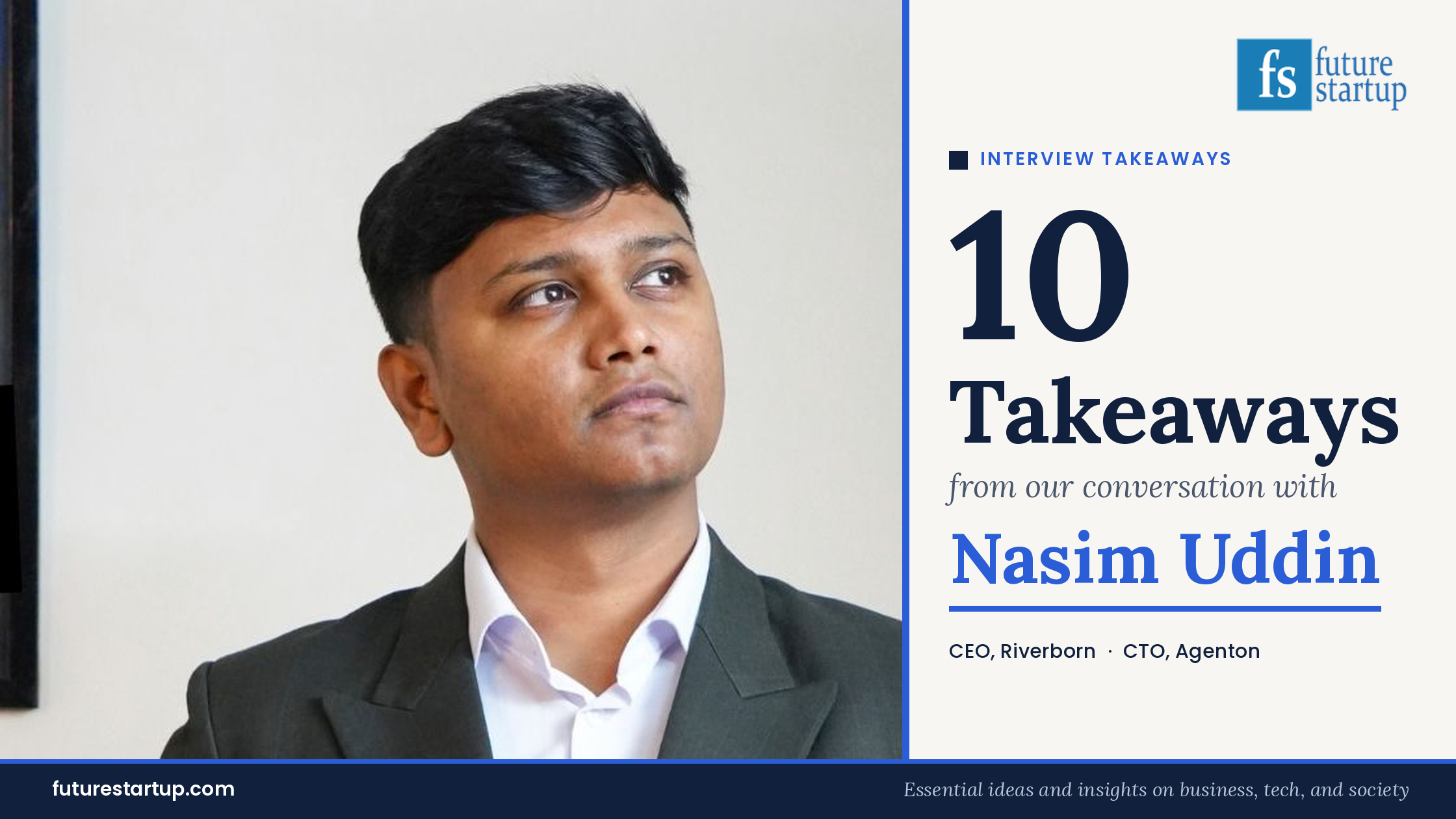
Last week, we published a long-form interview with Nasim Uddin, co-founder and CEO of Riverborn, a Dhaka-based AI solutions company that builds production-grade AI systems for clients across the US, Canada, and Europe. He is also co-founder and CTO of Agenton, a Finland-based AI voice company serving the automotive industry.
The interview has drawn a lot of attention online, for good reasons.
Nasim has taken an unconventional path into entrepreneurship. He grew up in a village in Sirajganj without electricity at home until Class 10, taught himself software engineering, skipped university, and got his first international job through a Twitter DM. His journey to date includes a failed startup, a return to employment, years of experimentation, and a gradual discovery of what his team does best.
Riverborn, the company he leads today, started as Connekt Studio, an experimental product studio run by friends and cousins from Bogura and Sirajganj. It is now profitable and eyeing expansion. Riverborn's evolution into an AI solutions company offers a useful look at how a young technology company can find its footing.
Our conversation with Nasim runs over an hour and goes beyond technology and business strategy. It covers where his ambition comes from, how he taught himself software engineering, and the Twitter DM that changed his path. We talk about curiosity, self-directed learning, ambition, finding the right environment, and the difficult process of figuring out what kind of company to build. It is a fascinating read in its entirety.
Following our tradition of a post-interview debrief, we pulled together the key takeaways. You can read the full conversation here.
Here are ten takeaways from our conversation with Nasim Uddin.
Nasim grew up in circumstances that offered few obvious paths into the global technology industry (read the interview to learn more). But he was a curious kid. He spent his childhood taking toys apart, experimenting with batteries and electronic components, and trying to build small devices. In school, he was an active participant in science fairs and competitions. In one of those fairs, he encountered a phone-controlled robot built by a fellow student, which introduced him to programming and a new way to build things. That curiosity eventually led him to software engineering and entrepreneurship.
We all hear about the incredible power of following our curiosity and how it becomes valuable when you follow it. Nasim did not simply find technology interesting. He kept investigating, learning, experimenting, and looking for ways to go further.
For young people who lack access to conventional opportunities, this is a useful place to begin. You may not control your starting point, but you can decide what to do with the opportunities and information available to you.
Nasim's curiosity was personal, but exposure helped it grow into something more consequential.
Attending a better-resourced school introduced him to science fairs, competitions, and students working on projects he had never imagined. He encountered new ideas through books, blogs, YouTube, and online communities. Teachers helped him participate in competitions and provided support that his family could not always afford.
In Class Nine, Nasim saw another student demonstrate a robot controlled by a phone. Until then, he had mostly worked with manually wired electronic components. The idea that software could control hardware opened up an entirely new possibility.
This is one of the understated roles of education. Beyond textbooks and examinations, good educational environments expose people to ideas, people, and possibilities they might never encounter otherwise.
Nasim's story also shows that exposure does not have to come exclusively from elite institutions. A supportive school, a science fair, a book, or an online community can change the direction of someone's life.
This further proves our core thesis at Future Startup that exposure has power. When you grow up in environments with limited opportunities, it also limits your imagination of what is possible. For many incredibly talented people, this is the major bottleneck. They can’t imagine beyond what they have already seen. Exposure helps to expand our world. We come to realize a better world is possible.
Nasim decided not to attend university after completing his higher secondary education. He wanted to become an entrepreneur, and he believed that learning software engineering, getting a job, and accumulating capital would be a more direct route toward that goal.
He approached learning with unusual discipline. Rather than following a formal computer science curriculum, he studied job descriptions, identified the skills employers expected, and built his own learning plan. He practiced programming, learned practical tools, and applied for jobs while his friends prepared for university admission tests. Eventually, he joined Graaho Technology and then secured a remote software engineering position with a Canadian company.
Nasim acknowledges that his path involved luck and that he might make a more informed decision if he were starting today. His experience is not an argument against university. It illustrates what can happen when learning connects to a specific objective and is supported by sustained effort.
One broader lesson is to work backward from the outcome you want. Identify the skills required, find ways to acquire them, and test your progress against real-world standards.
Nasim's early career offers an example of how online communities can create professional opportunities.
While learning to code, he joined the freeCodeCamp community and participated in the #100DaysOfCode challenge on Twitter. He posted updates about his learning, interacted with other programmers, and gradually built connections with people in the international technology community.
One of those connections changed his career. Nasim followed a Canadian programmer who had succeeded without a computer science degree. When the programmer posted that he was looking for someone to help with paid tasks, Nasim expressed interest. They worked together on a small project, developed a relationship, and eventually began working together more closely.
Within months, Nasim had moved from a local software job to a remote position paying substantially more.
He describes the outcome partly as luck. But luck had something to work with. He was learning, sharing his progress, building a portfolio, and participating in a community where opportunities could emerge.
The internet is more than a place to consume information. Used deliberately, it can help you develop skills, demonstrate your work, build relationships, and access markets that would otherwise remain out of reach.
After working internationally for two years, Nasim left his job to pursue entrepreneurship full-time. He and his team at Connekt Studio built Mullokoto, an e-commerce price-comparison platform. The product attracted users, but they could not establish a sustainable business model or raise funding. Nasim eventually ran out of savings and returned to employment.
The experience forced him to reconsider his approach. He realized that he had built Mullokoto partly because the idea seemed interesting, without asking whether it was something he genuinely wanted to spend years pursuing. He also came to understand that building a product and finding a viable business around it are two different challenges.
Rather than abandoning Connekt Studio, his experimental product studio, he returned to the original idea behind it: experimenting with technology, building things, and seeing what worked. When generative AI began opening up new possibilities, his team started exploring the technology and building products.
Some experiments attracted attention. Others did not go far. But the work helped the team develop new capabilities and attract international clients.
Failure did not automatically produce success. But it helped him make better decisions about what to pursue next.
After Mullokoto, Nasim set himself a rule. He would only work on things that fell into one of two categories: work he enjoyed and got paid for, or work he enjoyed enough to do without pay.
This approach shaped Connekt Studio's experiments with AI. ChatGPT, Stable Diffusion, and Midjourney had just arrived, and they felt like magic to him. His team built Sketch to Image, a tool that turned hand-drawn images into more realistic visual outputs, and Vocalo, an AI-powered English-speaking practice app designed particularly for Bangladeshi users. These experiments gave the team room to explore new technology and create products people could use.
Nasim says the team enjoyed this work much more than its earlier attempts to build products simply because the ideas seemed promising. The important point here is that passion alone is not a business model, and enjoying a project does not guarantee demand. But genuine interest can help sustain the curiosity, persistence, and willingness to learn that difficult technical work requires. For Nasim, it also helped the team discover a field in which its interests and capabilities could translate into commercial opportunities. The rule worked in part because his job covered his living costs and the studio's gap. Money was not the point, and in 2024 the company broke even for the first time.
For years, Nasim wanted to build a product company. His team was almost entirely engineers. They could build and launch products. While Connekt Studio developed its own products, the team repeatedly struggled to take them beyond an initial level of traction. It could build and launch software, but it lacked the marketing and distribution capabilities required to scale those products.
Meanwhile, another pattern emerged. International clients began approaching the team after seeing its experiments and asking it to build similar systems for their businesses.
Nasim recognized a difference between what the company wanted to be and what it could consistently do well. Riverborn's team had developed strong technical capabilities, particularly in building complex AI systems from scratch and making them work in real-world settings. It had a harder time distributing and scaling its own products. The company decided to build its business around that strength.
Today, Riverborn combines client work with its own product experiments. According to Nasim, roughly 70–80% of revenue comes from consulting and client projects, while its own products contribute the remaining 20–30%. The products also serve another purpose: they demonstrate the team's capabilities and help attract consulting clients.
This is a valuable strategic lesson. Founders often become attached to a particular business model or identity. Sometimes the better move is to look honestly at what the team can do well, where customers see value, and how those strengths can support a sustainable business.
Riverborn calls itself an AI solutions company because of what happens after the demo. Nasim says plenty of teams can show an AI tool working on a laptop. Real users then send odd inputs, and the edge cases pile up. A rule-based system is easy to patch with more rules. The real world keeps producing situations nobody wrote a rule for.
The team has shipped more than ten AI products, some with hundreds of thousands of users at the same time. They build on existing models, fine-tune occasionally, and design the architecture and tool access around them.
Nasim also noted where AI leaves the human bottleneck. He can now do far more in the same hours, so his judgment is what limits him. Someone still has to review and vet the work.
Building something that works under controlled conditions is different from building something reliable enough for everyday use. The latter requires testing, iteration, domain knowledge, and an understanding of what happens when things go wrong. As businesses experiment with AI, the ability to move from promising demonstrations to dependable systems is likely to become an important source of value.
Riverborn does not want to operate like a conventional outsourcing firm that receives a list of requirements and simply implements them. The company prefers project-based engagements and works closely with clients to understand the underlying problem.
Nasim describes a project in which Riverborn built an AI assistant for golfers. The team understood AI, but it needed the client's expertise to understand the details of golf and the specific requirements of the product. The technical work was only one part of the challenge. Understanding the domain and designing the right solution required close collaboration.
Riverborn also questions client requests when necessary. If a customer asks for a feature, the team tries to understand why it is needed, whether the timing is right, and whether a better approach exists. It also offers AI readiness audits to help companies assess whether they have the data and operational foundations required for an AI project.
This approach reflects the idea that clients need outcomes, not deliverables. A company that understands the business problem, challenges weak assumptions, and remains involved after launch can become a much more valuable partner than one that only executes instructions.
For several years, Connekt Studio operated remotely, with team members based in Bogura and Sirajganj. The arrangement worked, but Nasim eventually felt it was limiting the company's next stage of growth.
The team struggled to tell its story, build a stronger brand, and collaborate as effectively as it wanted. Nasim also recognized that moving from a team of eight to ten people toward a company of 40, 50, or 100 would require capabilities and processes he had not yet developed.
He began speaking with people who had already navigated similar transitions. He then decided to move the team to Dhaka, closer to Bangladesh's technology community and the people from whom he hoped to learn.
The decision was significant because it required the entire team to relocate. Nasim says transparency helped make it possible. The team understood the company's finances, its direction, and the reasoning behind major decisions. Having worked together from the beginning, its members trusted the process enough to leap with him.
The move reflects an important aspect of entrepreneurship: the skills and environment that help a company reach one stage may not be enough for the next. Growth requires founders to recognize those limits and deliberately seek new people, knowledge, relationships, and ways of working.
Nasim's journey is a reminder that building a company rarely follows a straight line. His path moved from tinkering with electronics in a village to self-directed software learning, international employment, a failed product startup, AI experiments, and eventually a company serving international clients.
As we noted above, several things stand out: the habit of following curiosity, the willingness to learn independently, the ability to recover from failure, and the discipline to change direction when the evidence points elsewhere.
Perhaps the most useful lesson is that building a business involves two parallel tasks. You have to develop the ability to do something valuable, and you have to figure out how to turn that ability into a sustainable business. The first does not automatically solve the second.
Riverborn's evolution shows what can happen when a founder begins to understand both. The company is building on a technical strength it has developed through years of experimentation, while using client work to finance its growth and its continued exploration of AI.
If you are building from Bangladesh, our full conversation with Nasim Uddin is worth your time.