
The best way to learn entrepreneurship is to do it. You get out of the building, get bruised, and learn from the field. You start something, try different approaches, make mistakes, solve problems, and work with people. Slowly, you learn what works and what doesn't. Some lessons come quickly. Some take years. A few you learn only after making the same mistake more than once. Experience remains the best teacher.
The next best way is to learn from people who have done it.
I have written before about tacit knowledge and entrepreneurial success. Many of the most important skills in entrepreneurship are hard to teach through books, courses, or formal instruction. The philosopher Michael Polanyi put it plainly in The Tacit Dimension (1966): "we can know more than we can tell."
I often use the analogy of riding a bicycle. You can read about balance, understand the mechanics, and watch other people ride. You still have to get on the bike yourself. You practice, lose your balance, fall a few times, and keep trying. Then, after some bruising, something changes. You develop an intuitive sense of how to do it. Entrepreneurship works in much the same way.
You can study business, strategy, and management. All of that is useful. A large part of what makes someone good at building businesses, however, comes from experience. It is knowledge acquired through action, observation, and trial and error.
There is another way to get closer to this kind of knowledge. You can study the experiences of people who have already built businesses. You can learn how they found their first customers, gathered resources, recognized opportunities, dealt with uncertainty, made difficult decisions, and built organizations. Their experiences offer something textbooks rarely do: a practical understanding of how things actually work.
Reading about what other people have done cannot give you everything that comes from doing. It can shorten your learning curve. You see how others approached problems, understand why certain decisions worked, and learn from mistakes without having to make every one of them yourself.
This is one of the reasons we have spent so much time interviewing entrepreneurs at Future Startup. Over the years, we have interviewed hundreds of founders and business leaders, documenting their journeys and trying to understand how they build and run their companies.
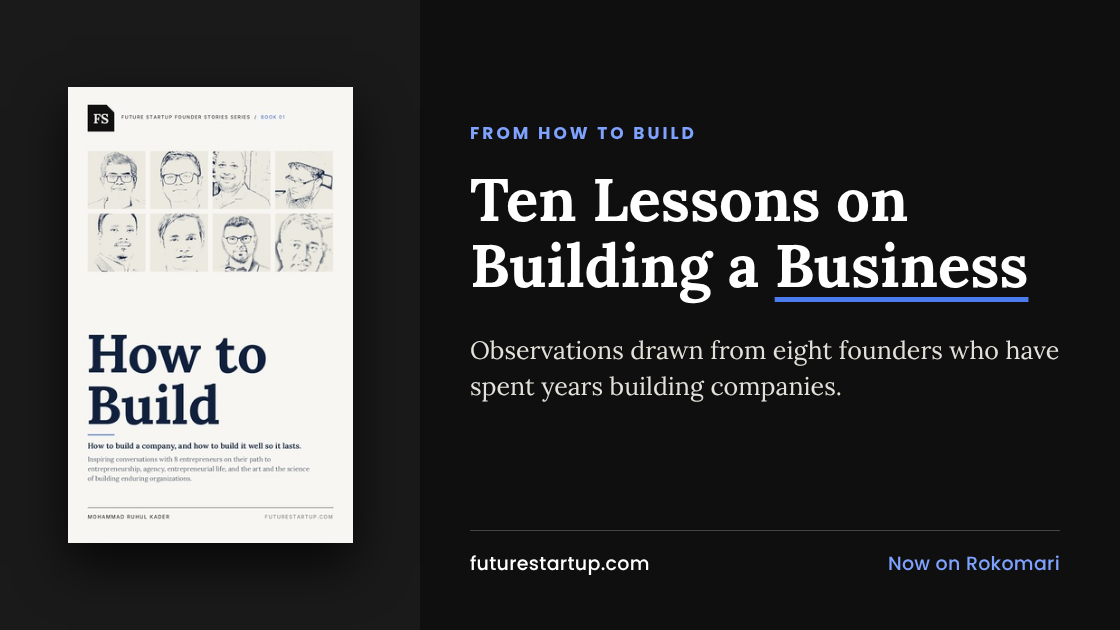
For How to Build, our first interview collection book, we brought together conversations with eight founders. They come from different industries and serve different markets. There is an online job platform, a solar and electrical engineering business, a software product company, two software companies, an electronics retailer, a remote-first software company, and an education group.
These are eight different entrepreneurial journeys. The circumstances, opportunities, and challenges vary a great deal. Yet when you read the stories together, certain patterns keep appearing. Founders who have never met each other often arrive at similar conclusions about trust, customers, people, decisions, and organizations.
I find these recurring patterns particularly interesting. A single story tells us what happened to one founder and one company. Reading across several stories lets us find principles that travel beyond any one company.
We have tried to distill ten such lessons from the book. They are observations drawn from people who have spent years building companies, and each is worth thinking about if you are starting a business, running one, or simply trying to understand how businesses grow. Treat them as prompts for your own thinking. Every business is different, and none of this is a formula.
Here are the ten lessons.
When Mohammad Rashed Ali Bhuiyan started Star Tech, he did not have much money. What he had was a reputation for keeping his commitments.
In the early days, he needed suppliers to give him credit to keep the business running. Suppliers agreed because they knew he would pay them back. As the relationship grew, they trusted him enough to extend credit without a fixed limit.
It is an interesting way to build a business. Rashed did not have substantial financial capital. He had earned the confidence of the people around him, and that confidence let him operate beyond what his money alone would allow.
Trust is an important and often overlooked business asset. It takes time to build. You cannot get it simply by asking for it, and you cannot easily replace it once it is lost. It comes from doing what you say you will do, paying people on time, keeping commitments, and treating business relationships seriously.
For a small business, this can make a considerable difference. A supplier who trusts you may give you more time to pay. A customer who trusts you may give you a second chance. A partner may take a risk on you when the numbers alone do not make the case.
In this sense, trust is a form of capital. It lowers the cost of doing business and opens doors that would otherwise stay closed.
Rashed's journey with Star Tech is a useful account of how this works in practice.
When Mahmudul Hasan Sohag was a student at Dhaka College, he noticed that many teachers discouraged students from asking questions. It affected his own learning. He wanted a different kind of educational institution, one where students could ask questions freely and learn without feeling discouraged.
That personal frustration became the starting point for Udvash.
In December 2000, Sohag and a friend opened the institution with Tk 6,000 and a rented room that cost Tk 800 a month. There was no grand business plan and no large investment. They started with an idea about how education could be different.
There is something worth examining here. Many business ideas come from noticing a problem in the market. Sometimes that problem is one you have lived through yourself. You run into an inconvenience, a poor service, an inefficient process, or an unmet need. You start to wonder why things have to be this way and whether there is a better way to do them.
Personal experience is a useful starting point because you understand the problem from the inside. You know what is frustrating about the existing options, and you already have a rough sense of what a better solution might look like.
Of course, a personal frustration is only a business opportunity if other people share it and enough of them want a solution. Personal experience helps you notice opportunities that might otherwise stay invisible.
Udvash began with something its founder wished existed. Over time, it grew into one of the country's largest education groups.
One of the questions we asked Mahmudul Hasan Sohag was whether he had imagined what Udvash would eventually become when he started it.
His answer was that they had no concrete plan. They had an idea about the kind of institution they wanted to build. They started with that and figured out the rest along the way.
Atiqur Rahman Sarker Sohel's experience with Filament offers another illustration of how businesses evolve.
He started the company in 2010 with his elder brother in a rented room in Mohammadpur. Both kept their full-time jobs while working on the business. Filament first focused on IPS products. Over time, the company moved into CFL bulbs, solar products, electric poles, and intelligent street lighting.
These were significant changes in direction. Each new product category came out of experience, market conditions, and opportunities the founders met along the way.
The company also faced a major setback when floods destroyed much of what Sohel had built. He had to start again. Henry Ford wrote in My Life and Work (1922): "Failure is only the opportunity more intelligently to begin again."
Stories like these tell us something about the nature of entrepreneurship. We often imagine that successful founders begin with a clear picture of what they want to build and then execute the plan. In practice, the journey is rarely so straight.
You start with an idea, take the first few steps, learn about the market, meet customers, run into problems, and discover opportunities. Your understanding changes as you gain experience. Sometimes the original idea needs work. Sometimes you find an entirely different opportunity.
A plan gives you direction. The ability to learn and adjust as circumstances change matters just as much.
When M Asif Rahman was still in college, he sold his first website for about $2,500.
It was an important experience. He discovered that something he had made had commercial value. Someone found it useful enough to pay real money for it.
This is one of the basic lessons of building a business. You may have an interesting idea. You may be able to build an impressive product or a technically sophisticated solution. A business still needs customers who are willing to pay for what you make. Peter Drucker put it in one line in The Practice of Management (1954): "There is only one valid definition of business purpose: to create a customer."
It sounds obvious. It is also easy to forget when you are absorbed in making something. Founders can spend a long time on features, technology, design, and product improvements without really knowing whether customers need what they are building.
A few basic questions bring the focus back to the market. Who has this problem? How are they solving it today? What would make them choose your product or service? How much would they pay for it?
The answers are rarely available right away. You have to talk to customers, test different approaches, and change your offering. Getting closer to customers is one of the most important activities in building a business.
Asif's experience is a useful reminder that the commercial side of entrepreneurship deserves as much attention as the creative and technical sides.
Fahim Mashroor knew from the beginning that BDjobs would take time to establish. He expected regular challenges for the first two to three years and prepared himself for that.
Udvash took eight years to break even. Todoist took more than a decade to become the established product company that Amir Salihefendic describes today.
These companies have very different business models, markets, and operating conditions. Their stories share one quality. Their founders were prepared to stay with the work for a long time.
This is worth thinking about because our idea of business success is often shaped by what we can see. We see established companies, large customer bases, strong revenues, and successful founders. We rarely see the years of uncertainty, small beginnings, financial strain, and repeated attempts that came first.
Building a company is a long process. It takes time to understand customers, earn a reputation, develop a product, build a team, and create an organization that can run sustainably. Working harder or spending more money cannot always speed these things up.
Patience, then, is an active discipline. It means understanding the time required to build something and making decisions that keep the business alive long enough to get there.
A founder has to manage resources carefully, develop a realistic view of the market, and avoid decisions that assume immediate success. The business must be able to keep going through the years when progress is slow and the future is unclear.
Fahim's experience with BDjobs offers useful insight into this side of entrepreneurship.
In its early years, Udvash made an educational choice that was not always popular with parents.
Many coaching centers gave students notes, suggestions, and ready-made answers. Udvash chose a different path. It wanted students to understand their subjects and learn to solve problems on their own.
This created some difficulties. Parents who wanted ready-made notes sometimes preferred other institutions. Udvash lost students because of its approach.
Sohag believed the purpose of education was to build a student's capacity to think and learn. Notes could help students prepare for exams. They could not replace understanding.
The institution kept its approach and gradually attracted students and parents who valued that philosophy.
There is a broader lesson here about building organizations. Every business has to choose what it offers, how it serves customers, and what standards it keeps. These choices are rarely easy. Sometimes customers ask for things that conflict with what the business believes is the right way to serve them.
Listening to customers matters. Building a good business also takes judgment about which demands to accommodate and which principles to keep.
A company that changes its approach every time someone disagrees will eventually lose its sense of direction. At times you have to accept short-term costs to protect the quality of what you are building.
This is different from stubbornness or a refusal to learn. It means knowing what you stand for, being willing to explain your choices, and having the conviction to continue when you believe you are doing the right thing.
Udvash's early years show how a founder's educational philosophy can shape the identity of an institution.
When Brain Station 23 was small, Raisul Kabir was involved in almost everything. He was the CEO, the project manager, and the architect. That worked because the organization was small and the number of decisions was manageable.
As the company grew, the arrangement became harder to sustain.
The company gradually brought in project managers, functional managers, and more specialized roles. Eventually, it built business units with their own profit and loss responsibilities.
Star Tech went through a similar process. In 2022, the company reorganized parts of its operations into three independent units.
These experiences point to an important part of organizational growth. The management structure that works for a small business often stops working for a larger one.
In the early days, founders usually have to do everything themselves. They make sales, manage customers, supervise employees, solve operational problems, and make the big decisions. That is understandable. A small company cannot afford specialists for every function.
As the business expands, the same arrangement becomes a constraint. The founder cannot stay involved in every decision without slowing the organization down. People need clearly defined responsibilities. Managers need the authority to decide. The company needs systems that let its different parts work together.
Organizational structure is sometimes treated as an administrative matter. In reality, it directly shapes how much a company can grow. A business needs an operating structure that fits its size, complexity, and ambitions.
One of a founder's responsibilities is to recognize when the existing arrangement has outlived its usefulness and to change it.
Raisul's experience with Brain Station 23 offers a detailed account of this process.
Wahid Choudhury built Kaz Software around a particular philosophy of working with people. The company places great emphasis on trust and autonomy.
One interesting example: employees cannot see one another's computer screens. The company hires people for their ability to solve problems and work with others. During interviews, it sometimes stages a debate to watch how candidates handle disagreement and collaboration.
Wahid also describes himself as a founder with fairly modest ambitions for growth. Kaz began with one project in June 2004. It grew gradually through good work and referrals from existing clients.
He was comfortable growing at a pace that let the company protect the quality of its work and its relationships.
This is an interesting perspective because we often talk about entrepreneurship almost entirely in terms of growth. Founders are expected to build large companies, expand fast, and chase ever bigger targets. We talk much less about the kind of organization they want to create and the working environment they want to keep.
Wahid's experience suggests a business can be built around a different set of priorities. You can pursue growth while protecting employee autonomy, keeping trust, and maintaining a manageable working environment.
There is a practical side to this too. People tend to do better work when they have the freedom to use their judgment and take responsibility for their work. A company that trusts its people creates an environment where they are willing to give more than the job formally asks.
Building such an organization takes thoughtful hiring, clear expectations, and a culture that supports responsible independence.
The way a founder treats people eventually becomes the way the company operates.
Before building Todoist, Amir Salihefendic spent years on side projects. He built products, launched them, learned from them, and sold some of them. These experiments gave him the skills and judgment he would later use to build a much larger company.
His advice to young people is to spend their early years making things.
Build projects. Put them in front of people. Find out what works and what doesn't. Improve what you made and try again.
A particular kind of learning happens through this process. When you build something, you have to deal with all the practical problems of turning an idea into reality. You make decisions with incomplete information, find resources, understand users, and figure out how to get things done.
Each experience adds a little more knowledge. You develop judgment about what matters, what can go wrong, and how to approach unfamiliar problems.
This is also why formal education alone struggles to replace experience in entrepreneurship. Theory about how businesses work is useful. The ability to spot an opportunity, decide under uncertainty, persuade someone to work with you, or find a way around an unexpected problem comes through practice.
Amir is candid about how much work and persistence it takes to build successful products. Very few people get lucky right away. Most have to make things again and again, learn from the results, and keep improving.
The earlier you start building these skills, the more experience you collect over time.
One of the central ideas in the closing essay of How to Build is that a lasting company needs two kinds of judgment. You need to understand what must change as the business evolves, and what should stay constant. Jim Collins and Jerry Porras captured the same idea in Built to Last (1994): "Preserve the core and stimulate progress."
Brain Station 23 and Star Tech offer useful examples.
Brain Station 23 changed its organizational structure, built its finance function, and evolved its sales model as it grew. These changes helped the organization meet the demands of a larger business while keeping its commitment to its people and its purpose.
Star Tech made hard decisions about its distribution business. At different points, it had to reconsider the risks, wind down operations, and later rebuild distribution as an independent business unit.
Both companies had to change to keep moving forward. Some things stayed. Their relationships with customers, suppliers, and employees, and the principles behind their decisions, continued to matter.
This is one of the harder parts of building a business. Markets shift, customers develop new expectations, technology moves, and organizations grow more complex. A company that refuses to adapt will eventually fall out of step with its environment.
Changing everything is a mistake too. Companies need continuity. Their values, relationships, and operating principles give them a sense of direction through periods of change.
The founder's challenge is to tell the two apart. Some things need to be reconsidered regularly. Others are worth protecting, even when changing them might bring an immediate advantage.
Over time, a company's identity comes from these repeated decisions. How it treats customers, how it works with employees, what it considers acceptable, and how it responds to hard situations all shape the kind of organization it becomes.
If there is one question worth returning to as you build a company, it is this: What should we change, and what should we protect?
There is no single formula for building a successful business. Every company begins under different circumstances. Founders have different resources, ambitions, abilities, and opportunities. Markets behave differently, and a decision that works in one situation may fail in another.
Yet the experiences of entrepreneurs reveal certain recurring patterns. Trust takes time to build and creates opportunities. Customers decide whether an idea has commercial value. Organizations need to evolve as they grow. People do better work when they are trusted. And building something worthwhile usually takes much longer than we first expect.
These are simple ideas. Understanding them and practicing them are two different things. That may be the most important lesson about entrepreneurship: much of what matters has to be learned through experience.
This is what we have tried to capture in How to Build, the first book in our Founder Stories Series.
The book brings together eight founder conversations and a closing essay on the decisions involved in building lasting companies. Across more than 100,000 words of conversation, it documents the early struggles, unexpected opportunities, hard decisions, and operating principles behind businesses built by entrepreneurs in Bangladesh and beyond.
We have spent years doing these interviews at Future Startup. The book brings some of that accumulated knowledge together in one place, so that people who are building businesses, or thinking about starting one, can learn from these founders.
The hope is simple. You may find something in these stories that helps you think through a problem in your own business, see an opportunity you had missed, or avoid a mistake someone else has already made.
A book cannot teach you everything about building a company. You can still learn a great deal from people who have spent their lives doing it.
Get your copy of How to Build on Rokomari. You can also read our note on the launch of the book.

The FS Letter brings the week's interview, our analysis and a few pieces from the archive. Free, once a week. Sign up and we will send you our quarterly ebook of the best interviews.
Subscribe and get the ebookHow to Build brings together our founder interviews on how companies in Bangladesh are built.
Visit our shop Get your copyFor companies
FS Narrative Studio tells it through reported stories, published here and sent to our readers. See how it works