
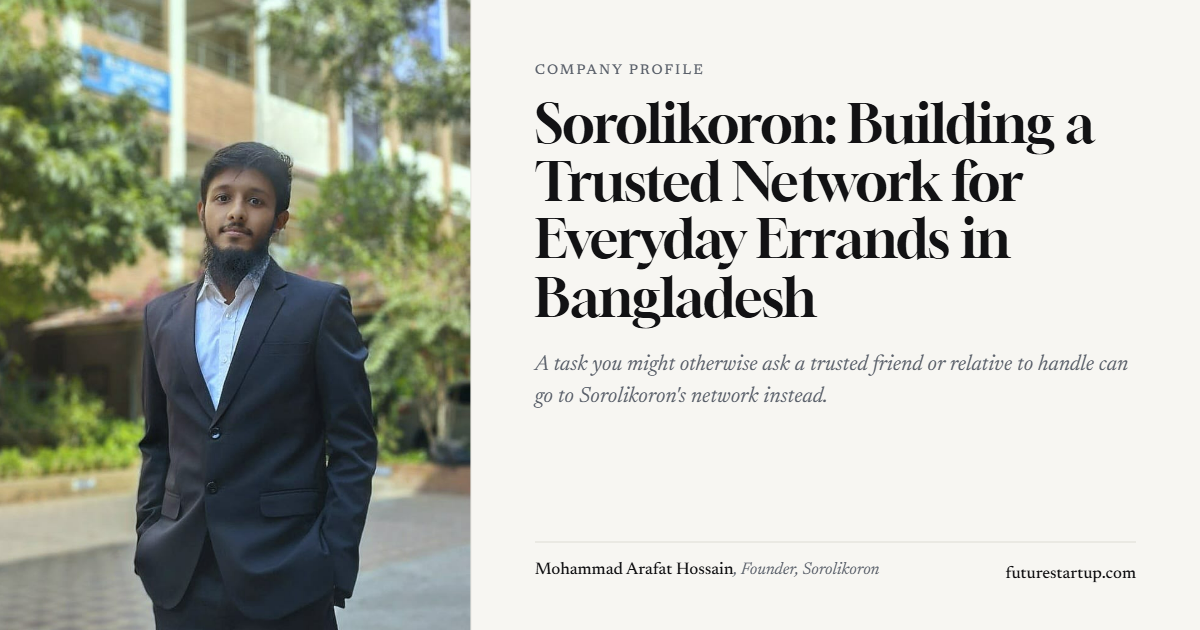
The article is written by Rownak Morshed, Trainee Research Analyst, Future Startup
While carrying out daily tasks in another city may not seem like a huge issue, finding someone to carry them out for you can be surprisingly hard.
A university graduate living in another district may need to collect an academic certificate from Dhaka. Someone working abroad may need a document submitted to a government office. A family in Rangpur may need a particular product purchased in Dhaka and dispatched urgently. Each of these is an ordinary task. Each also needs time, a physical presence, some local knowledge and, above all, someone you can trust.
For most of us, the answer has always been a person we know: a friend, a relative, a former classmate. But what happens when there is no one to ask?
That question comes up more often now. A generation ago, most families could find someone for a small errand: a cousin already living in Dhaka, a neighbour's son at the university, a younger brother with a free afternoon. Bangladesh has changed since then. More households run on two incomes, and both earners have little time to spare. Families are smaller. Relatives are spread across districts and countries, and the ties that once kept them close have loosened. Cities keep growing, and many people who live in them barely know the family next door. Everyone is busier. The informal network that once handled these chores has thinned out. But the chores themselves remain.
Sorolikoron wants to be that someone.
Founded in February 2023 by Mohammad Arafat Hossain, Sorolikoron is a Dhaka-based representative service platform where people hand physical and administrative tasks to verified representatives.
The idea is simple. A task you might otherwise ask a trusted friend or relative to handle can go to Sorolikoron's network instead.
It began small, helping people with university paperwork, a problem Arafat and his team knew first-hand as students.
Since then, the service has widened. People now hire its representatives for custom tasks, document processing, online applications, purchases and deliveries.
It is still an early-stage business. It has served over 2,000 clients and works with a network of more than 90 people, including freelancers. Its trajectory points to an emerging kind of service business in Bangladesh, one that takes the errands people already ask friends and relatives to do and turns them into a dependable, paid service.
Sorolikoron grew out of Arafat's time as a student at the University of Dhaka.
At the time, Arafat was an undergraduate living in one of the university's residential halls. Around him, he kept meeting students and alumni from other districts who needed help with some piece of campus paperwork.
Someone had to visit a department, collect a document or finish a task in person. For people living outside Dhaka, that meant a long journey for a small job.
The idea itself came from a favour.
One of Arafat's friends, who was studying at the University of Chittagong, needed to collect his brother's medical report from the National Institute of Traumatology and Orthopaedic Rehabilitation, popularly known as Pongu Hospital, in Sher-e-Bangla Nagar, near Shyamoli. The report had to be picked up in person, and his classes made the trip from Chittagong hard. So he asked Arafat to go instead.
Arafat collected the report, and the errand stayed with him. If his friend needed this kind of help, many others probably did too, especially in a city where they knew no one.
He talked it over with 10 to 12 friends. Most were happy to help as team members or volunteers. Few were keen on turning it into a business.
Arafat decided to move ahead anyway.
After about two months of preparation, he and the team published a Facebook post in a Dhaka University student group, Shikkharthi Shongshod, announcing that they would begin offering the service the following day. They had assembled a 12-member team, and each person was prepared to handle requests as they arrived.
The first request arrived on day one. One of the team members completed it.
That was the beginning of Sorolikoron.
The launch cost very little. The two months of preparation went into content, a way of talking to customers, and service policies, all run through Facebook. There was no app, no costly technology and no outside funding. Arafat says the real investment was the team's time and effort.
Sorolikoron means simplification in Bangla. The founders chose the name because the service simplifies a task by sending someone to do it on another person's behalf.
Sorolikoron initially concentrated on university-related administrative services, particularly at the University of Dhaka.
This was a natural starting point. The founders were students, their initial network consisted of fellow students, and they understood the administrative requirements of their university. Most importantly, the same community could use the service and supply the people to run it.
Graduates who had moved on to jobs still needed their old university for certificates, verification and academic records. Few could return to campus for every small task. Sorolikoron stepped in between them and the offices they needed to deal with.
Over time, the founders began to see opportunities beyond university administration.
Today, the company is moving towards what Arafat describes as customized representative hiring. Clients describe what they need, and Sorolikoron finds someone to do it.
Consider someone living in Rangpur who urgently needs a medicine available in Dhaka. A regular order might take days. Through Sorolikoron, a representative in Dhaka can buy it and hand it to a courier.
Similarly, someone living outside Dhaka may need a document submitted to the University Grants Commission, the Directorate of Secondary and Higher Education, or a corporate office in Motijheel. They can hire a representative for as long as the job takes and skip the trip.
One customer, Sanzida Maliha, needed a book urgently and could not find it in Cumilla. The team collected it and sent it to her by courier.
The service is not limited to inter-city requirements. It also covers tasks within Dhaka, including professional package delivery between locations.
Another area of expansion is online application assistance. Sorolikoron helps clients with processes such as passport applications, apostille, and attestation. A client shares the details and documents on WhatsApp, and the team helps with the application from there.
The company has also added document-processing services, including affidavits, notarization, newspaper notices, and trademark applications. It offers basic legal services through an advocate associated with its team. Its website lists smaller, very specific jobs too: buying books from Nilkhet, collecting medicine and hospital reports, National University attestation, name-correction affidavits, paperwork for WES credential evaluations, and express courier through DHL and FedEx.
Most people go through these processes once or twice in a lifetime. Each time, they have to learn the rules, find the right office and work out the steps from scratch. That takes time.
Sorolikoron is trying to make these processes easier by combining several forms of assistance within one service network.
The first conversation costs nothing. People can ask for advice through its Facebook inbox, and the team sets service charges case by case.
Even so, university work, especially educational verification, still brings in most of its revenue.
Sorolikoron relies on a flexible network of student freelancers to deliver its services.
The original 12-member team was made up primarily of Arafat's university friends. As members graduated and moved into professional careers, their availability declined. The company responded by recruiting students from subsequent university batches.
This became a recurring recruitment model.
It recruited newer students at the University of Dhaka first, then built networks at institutions such as Jahangirnagar University and the University of Chittagong. Students in their early years usually have more free time, which makes part-time work easier.
Today, Arafat puts the company's overall team size at approximately 90 to 92 people, including freelancers. Its executive team consists of six members, with responsibilities divided across administration, technical operations, marketing, and page moderation.
Arafat serves as the chief administrator. Abu Bakar Siddik oversees marketing, while Tasfin is responsible for the technical side. Page administrators and coordinators manage incoming projects before assigning them to field representatives.
The arrangement is deliberately flexible.
Freelancers have no weekly quota. When a request comes in, it goes out to the team, and whoever is free and interested takes it.
Arafat compares it to how riders pick up trips on Pathao or Uber.
This lets Sorolikoron keep a large network without the fixed cost of a large full-time staff.
A flexible workforce is harder to coordinate, and plans change in the field. An official may be out, a document may need one more step, or an office may refuse to cooperate. When that happens, the representative has to find a way through and finish the job.
So when Sorolikoron recruits, it looks for accountability and empathy. Previous involvement in voluntary organizations, campus clubs, and community activities is seen as an indicator of whether someone is comfortable working with others.
The company also verifies its representatives. Students are asked to provide evidence of their institutional affiliation, while members recruited outside established campus networks undergo additional checks involving identification, addresses, and personal references.
The aim is a workforce customers can depend on.
When a service hands someone's documents, money and errands to a stranger, trust is the product.
A customer has to be willing to hand that task to someone they have never met.
Here, the university network gave Sorolikoron its first advantage. In the early days, its representatives were students from the same institution as many of its customers. A graduate found it easier to trust a current student from their old university than a stranger. That shared connection became the base of its early customer relationships.
It takes the same approach at other universities. Recruiting through campus networks brings a level of familiarity and accountability that open hiring would struggle to match.
Arafat says the company has not received complaints involving a breach of customer trust during its three and a half years of operations.
In effect, the company is trying to turn personal trust into a system. Verification, institutional affiliation, moderation, training, and communication between clients and representatives are all parts of that effort.
The challenge is that trust established through personal familiarity does not automatically transfer to a much larger network.
As Sorolikoron expands into new districts and service categories, it will need to ensure that its verification and quality-control processes remain consistent.
Sorolikoron's growth so far has been relatively gradual.
Arafat says monthly revenue has at least doubled since early 2023.
In November 2026, Sorolikoron registered as an e-commerce business, a step toward the more formal platform it is building.
The company has also expanded its operational network beyond Dhaka. Chittagong is now another major focus, with students from the University of Chittagong handling assignments within the university and the wider city.
It has completed projects in other districts, including Rangpur, Rajshahi, Barguna, Khulna, and Sylhet. Not all of these places have a permanent team. The company pulls people together when a request comes in.
Most new customers still come through referrals. Sorolikoron runs campus promotions and Facebook campaigns, and hands out leaflets and stickers. But Arafat says word of mouth brings in the most business.
The reason is trust.
A Facebook advertisement might introduce someone to Sorolikoron, but it may not be enough to convince them to entrust the company with an important document or administrative task.
A recommendation from a former customer, a university junior, or someone in a relevant Facebook group can make a significant difference.
The company therefore treats referrals as an important part of its marketing strategy, including maintaining a separate referral policy for previous customers.
This also slows growth. Many people have never paid a company for this kind of help. Sorolikoron first has to tell them the service exists, then explain how it works, and then earn enough trust for them to try it.
Sorolikoron has funded itself so far. Arafat says the company has not taken external investment and has preferred to build its operational structure before bringing in third-party capital.
Without a working system, Arafat argues, more capital would be spent without improving the business.
The company is now considering external investment as its operations become more standardized.
Its largest expense areas are operations and technology development. Payments to representatives who complete assignments constitute a direct operating cost. However, Arafat identifies technical development as the company's largest current cost.
It builds its technology in-house. That keeps the company in control of its systems, though building and maintaining them takes considerable resources.
There are also challenges that cannot easily be addressed through technology or additional capital.
One is the unpredictability of field operations. A representative may arrive at an institution only to discover that an official is unavailable or that an additional requirement has emerged. A standard operating manual cannot anticipate every possible situation.
Training freelancers to respond appropriately requires repeated experience and supervision.
Another challenge is dealing with uncooperative third-party organizations and bureaucratic obstacles. Since Sorolikoron operates as an intermediary, its ability to complete a task sometimes depends on institutions and individuals over whom it has no control.
The company therefore needs to maintain coordination between three parties: the customer, the representative, and the moderator overseeing the assignment.
Arafat considers this coordination one of the company's most important operational capabilities.
Sorolikoron conducts internal training sessions and monthly meetings to maintain service standards. Each month, it rates members' performance, and the best performers receive gifts.
Arafat says the company has received support and guidance from faculty members at the University of Dhaka.
Sorolikoron operates in a relatively new service category in Bangladesh, where the number of organized providers remains limited.
Arafat says the company welcomes competition because new entrants can help educate customers about the category itself.
He identifies Cholo BD as a recent entrant offering similar services. Another platform had appeared earlier but eventually discontinued operations.
Arafat also believes the company benefits from an early presence in the market. Customers who have used the service and come to trust its representatives may be less likely to switch.
However, an early-mover advantage alone does not guarantee long-term competitiveness. The company will need to maintain service quality, improve its operational systems, and ensure that its customer relationships remain dependable.
Arafat points to Sorolikoron's ratings on Google and Facebook, which he says are close to five out of five, as evidence of its customer reception.
He sees the broader market as considerably larger than the number of existing providers suggests.
In his view, the opportunity reaches well beyond university paperwork, into the many everyday situations where people need someone physically present in another place.
Until now, Sorolikoron has primarily operated through Facebook and WhatsApp. That has been sufficient for managing its initial customer base, but the company believes it needs dedicated digital infrastructure to expand.
A web application and a mobile application are in development.
The planned system will let customers log in, pick a service, check requirements and prices, and talk to the admin team about custom requests. Representatives will see open assignments and accept or decline them. Customer profiles, service histories and tracking are part of the plan too. The aim is to bring the customer, the representative and the admin team into one place.
Arafat wants both a web and a mobile app, because not every customer wants another app on their phone. Some would rather use a browser.
Sorolikoron also wants a wider district-level network. Today it relies on university networks in Dhaka and Chittagong and on project-based contacts elsewhere. Over time, it hopes customers will be able to hire representatives in many more districts.
The company also sees opportunities in corporate partnerships. Reaching working professionals may require a different marketing approach from its existing campus-focused promotions. Arafat identifies business-to-business outreach and corporate collaborations as important future channels. Its website already lists corporate packages: project-based representative hiring, a quality-inspection team and a field survey team.
Another planned area is the expansion of legal services. Sorolikoron currently offers basic assistance with affidavits and notarization, but Arafat sees room to develop a broader legal consulting and service platform.
Automation and AI are part of the longer-term plan. Much of the work is still manual, and communication, coordination and task management take up a lot of time. Sorolikoron wants to use its operational data and experience to automate the parts that suit it.
Arafat does not expect technology to replace people. The customized nature of the service requires someone to understand the customer's actual problem and respond to circumstances that may not fit a predefined process.
Sorolikoron's business rests on a relatively simple observation: people frequently need assistance with tasks that require physical presence, but their personal networks cannot always provide it.
As we noted at the start, that gap is widening. Households run on two incomes. Families are smaller, and relatives live farther apart. City life leaves many people with few local ties. Each of these shifts takes away a little of the informal help people once took for granted. Together, they make Sorolikoron's case stronger with time.
Sorolikoron is trying to turn that informal help into an organized service.
Its early development demonstrates the advantages of starting within a community where the founders already have access, familiarity, and trust. The University of Dhaka provided both the initial customer base and the workforce. From there, the company has gradually expanded its services and geographical reach.
The company must maintain representative quality across locations, coordinate increasingly customized assignments, and establish trust with customers who may have no prior connection to its network. It must also make the economics of the service work as its operational complexity increases.
The planned applications could help address some of these constraints by standardizing communication, project allocation, and tracking. A wider network could increase its geographical reach, while corporate partnerships and additional service categories could open new customer segments.
Still, the central challenge will remain operational: ensuring that a representative can reliably complete a task on behalf of someone who is not physically present.
For Arafat, the lesson from building Sorolikoron is that organizing a freelance workforce requires more than recruiting people who are willing to work. Members must understand the customer's requirements, adapt to changing circumstances, and coordinate effectively with the administration team.
Sorolikoron is still building towards its larger ambition. Its revenue remains modest, its geographical coverage is uneven, and its digital infrastructure is yet to be fully established.
But the underlying problem it addresses is persistent. People will continue to need documents collected, applications completed, items purchased, and administrative tasks handled in places where they cannot always be present.
The larger ambition is to make that kind of assistance available beyond the boundaries of personal relationships.
If Sorolikoron can build the systems and trust required to do that consistently, it could help formalize a category of services that has largely operated through informal arrangements in Bangladesh.
The FS Letter brings the week's interview, our analysis and a few pieces from the archive. Free, once a week. Sign up and we will send you our quarterly ebook of the best interviews.
Subscribe and get the ebookHow to Build brings together our founder interviews on how companies in Bangladesh are built.
Visit our shop Get your copyFor companies
FS Narrative Studio tells it through reported stories, published here and sent to our readers. See how it works