
Cloth Scanner is a cut panel inspection table for the RMG industry with AI vision and robotics engineering capabilities from Advanced AI Lab (AAI), a Dhaka-based AI company. The company says it checks cut garment panels for defects, ensuring 4x higher buyer acceptance.
Advanced AI Lab (AAI), a Bangladeshi AI company, has opened pre-orders for Cloth Scanner, a cloth inspection table with AI vision that checks every cut fabric panel (a sleeve, a back, or any other piece cut from a roll) for defects before it reaches the sewing line. The company says it co-built the machine with industry pioneer Urmi Group. Delivery is dated for February 2027.
AAI is part of ACI, one of Bangladesh's largest conglomerates. The company operates on an ambitious goal: to conduct fundamental AI research and build global AI products. Cloth Scanner is one of its first products. Its founder, Oli Ahad, earlier built the enterprise AI firm Intelligent Machines, after more than a decade at British American Tobacco.
The case for a machine like this starts with money. Materials account for the largest share of garment costs. In a study of Bangladeshi cotton T-shirt factories, materials made up 77% of production cost and wages only 2%, so a flawed panel wastes the most expensive input in the factory, far more than the labor around it. Mostafiz Uddin of Denim Expert wrote in a 2020 Dhaka Tribune column that a factory exporting $1 million a month with a 1% rejection rate loses $10,000 a month, a huge amount in an industry where margins are often low.
Factories do inspect their fabric at several stages and to global standards. People do most of the checking, and often manually. A 2024 survey puts human accuracy, meaning the share of real defects an inspector catches, at 60 to 75%, and it falls as a shift wears on.
Cloth Scanner says it automates that check using AI vision and robotics engineering. Cloth Scanner says a gantry carries each panel under two overhead cameras, an AI model inspects the images in under two seconds, and the machine sorts the panel into accept, repair, or reject. The company adds that the efficiency gain enables one operator to do the work of four inspectors.
Catching flaws like these is difficult, and the opportunity is large. Ready-made garments earned $39.35 billion in FY2024-25 and supplied 81.5% of Bangladesh's export earnings, so small gains in quality control add up. Machines that bring AI to fabric inspection already run on fabric rolls in factories across Asia. Cloth Scanner moves the check to the cut panel, a stage where, as far as our research shows, no commercial product operates. If it performs, it will help garment makers improve quality and show that Bangladeshi companies can build AI products for global markets.
In this article, we examine the product, how it works and, if it works, what it means for the garment industry and for AAI. We base the analysis on the publicly available details of the product, research papers, trade reporting, and factory benchmarks. We begin by asking: how does the machine perform on a factory's own fabric, across defect types and a full shift? The website's numbers are a promising start. To weigh what is known today, we begin with the problem Cloth Scanner seeks to solve.
Picture one flawed panel. A roll of knit fabric arrives at the factory. Inspectors check only a sample of rolls, so this one goes straight to the cutting room. Workers spread it in layers on a long table and cut dozens of panels at once. One sleeve panel carries a small hole, and nobody at the cutting table spots it. The panel joins a bundle and moves to the sewing line, where quality staff spot-check a few pieces every hour. A sewer, working at speed, joins the sleeve to the body without noticing the hole.
A cutting room sends panels to sewing all day. Cloth Scanner's rated capacity, about 900 panels an hour or 7,200 panels in an eight-hour shift, shows the volume a single inspection table is built to check. At that volume, even a small share of misses becomes a steady stream of flawed panels.
The 2024 survey's 60 to 75% accuracy estimate for fabric inspection suggests that people let 25 to 40% of flawed pieces through. If cut panels fared the same, 250 to 400 of every 1,000 flawed panels would reach the sewing line.
Sooner or later each flawed panel surfaces, and the factory then repairs the garment, scraps it, or ships it with the flaw. All three are costly.
Repair usually means paying twice: a worker unpicks the sleeve, a cutter makes a new panel from the same batch of fabric so the color matches, and a sewer attaches it, all against the order's deadline.
Scrapping writes off the fabric, the sewing labor, and the trims already in the garment.
Shipping saves the repair bill and hands the risk to the buyer, who can count the flaw against the whole order.
All three cost more than catching the panel at the cutting table, where the fix is one new cut before anything else has been invested.
Across a whole factory, these costs add up, and no Bangladeshi study of total quality cost turned up, so the nearest benchmark comes from India.
A 2009 German Technical Cooperation report on 61 Indian apparel manufacturers found that the cost of quality, everything spent to prevent, check and fix defects, averaged 14.05% of sales.
Internal failure, meaning defects caught inside the factory (scrap, rework and re-inspection), was the largest part at 9.86%. The report estimated that cutting the total from 14% to 6% could lift profitability by almost 50%.
Bangladeshi data, though on a narrower slice, points in the same direction.
A 2025 IEOM paper measured sewing defects per hundred units (DHU) in one leading factory at 9.96%, nearly ten defects per 100 garments, before it enforced standard procedures, and 5.21% after.
The paper's literature review adds that in Bangladesh, cutting generates a large share of fabric waste and contributes to cut-panel rejections, the stage Cloth Scanner targets.
Most factories start with the four-point system, which grades fabric by its flaws. Fouzul Imran Khan, managing director of Benchmark Apparels, explains it in Apparel Resources. On a roll, the long cylinder of fabric that arrives from the mill, inspectors give each flaw up to four points, with bigger flaws earning more. The total per 100 square yards sets the roll's grade, and the lower the score, the better the fabric.
ASTM D5430 sets out the standard method. Each buyer sets its own pass mark. In Khan's example, one buyer allows up to 20 points per roll and a stricter one allows 18.
People do the checking manually. Khan puts the pace at about 10 yards a minute and the catch rate at roughly 70% of defects, in line with the survey estimate above.
Once a roll is cut, checks shift to sampling: a few pieces stand in for the rest. One leading Bangladeshi factory, described in the IEOM paper, has staff check seven random pieces from each step of the sewing line every hour, inspect 50 garments at first output, and check cut parts against guides.
Even with all these checks, four gaps remain.
Despite these limitations, people still bring something a machine has to match. Experienced inspectors read context, such as whether an odd texture is a flaw or part of the fabric and whether a mark matters to a particular buyer. Any machine has to meet that standard on judgment calls as well as obvious holes.
Between the roll check and the sewing line, few factories inspect every panel. That gap is where Cloth Scanner works. Cloth Scanner describes the idea: factories check rolls of fabric (thaan kapor, as the site puts it) at the start of production, but new defects appear once the fabric is cut and processed, so cut panels need an inspection of their own.
Cloth Scanner inspects every cut panel after cutting and before sewing, applies one standard to each, and records the result. That closes the gaps above. Every panel gets looked at, the last one of shift gets the same attention as the first, and the results go into a record that many factories don’t have yet.
The machine leaves the rest of the quality system as it is. Roll inspection continues, and people keep reviewing the calls the machine cannot settle. The harder part is doing it panel after panel, shift after shift.

Checking every panel takes three things: hardware that handles fabric cleanly, cameras and a model that judge flaws, and records that outlast the shift.
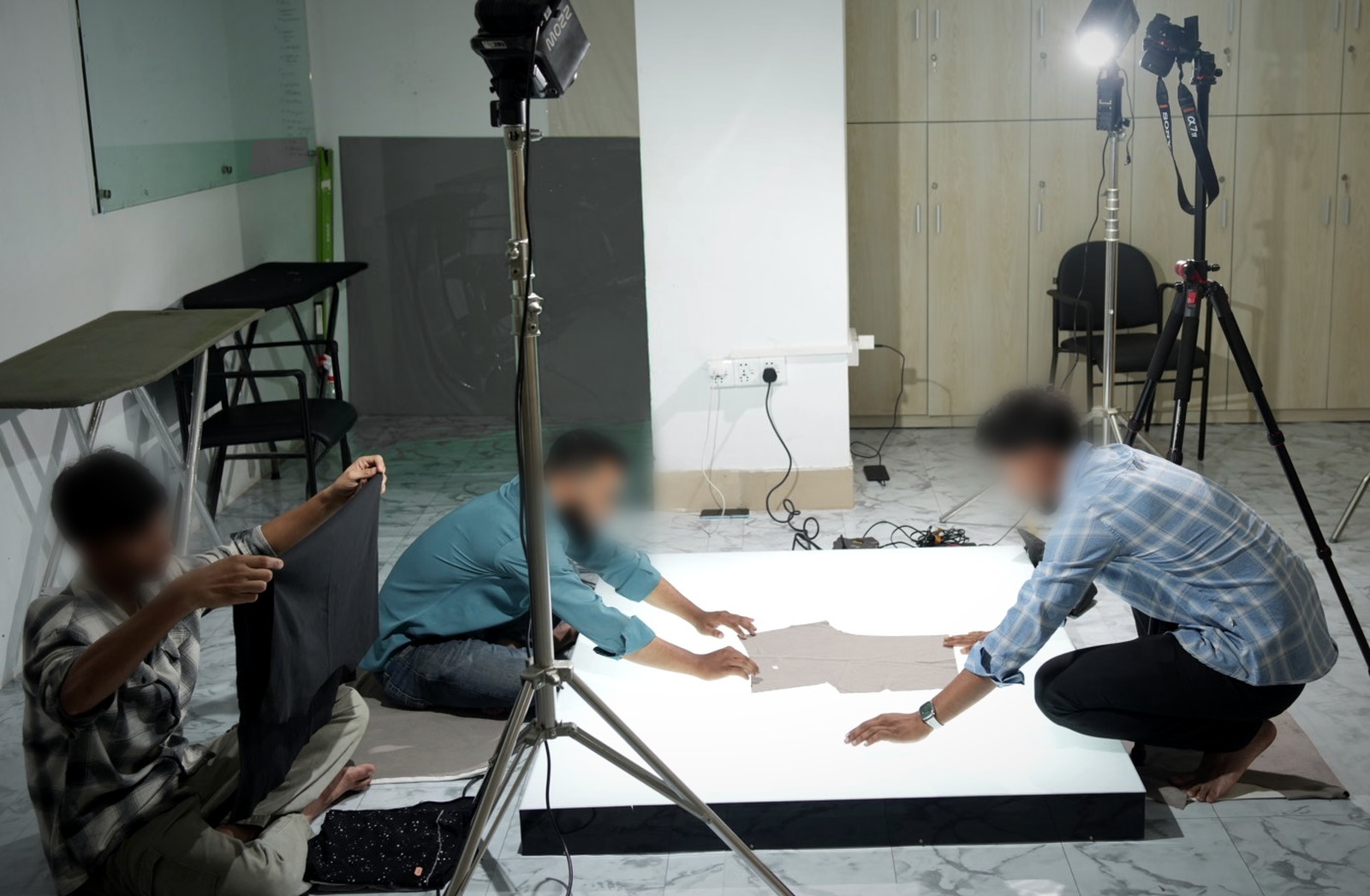
According to Cloth Scanner, a cut panel arrives on the working surface. A robotic gantry, a motorized frame that moves along two axes, grips, lifts, and positions it on a glass bed lit from above and below, and two overhead cameras photograph it.
The AI model scans the images, and the gantry sorts the panel by decision: accept, repair, or reject.
To see the process for yourself, visit the website for an interactive 3D walk-through and an inspection demo that flags defects on dark textured and light solid fabrics. The spec sheet puts numbers on it.
| Spec | What the company lists |
|---|---|
| Working area | 1.8 by 2.4 meters |
| Cameras | Two overhead 4K |
| Gantry speed | Up to 1.5 meters per second on the X and Y axes |
| Inspection time | Under two seconds per panel |
| Sorting capacity | About 900 panels an hour at a gantry speed of 1.2 meters per second |
At about 900 panels an hour, the machine finishes a panel every four seconds, so inspection takes under half of each cycle if both figures hold in the same run, and handling, capture and sorting use the rest.
Over an eight-hour shift, that rate means about 7,200 panels, the volume cited earlier, and four inspectors would each have to check a panel every 16 seconds, without a break, to match it.
The arithmetic assumes the machine holds its stated rate all shift, which a pilot can confirm.
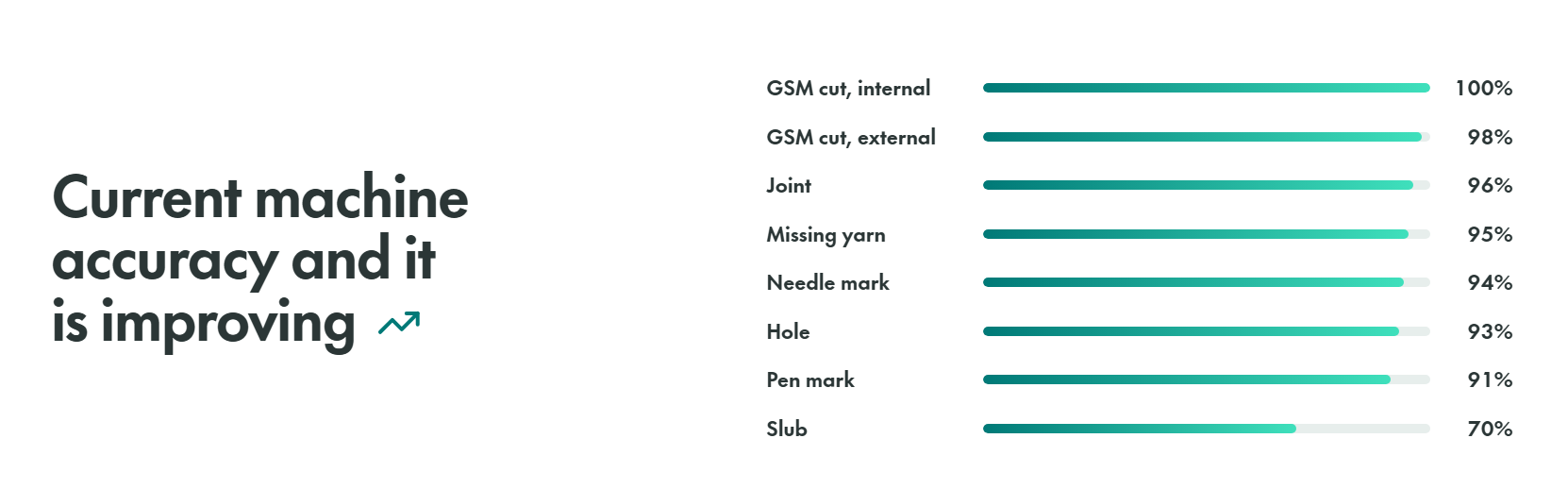
Cloth Scanner shows what it calls current machine accuracy, which it says is improving: GSM cut 100% (internal) and 98% (external), joint 96%, missing yarn 95%, needle mark 94%, hole 93%, pen mark 91% and slub 70%.
GSM (grams per square meter) is the standard measure of fabric weight, and slubs are thick, lumpy spots in yarn. Slubs come in the lowest, which shows where the model has the most to learn.
One caveat: the company has not said whether it counts accuracy per panel, per defect or per image, so these figures are a first public benchmark and cannot yet be set against the 60 to 75% estimate for human inspectors.
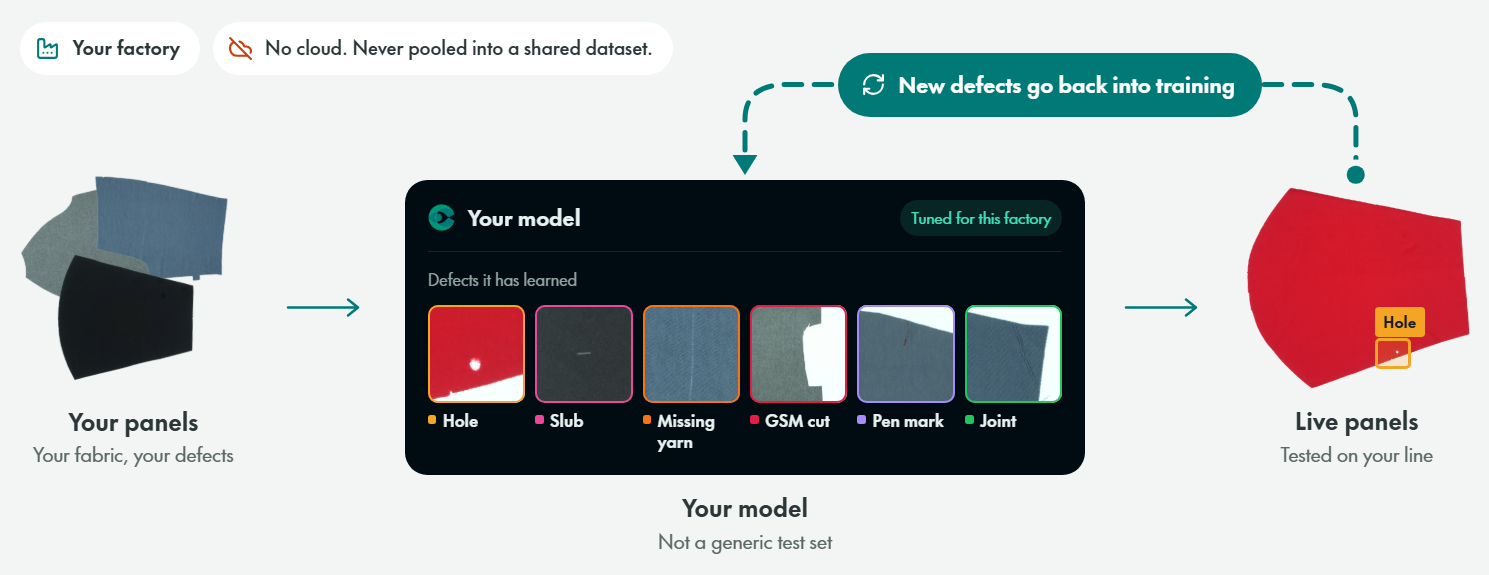
Cloth Scanner learns from the factory it serves. The company tunes each model to the customer's garments and fabrics before go-live, feeds new defect examples back into training and keeps the data inside the factory: "No cloud. Never pooled into a shared dataset." The site adds that the company tests the model on the factory's own line, "Not a generic test set."
Tuning matters because defects do not transfer cleanly between fabrics. A 2024 Heliyon paper built the ISL-Knit dataset from Bangladeshi knit dyeing factories, with seven annotated fault types, because most public datasets cover woven fabric and woven faults differ from knit faults.
AAI says finding flaws in fabric is a hard problem, and many research efforts have met uneven and sometimes limited success. A 2024 survey notes that few of those studies test their models in factory conditions. What worked for AAI was working directly in factories: for more than 11 months, the company says, its team has taken photos, annotated them, and trained the models on them. Whether that groundwork holds up on a customer's floor will only show once the first machines go to work in February.
In a learning loop of this kind, the machine flags a panel, a QC worker confirms or overrules the call, and the confirmed result trains the next model version. Labels must be right, and each update needs testing so a gain on pen marks does not cost accuracy on slubs.
Done well, each round improves the model a little. Operators see fewer false alarms, trust it more, and keep feeding it examples.
Every inspection also leaves a record. Cloth Scanner shows a dashboard dated 1 to 30 September 2026 that tracks panels checked, defective panels, the defect rate, defects by type, and how the AI model's detections compare with the QC team's.
A separate insights section says the system records every defect with style, batch, and decision and builds a traceable quality history, which its illustration shows feeding ERP and MES systems, the planning and production software factories run on, so managers can spot recurring problems and trigger corrective and preventive action.
The records show the pattern. Finding the cause, whether a knitting fault, handling damage, or a cutting issue, still takes people.
Cloth Scanner is built by Advanced AI Lab Limited. Hardware asks more of a company than software does. Engineers can update a model overnight, but a gripper, a camera, or a gantry sometimes needs an engineer on site, and testing needs real production floors. That is where Urmi Group, the product's co-builder, comes in.
Urmi describes itself as one of Bangladesh's leading readymade garment makers, with three factories and 32 years in the business, and it won the Digital Bangladesh Award 2022 for a factory RFID system. The site says little about the scope of Urmi's role or where the machine has run in production.
All of this is interesting, but how does a factory actually get one?
AAI plans to sell Cloth Scanner as a subscription.
According to Cloth Scanner, AAI charges a monthly fee for each unit, with flexible options, and no capital expenditure, so the factory does not buy the machine up front.
The fee comes with a service package: installation at the factory, team training and a model tuned to its garments before go-live, updates and retraining while it runs, and same-day attention if a part breaks.
Pre-orders are open, with delivery listed for February 2027.
Two things remain unknown: the fee, which the company has not published, and the number of machines already running in factories.
Does it pay? That means asking what a machine like this could save a factory, and whether similar machines have delivered elsewhere.
The sum starts with what a factory pays today for inspection, rework, rejected panels, and defects that escape. Two things matter most.
Payroll is the smaller one. The entry-level minimum wage for garment workers is Tk 12,500 a month, about $113 at the November 2023 exchange rate, so the three inspectors freed when one operator replaces four save roughly $340 a month at that floor.
Rejects are the larger one. By Uddin's arithmetic, a factory shipping $1 million a month gains $1,000 for every tenth of a percentage point of rejection (garments the buyer refuses to accept) it avoids, about three times the payroll saving. Only rejects that trace back to cut-panel flaws count, and no source says what share that is in Bangladeshi factories.
The German report's cost split shows the opening: appraisal cost, meaning inspection, ran at 3.31% of sales and internal failure at 9.86%. Cloth Scanner takes over part of the first and targets part of the second for cut panels.
Break-even comes down to one sum: payroll saved, plus rejects and rework avoided, minus electricity, floor space, maintenance, and installation disruption. The monthly fee has to come in below the result, and AAI sets the fee.
Take a factory exporting $1 million a month, where one table keeps pace with the cutting room. If the machine trims rejects by 0.2 percentage points, the saving is $2,000 a month. The payroll saving adds about $340, for roughly $2,340 a month before electricity, floor space, and maintenance.
A fee comfortably below that would pay its way. The 0.2-point figure is an assumption, and a pilot would replace it with a measured number.
AI inspection already runs on fabric rolls, and established equipment makers have taken notice. Taiwan's Oshima says its EagleAi machine operates in Taiwan, Vietnam, Cambodia, Thailand and Indonesia and inspects 10 to 40 meters a minute with one operator.
Bullmer, a cutting-equipment maker, launched its AI 01 inspection machine in 2021 and says one machine saves four inspection workers. In 2024, Lectra, the French cutting software and equipment maker, took a minority stake of about 30% in AQC, a French company that sells AI defect recognition as software and equipment.
Some results exist. A trade-press report says Portugal's Tintex Textiles put Smartex AI cameras on 21 knitting machines and saw needle and sinker defects fall 41% in nine months, with payback inside a year. The same report says vendors now sell inspection by subscription or by the meter, much like Cloth Scanner's monthly fee. These figures come from vendors, and none is from Bangladesh.
Cut pieces have a limited record. Searches turned up no commercial machine that inspects cut garment panels the way Cloth Scanner does, which leaves the field open for a first mover.
On paper, the case holds up, and four things count in Cloth Scanner's favor.
Start with accuracy: the site's own chart puts holes, missing yarn, needle marks, pen marks, and joints at 91% to 96% and GSM cuts at 98% to 100%, and its demo runs on dark textured and light solid fabrics.
The second is the commercial model, a monthly fee with no capital expenditure, which lowers the risk of trying the machine.
The third is factory-first design: models tuned to each factory's fabrics, with data kept inside the factory, suit a market where knit and woven faults differ and give factories control of their own information.
The fourth is the partner. Urmi, an established garment manufacturer, opens the door to real production floors, and the machine targets a stage that, as far as searches show, no commercial product serves.
A few things need watching.
Cloth Scanner's dashboard doubles as the site's main evidence. Over the 30 days, 3,287 panels came through, and 154 were defective, a rate of 4.7%. The AI model found 153 of them, or 99.4%, and the QC team found 55, or 35.7%. The AI alone caught 99 that the QC team missed, and it missed only one, a hole.
The site marks its shift view as an example and does not say whether the dashboard figures come from a customer factory. At roughly 110 panels a day, the volume sits well below what the machine can handle in a shift. The 99.4% counts detections only and says nothing about good panels the machine rejected. The QC team's 35.7% sits below the 60 to 75% range for human inspectors, which suggests a hard batch or a modest human baseline. And the dashboard shows 100% detection on slubs while the accuracy chart gives 70%, so the two views count different things.
Cloth Scanner advertises four times higher buyer acceptance. Its chart plots the chance that a buyer accepts a shipment against the share of faulty pieces in it and shows a 58% chance, about six in ten shipments, at 5% faulty. The page does not describe the data behind the curve or the baseline for the fourfold figure. Acceptance depends on stitching, measurements, finishing, packing, and the buyer's specifications. A cut-panel scanner removes one source of rejects, and measuring its effect takes comparable production runs.
A factory pilot would answer most of these questions. The factory would run the machine beside its existing inspection, on its own fabrics, and check both against independently verified defects. It would track:
As AI adoption grows across sectors, job loss has become an important topic of discussion. For instance, Fakir Fashions in Rupganj told the Thomson Reuters Foundation in 2024 that AI allowed the company to dismiss dozens of quality inspectors. The same report cites the ILO's estimate that about 60% of Bangladesh's apparel workers, 2.7 million people, risk losing their jobs to automation. However, AAI says that its technology operates with humans in the loop. The company wants to enable humans to do their jobs better and thus create better opportunities for all.
Fardina Hafiz, who leads enterprise projects at AAI, is frank that job losses are happening around the world and that people who do not upgrade their skills will struggle. However, she emphasizes that AAI's ambiton is to enable people to achieve more. "Our objective is to make people more human using AI-powered solutions, so that they can be more creative and work with their core capacity," she says. In the systems AAI designs, she adds, a person stays in the loop: "We won't leave out human experience."
Mohammad Faisal Akram, AAI's product group lead, says managers should state in advance where displaced inspectors will go, such as fabric inspection, finished-goods checks, or pre-shipment inspection. A Cloth Scanner buyer might cut inspectors or move them to other quality work, depending on panel volume and what else they do.
Every garment factory has a cutting room, so the potential market is wide. An industry that loses money to defects at every stage has reason to try a machine that works, and the first product to prove itself at this stage will set the benchmark others must meet.
In the meantime, a few details may help: the monthly fee, written support terms, and customer-verified numbers. A factory that wants to test the claims sooner can request a demo or pre-order and ask for those four in writing.
If the market proves out, competition will likely follow, and established vendors such as Oshima, which already link inspection to spreading and cutting equipment, can extend into cut panels.
If Cloth Scanner delivers, Advanced AI Lab gets a reference customer (a factory other buyers can visit), steady subscription income, and a concrete answer to the question Fardina says many businesses still ask: what AI can do for their operations.
AAI keeps each factory's data inside that factory. That builds trust with customers and rules out a shared pool. Taiwan's Oshima says its EagleAi machine takes the opposite approach: participating manufacturers contribute anonymized defect data, with permission, to a shared AI model, backed by a defect database Oshima built with the Industrial Technology Research Institute. The company says pooling cuts each customer's training cost and speeds model improvement.
AAI has no such shortcut: each factory's model improves on that factory's own data, so accuracy is earned one installation at a time. The trust that choice builds is an asset of its own, and the first installations will show whether it is worth the slower pace.
So can AI make cut-panel inspection more reliable? The published numbers say plausibly yes for defects such as holes, missing yarn and joints, which the site rates above 90%, and the proof on harder ones like slubs is still to come.
The evidence will start to arrive with the first installations. If a factory puts its numbers on the table and they hold, AAI will have a measured result in the country's biggest industry, and Bangladesh will have a reason to believe in the AI products it builds itself. Until then, somewhere in a cutting room, a sleeve panel carries a small hole that nobody has noticed. Catching it is the whole test.