
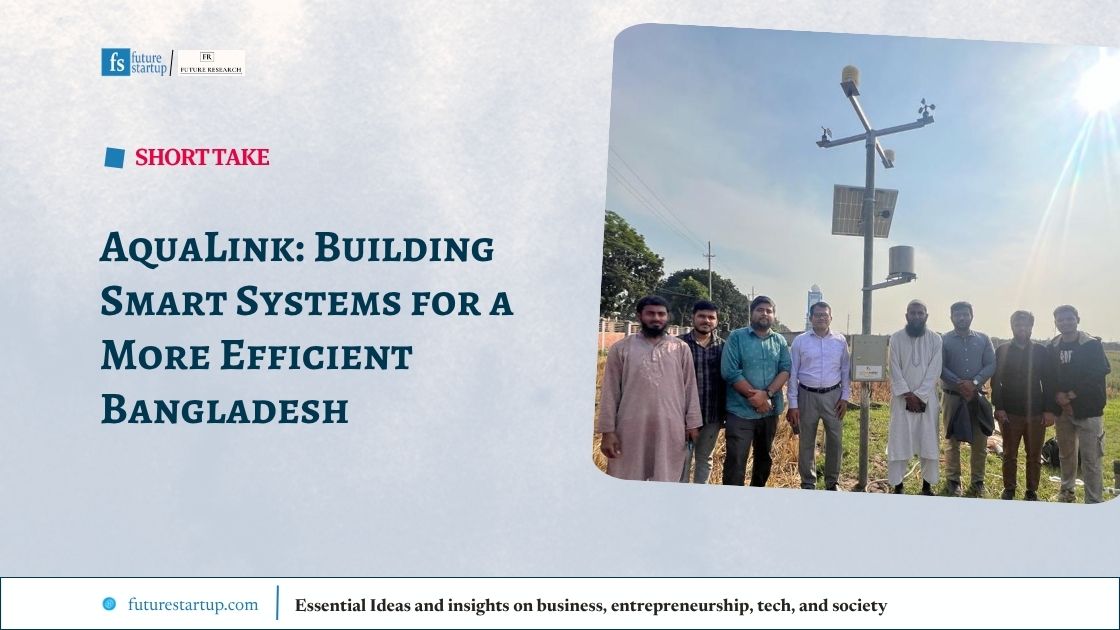
When Sayed Rizban Hussain, Masnur Rahman, and Abdul Ghafur Bashir, three founders of AquaLink- more on that in a moment- began visiting factories, retail outlets, and farms across Bangladesh, they kept running into the same problem: businesses were making critical operational decisions with little or no real-time data. In many instances, they didn’t have any visibility into many aspects of their operations. A common failure mode across sectors and industries because nobody could see what their own operation was doing while it was happening. For instance, air conditioners ran when nobody needed them. Pumps stayed on longer than necessary. Farmers often learned about a problem only after productivity had already dropped. As you can imagine, these have obvious costs. They lead to suboptimal decisions, cause wastage, and drive up the costs of inefficiencies.
It was against this backdrop that the trio decided to start AquaLink Bangladesh Limited in 2019 with an ambition to enable organizations across sectors to have better visibility of their operations and thus make better decisions, reduce wastage, and improve efficiencies.
Today, AquaLink has grown into a meaningful operation with multiple products and clients across sectors. The company describes itself as a Dhaka-based, R&D-driven technology company that designs and builds IoT hardware and software. Its work spans energy monitoring, aquaculture, cold storage, and irrigation, across industrial, retail, and agricultural clients, all built around a single idea: an operation can only run efficiently if it can see itself in real time.
Their work has also received meaningful attention from ecosystem players. AquaLink is a recipient of the Orange Corners Bangladesh Innovation Fund (OCBIF), an initiative of the Kingdom of the Netherlands led by SAJIDA Foundation in partnership with YY Ventures. The company was part of Cohort 3 of Orange Corners Bangladesh (OCB), where SAJIDA Foundation awarded it a Track I grant. Its current Track II support through OCBIF is helping AquaLink accelerate research and development, expand deployment across retail and agricultural sectors, and enhance its Sensometer platform.
AquaLink operates in a challenging vertical. To take on the challenge, the company says it has built an excellent team, and its founders come with years of experience. Rizban co-founded AquaLink as its Chief Technology Officer and now leads the company as CEO. His background is in embedded systems, building firmware for boards like Raspberry Pi, NodeMCU, and Arduino, and applying that hardware knowledge to industrial automation problems.
Masnur Rahman co-founded the company and has led its research and development, an extension of his own background in embedded systems and robotics, including a stint on BRAC University's Mongol Tori robotics team.
Abdul Ghafur Bashir rounded out the founding team with an industry-facing view, watching Bangladesh's textile, leather, and agro-processing sectors edge toward automation and asking where AquaLink could meet them first.
Together, the three set out to prove that advanced industrial automation could be built in Bangladesh, at a fraction of the imported price.
AquaLink has since launched several interesting products. Its flagship IoT and AI-powered automation platform Sensometer combines sensors, controllers, cloud-based analytics, and automation tools into one system, and it integrates into existing operations with minimal infrastructure change. This has made Sensometer a convincing product to many partners because it can be readily deployed without making any changes to their existing system.
Today, Sensometer is used across retail outlets, industrial facilities, aquaculture farms, greenhouses, cold storage, and irrigation systems. The company claims Sensometer’s retail clients typically cut electricity consumption by 15 to 25 percent. Industrial facilities often save up to 30 percent. In agriculture, better monitoring and automation help farmers grow more and waste less.
One of AquaLink's most notable partnerships has been with Shwapno, one of Bangladesh's largest supermarket chains. A pilot installation cut Shwapno's energy consumption and carbon footprint by more than 15 percent within three months. That pilot eventually grew into a strategic collaboration focused on improving operational efficiency at scale.
To date, AquaLink claims it has delivered more than 250 projects across 16 districts. It has served over 1,150 beneficiaries. Together, they save more than 100,000 kilowatt-hours of electricity every month, avoiding over 60 tonnes of carbon dioxide emissions every month.
Beyond funding, OCBIF is helping AquaLink move into its next phase through Technical Assistance. The company plans to strengthen research and development, expand deployment across retail and agriculture, and further enhance its SmartOps AI platform.
Over the coming years, AquaLink wants to reach all 64 districts of Bangladesh. It is also exploring international markets that face similar challenges around energy management and productivity. Data-driven decision-making increasingly defines the world. AquaLink is showing that innovation built in Bangladesh can compete on that stage.