
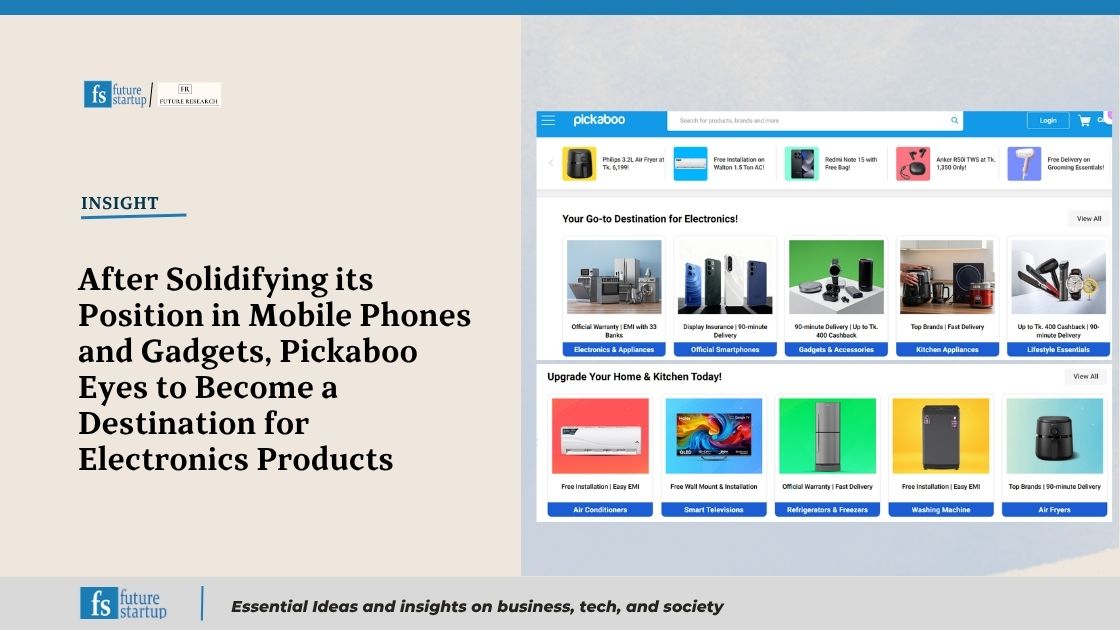
In Dhaka's fast-evolving e-commerce landscape, Pickaboo’s recent expansion into electronics can be viewed as an interesting case study in strategic expansion to an adjacent market. Founded in 2016 as a mobile phone and gadgets-focused online retailer, Pickaboo has spent the past two-plus years making significant inroads into consumer electronics, a market valued at approximately $9.7 billion in 2024 and projected to reach $13.5 billion by 2029.
This is not to say that Pickaboo never errs. Like every other business, the company has its share of failures, false starts, and missteps. However, its move into electronics is notable for several reasons, including that it is a strategically well-thought-out move to an adjacent market and the company has applied a calibrated approach to execute it.
The result: by 2024, Pickaboo was selling several hundred air conditioners daily during peak season at prices roughly 20% below traditional retail, obviously enabled by procurement scale, a volume and pricing dynamic that, the company claims, has influenced market-wide pricing for consumer electronics.
This expansion from a mobile and gadget-focused player to a significant force in consumer electronics offers insights into how patient capability building in one vertical can create advantages in adjacent markets and enable meaningful expansion. More so in markets like Bangladesh, where customer trust and operational excellence remain scarce, and customers tend to prefer to stick with brands they trust—trust and the power of the internet enabling a powerful aggregation effect.
When Pickaboo launched in 2016, Bangladesh's e-commerce sector was still in its early days. Online shopping for high-value electronics was fraught with challenges: counterfeit products, unreliable delivery, and virtually nonexistent after-sales service.
For consumers, buying an authentic smartphone online was essentially a gamble.
CEO Morin Talukder and his team saw this trust deficit as an opportunity. Rather than pursuing the horizontal marketplace model that dominated the industry at the time, where platforms aggregated everything from electronics to fashion, Pickaboo made a strategic decision: focus exclusively on mobile phones and gadgets and build operational excellence in that single vertical.
"We wanted customers to know about Pickaboo as a brand that delivers authentic products and reliable service every time they purchase from us, without exception," Talukder explained in an earlier interview with Future Startup. The company's early strategy centered on three commitments: guaranteed authentic products, excellent customer service, and on-time delivery.
These weren't revolutionary promises. In mature e-commerce markets, they were table stakes. But in Bangladesh's nascent ecosystem, consistent execution on these basics was genuinely differentiated. Most competitors competed primarily on price, often at the expense of authenticity and service quality.
The focused approach created a virtuous cycle. By restricting operations to mobile phones and gadgets, Pickaboo developed deep domain expertise. The company understood supplier relationships, customer purchasing patterns, logistics requirements, and after-sales service needs for this category at a level that generalist competitors couldn't match.
Within three years, Pickaboo had established itself as a market leader in mobile gadgets. But more importantly, the company had built something less visible and more valuable: a reputation as a trusted destination for high-value electronics purchases, and institutional knowledge about how to operate profitably in this specific vertical.
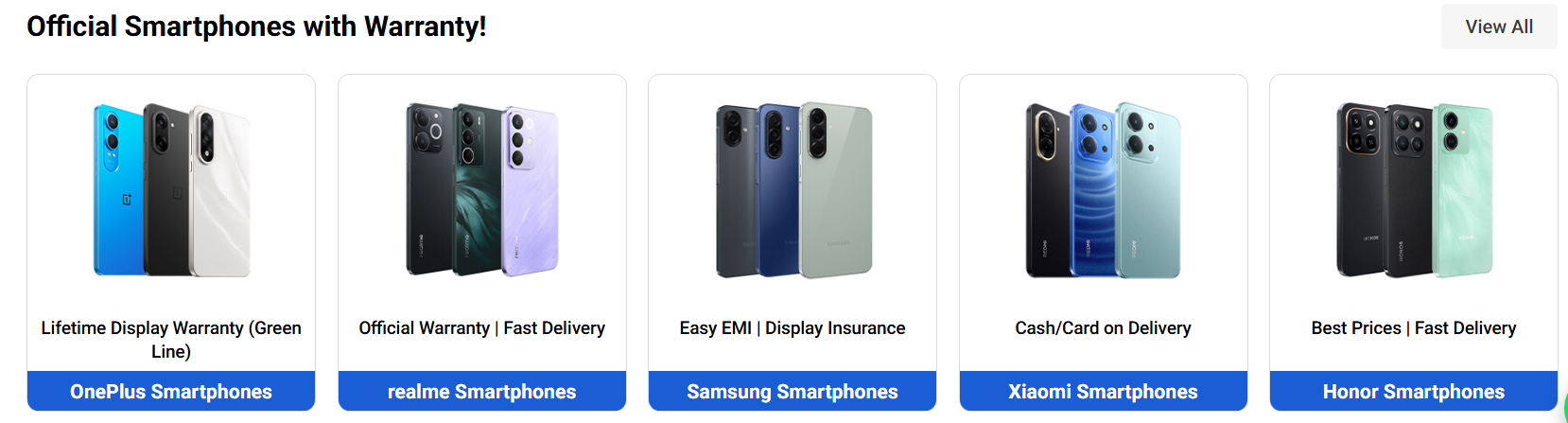
Around 2018-2019, Pickaboo faced what Talukder described as "an almost existential challenge." While the details remain private, the company's response proved instructive.
The conventional startup playbook in such situations typically involves raising more capital, doubling down on growth, competing aggressively on price, or expanding product categories to increase revenue. Pickaboo did almost the opposite. The company made a counterintuitive decision: prioritize sustainable unit economics over rapid growth.
"Instead of joining the discount race typical among startups, Pickaboo decided to go in the opposite direction, focusing on improving customer experience and services," noted a Future Startup analysis of the company's turnaround. "The strategy has paid off."
This meant resisting the discount wars to buy growth. It meant focusing obsessively on operational efficiency and customer experience rather than vanity metrics like gross merchandise value or transaction volume. Every strategic decision needed to generate sustainable unit economics.
By 2020, Pickaboo had achieved profitable unit economics with simultaneous growth. The company reported 19% month-on-month growth over six months while maintaining profitability, a combination that typically requires either exceptional operational discipline or mature market positions.
This discipline would prove crucial. When Pickaboo eventually expanded into electronics, it would do so from a position of financial strength rather than desperation.
While mobile phones and gadgets had been Pickaboo's foundation, the broader consumer electronics market represented a fundamentally different opportunity, one with characteristics that aligned perfectly with what Pickaboo had built over the previous years.
The market dynamics were compelling. Bangladesh's consumer electronics market, valued at approximately $9.7 billion in 2024 and projected to reach $13.5 billion by 2029, is substantially larger than the mobile phone market. This wasn't just about size; it was about fragmentation and opportunity.
Unlike mobile phones, where established players had already captured significant market share online, consumer electronics had no dominant online player. The category remained largely offline, characterized by traditional retail chains with high overhead costs, limited price transparency, and inconsistent service.
More importantly for Pickaboo, consumer electronics are an adjacent market to mobile phones. The two categories share underlying operational patterns that make strategic expansion logical rather than random diversification.
To that end, Pickaboo's move into electronics represents textbook adjacent market expansion, where existing capabilities transfer directly and create compounding advantages. As we observed in an earlier essay: "Once you associate a brand with a particular set of product categories, that brand automatically carries meaningful credibility when it expands into adjacent markets."
Operational adjacency
Mobile phones and consumer electronics share common operational requirements.
Both are high-value products requiring careful logistics handling and quality control to prevent damage during transit.
Both involve similar supplier relationship dynamics with major electronics brands, Samsung, Whirlpool, Bosch, LG, Haier, and Walton, where procurement volume can influence pricing power.
Both require comparable last-mile delivery capabilities, including trained personnel who can handle fragile, expensive items.
Both demand robust after-sales service expectations around installation, warranty fulfillment, and technical support.
Pickaboo spent seven years building operational excellence in these areas for mobile phones. When expanding to air conditioners, refrigerators, and televisions, these capabilities transfer directly. The supply chain infrastructure works. The logistics network functions. The quality control processes apply. The after-sales service systems translate.
This is significantly different from a mobile phone retailer trying to sell fashion or groceries. Those categories have entirely different operational requirements: different logistics, different supplier dynamics, different customer service needs. Electronics expansion leverages existing capabilities rather than requiring the development of new ones from scratch.
Trust adjacency
Perhaps more importantly, consumer electronics is a high-trust category, and trust is exactly what Pickaboo had spent years building.
When buying a 50,000 Taka refrigerator or 100,000 Taka television online, consumers need confidence that the product is authentic, that it will arrive undamaged and on schedule, that installation support is available if needed, that warranty claims will be honored without hassle, and that after-sales service exists if something goes wrong.
These trust requirements are identical to those that made buying smartphones online risky in 2016. And they're precisely the trust barriers Pickaboo had already overcome.
A customer who bought a Samsung phone from Pickaboo and had a positive experience, authentic product, on-time delivery, and responsive service, naturally extends that trust to a Samsung television or refrigerator from the same retailer. The brand equity built in mobile phones becomes the foundation for electronics' credibility.
This creates an asymmetric advantage. A new entrant to online electronics would need years to build equivalent trust through consistent execution. Pickaboo already possesses it. They can leverage seven years of trust-building to enter electronics with instant credibility that competitors must earn from scratch.
The move into electronics, which accelerated notably in 2024, shows strategic timing meeting operational readiness.
Extreme weather conditions in 2024, particularly severe heat across Bangladesh, drove unprecedented demand for air conditioners, refrigerators, and washing machines. Pickaboo was positioned to capture this demand surge because they'd already built the capabilities needed to execute at scale.
The results have been striking. When you sell over several hundred air conditioners daily, you achieve a procurement scale that can change market dynamics and negotiating power with suppliers. You can offer better prices to customers, driving demand and building loyalty. Pickaboo has done exactly that. The company claims it managed to offer significantly lower prices to customers, which reportedly had a market-wide impact. Traditional retailers now sell comparable air conditioners for a significantly decreased price from previous pricing. The transformation was driven by consumers using transparent online pricing as leverage in offline negotiations.
As Morin Talukder notes: "Go to any offline retail store, show them the online price for a Samsung refrigerator or Haier AC, and they will instantly discount." This dynamic wasn't possible two years ago.
This represents value creation in the truest sense. Rather than extracting value through information asymmetry or monopolistic market position, Pickaboo's electronics expansion has increased overall market efficiency.
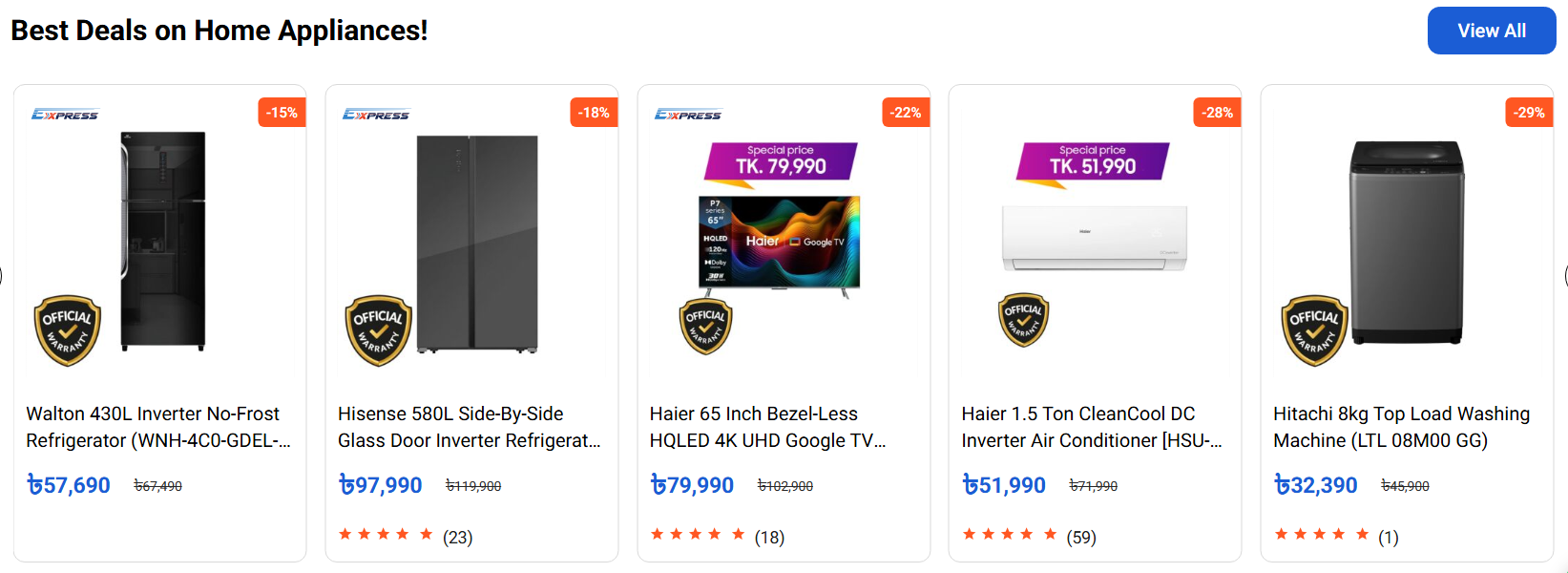
Pickaboo's electronics expansion is particularly interesting because the company is building a strong position in a market segment that lacked a dominant online player.
In mobile phones, Pickaboo competed against established online and offline players. Success required out-executing competitors in a relatively mature market where customer acquisition costs were high, and differentiation was challenging.
In electronics, the competitive landscape is different. No single player dominates online electronics retail in Bangladesh. The market remains fragmented across traditional retailers with limited online presence, smaller online players with limited scale, and horizontal marketplaces where electronics is one category among many rather than a strategic focus. This fragmentation creates an opportunity for a first mover who can execute well, and Pickaboo's seven years of operational discipline in an adjacent category positioned it to be that player.
The company now handles multiple electronics categories beyond air conditioners: refrigerators, televisions, washing machines, kitchen appliances, home electronics, air fryers, Starlink, etc. Each category benefits from the same operational advantages and trust transfer that worked for air conditioners.
The strategic question wasn't whether to expand into electronics; the adjacent market logic was compelling. The question was whether Pickaboo could execute the expansion while maintaining the operational excellence and profitability that defined its mobile business. Early evidence suggests it can.
Underpinning Pickaboo's electronics expansion is a meaningful data capability built during the mobile-focused years. The company operates on an 80/20 principle: 80% of decisions are data-driven, 20% based on informed assumptions.
"We collect information about users, albeit anonymous data, through cookies and other means," Talukder explained. "When people browse our website, we get to know how they navigate the site, products they view, and so on, that help us better serve our customers through better communication."
This data infrastructure enables several capabilities that translate directly from mobile phones to electronics.
Personalized remarketing based on purchase history and browsing behavior, a customer who bought a Samsung phone sees Samsung TV recommendations. Dynamic pricing based on competitive data and demand patterns. Inventory optimization across categories to minimize holding costs while maintaining availability. Targeted product recommendations that increase basket size and customer lifetime value.
The company's data shows insights like brand loyalty patterns, approximately 40% of Samsung phone users stick with the brand for their next purchase, while 60% switch. Applied to electronics, this behavioral understanding helps anticipate customer needs and cross-sell effectively across product categories.
For electronics expansion, this means using mobile phone data to inform the initial electronics strategy while remaining open to category-specific patterns that emerge. Air conditioners have more seasonality than mobile phones. Refrigerators may have different brand loyalty dynamics. The data infrastructure helps identify these differences rather than assuming mobile phone patterns transfer perfectly across all categories.
Pickaboo raised $1.5 million in a pre-Series A round in August 2023 from investors including IDLC Venture Capital Fund I, Startup Bangladesh Limited, Sr Infin, and Gero. Total funding to date: approximately $3 million.
For context, this is substantially less than what many e-commerce competitors have raised. It's also modest compared to what electronics inventory expansion and omnichannel retail buildout typically require.
"Raising capital remains a major challenge in Bangladesh," Morin acknowledges. "The amount of venture capital raised by all VC-funded ecommerce companies is meager compared to the opportunity the market offers."
However, capital constraints have arguably strengthened Pickaboo's business model. Without unlimited funding for inventory expansion across all electronics categories simultaneously, Pickaboo had to be selective and sequential about which categories to prioritize.
This forced strategic thinking. Rather than spreading resources across every possible electronics category, the company focused on categories where operational excellence and procurement scale created meaningful differentiation, starting with air conditioners during a heat wave, then expanding to refrigerators, televisions, and other appliances.
The result is electronics expansion built on sustainable unit economics rather than subsidized growth. Each category needs to work economically before expanding to the next.
This sequential approach may be slower than a capital-intensive blitz across all categories simultaneously, but it's also more sustainable and less risky.
Despite early success, Pickaboo faces significant challenges in becoming Bangladesh's premier electronics destination.
Operational complexity at scale. Electronics inventory is more complex than mobile phones. The product range is broader, from small kitchen appliances to large refrigerators and wall-mounted televisions. Installation and after-sales service requirements vary dramatically by category. Supply chain logistics must handle products with radically different sizes, weights, fragility levels, and storage requirements. Managing this complexity while maintaining service quality requires continuous operational innovation.
Supply chain leverage across categories. While volume in air conditioners provides strong supplier leverage, building similar advantages across all electronics categories takes time. Some categories may not reach sufficient volume for meaningful procurement advantages. The company must determine which categories justify strategic focus and which remain supplementary offerings.
Market education requirements. Mobile phone purchasing behavior is well-established online. Many electronics categories require more customer education. Buyers need information about specifications, energy efficiency ratings, installation requirements, and long-term maintenance costs. Creating content, comparison tools, and educational resources that facilitate confident online electronics purchasing requires sustained investment.
Competition response. As Pickaboo's success in electronics becomes evident, competitors will respond. Traditional electronics retailers are building online capabilities with dedicated teams and investment. Horizontal e-commerce platforms are strengthening their electronics offerings with category-specific focus and potentially deeper capital. International players may enter or expand in Bangladesh. First-mover advantage diminishes over time as competitors copy successful strategies and customer acquisition costs increase.
Funding requirements for sustained growth. Although Pickaboo has achieved meaningful capital efficiency, continued electronics expansion requires significant investment in inventory to maintain availability across growing SKU counts, delivery infrastructure, including installation capabilities for large appliances, and technology to support more complex operations. The company will need to balance its sustainability focus with the growth capital requirements of capturing market share before competition intensifies.
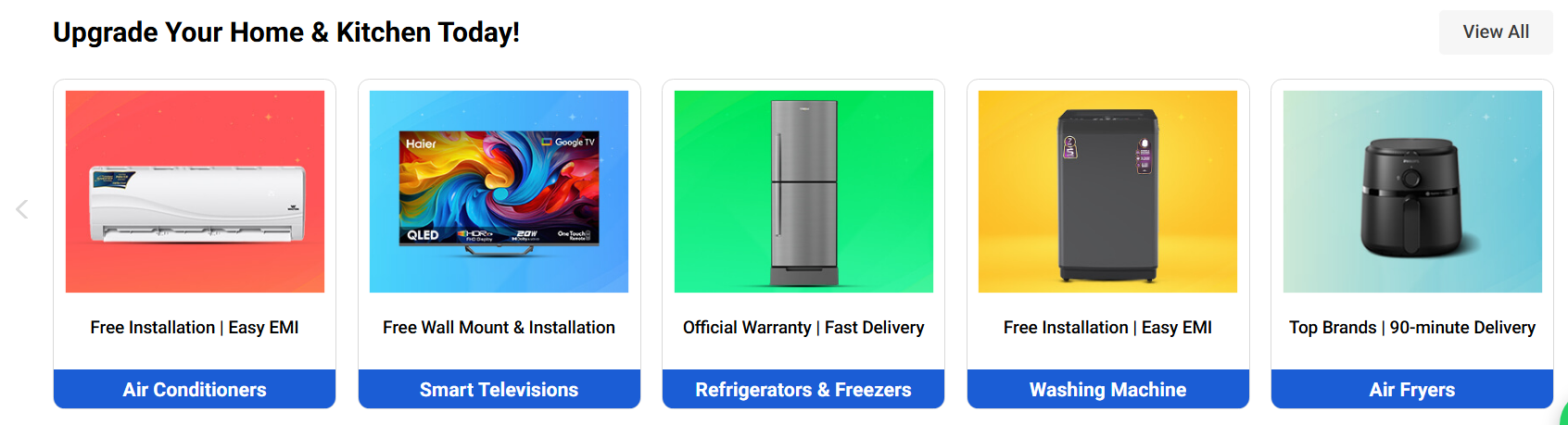
Looking ahead, Pickaboo's opportunity in consumer electronics is substantial. The market is large and growing. No dominant online player exists. The company’s operational capabilities transfer effectively from mobile phones. Its brand trust facilitates customer acquisition at a lower cost than building trust from scratch. Its capital efficiency enables sustainable expansion without dependency on continuous external funding.
If Pickaboo can maintain operational discipline while scaling across electronics categories, it could emerge as Bangladesh's premier online electronics destination. The expanding market provides an enormous growth runway, particularly for a player combining procurement scale with service excellence and brand credibility.
The challenges are real and significant. Execution complexity across diverse product categories, intensifying competitive pressure from both traditional retailers going online and horizontal platforms focusing on electronics, and capital requirements for inventory and infrastructure will test the organization's capabilities and strategic discipline.
But Pickaboo has demonstrated resilience and strategic clarity over eight years. The company that survived near-existential challenges in 2018-2019 to emerge stronger and more focused, that experimented with omnichannel retail and made the difficult decision to refocus on e-commerce core competency, that built profitability before pursuing aggressive scaling, has shown it can navigate adversity and make disciplined strategic choices under pressure.
The electronics expansion represents the culmination of eight years spent building operational excellence, trust, and sustainable economics in mobile phones. Rather than a desperate pivot, it's a calculated move into adjacent territory where those accumulated capabilities compound to create defensible advantages.
Whether Pickaboo ultimately becomes the dominant online electronics player in Bangladesh remains uncertain. Market dynamics can shift, competitors can learn and adapt, and execution challenges can derail even well-conceived strategies. But the company has positioned itself better than any current competitor to capture that opportunity through patient and disciplined strategic expansion. We’ll be watching closely what the company does next.