
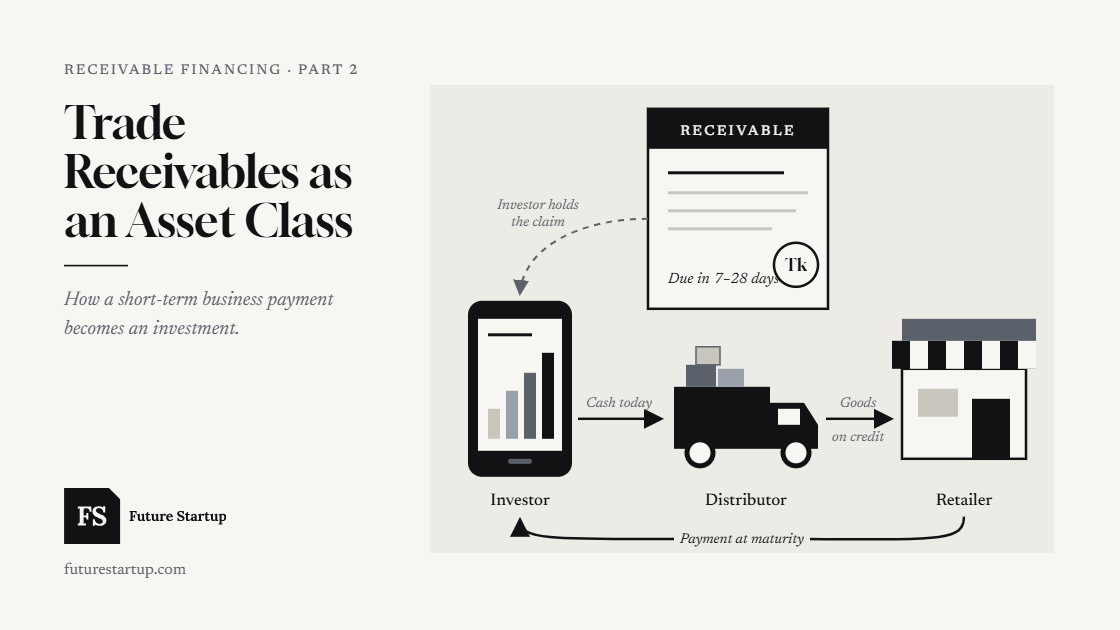
This is the second piece in our series on receivable-based financing in Bangladesh. The first article examined how trade receivables-based financing can reduce the SME financing gap. This piece takes the investor's perspective: what receivables are as an investment option, what they offer against other options in Bangladesh, and what investors need to understand honestly before putting money into receivables.
If you are a retail investor in Bangladesh, your investment options are limited. In many advanced markets such as the US, decades of regulatory development have built an accessible toolkit of index funds, ETFs, corporate bonds, REITs, Treasury instruments at different maturities, and commodity funds. Even neighboring India has seen mutual fund penetration expand significantly over the past decade, and its retail bond market has deepened. In Bangladesh, the choices come down to the stock market, national savings certificates, bank deposits, mutual funds, and then real estate if you have large capital.
Each of these options comes with both upsides and limitations. Bank deposits return roughly 8 to 11 percent a year on a one-year fixed deposit as of November 2026, depending on the bank, a modest real return once inflation, at 8.27 percent in October 2026 according to the Bangladesh Bureau of Statistics, is taken into account.
National savings certificates offer 11.77 to 11.98 percent depending on the scheme and amount, rates the government has kept unchanged for July to December 2026. They are government-backed and competitive in absolute terms, but most are five-year commitments (the three-monthly certificate runs three years) with lower rates for early encashment, and the government has repeatedly adjusted rates, purchase limits, and taxes.
The Dhaka Stock Exchange is the only option offering meaningful liquidity and upside potential, but the DSEX climbed above 7,350 in October 2021, its highest level since the index was launched in 2013, and has not approached that level since. In 2024 alone, the DSEX fell 16 percent. Over the long run, equities can reward patient investors. Recent years, though, have been difficult for many retail investors here, and the market still carries long-standing issues in corporate governance and market depth that regulators have yet to fully resolve.
Mutual funds offer diversification and professional management, and they have real potential, though the market is still small and investor trust is still being built.
Taken together, these options serve some investors well and leave others underserved. A retiree who wants steady income has good choices. A salaried professional who wants to set money aside for a few months, or a business owner with cash sitting idle between orders, has far fewer. Different investors need different mixes of safety, return, liquidity, and time horizon, and the current menu covers only part of that range.
This means there is a real and specific gap for short-duration, reasonably liquid, yield-generating instruments in Bangladesh's retail investment market that are less tied to equity markets, not subject to government rate decisions, and accessible at small ticket sizes.
Trade receivables, structured correctly, could fill that gap. The instrument has a history going back to the merchants of ancient Mesopotamia, a global market that turned over more than €4 trillion in 2025, and characteristics that fit the gap. Almost no retail investor in Bangladesh has ever held one.
Before evaluating receivables as an investment, it is worth understanding what the instrument is. Partly because it is different from everything else in Bangladesh's current retail market. Partly because your investment decisions should follow a clear understanding.
When an investor purchases a trade receivable, they are acquiring the documented right to collect a specific payment as an actionable claim from a specific counterparty within a specific timeframe. The underlying commercial transaction has already happened. Goods or services have been delivered. Obligations have been incurred. A buyer owes a seller a defined amount. The investor is not speculating on future earnings or taking a position on an economy's direction; they are buying an existing, documented obligation backed by the evidence of a completed trade.
Equity investing is fundamentally a bet on future performance, that is, future earnings, future growth, future management decisions. Receivable investing is a bet on a past transaction completing its payment cycle. The nature of the risk is different. The uncertainty is whether this buyer will pay this invoice on time. The variables are fewer, and the timeframe is short, usually days or weeks rather than years. The risk is analyzed partly based on the buyer's historical payment behavior rather than anyone's projection of future cash flows.
The short duration is one of the most important structural properties of trade receivables as an instrument. A trade receivable that matures in seven to twenty-eight days returns the investor's capital quickly, re-prices it at each cycle, and never accumulates the kind of silent, long-dated risk that characterizes longer-duration instruments.
A bank fixed deposit locks capital for months. A savings certificate locks it for five years. A trade receivable matures in less than a month. If something goes wrong with the underlying business, it surfaces almost immediately rather than after years of gradual deterioration.
This is what credit analysts mean when they describe receivables as self-liquidating. The asset converts to cash on its own schedule, as the buyer pays. It doesn't need to be sold into a secondary market, doesn't require a forced sale process, and doesn't leave the investor holding something whose value has to be estimated.
The binary outcome of paid or unpaid is easier to price and manage than open-ended instruments whose value depends on continuous market revaluation.
These properties make receivables a genuinely different kind of investment. This difference, of course, doesn't mean it is better than equities in every dimension, but it is meaningful in ways that matter for portfolio construction.
An investor who holds savings certificates and bank deposits has concentrated exposure to interest rate decisions and government fiscal conditions. One who holds stock is exposed to market sentiment, corporate governance risk, and the structural problems of the equity market.
A small allocation to trade receivables introduces a short-duration, transaction-backed instrument whose performance depends mainly on whether real businesses pay real invoices. That risk is bounded and transparent, and it is driven by different forces from the other two. It is not immune to the wider economy, though. When consumer demand weakens, distributors feel it too.
The case for receivables as an investment class is not that they are low-risk. It is that their risks are legible and manageable in ways that equity risk often is not. But you still have to understand the nature and extent of the risk before seriously considering the instrument.
The risk in trade receivable investing has four distinct components. Investors need to understand all four to make an informed decision. As in our first piece, we use Chamak, Bangladesh's only trade receivable investment platform, as an example to explain and understand the instrument.
The first is counterparty risk — the risk that the specific buyer named in the receivable doesn't pay. This is an obvious risk and is usually managed through borrower selection and guarantee structures. When a platform like Chamak targets established FMCG distributors with at least three years of operating history, businesses that major brands already work with, it is doing substantive credit assessment work before any investor capital is deployed. Personal and business guarantees, combined with the right to recover unsold goods, further reduce the counterparty risk. Moreover, a default reserve, a part of Chamak's current structure, built from every transaction's margin, provides a financial buffer.
For Chamak, the counterparty risk has so far appeared to be well managed. Across 130 crore taka in facilitated transactions, Chamak's actual defaults have run to around three lakh twenty-seven thousand taka in total, a default rate of roughly 0.025 percent. That figure reflects the quality of the selection process at current scale.
The second is platform risk — the risk that Chamak itself fails, faces regulatory action, or encounters operational problems that prevent it from managing the receivable portfolio and honoring its principal guarantee. This is a real risk and is different from counterparty risk. An investor's principal guarantee is only as good as Chamak's balance sheet and reserve fund. If the company were to fail for any reason, the recourse available to investors would be significantly less clear than if the receivables were held under a formal regulated framework. In practice, the principal guarantee does not remove counterparty risk so much as move it onto Chamak. If enough buyers default at once, the guarantee depends on Chamak's ability to pay, and if Chamak fails, the guarantee fails with it.
This means the instrument will need clear regulatory legibility today or tomorrow to truly become an asset class that people can rely on. While the regulatory framework for receivable trading is still unclear in Bangladesh, Chamak, the company says, is working proactively to follow the standard regulatory practices including engaging ACNABIN, one of the country's reputed accounting firms as their transaction auditor, clear control and separation on customer KYC, transaction and investor fund management. Additionally, Chamak is working with potential regulators to bring this under standard regulation.
The third is scale risk — the risk that early performance doesn't hold as volume grows. Every credit model looks excellent on its early portfolio, which tends to contain the best available borrowers selected with the most attention. The difficult test comes when volume grows by an order of magnitude, selection discipline is harder to maintain at the same intensity, and the reserve fund is tested during an economic downturn.
Bangladesh's own financial history has examples of this pattern in microfinance and alternative lending. Strong early performance, rapid scaling, and then a stress event that exposed inadequate reserves.
This is the risk that is hardest to evaluate from the outside and most important to keep in mind.
The fourth is concentration risk — the risk that comes from lending to one kind of business in one sector. Chamak's portfolio is built mainly on FMCG distributors. That focus is part of why selection has worked so well, because the sector is familiar and its payment patterns are easy to read. It also means a single shock to consumer goods distribution, such as a sharp fall in demand or a supply disruption at a major brand, would reach much of the book at the same time. Spreading money across many buyers helps less when those buyers share the same exposure.
Investors who consider and understand these risks and price them against the return will make a reasoned decision.
Trade receivable investing is not exactly a new or experimental category. The instrument, as we mentioned above, not only has a long historical background, but it is also quite well established globally. FCI, the global association for factoring and receivables finance, has close to 400 member banks, financial institutions and factoring companies in more than 90 countries.
The global factoring market processes trillions of dollars annually. There are also relevant precedents for what Chamak, our case in point for Bangladesh, is trying to do: take the instrument to retail investors through digital platforms.
In the United Kingdom, platforms like Kriya (formerly MarketInvoice) and Funding Circle built early retail markets for business invoice trading and SME lending in the 2010s. The platforms provided real returns, funded businesses that banks wouldn't work with, and the short-duration structure did produce more predictable cash flows than equity.
Funding Circle went public in 2018 at a £1.5 billion valuation and subsequently lost most of it, mostly because rapid scaling outran the quality of underwriting, loan losses exceeded projections during COVID, and the business model faced structural compression between the cost of capital and the yield the market would accept.
Several smaller invoice trading platforms that had attracted retail investors with attractive returns eventually wound down, leaving investors with recoveries well below face value.
A similar pattern followed in each case. Early performance was strong because early portfolios were carefully selected; scaling diluted that discipline before the reserve buffers were deep enough to absorb the losses.
India's Trade Receivables Discounting System (TReDS) is the other end of the spectrum, what the market looks like when it is properly institutionalized. TReDS is an RBI-regulated digital marketplace that connects MSME sellers, large corporate buyers, and multiple competing financiers in a structured, transparent, auditable environment.
Default rates on the platform have been low, partly because the buyers on the platform, large corporates owing the invoices, are creditworthy institutions whose payment behavior can be reliably assessed, and partly because competitive bidding by multiple financiers prices risk continuously rather than depending on a single platform's assessment.
The RBI issued the TReDS guidelines in 2014, and the first platforms went live in 2017. The government later required companies above a turnover threshold to register, first set at ₹500 crore and since lowered to ₹250 crore, bringing institutional participation that transformed the market's scale and reliability.
Bangladesh is currently closer to where the UK was in 2012: early, promising, working without the regulatory scaffolding that eventually separates instruments that endure from those that don't.
Global instances suggest that what happens in the next few years, both in terms of how platforms like Chamak REX (https://chamakrex.com/), Chamak's receivable investment platform, maintain underwriting discipline at scale and whether regulators develop a formal framework, will determine whether this becomes a durable asset class or another cautionary tale.
For investors considering the asset class, the specific terms available through Chamak's investment platform are worth examining, both as the most concrete example currently available and as a lens for understanding what to look for in any receivable investment platform.
The minimum investment is one thousand taka, making the asset accessible regardless of capital level. Receivables are automatically assigned to investor portfolios as transactions are originated, so capital is deployed continuously rather than sitting idle between allocations. At current scale, maximum transaction maturity is twenty-eight days. Investors can track portfolios in real time, with visibility into exactly which transactions their capital is funding. Annualized returns sit at thirteen to fifteen percent, capped deliberately as a structural decision rather than a market constraint.
The return cap is a meaningful decision. Most investment products compete by offering higher returns. Chamak constrains its returns because the principal guarantee, the mechanism that makes retail participation viable, must be funded from the spread between what the underlying businesses pay and what investors receive. A platform that offered twenty percent returns would either need to charge businesses rates that make the economics unworkable, or accept that the guarantee is less well-funded.
The thirteen to fifteen percent cap is the rate at which the reserve can accumulate fast enough to remain credible under a stress scenario. Whether that rate is sufficient under stress conditions at ten times the current volume is a question that can only be answered by watching the portfolio perform at that scale.
The principal guarantee is important. Chamak states on its investor page that it guarantees full protection of investor principal: if a borrower defaults, Chamak returns the principal. The default reserve that is built from every transaction's margin is expected to fund this guarantee. At current volumes, the reserve has been adequate.
Three lakh twenty-seven thousand taka in actual defaults across 130 crore taka in transactions is a default rate that the reserve can absorb without stress. The question is what happens to the reserve if the default rate normalizes upward as volumes grow, as borrower selection becomes harder to maintain with the same intensity, and as the economic cycle turns unfavorably.
For investors who keep their allocation small, the kind of slice usually given to a new and untested asset, the risk profile looks reasonable against the alternatives. The return beats savings certificates, and capital comes back far sooner than a five-year certificate allows. The duration is shorter than equities. The risk is bounded and transparent. The principal guarantee provides a floor, as long as Chamak is able to honor it.
For investors putting in a significant portion of their savings on the strength of early performance numbers alone, the analysis is more complicated.
The other dimension of risk in the current receivable market in Bangladesh that investors should understand is that the regulatory framework for this asset class does not exist yet.
Chamak's model, as the company explains, is legible under Bangladesh's Transfer of Property Act, which permits the transfer of unmortgaged debts as actionable claims.
However, Chamak's transactions are commercial sales and actionable claim transfers, not loans in the conventional sense, and currently sit outside the Bangladesh Bank's regulatory perimeter, which covers financial institutions and their lending activities. There are no formal guidelines governing who can originate, trade, or hold these claims; no disclosure requirements; no investor protection standards specific to this instrument.
This means an investor who buys a receivable through Chamak's platform has recourse through the underlying commercial guarantee structure and through general contract law, but not through a financial regulatory framework designed to protect investors in this specific instrument.
If the platform faces regulatory action, if Bangladesh Bank or another authority decides at some point that the activity requires licensing or falls under existing regulations, the implications for outstanding investor positions would be uncertain.
Chamak is working toward regulatory clarity, building a legal record, and planning eventually to present the model to regulators for a formal framework. Debasish Chakraborty, the founder, has described the strategy: operate within existing law, document carefully, and engage with regulators from a position of demonstrated track record.
In the meantime, Chamak has put in place some of the safeguards a regulator would expect. It has engaged ACNABIN, one of the country's reputed accounting firms, as its transaction auditor, and it keeps customer KYC, transactions, and investor funds under separate controls.
This is the right approach, and for anyone innovating in a new space, few alternatives exist. It is also, by definition, an approach that leaves regulatory uncertainty in place for the period of time it takes to execute.
Investors who understand this and price it into their allocation decision are taking a considered position.
The regulatory grey area is a real risk. However, it is not a reason to dismiss the instrument. Most genuinely new financial instruments spend time in regulatory grey areas before formal frameworks emerge, but it is a risk that deserves honest acknowledgment. Microcredit is a useful example. BRAC began its work in 1972, and Grameen's experiment began in the late 1970s, but the Microcredit Regulatory Authority Act was not passed until 2006. Regulators often need years to understand a new activity before they write rules for it.
All that said, here is the investment case for a small allocation.
Bangladesh's retail investors currently have a narrow menu for building a diversified portfolio.
The equity market has underperformed since its 2021 peak. Savings certificates are safe and government-backed, but they lock money in for three to five years at rates the government sets. Bank deposits are safe and flexible, but their return after inflation is modest. Real estate can hold its value well, but it needs large capital and is hard to sell quickly.
Trade receivables offer something genuinely different. A short-duration instrument backed by real commercial transactions, with returns that are competitive with the best available alternatives, a risk profile that is transparent and bounded rather than diffuse, and a maturity structure that means the investor's capital is re-evaluated every twenty-eight days rather than locked in for years.
For a retail investor with some risk tolerance and a portfolio that currently sits mostly in savings certificates and bank deposits, a small allocation to trade receivables — through a platform like Chamak with a demonstrated track record and a stated principal guarantee — represents a reasonable diversification step.
For institutional investors, particularly development partners, financial institutions, and impact-oriented funds, the opportunity is different. As we described in our analysis of the SME financing gap, the capital flowing through receivable platforms is directly traceable to specific working capital transactions in specific businesses. The return and the economic impact are the same transaction, not separate considerations.
An institution that wants to fund SME working capital while earning a return and maintaining short-duration liquidity will not find many instruments that deliver all three. Trade receivables do.
The limitation in that case is clear. The asset class works when the underlying credit model is sound, the platform is financially healthy, the regulatory environment is stable, and volumes are growing without diluting selection discipline.
Investors who can form a view on each of those conditions are in a position to make an informed allocation decision. Investors who are attracted primarily by the return without engaging those questions are taking on a risk they haven't understood.
The global experience with retail receivable investing points to a pattern where the early years of a new platform produce strong performance on the back of careful early portfolio selection, the best early borrowers, and the reserve builds on a clean base. The difficult years come when volume grows, selection discipline gets harder to maintain, the economic cycle turns, and the reserve is tested.
Bangladesh's receivable financing market is currently in its early years. The track record of Chamak, as we noted above, is impressive. The model makes sense. The instrument has characteristics that meet a real gap in the investment menu.
The question this market has to answer over the next three to five years is whether the discipline that has produced that track record can be maintained as volume grows by an order of magnitude.
The answer depends partly on the quality of Chamak's technology and credit model, and partly on Bangladesh Bank. The market needs a regulatory framework that leaves room for innovation while giving investors real accountability and transparency.
This is the second piece in Future Startup's series on receivable-based financing. Read the first — How Receivable-Based Financing Can Reduce the SME Financing Gap in Bangladesh. Up next in the series: the role of Chamak in building the infrastructure for receivable financing in Bangladesh. Future Startup covers Bangladesh's business economy with the depth it deserves.
You can learn more about Chamak here: https://chamakinc.com/
This article is for information purposes only and must not be treated as investment or legal advice.
The FS Letter brings the week's interview, our analysis and a few pieces from the archive. Free, once a week. Sign up and we will send you our quarterly ebook of the best interviews.
Subscribe and get the ebookHow to Build brings together our founder interviews on how companies in Bangladesh are built.
Get the book Order copies for your teamFor companies
FS Narrative Studio tells it through reported stories, published here and sent to our readers. See how it works