
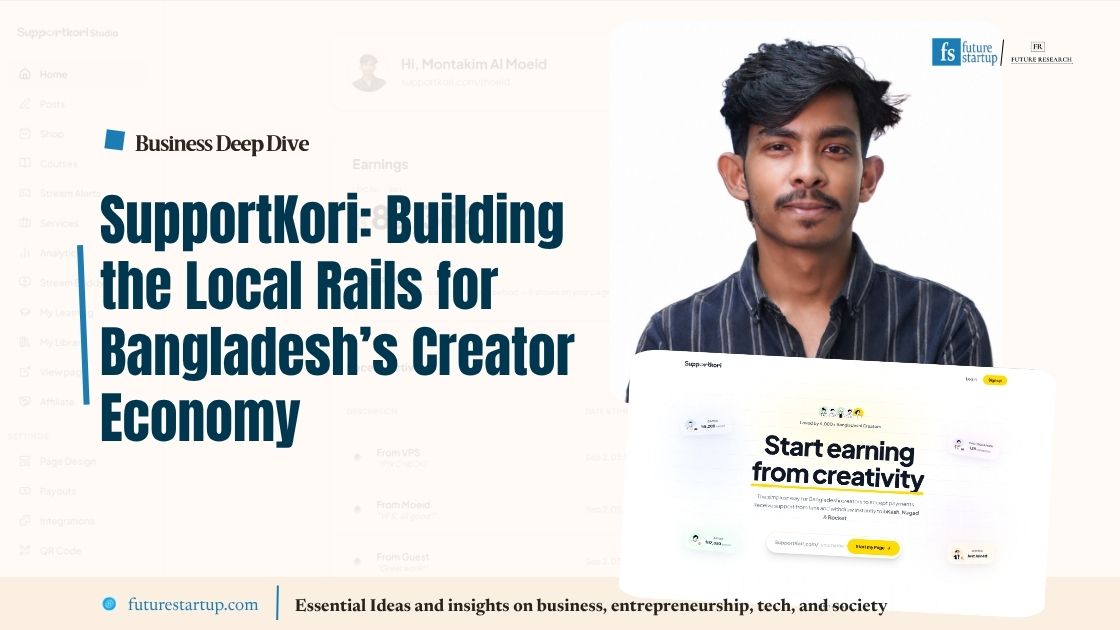
SupportKori started as a ‘Buy Me a Coffee for Bangladesh’. It is now building a broader creator-commerce platform around a simple thesis: Bangladesh has the creators and the audience. What it has lacked is the infrastructure connecting the two.
Over the last several years, the idea of the creator economy has gone mainstream in Bangladesh. Bangladeshi creators have built meaningful audiences on Facebook, YouTube, Instagram, and other platforms—teaching, streaming, designing, writing, photographing, and making videos around their expertise.
But turning that audience into direct income has been the hard part. Unlike many markets, payment infrastructure remains a critical challenge for digital entrepreneurship in Bangladesh.
A creator may have thousands of followers and still struggle to sell a ৳500 digital product, collect a payment for a course, receive a live tip, or turn an audience into a paying community. The audience has the money and the will to pay. The creator has the product. The rails don't connect the creator, the audience, and the payment system.
That is the gap SupportKori, a Dhaka-based creator monetization platform, is trying to close. Creators can receive support, sell digital products, run courses, accept live SuperChats, and participate in affiliate marketing from a single account. The company describes itself as a platform for Bangladeshi creators to accept payments, receive fan support, sell digital products and courses, and monetize their audiences. The platform supports bKash, Nagad, and Rocket alongside card payments, and integrates with OBS, Telegram, Discord, Meta Pixel, and webhooks.
In an interview with Future Startup, founder Montakim Al Moeid said the platform had crossed 7,000 registered creators. It launched publicly in January 2026. It is still small and built by one person—Moeid.
Moeid explains his unique insight behind the company is that “in Bangladesh, monetization is not a payments problem or a content problem; it’s a rails-and-trust problem, and it has to be solved locally. Every global player treats local payment support as a 'later' feature. My thesis is the opposite: for this market, local payment rails aren't a feature; they're the entire foundation. If a creator can't get paid into the wallet they actually use, nothing else matters, not the storefront, not the course player, not the analytics. So SupportKori is built payments-first, and BDT-first, and everything else is layered on top of rails that already work for both the fan paying and the creator getting paid.”
Moeid is 21, studying for a BSc in Electrical and Electronic Engineering. He is also SupportKori's sole developer and handles product, engineering, design, marketing, and day-to-day operations himself. His brother helps with harder engineering problems and major decisions.
There are no employees, contractors, or agencies. The entire platform has been built in-house.
The problem SupportKori is trying to solve, and the way the company is solving it, make it an interesting case study in agency, tenacity, and passion. In this article, we take a closer look at Bangladesh’s first creator monetization platform.
While Moeid didn’t set out to build a payments-adjacent company, he has been on this trajectory for quite some time. He took a circuitous path to starting SupportKori. As we have repeatedly explained in these pages, almost every entrepreneurial journey takes a circuitous and winding path. Moeid’s story explains it once more.
During the COVID lockdowns, he taught himself cinematography, video editing, web development, and digital marketing. The skills accumulated into something more useful than a collection of hobbies.
“The skills that actually built the company came from the COVID lockdown years,” explains Moeid. “I was shooting and editing video, then building the websites to host it, then figuring out how to market it.”
By the time SupportKori came along, he had become comfortable doing the entire product cycle himself: designing, building, and shipping.
Before SupportKori, he built ZBSMCric.live, a full-stack cricket tournament platform for his school community, with live scoring, streaming integration, player auctions, and tournament management.
The experience gave him something that formal training had not: shipping a complete product for real users under real deadlines.
That became kind of an early training ground for SupportKori.
“I'd already spent years being the person who does all of it: design the thing, build the thing, and ship the thing,” Moeid reflects.
SupportKori is fully self-funded. No external investment has been taken to date, according to Moeid. Moeid doesn't frame the lack of capital as the binding constraint. He frames the lockdown years as the actual seed funding.
“The honest version of our ‘initial investment’ is that the main resource was skill, not money,” he says. “I already had the cinematography, design, and development in hand from the lockdown years, so I could build the entire product, all the visual assets, and the marketing myself instead of paying anyone for any of it. That's what let one 21-year-old put a full platform on the internet with no outside capital.”
It is an unusually literal example of a solo founder substituting capability for capital.
SupportKori remains remarkably lean.
“It’s me,” Moeid says. He handles product, engineering, design, marketing and day-to-day operations. His brother helps with difficult engineering problems and larger decisions. There are no employees, contractors, or agencies, he says.
The upside is speed. There are no product meetings. No approval chain. No handoffs between engineering and design. If something needs fixing, Moeid can fix it.
The company operates around four basic functions: product and engineering; payments and payouts; trust and safety; and creator growth.
However, the downsides are obvious too.
Moeid is also the single point of engineering failure. As the user base grows, the company will need more operational depth. Payments require reliability. Creator support requires responsiveness. Trust and safety become more difficult as volume increases.
The very thing that makes SupportKori fast today could eventually become the thing that limits its growth.
That is probably one of the most important decisions the company will face over the next stage.
Moeid understands the challenge: “I’m the single point of engineering. It’s a strength for speed and a risk for scale.”
For now, however, the trade-off has helped SupportKori remain capital-efficient.

SupportKori did not begin as a creator-commerce platform. The original idea was much simpler.
“The first version of SupportKori was essentially ‘Buy Me a Coffee, but for Bangladesh’, a way for a creator to receive a tip or a bit of support from their audience,” Moeid says. The idea was to give creators a simple page where their audiences could send them money.
The problem was that global creator monetization platforms like Patreon, Gumroad, Ko-fi and Buy Me a Coffee are built around payment rails that assume a card, a foreign payout account, a Stripe-supported country. None of that fits Bangladesh well.
“The motivation was a frustration I kept seeing everywhere,” Moeid explains. “Bangladesh has a huge, young, genuinely talented creator base. But almost none of the global tools that let creators actually earn directly from their audience work here. Patreon, Gumroad, Ko-fi, Buy Me a Coffee- they all assume you have a card, a foreign payout account, a Stripe-supported country.”
A Bangladeshi creator might have an audience, a product and people willing to pay. But getting that payment into a local wallet could become the difficult part.
“A creator in Bangladesh with 50,000 engaged followers has no clean way to sell them a PDF, host a course, or take a SuperChat and get that money into their bKash or Nagad,” Moeid says. “I'd lived the creator side of this myself during lockdown, so it was never an abstract market; it was a problem I'd personally hit.”
That became the central insight behind the company.
“In Bangladesh, monetization is not a payments problem or a content problem, it's a rails-and-trust problem, and it has to be solved locally.”
This is the part of SupportKori's thesis that matters most. Local payment support as the foundation of the product. The platform currently allows creators to receive payments through local methods including bKash, Nagad, and Rocket, while its website also lists card payments.
The idea is that the fan should be able to pay using the payment method already in their hand, and the creator should be able to receive the money through a payment system they already understand.
From there, it grew feature by feature: digital product sales first, then courses, then Stream Buddy for streamers, then affiliate marketing. Each one shipped only after the last was solid.
SupportKori's current product still retains that simplicity. A creator claims a unique page, shares it through social channels, and receives support from fans.
But the company quickly discovered that tipping was only one part of the problem. Creators had other things they wanted to sell.
So SupportKori expanded. Digital products came first. The platform now lets creators sell PDFs, presets, graphics, source code, and other downloadable products, with automated delivery.
Then came courses. Creators can upload lessons, set prices, and let SupportKori handle hosting, access, and payments.
Then came live SuperChat-style support for streamers. And more recently, affiliate functionality. The product evolved from a tipping page into a broader creator-commerce platform.
Moeid sees that evolution as a consequence of one broader insight. First, that local rails have to be the foundation, not a bolt-on. Second, that creators don’t want five separate tools; they want one tool that can take care of the entire commerce stack for them.
“Creators don’t want five separate tools. They want one place to sell a digital product, run a course, take live tips on stream, and run affiliate deals — with one payout,” Moeid explains. “Fragmentation is the tax creators pay for using global tools that were never designed to work together in this market.”
SupportKori is trying to become the commerce layer sitting underneath a creator's existing audience. The creator brings the audience. SupportKori provides the monetization infrastructure.
A critical aspect of this infrastructure is local payment. For a global platform, supporting bKash or Nagad might be an incremental market feature. For SupportKori, local payments are the starting point. “Every global player treats local payment support as a ‘later’ feature. My thesis is the opposite: for this market, local payment rails aren’t a feature; they’re the entire foundation,” Moeid says.
He puts the logic even more bluntly: “If a creator can’t get paid into the wallet they actually use, nothing else matters, not the storefront, not the course player, not the analytics.”
Moeid explains that what SupportKori is doing is both necessary and important for Bangladesh, partly because “we're not asking creators or fans to change their behavior,” he explains. “The fan pays with the wallet already in their hand. The creator gets paid into the wallet they already use. We just built the missing layer between them - and made it one platform instead of five.”
For a creator, using SupportKori looks simple: a page, a payment button, a product listing, a course, a dashboard. The platform breaks into four earning tracks, plus payouts, under one account:
The platform primarily serves Bangladeshi content creators, educators, streamers, and small digital sellers and, through them, their audiences. The creator is the account holder; the fan is the payer. The platform is entirely digital and self-serve. A creator signs up, sets up their storefront, courses, or stream tools, and shares a link. Payments go through local rails, and payouts land in the creator's own account.
For a creator, SupportKori can look simple. A page. A payment button. A product listing. A course. A dashboard.
The harder work sits underneath what a creator sees: security, payout reliability, fraud prevention, moderation. "Alongside every feature, I invested heavily in the parts users never see: the security, the payout reliability, the moderation," Moeid says. "In a product that handles other people's money, that invisible work is the product."
That philosophy is reflected in the platform's public documentation, which includes dedicated sections for payments and payouts, trust and safety, integrations, and creator support.
The company says it's a legally registered business with a trade license, processes payments through EPS, a Bangladesh Bank–authorized aggregator, and describes its payment environment as PCI-DSS compliant and 256-bit encrypted. It says it operates on top of licensed payment rails rather than as a licensed payment institution itself.
The company also publishes security and legal policies and identifies its government registration number on its website. For an early-stage platform handling money, these details matter. The product's success ultimately depends less on whether a creator can create a page in 60 seconds than on whether the payment works when a fan tries to send ৳500.
Creators join for free. SupportKori takes a flat 5% fee on transactions — no subscription, no listing fee. If a fan sends ৳100, SupportKori takes ৳5 and the creator receives ৳95. Withdrawals go to bKash or Nagad, with a ৳500 minimum.
"We only make money when a creator makes money," Moeid says. The tradeoff: payment processing is the company's largest variable cost, and it comes directly out of that 5%. "The processing cut is our biggest cost, so pricing and margin have to be managed carefully."
This is attractive to creators because there is no upfront cost. It is also attractive strategically because it aligns the platform with creator success.
At the same time, the model creates a specific incentive for platform expansion. More creators matter. But more transactions matter more.
A creator who signs up and receives two Tk50 tips does little for the business. A creator who sells courses, digital products, receives regular support, and generates affiliate transactions can be economically meaningful. That helps explain why SupportKori is expanding from tipping toward creator commerce. The additional products are not only useful to users. They potentially increase the economic value of each creator relationship.
So far, SupportKori has not built its growth around a large advertising budget.
Moeid says growth has come from the product itself and from creators sharing it with their audiences.
That makes sense for the product. A creator signs up. They receive a personal SupportKori URL. They put it in a Facebook page, YouTube description, Instagram bio or another channel. The audience arrives there.
The current SupportKori onboarding flow is designed around exactly this behaviour: create a page, share the link, get paid. This gives the product a built-in distribution mechanism.
The creator distributes SupportKori every time they distribute their own work.
Affiliate marketing adds another layer. If creators promote products made by other creators, the platform can potentially create a network effect around its own marketplace. Creators become both sellers and distributors.
That is more interesting than simply acquiring creators one by one through paid advertising. It gives SupportKori a chance to turn its users into part of its growth engine.
SupportKori's obvious competitors, global creator platforms like Patreon, Gumroad, Ko-fi, Buy Me a Coffee, Kajabi, and Teachable, are far larger and better resourced. SupportKori does not have a realistic path to beating them at their own game.
Moeid doesn't pretend otherwise. How he points out he is playing a different game."How big we are vs. them: honestly, tiny. But we're competing on fit, not size."
The opportunity exists because global products do not necessarily optimise for Bangladesh.
The bet is that local fit compounds: BDT pricing, local payout behavior, local campaigns like the Eid Salami flow, creator support, local campaigns, and a single unified account instead of five disconnected tools.
Features such as the company's Eid Salami gifting flow. And an understanding of how Bangladeshi creators actually sell things to their audiences. The company is effectively making a geographic bet. It does not need to win the global creator economy. It needs to become difficult to replace inside Bangladesh.
That said, none of that is a durable moat by itself. A competitor could build a tipping page. A competitor could integrate bKash. A competitor could build a course player or an affiliate system, each individual feature is reproducible.
What's harder to copy is the accumulated system underneath around those features: creator relationships, payment integrations, transaction history, trust, support, brand, distribution, and eventually habit.
This is why SupportKori's emphasis on trust matters.
Moeid describes security as a first-class product concern rather than something added later. Content safety is automated, while the small user base allows him to provide direct support to creators.
The company's website says payments are secured through SSLCommerz and EPS and describes its payment environment as PCI-DSS compliant and 256-bit encrypted. Its terms say SupportKori deducts a flat 5% platform fee and operates payouts through local wallets.
For a normal SaaS product, these details might sit in the background. For a platform handling other people's money, they are the product.
Moeid puts it bluntly: “When you're handling other people's income, self-deception is the most expensive habit you can have.” That may be the right operating philosophy for the company.
The other challenge for SupportKori is culture. Tipping or buying directly from creators is not yet a dominant cultural habit in Bangladesh. People do pay for courses and books and so on. But paying for digital products is still an emerging habit. It means SupportKori will also have to work on customer education before it finds significant scale.
The company is building its growth strategy on three adjacent ideas. First, local payment and payout infrastructure. Second, a unified product rather than multiple disconnected tools. Third, creator referral loops that can turn users into distributors. If creators already have audiences, a creator platform does not necessarily need to acquire every new user itself. Each creator can become a distribution node. SupportKori's growing set of creator tools is therefore also a potential growth engine.
The opportunity is clear; the execution is harder. SupportKori has to build trust among creators routing real income through a young platform. It has to keep payments and payouts reliable as volume grows. It has to manage fraud and abuse at a scale a single founder can no longer personally oversee. And it has to hold its margin as payment processing eats into a flat 5% fee.
Five specific problems stand out:
The timing of the business matters. Globally, Adobe's 2022 Future of Creativity study counted more than 303 million creators across nine markets, and the broader creator economy is widely estimated near $250 billion.
Bangladesh's own influencer-marketing market, brand-driven spend, not direct fan monetization, was projected at about $35 million in 2025, growing toward $49 million by 2029, per Statista. Direct creator-to-fan monetization, by Moeid's account, "barely exists" here yet.
Bangladesh has 77.7 million internet users and roughly 60 million social media user identities, per DataReportal. Mobile financial services are further along: Bangladesh Bank's 2024–25 data puts registered MFS accounts at 240.46 million as of February 2025, including 239.24 million personal accounts, with nearly Tk1.72 trillion moved through MFS in January 2025 alone.
These figures should not be read as 240 million individual users. People can hold multiple MFS accounts, and Bangladesh Bank explicitly notes that account figures do not necessarily represent unique users.
The underlying point is important. The country already has a large digital audience and a deeply established mobile-payment habit.
The ingredients are in place: creators, audiences, smartphones, and a mobile-payment habit. What's missing is the behavior of paying creators directly rather than through ads, brand deals, or platform payouts. SupportKori is trying to build a layer on top of those existing behaviours.
Moeid describes the problem in simple terms. “Bangladeshi creators can produce and distribute content at global scale, but can't monetize directly at local scale. They earn from ad-share and brand deals, money that flows to them from platforms and agencies, but they have almost no infrastructure to earn directly from their own audience in local currency.”
He further explains: “A creator in Bangladesh with 50,000 engaged followers has no clean way to sell them a PDF, host a course, or take a SuperChat and get that money into their bKash or Nagad. The audience has the money and the will to pay. The creator has the product. The rails just don’t connect.”
Moeid is betting that changes: "Direct creator monetization in Bangladesh goes from 'almost nonexistent' to 'expected.'" If it does, a YouTuber stops depending entirely on ad revenue, a designer sells templates directly, a teacher sells a course, a streamer gets paid mid-broadcast. The audience stops being only an audience and becomes a customer base.
The opportunity is clear. However, the execution challenge is hard.
SupportKori has to build trust among creators who are being asked to route real income through a relatively young platform. It has to keep payment and payout systems reliable. It has to manage fraud and abuse. It has to maintain margins when payment processing costs take a significant share of its 5% platform fee.
And eventually, the company has to move beyond its dependence on one person. Moeid also points to regulatory clarity as an increasingly important consideration. “As volume grows, being clear about our legal and payments status matters more, not less.”
These are not minor operational details. They will be the difference between a useful creator tool and a piece of financial infrastructure as the platform grows.
For now, SupportKori's near-term goal is relatively restrained. Moeid says, “polish and stabilize what’s live, deepen creator adoption, and keep making the whole thing easier for everyone who touches it.” The long-term ambition is more expansive. “Become the default monetization layer for Bangladeshi creators; the one place any creator here goes to earn directly from their audience,” he explains. That could eventually include memberships, deeper analytics, additional payout options, and other creator-business tools, built, he says, on the same foundation.
Moeid sees a five-year shift: Bangladeshi creators moving from monetizing mainly through platform advertising and brand deals toward direct audience commerce — courses, products, memberships, tips.
The global comparison is large. Hundreds of millions of creators, a creator economy estimated in the hundreds of billions of dollars. However, for SupportKori, the more relevant number is local: Bangladesh already has the audience, the digital distribution, and the mass-market mobile payments.
What it hasn't had is the infrastructure for creators to own the economic relationship with their audience directly. That's the gap Moeid wants SupportKori to occupy.
Moeid's advice to other founders doubles as a description of how he built this one: "Solve a problem you've personally lived. Start smaller than feels ambitious. Learn to build the thing yourself if you can — it completely changes what's possible when you have no money." And, given what the business handles: "Be relentlessly honest about the weak points in what you've built, especially where other people's money and trust are involved."
SupportKori is still early, and its larger economic thesis remains to be proven at scale. But the underlying bet is a clean one: the next stage of Bangladesh's creator economy may not need another global platform. It may need better local rails. And that is what SupportKori is trying to build.