
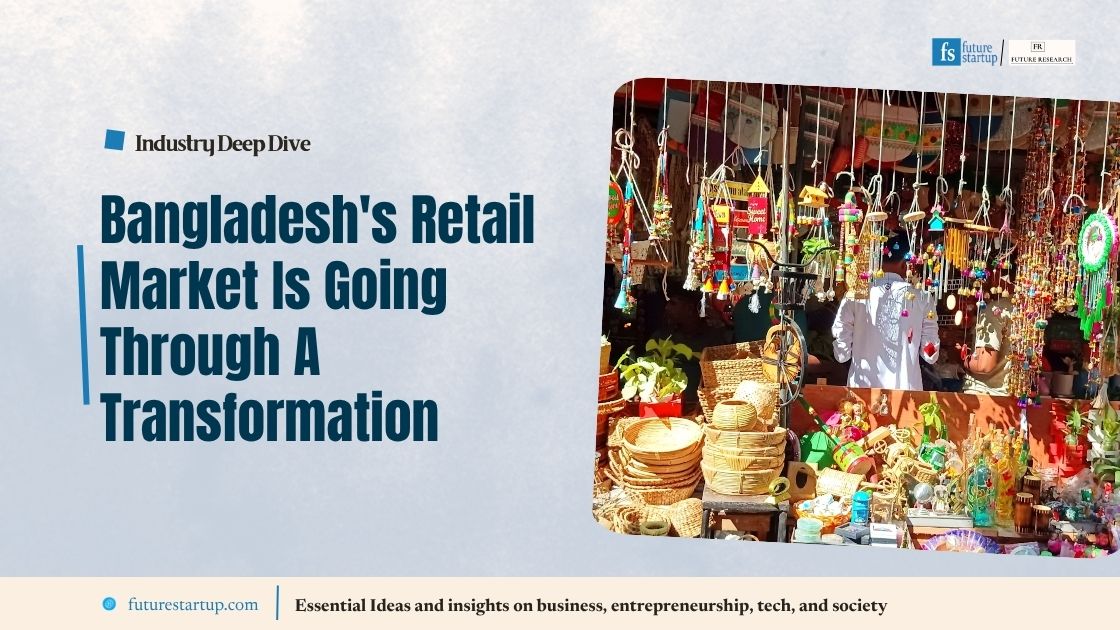
Bangladesh's retail market is transforming as traditional shops, modern retail, e-commerce, and digital distribution converge. We look into what's changing and what's next.
Bangladesh’s retail landscape is going through a metamorphosis. For decades, millions of small shops have dominated the country’s retail landscape. The neighbourhood grocery store, or mudi dokan, the local pharmacy, electronics shop, and small market stall have served as the final link between manufacturers and consumers. Large companies built factories, brands, warehouses, and distribution networks. Small businesses owned the last-mile relationship with the customer.
That model remains dominant. But a different retail economy is taking shape around it. Many people call it organized retail.
This story of organized retail is not new.
Modern superstores began appearing around 25 years ago. PRAN-RFL was among the early movers, followed by players such as Shwapno, Agora, Meena Bazar, Unimart, and many other small and large players.
These businesses gradually built a market around organized shopping, wider assortments, consistent store experiences, and greater convenience.
But the sector remained small. For much of its first two decades, modern retail accounted for only around 3% of urban retail sales. According to some estimates, this number has recently reached around 5%.
There were good reasons for this rather slower growth.
Bangladesh’s traditional retail system was and is convenient. The country is densely populated, and its retail shops are everywhere. In most neighbourhoods, customers can find a shop within a short walk from home. They can buy in small quantities, and avail informal credit if needed. Shopkeepers know their customers and, in many cases, their families. Wet markets and traditional shops have also historically competed aggressively on price.
For a price-sensitive population used to this model, the proposition offered by a supermarket was not always compelling enough to change behaviour.
Organized retail also faced structural constraints. Investment remained limited. Retail infrastructure was underdeveloped. Regulatory and tax issues made formal retail more difficult to operate. And modern retail remained concentrated largely in major urban centres.
Yet the foundations for a different model were being built.
Large manufacturers began moving deep into retail, building branded outlets and experimenting with different formats. PRAN-RFL became one of the clearest examples. Best Buy began in 2011. Vision Emporium followed in 2013. RFL has since built a network spanning Best Buy, Vision Emporium, Regal Emporium, RFL Exclusive, Mithai, and other branded formats.
The group’s retail ambitions have also extended into groceries, food, restaurants, and other consumer categories. Our earlier analysis of PRAN-RFL documented more than 3,000 outlets across its various retail brands. We have written about PRAN-RFL’s retail strategy before.
PRAN-RFL's example shows that the idea of owning more of the retail relationship is not new. What is new is the scale and breadth of companies now pursuing it.
Over the past several years, some of Bangladesh’s largest business groups have moved deeper into retail. ACI has continued to expand Shwapno, which recently crossed 1,000 outlets. Meena Bazar, Unimart, and Agora continue to build their networks. Akij has Metro Mart and Akij Pharmacy. Meghna Group has entered small-format retail around Dhaka’s metro stations and other selected locations. Independent chains such as Prince Bazar have also continued to expand.
However, the movement is not limited to local conglomerates.
International retailers are beginning to pay attention to Bangladesh as well. Indonesian retail giant Alfamart has entered the market through a joint venture with Kazi Farms Group and Mitsubishi Corporation. Pharmacy retail is seeing its own wave of investment, with local and international companies exploring organized formats.
These are only some of the developments underway. Taken together, however, they point to the fact that retail is changing and that change is gaining momentum by the day.
The numbers indicate the speed of the change.
According to USDA data reported by The Daily Star, supermarket-chain outlets more than doubled to more than 1,500 in 2025 from more than 750 a year earlier. Small modern retail stores grew from around 1,000 to about 1,500. Estimated annual turnover of the sector reached $800 million, up from $600 million in 2024.
The numbers are still small relative to Bangladesh’s enormous traditional retail economy. As we mentioned above, modern retail accounts for only around 5% of urban retail sales. But the growth has gained momentum in recent years. And that makes the current moment interesting. The market remains relatively underdeveloped, while investment and experimentation are accelerating.
You may ask, after years of slow growth, why now? What are the forces aiding this growth?
Part of the answer lies with the consumer.
Urban households have changed. Dual-income households mean people have increased affordability but are time-poor. They value convenience and a good experience. So do hygiene, product quality, authenticity, assortment, and service. A growing generation of urban consumers has also become accustomed to different retail experiences through travel, the internet, social media, and global consumer brands. That exposure raises expectations and makes new forms of retail more familiar.
Part of the answer lies with the businesses themselves.
Large manufacturers already have factories, warehouses, distribution networks, sales teams, and established consumer brands. Retail offers them a way to move closer to the customer and capture more of the value created between production and consumption. It also gives them greater control over distribution, pricing, merchandising, customer data, and the retail experience.
And part of the answer lies in the market and policy environment. Changes in taxation have affected the relative competitiveness of organized retail. Foreign retailers are bringing capital and operating experience. E-commerce has changed consumer expectations around price, assortment, convenience, and information, even where consumers ultimately choose to shop offline.
Taken together, these forces are creating a new retail dynamic in Bangladesh.
However, it is not a simple story of supermarkets replacing mudi dokans. Nor is it clear that the biggest companies entering retail will necessarily become the winners. Traditional retail has structural advantages that are difficult to replicate, while organized retail has to contend with high rents, operating costs, supply-chain complexity, inventory management, and the challenge of building profitable stores at scale.
It means we are in for more interesting questions about what kind of retail model Bangladesh is moving toward.
Will large conglomerates build profitable retail businesses or discover that retail economics are fundamentally different from manufacturing and distribution? Which formats will work: supermarkets, neighbourhood stores, specialty outlets, pharmacies, or hybrid models? How important will scale become? What happens to the millions of small retailers that still dominate everyday commerce once organized retail becomes dominant? Would it lead to some sort of monopoly where a small number of players dominate a significant percentage of the retail market? And what does the transformation of retail tell us about Bangladesh’s changing consumers, business models, and broader economic transition?
In this article, we try to explore answers to some of these questions.
| Metric | 2024 | 2025 | Change |
| Supermarket-chain outlets | 750+ | 1,500+ | More than doubled |
| Small modern-retail stores | ~1,000 | ~1,500 | +50% |
| Modern food-retail turnover | $600 million | $800 million | +33% |
It helps to start with the structure. Bangladesh's retail sector is a collection of markets that overlap. You have traditional retail dominated by small players. You now have growing organized retail. There is specialized retail and then manufacturer-led retail.
Traditional retail is still the foundation and dominant model. Millions of small shops, local pharmacies, wet markets, independent clothing stores, electronics dealers, and other merchants serve consumers every day.
These retailers enjoy several advantages, as we noted above. They are close to the customer, have low overheads, and can sell in small quantities.
Many have long-standing relationships with customers and suppliers. Some also provide informal credit. That makes traditional retail remarkably resilient.
Then comes organized grocery retail, which is the part most people associate with modern retail, though it's older than it looks. Modern superstores began appearing in Bangladesh roughly 25 years ago. For most of the two decades that followed, the sector's market share stayed stuck near 3%, held back by deep-rooted consumer habits, policy bottlenecks, real and perceived price gaps, and a lack of meaningful investment.
That has only recently started to break.
ACI's Shwapno, Agora, Meena Bazar, Unimart, Daily Shopping, Akij's Metro Mart, Meghna Group's Fresh Super Mart and independent chains such as Prince Bazar are among the visible players. The sector has found a new growth path in recent years. USDA data cited by The Daily Star shows supermarket-chain outlets more than doubling in 2025.
You can also organize a portion of retail around categories, which may be called specialist retail.
Fashion has brands such as Aarong, Yellow, Sailor, Le Reve, Ecstasy, Cats Eye, Kay Kraft, and a growing number of new entrants.
Electronics and home appliances have developed extensive showroom networks.
Pharmacy is organizing the fastest of all. For decades, Bangladeshis bought medicine from small, independent drugstores. That is changing quickly, driven by a mix of established conglomerates, dedicated pharmacy chains and foreign entrants.
| Chain | Backing | Model | Scale |
| Lazz Pharma | Independent chain, launched 2019 | Primarily franchise-operated | 60+ outlets |
| AKS Pharmacy | AKS Khan Pharmaceuticals, a spin-out of the AK Khan Group | Self-run "model pharmacies," paired with clinics and diagnostics | Expanding from 30 to 100 outlets by mid-2026, backed by a Tk152 crore investment from Denmark's IFU |
| AKIJ Resource | Akij Group | Conglomerate-led entry | Has committed at least Tk2,000 crore to pharmacy retail |
| Aster Pharmacy | International chain (UAE-based Aster DM Healthcare) | Foreign-format entry | Recently entered the Bangladeshi market |
| BRAC | Development organization | Healthcare-access model | Expanding into organized pharmacy alongside its other health work |
The split between AKS Pharmacy's self-run outlets and Lazz Pharma's franchise network is itself a small preview of the format debate playing out across the rest of retail: own the stores directly, or scale faster through franchisees and accept less control.
Furniture, footwear, beauty and other categories have their own branded retail formats.
Then comes the manufacturer-led retail across sectors where companies that already manufacture products are increasingly building their own consumer-facing channels.
PRAN-RFL is an established example, one of the earliest movers in the space, dating back to when organized retail first appeared in the country roughly 25 years ago. Its retail portfolio includes Best Buy, Vision Emporium, Regal Emporium, RFL Exclusive, Mithai, Walkar and other branded outlets. Best Buy launched in 2011 and now says it has more than 350 outlets; Vision Emporium followed in 2013 and has grown to more than 278. Its RFL Exclusive franchise network alone says it has grown to more than 1,950 outlets since launching in 2011. Taken together across all its retail brands, PRAN-RFL's network runs to more than 3,000 outlets.
The important point is that manufacturer-led retail is not new. What is changing is its scale, breadth and strategic importance.
The same pattern is visible in apparel. Giant Group opened Texmart in 1998, Beximco launched Yellow in 2004, and later apparel groups launched brands including Le Reve, Twelve, Sailor, SaRa Lifestyle and Qrius.
Finally, if you want, digital commerce sits across the entire market. Consumers can discover products, compare prices, order groceries, buy fashion and purchase household products online. It is still a relatively small part of the overall retail economy, but it changes consumer expectations around convenience, price discovery and delivery.
One of the ways to look at the market as a stack: traditional retail → organized retail → specialist brands → manufacturer-led retail → digital commerce.
Of course, these layers compete, but they also overlap.
One of the easiest ways to understand the competitive landscape is to look at where the players come from. You can broadly point to the following groups.
One, retailers becoming larger. Two, manufacturers becoming retailers. And three, foreign companies bringing new formats and operating models.
The first group includes the established supermarket chains.
Shwapno, owned by ACI, is the largest and most visible example. Its story is also useful because it shows how difficult grocery retail can be. The company operated around 37–38 outlets in its early years and went through a major turnaround before reaching more than 1000 stores and eight consecutive years of positive EBITDA.
Other chains have chosen different positions.
Agora and Meena Bazar were among the pioneers of organized supermarket retail. Unimart has built a premium positioning. Metro Mart is the new entrant in the market. Meghna Group has entered through Fresh Super Mart, including smaller-format stores clustered around Dhaka's metro stations.
The second group is perhaps more strategically interesting.
Manufacturers already possess products, factories, procurement networks, distribution systems and capital.
Retail gives them something they previously lacked: direct access to consumers.
PRAN-RFL shows this particularly well.
Its retail operation spans multiple categories and brands. Best Buy sells groceries, household products, electronics, and other consumer goods. Vision sells appliances. RFL Exclusive sells household products. These are different retail formats built around products the group already manufactures or distributes.
The same logic is visible in fashion.
Some of Bangladesh's apparel exporters have built local brands partly because their manufacturing capabilities give them advantages in sourcing, product development and logistics.
The third group is new foreign competition.
In 2025, Indonesian convenience-retail giant Alfamart announced a $120 million joint venture with Kazi Farms Group and Japan's Mitsubishi Corporation to build a convenience-led retail network in Bangladesh.
That is important because Alfamart is not simply bringing capital. It is bringing a retail format that has already been tested at scale in Southeast Asia.
Malaysia's MR.DIY is running the same playbook in a different category. The home-improvement and variety retailer opened its first two Bangladeshi outlets in April 2024 and had reached 13 stores by February 2026, a pace few domestic chains have matched at a comparable stage. Like Alfamart, MR.DIY isn't experimenting. It is a 5,000-store global operator applying a format it has already proven across Southeast Asia, South Asia and beyond.
| Group | Type of entrant | Examples |
| Retailers scaling up | Domestic grocery chains | Shwapno, Agora, Meena Bazar, Unimart, Metro Mart, Fresh Super Mart |
| Manufacturers moving downstream | Conglomerates and apparel groups | PRAN-RFL (Best Buy, Vision, RFL Exclusive), Beximco (Yellow), Giant Group (Texmart), Le Reve, Sailor, SaRa Lifestyle, Qrius |
| Foreign entrants | International chains bringing tested formats | Alfamart (with Kazi Farms and Mitsubishi), MR.DIY |
The competitive landscape is therefore becoming a contest between different advantages: store networks, manufacturing capacity, procurement power, brand strength, capital, technology, location and customer data.
The traditional retail landscape has several layers: manufacturer, distributor, wholesaler, local retailer, and then consumer.
Organized retail compresses some of those layers. A large retailer can purchase directly from manufacturers, operate centralized warehouses, and move products through its own network. That can improve assortment, pricing, inventory visibility and consistency. It also changes who captures the margin.
1. From manufacturing to vertical integration: The old model separated manufacturing from retail. A company made the product. Someone else sold it. That separation is becoming less important. A manufacturer can now make the product, build the brand, operate the store, and collect information about the consumer. Companies are increasingly going for vertical integration as a strategy and way to control more of the value chain.
2. From one store format to many. The supermarket used to be the symbol of modern retail. However, that model is changing. A dense urban neighbourhood may support a small convenience store. A middle-class residential area may support a supermarket. A major shopping district may support a large-format store. A consumer may use an app for replenishment. The same household can use all four. This is why Bangladesh's next retail phase is likely to be multi-format.
3. From selling products to owning the customer relationship: This may be the biggest strategic shift. A manufacturer that sells through distributors knows relatively little about the final consumer. A retailer knows more. It sees what people buy. It sees which products move. It sees which locations perform. It can experiment with pricing and assortment. It can build loyalty programs. It can develop private labels. Retail therefore creates information. And information can become a competitive advantage.
4. From stores to retail infrastructure: As networks grow, the store becomes only one part of the system. Behind it sits procurement, warehousing, inventory management, logistics, payments, technology, demand forecasting and customer data. A retailer with ten stores can manage many of these processes manually. A retailer with 1,000 stores cannot. That changes the nature of the business. Retail becomes an operating system.
Several forces are driving this change.
First, urbanization and density. Modern retail works best when enough consumers live within a relatively small radius. Bangladesh's urban centres provide that density. Dhaka is especially attractive because millions of consumers live and work within a concentrated geography. That creates enough demand to support different store formats.
Second, convenience is becoming more valuable. Consumers have always cared about price. They also care about time. A store that allows someone to buy groceries, household products and personal-care items in one trip saves time. That value becomes greater as households become busier. Recent reporting on Bangladesh's supermarket sector identifies convenience, hygiene, quality and organized shopping experiences among the reasons supermarket demand is increasing. The report also points to smaller families and working women as factors behind the shift.
Convenience is therefore becoming an economic proposition. Consumers are increasingly willing to pay for it when the value is clear.
Third, trust and quality matter more. Retail is also a trust business. Is the product genuine? Is the price clear? Has the food been stored properly? Is the expiry date reliable? Can the consumer return something? Organized retailers can build processes around these questions.
However, that does not mean traditional retailers lack trust. Many neighbourhood retailers have something organized chains struggle to reproduce: personal relationships. The difference is that organized retailers can try to make trust systematic.
Fourth, formalization changes the economics. Tax policy is another force. In February 2025, the NBR removed the additional VAT that supermarket customers had previously paid on top of product prices. Under the new arrangement, customers pay the MRP, while superstores can claim input-tax credits under the standard 15% VAT system, subject to the rules.
"Superstore" here is not a size description. It is a specific, registered business category the NBR and the Bangladesh Supermarket Owners' Association regulate separately from ordinary retail shops, which is exactly why the VAT treatment differs. A shop that isn't registered and operating as a recognized superstore doesn't fall under this regime at all, and doesn't carry the compliance obligations that come with it either.
That matters because tax treatment affects the price gap between formal and informal retail.
The effect was immediate and measurable. Following the February 2025 VAT removal, major chains reported a 20% jump in footfall as supermarket prices became more competitive against traditional bazaars. Agora's COO said the chain planned 110 new outlets over the following two years on the back of the change.
The broader direction is formalization. More transactions become recorded. More suppliers operate through formal invoices. More retailers use standardized systems. More businesses have to manage compliance. That can favour companies built for formal operations.
Fifth, capital and conglomerate economics. Large players also have an advantage. They can finance expansion. They already have supplier relationships, logistics infrastructure, distribution networks and many have manufacturing capacity. They may own or have access to real estate.
That makes retail an attractive downstream extension of an existing business. A conglomerate does not enter retail as a blank-sheet startup. It enters with assets, which can make an important difference.
Six, technology is reducing the complexity of scale. Modern retail depends heavily on technology, such as point-of-sale systems. Inventory tracking, demand forecasting, customer databases, digital payments, online ordering, warehouse management, route optimization, and so on.
The arrival of Alfamart illustrates this point. Local partners have highlighted the company's store-level sales and inventory systems as part of the know-how it brings to Bangladesh.
While technology does not essentially make retail easy, it makes larger networks more manageable.
| Force | Mechanism | Signal so far |
| Urbanization and density | Concentrated consumer geography supports multiple store formats | Dhaka's density underwrites both supermarket and convenience formats |
| Convenience | Time savings become an economic proposition | Smaller families and more working women cited as demand drivers |
| Trust and quality | Organized retail systematizes what individual shopkeepers do informally | Genuine-product and hygiene concerns favor licensed chains |
| Formalization | Tax treatment narrows the formal–informal price gap | +20% footfall after Feb 2025 VAT removal; Agora's 110-outlet expansion plan |
| Capital and conglomerate economics | Existing balance sheets absorb retail's slow payback | AKIJ's Tk2,000 crore pharmacy commitment; Alfamart's $120M JV |
| Technology | Larger networks become operationally manageable | Alfamart's POS and inventory systems cited as a transferable asset |
Retail looks simple from the outside: Buy something, sell it for more, repeat. However, the actual business is much harder. A retailer has to make the economics work at the store level.
The basic equation is: Sales per store × gross margin − store operating costs = store contribution.
Then comes the rest: Warehousing, logistics, head-office costs, technology, financing, taxes, expansion, and more. One major challenge is often inventory. A retailer has to buy products before customers buy them. While most retailers pay after 30-90 days to suppliers, all suppliers don’t supply products on credit. It means, at least in some cases cash gets tied up.
There are other challenges as well. Some products move quickly. Others sit on shelves. Fresh products can spoil. Fashion can become obsolete. Electronics can lose value as new models arrive. The retailer therefore needs high inventory turnover.
This is why revenue alone tells us little about the quality of a retail business. A company can have hundreds of stores and still destroy capital. Another company can have fewer stores and produce much better returns.
That said, scale can improve the economics. Large retailers have several advantages. They can purchase in larger quantities and negotiate better supplier terms. They can centralize procurement and distribute logistics costs across more stores. They can invest in technology and develop private labels.
That can create a reinforcing cycle: more stores → more purchasing power → better terms → better economics → more ability to expand.
This is one reason retail markets tend to consolidate as they mature.
As we noted above, private labels could become increasingly important as a retail chain expands. Shwapno and several other players have tried this with mixed results. The assumption is that private labels give retailers another way to move upstream. Instead of selling someone else's brand, the retailer develops its own that can improve differentiation and potentially improve margins. It can also give the retailer more control over the product. And it makes the store itself part of the brand.
As Bangladesh's organized retail sector grows, private labels could become a bigger part of the competition. But scale and private labels are the reward for surviving long enough to earn them. Not every chain does.
We have only looked at the bull case for organized retail in Bangladesh. But it is worth noting the opposite as well. Retail is hard. We have seen several high profile casualties over the years.
For instance, Nandan was once counted among the country's leading supermarket chains, alongside Agora, Shwapno and Meena Bazar. And then the company had to shut down the operation due to various challenges of its own making as well as the market pressure.
Retail rewards scale unevenly. A chain that cannot cross a certain threshold of stores, purchasing power and cash discipline does not stay a smaller version of the market leader. It shrinks toward irrelevance.
The reasons are structural.
As we noted above, margins are thin, and suppliers control much of them. Smaller chains have historically had far weaker leverage with suppliers than large ones. Owners of independent supermarkets have described being offered single-digit margins on categories where bigger chains negotiate much better terms, simply because volume determines bargaining power.
Regulatory friction falls hardest on the formal. Organized retailers are the visible, licensed, inspectable part of the market. Reporting on the sector's difficulties has pointed to overlapping food-safety inspections, city-corporation enforcement and eviction drives targeting supermarkets in areas like Gulshan, Dhanmondi and Mirpur, on top of VAT obligations that informal shops selling the same products simply don't carry. Formalization has a cost, and that cost lands unevenly on the businesses trying to do things by the book.
The scale of that gap was stark before the 2025 reform. The 2025 changes eased the burden, but the underlying pattern is structural: the more visible and licensed a retailer is, the more of the tax and compliance load it carries relative to its informal neighbours.
Real estate and rent economics can be unforgiving. A neighbourhood shop can operate out of a few hundred square feet with negligible overhead. A supermarket needs cold storage, floor space, staffing and consistent footfall to justify its lease. When footfall doesn't arrive on schedule, the fixed costs don't wait.
However, none of this contradicts the broader thesis. The conglomerates entering retail now such as Akij, Meghna, Alfamart's joint venture, are entering with balance sheets that can absorb years of thin or negative store-level economics, supplier relationships that give them better margins from day one, and enough scale to make regulatory compliance a manageable line item rather than an existential threat.
That is partly why scale matters so much in this market. The failures aren't a sign that organized retail doesn't work in Bangladesh. It is much more complex than that.
This is where simplistic narratives about modern retail usually go wrong. Why would a consumer walk twenty minutes to a supermarket when there is a shop downstairs? Why buy a large pack when the household needs only a small quantity? Why pay immediately when the neighbourhood shopkeeper knows the family and can provide informal credit? Why drive through traffic for something available around the corner?
Traditional retail has structural advantages such as proximity, flexibility, small quantities, relationships, low overhead, informal credit, and other things.
Those advantages will not disappear because supermarkets are expanding. That is why modern retail is unlikely to simply replace traditional retail.
A more plausible outcome is coexistence. The organized sector will capture more of some shopping occasions. Traditional retailers will retain others. And some traditional retailers may become more organized themselves. They could join buying groups. Adopt inventory software. Accept digital payments. Operate as franchises. Build local brands. Aggregate procurement.
This could become one of the most interesting opportunities in the market. The future may not be the disappearance of the small retailer. It may be the formalization of the small retailer.
Most organized retail investment is concentrated in major cities, which makes economic sense. But Bangladesh's long-term opportunity is national. The country has roughly 180 million people, with a large population outside the major metropolitan areas. Moreover, the economics change as retailers move beyond Dhaka. Many retailers outside lack meaningful supply. It means if you can provide a meaningful collection, you will easily attract a set of customers. Moreover, as you move outside Dhaka, rents can be lower, store sizes can be smaller, basket sizes can differ, and so on. There are certain advantages. But there are disadvantages too. Traditional retailers can be stronger outside Dhaka. Logistics can be harder. Consumer preferences may vary.
That makes format innovation important. A national retail company may eventually need several models. A large supermarket for major urban centres. A smaller convenience format for district towns. A franchise model for smaller markets. Digital ordering for consumers who are harder to serve physically. The winner may be the company that can adapt its format to the market rather than forcing one format everywhere. We have already seen some of these moves in Bangladesh. Shwapno has shown flexibility in store size and type. There are players who are using franchisee models to expand. So some of these are already happening.
Bangladesh is not the first emerging Asian economy to experience this transition. Several peer markets already show what determines the winners: scale changes what's possible, format matters as much as size, and profitability takes longer than the growth story suggests.
Indonesia shows that the supermarket isn't the only winning format. Euromonitor estimates that Alfamart and Indomaret together accounted for 91% of Indonesian convenience-retail value sales in 2025. Both players' scale is built on density than giant stores. Small formats close to consumers, backed by an efficient supply chain. That is exactly why Alfamart's entry into Bangladesh deserves attention. It is effectively testing whether that model transfers.
India shows what scale does. According to Reliance's FY2025–26 reporting, Reliance Retail generated gross revenue of ₹3.71 trillion, recorded EBITDA of ₹270.34 billion, operated 20,160 stores and served 387 million registered customers, processing more than 1.9 billion transactions during the year across grocery, fashion, lifestyle, electronics, pharmacy, beauty and digital commerce.
The point for Bangladesh is to see what scale actually buys: better procurement, technology investment spread across more revenue, viable private labels, and a data asset large enough to run several formats under one system. Retail at that scale stops being a collection of stores and becomes a platform.
Vietnam shows that growth and profitability move on different timelines. Bách Hóa Xanh's grocery network generated nearly VND46.9 trillion in revenue in 2025, up 14% year on year, and posted its second consecutive profitable year, 710 billion Vietnamese dong in profit, roughly seven times the previous year's figure. Store count grew faster than profit for years before the two lines converged. New stores need time to mature. Assortment, fresh-food quality, wastage and logistics all have to be worked out before profitability follows, a pattern directly relevant to Bangladesh's own emerging chains.
| Market | Reference player | Scale | Key metric |
| India | Reliance Retail | 20,160 stores, 387 million registered customers | ₹3.71 trillion gross revenue, ₹270.34 billion EBITDA (FY2025–26) |
| Indonesia | Alfamart + Indomaret | Combined convenience-retail dominance | 91% of convenience-retail value sales (2025) |
| Vietnam | Bách Hóa Xanh | Second consecutive profitable year | VND46.9 trillion revenue (+14% YoY), VND710 billion profit (~7x prior year) |
| Bangladesh | Shwapno (for scale reference) | 750+ stores | Eight consecutive years of positive EBITDA |
There are lessons Bangladesh's retail players can learn from these three markets. But Bangladesh will probably build its own hybrid model.
Scale, format and patience, the three lessons above don't compete with each other. Bangladesh will probably need all three at once. The country's density supports small-format stores. Its growing urban middle class supports supermarkets. Its conglomerates have the capital and manufacturing capacity to build brands. Its traditional retailers provide an enormous existing distribution network. Its digital economy creates another channel.
The resulting market is unlikely to look exactly like any peer market. It will be distinctly Bangladeshi.
Additionally, there are obvious adjacent opportunities around retail. As more stores become organized, they need infrastructure, such as logistics, warehousing, cold chain, inventory software, payments, retail analytics, procurement platforms, working-capital financing, private-label manufacturing, packaging, franchise systems, last-mile delivery, and so on.
A company that helps 10,000 existing retailers buy better, manage inventory better, or access financing could potentially create more value than another company opening 100 stores.
There is also an opportunity to organize traditional retail itself. The neighbourhood shop can become a node in a larger network. Technology can make it easier to manage. Aggregated procurement can improve purchasing power. Financing can improve working capital. Branding can improve consumer trust. Franchising can standardize operations. That is a very different way of thinking about modern retail.
Several things are likely.
Modern retail will continue to grow. The starting base is still small. That leaves considerable room for expansion.
Convenience will become more important. Consumers will increasingly have different shopping missions. A large weekly grocery trip is one. A quick evening purchase is another. Retail formats will adapt accordingly.
Manufacturers will continue moving downstream. Companies with strong brands, manufacturing capacity and distribution networks have a natural incentive to control more of the customer journey.
Retailers will move upstream. Direct sourcing and private labels will become more important as chains gain scale.
The market will become more segmented. There will be room for premium, value, convenience, specialist and digital formats.
Finally, some consolidation is inevitable. Scale matters. Companies with strong procurement, technology, logistics and capital will have advantages. Some chains will grow. Some will specialize. Some will struggle. Some will disappear.
The important point is that store count will not be the only measure of success. Store productivity will matter more. Inventory turns will matter. Cash generation will matter. Customer retention will matter.
The bigger story, however, is the consumer. The retail transformation tells us something about Bangladesh beyond retail. It tells us that companies increasingly believe the country's consumer economy is large enough to justify direct investment in the customer relationship.
For decades, a manufacturer could focus on production and leave the last mile to distributors and retailers. Now companies increasingly want to know what the customer wants, where they shop, what price they'll pay, and what makes them come back. Retail gives them those answers. That is partly why many companies are moving toward it.