
Last month, we published a fascinating long profile on Dhaka-based strategy consultant Mark Anupom Mollick and his consulting firm iDEAN Consulting. The piece covers a lot of ground. Mollick's fourteen-year journey from Naval Architecture at BUET to enterprise software engineer at CodeCrafters International to strategy consultant. The founding of his consulting firm, iDEAN, and its evolution into a substantive business growth strategy institution in Bangladesh. The full range of products and services the firm has built. And the overarching lessons from all of it. If you haven't read it, start there.
The profile, however, doesn't go deep into how iDEAN Consulting actually works with consulting clients. Partly because length was a constraint and partly because we wanted to give the subject its own treatment.
In this article, we do exactly that. We dive deep into how iDEAN actually works with clients, diagnose problems, the frameworks it applies, and what a business should expect from a consulting engagement with the company, with a goal to get a sense of what iDEAN stands for.
The idea is that we can only meaningfully understand the firm and its distinctions by understanding how it works with its clients, what it delivers to them, and what makes the firm different from others in the market.
For instance, iDEAN begins its engagement with clients in a rather counterintuitive manner. Instead of merely answering and validating the questions a client comes with, the iDEAN team begins by asking difficult questions to surface the crux of the problem instead of solving the symptoms. An engagement with iDEAN focuses more on funnel, growth, niche, blue ocean, growth hacking, positioning, etc., than trying to find short-term fixes for long-term challenges.
Let us explain the approach using a common scenario we often see in Dhaka. A company is spending real money on marketing. It has an agency on retainer, media campaigns running, and a well-maintained content calendar. The team is working hard. And yet revenue is either flat or growing more slowly than the spending suggests it should. The management's working diagnosis is usually some version of: the campaigns aren't good enough, or the agency isn't good enough, or we need more budget.
iDEAN Consulting approaches the diagnosis differently. The firm begins by questioning the obvious version of the problem. In most of these cases, the campaigns are not the problem. Often, something fundamental is not working. The strategy doesn’t have real legs. The offer architecture, the customer journey, the absence of a retention strategy, or sometimes a product-market fit issue that no campaign budget can fix. "Often, we find that marketing is not the problem at all," says Mark Anupom Mollick, iDEAN's founder. "It's product-market fit or operations, broadly strategy." iDEAN usually begins by trying to understand that fundamental problem first and right orient the strategy.
This is only one aspect of how iDEAN works. The firm says that over the years, it has developed a distinct engagement model, unique frameworks, and a practical philosophy to deliver services to its customers. If you are a business owner or executive who has considered working with a strategy consultant but has never done it before, or who has worked with agencies and found the results unsatisfying, this is worth reading before you make a decision.

Anupom tells us that at the beginning of an engagement, most businesses approach iDEAN with a symptoms-level explanation of their problem. Sales are down. Growth has plateaued. A product launch didn't perform. A competitor is gaining ground. The businesses usually seek a quick solution. Some sort of tactical mastery that would transform their digital marketing, fix their funnels, and help them find more customers.
iDEAN's starting position, however, is that the tactical solution is rarely the right starting point. For a client, that is not always something pleasant to hear. But to iDEAN team, the discipline to resist the shortcut, to stay upstream of execution long enough to identify the real problem, is what separates strategy consulting from agency work. An agency's job is to execute what you tell them. A strategy consultant's job is to figure out what you should be telling them in the first place.
An iDEAN engagement almost always begins with questions the client didn't expect. Not "what's your ad budget" but "who, specifically, is your customer, described precisely enough to predict their behavior?" Not "what content are you producing," but "what happens to a customer after their first purchase, do you have a system for keeping them, or are you spending to acquire them again?" Not "how is your campaign performing" but "what is your offer, and is the offer actually right for the customer you're trying to serve?" The initial discussion invariable turn to funnel, growth, niche, blue ocean, growth hacking, positioning, etc.
These questions feel slow at the start of a relationship. More so when a client comes with a problem and wants immediate action. However, that is a misunderstanding of how real, meaningful solutions work. A campaign built on top of a misdiagnosed problem compounds the problem rather than solving it. The fastest path to results is often the difficult path of identifying the core problem and solving it. It is not always easy. It can be time-consuming sometimes. But it is always the winning strategy.
By extension of its approach to problem diagnosis, one of the useful things iDEAN has figured out over the years of consulting is that every business doesn’t benefit equally from consulting. This sounds like an obvious observation, and it has significantly shaped how the firm operates and who it takes on as clients. Companies that make the best use of iDEAN's consulting are mid-size to large corporations with teams capable of implementing strategic recommendations.
When iDEAN identifies a problem and proposes a framework for addressing it, someone in the organization needs to execute. A company with a functional marketing team, a capable operations function, and a management layer that can receive and act on strategy gets dramatically more value from a consulting engagement than one where the founder is doing everything themselves.
"If we bring ideas but they don't have a team to execute, they can't do it," Anupom says.
Ideas without implementation infrastructure produce nothing. A solo founder who receives a new customer acquisition framework but has no one to build the funnel, run the campaigns, or manage the follow-up has effectively received a document rather than a solution.
This is partly why iDEAN built its education arm alongside its consulting practice. The training programs, such as the certification courses, iMarketing, and GrowthX, are designed for the business owner who cannot yet afford or benefit from consulting, but who can learn the frameworks and apply them directly.
A founder who goes through GrowthX and applies the seven frameworks to their own business gets a version of iDEAN's strategic thinking without needing a team ready to execute on someone else's recommendations.
One way to read this would be, if you are a solo founder or a very early-stage business, start with the training programs. If you have a team, a real revenue base, and growth questions your team cannot answer on their own, a consulting engagement is likely to be worth the investment.
A consulting engagement with iDEAN typically moves through three phases, regardless of the problem a client brings. Understanding these phases offers a sense of how iDEAN works and delivers results, what makes its approach different, and helps set the right expectations about what you are buying as a client.
Phase one: Diagnosis
The engagement begins with a diagnostic conversation, sometimes more than one, that deliberately goes wide before it goes deep. iDEAN tries to understand the full system before it touches any part of it. As we discussed earlier, this is an important part of how iDEAN works.
The questions in this phase cover the business model (what is actually being sold, to whom, at what price, and why does the customer buy it), the customer journey (what happens before a customer finds you, what happens after they buy, what brings them back or doesn't), the unit economics (what does it cost to acquire a customer, what is that customer worth over time, where is the business making money and where is it losing it), and the competitive context (who else serves this customer, what do they offer, and how does the client's offer compare).
The diagnostic phase frequently produces surprises.
Businesses that came in thinking they had a marketing problem discover they have an offer problem. The product or service isn't differentiated enough to command the position they are trying to sell it into.
Businesses that came in thinking they had a customer acquisition problem discover they have a retention problem. Their acquisition is actually working, but they are losing customers faster than they are replacing them, which makes growth impossible, regardless of how much they spend on campaigns.
Businesses that came in thinking they needed better campaigns discover they have an operations problem that makes the customer experience bad enough to undermine any marketing investment.
This First Principles approach runs through everything iDEAN does.
Rather than accepting the client's own diagnosis of their problem, iDEAN team breaks a business down to its foundational elements and reconstructs an understanding of where the actual failure is occurring.
Phase two: Framework and strategy
Once the diagnosis is clear, iDEAN builds the strategic framework appropriate to the specific situation. iDEAN does not apply a standard methodology to every client. The frameworks it draws on vary based on the diagnosis.
For businesses with a positioning problem, where the offer is not differentiated enough to avoid competing primarily on price, iDEAN may apply Blue Ocean Strategy thinking, helping the client identify the specific value dimensions where they can create distance from competitors rather than fighting for the same customers on the same terms.
For businesses with a growth architecture problem, where marketing is working at the top, but conversion and retention are leaking, iDEAN uses the AARRR framework: Acquisition, Activation, Retention, Referral, Revenue.
"Most companies only focus on acquisition," Anupom explains. "They get a customer and forget them. We teach them retention. It's much cheaper to keep an existing customer than to find a new one."
The AARRR framework maps each stage of the customer journey and identifies specifically where the business is leaking value, so the intervention can be targeted to address that challenge.
For businesses with a structural complexity problem, where multiple things seem broken simultaneously, and it's not clear which to fix first, iDEAN applies what Mollick calls the Zoom In, Zoom Out strategy.
The leader first zooms out to see the full business system, examining how different parts connect, where the dependencies are, and what the overall structure is optimized to produce. Then zooms in on the specific problem.
The discipline of zooming out before zooming in prevents the failure mode that iDEAN sees most often in Bangladeshi companies, where people treat every problem as if it exists in isolation, solve it tactically, and then watch the same problem reappear in a new form because the underlying architecture hasn't changed.
The output of phase two is a strategic framework specific to the client. A structured plan for how this particular business, with its specific resources and constraints, can address the problem the diagnosis identified.
Phase three: Implementation guidance and accountability
Strategy without implementation is a document. The third phase of an iDEAN engagement is about making sure the framework actually gets built into the business rather than filed away.
This phase looks different for different clients depending on the engagement structure. For some, iDEAN's role in implementation is advisory. Review progress, answer questions as the team executes, and adjust the framework as the business learns what works and what doesn't. For others, iDEAN is more hands-on during implementation, working directly with the marketing team, the operations function, or the leadership team to build the new processes into how the business actually runs.
The question iDEAN consistently asks during this phase is whether the changes being made are structural or cosmetic. A business that adjusts its Facebook ad creative but doesn't change its offer architecture has made a cosmetic change. A business that restructures its offer, builds a retention funnel it didn't have before, and trains its customer-facing team on how to activate first-time buyers has made a structural change.
Only the second kind compounds over time.
The consulting approach iDEAN takes is grounded in a specific diagnosis of what ails most Bangladeshi businesses, one that Anupom has developed over years of working across 50+ industries with companies ranging from early-stage startups to large conglomerates.
Most Bangladeshi businesses run on instinct and urgency rather than data and structured thinking. Decisions get made because the entrepreneur feels like it, or because a competitor did something and the pressure to respond felt immediate, or because a tactic worked once and became a habit.
"In our country, we are emotional as a nation. Structured thinking is not our strength," Anupom says. This is not a criticism — it is a description of the business culture that iDEAN is trying to help clients move through.
The solution iDEAN offers is not to replace business instinct with rigid frameworks. It is to give instinct a structure to work within. A way of organizing what you already know about your business, your customer, and your market into a system that compounds rather than just reacts. Data-driven decisions combined with strategic intuition and leadership: that is the combination iDEAN is trying to install in the businesses it works with.
A specific observation about the gap between leaders and managers in Bangladeshi companies shapes how iDEAN designs its engagements. "We have good leaders. What we lack are good managers. Leaders motivate others, but a company needs both. Managers keep things on track."
A consulting engagement that delivers a great strategy to a company without the management infrastructure to execute it consistently will produce nothing.
Part of iDEAN's work is identifying whether the management infrastructure is in place and, if it isn't, being honest with the client about what needs to be built before the strategy can work.
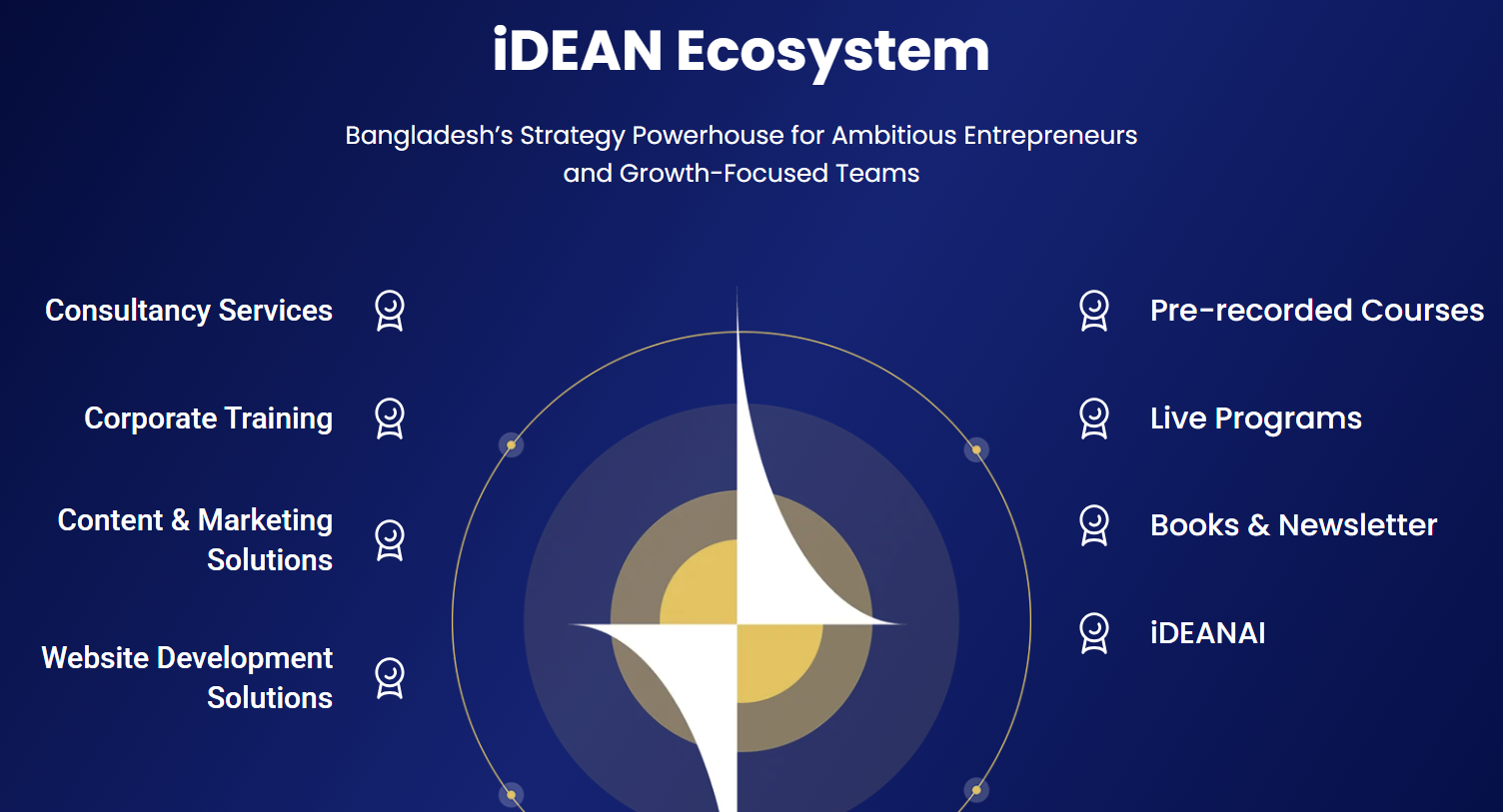
iDEAN describes itself as an ecosystem for intelligent business strategy and AI-powered growth in Bangladesh. The company has always preferred to be known as a consulting firm instead of an agency.
An agency's job is to execute: run campaigns, produce content, and manage platforms. A strategy consultant's job is to decide what to execute and why.
In practice, most Bangladeshi businesses have had access to the first and limited access to the second. The result is a market full of well-executed tactics on top of unclear strategies: campaigns running on undefined audiences, tools deployed before the process they are supposed to automate has been designed, and automation accelerating the wrong activity.
iDEAN's position in this landscape is not to do the execution. It is to specify what should be executed and why, including which technology the business actually needs, given its strategic situation, rather than which tools are popular or which platforms the team has heard of.
This requires the compound background that Anupom has spent fourteen years building: engineering systems thinking to assess whether a technology does what the business needs, combined with marketing strategy knowledge to assess whether the business's strategy is worth automating.
As we noted above, most businesses here make decisions based on instinct and urgency rather than data and structured thinking. iDEAN's work is not about replacing business instinct. It is about giving instinct a structure that makes decisions more consistent, more data-informed, and more oriented toward building something that compounds over time.
Apparently, the first thing an engagement with iDEAN produces is a diagnosis of your actual business problem, which may be different from the problem you came in describing. A strategic framework specific to your situation, built from the frameworks iDEAN has developed and applied across 50+ industries. Implementation guidance during the period when the strategy is being built into the business. And, over time, a different way of thinking about your business, more structured, more data-informed, more oriented toward compounding growth than short-term tactical wins.
What you don't get is execution. iDEAN tells you what to do and helps you think through how to do it. The doing is yours. This is a feature of its model. The businesses that extract the most value from strategy consulting are those whose teams own the implementation, because ownership drives the kind of consistent follow-through that strategies require to produce results.
The timeline also matters. iDEAN engagements are not designed to produce results in thirty days. The kind of structural change that makes a business compound, a rebuilt offer architecture, a functioning retention funnel, and a management system that keeps the strategy on track takes time to design, build, and bed in.
Business leaders who expect to see transformative results in a month are likely to be disappointed, regardless of who they work with. Those who are willing to invest in building the right foundation tend to find the results genuinely durable.
Before reaching out to iDEAN or to any strategy consultant, there are a few questions worth sitting with honestly.
Do you actually know what problem you are trying to solve? If your answer is "our revenue is flat" or "our campaigns aren't working," you are describing a symptom, not a problem.
The diagnostic work of a consulting engagement will get you to the problem, but it helps to go in with genuine curiosity about the diagnosis rather than a fixed belief about what the answer will be.
Clients who arrive convinced they know the problem and want the consultant to confirm it get less value than clients who arrive genuinely open to the possibility that the problem is somewhere they haven't looked.
Is your team ready to implement? A strategy engagement produces recommendations. Recommendations require implementation.
If your organization doesn't have the management capacity, the functional teams, or the cultural readiness to act on what the engagement produces, you may want to invest in building that capacity first, or start with iDEAN's training programs, which develop that capacity alongside the strategic frameworks.
Are you willing to hear something uncomfortable? The diagnostic phase of a consulting engagement regularly surfaces things business owners would prefer not to know — that the product isn't differentiated, that the offer is wrong, that the business model has a structural problem that marketing cannot fix.
The businesses that most need strategy consulting are often the ones most likely to receive uncomfortable findings. The willingness to hear those findings and act on them rather than explain them away is what separates engagements that produce results from those that produce reports."Without strategy, marketing is just throwing money into the wind."
This observation sits at the center of what iDEAN does. If you have been spending on marketing and wondering why the wind is keeping everything, the starting point is a conversation about what is upstream of the spend. That conversation, handled honestly and with the right framework, tends to be the most valuable investment a Bangladeshi business can make.
iDEAN Consulting works with mid-sized companies, corporations, and institutional partners across Bangladesh and beyond. For businesses at an earlier stage, the training programs — GrowthX, iMarketing, and the iMBA — offer a structured way to develop strategic capability directly. For full details on iDEAN's consulting practice and all programs, go to ideanconsulting.com.
The long-form company profile we published last month covers the full story of the firm and its founder.
If you recognize your business in the situations described in this article, flat revenue despite real marketing investment, growth that isn't compounding the way it should, or a sense that the problem is somewhere you haven't been able to identify, the most useful next step is a diagnostic conversation. A conversation about what your business is actually dealing with and whether a consulting engagement is the right intervention for it. That is how iDEAN engagements begin. And in most cases, that conversation alone clarifies something that was previously unclear.