
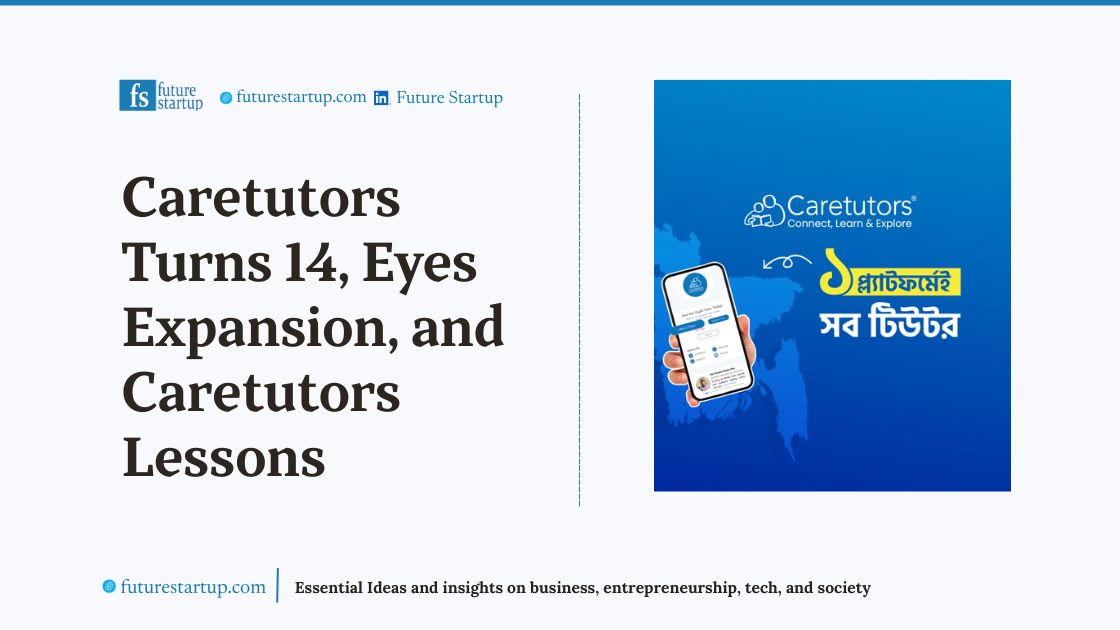
Fourteen years ago, a 22-year-old undergrad student came to realize that the private tuition market in Bangladesh was broken. He decided to fix it by building a platform. He paid a newspaper hawker 150 taka to slip 500 leaflets into the morning papers delivered to Gulshan. He and a classmate pooled their 18000 taka savings as initial capital, and spent 3,000 taka for a website. Hours after the leaflets went out, two guardians called looking for a tutor. Masud Parvez Raju had no tutor on the platform yet. Instead, he found university juniors he could personally vouch for, placed them in these initial tuition jobs, and collected his first platform fee. The whole thing was managed manually. And the tiny initial demand, it worked. Caretutors was born.
Today, Caretutors, the Dhaka-based tutor matching platform Raju built out of that leaflet drop, has more than 500,000 registered tutors on its platform, serves guardians and students across every divisional city plus Savar, Gazipur, Narayanganj, and Cumilla, and offers matching across 13 categories, from academic subjects to Arabic language instruction, drawing, and skills development, through a mobile app available on Android and iOS.
Last week, the company celebrated its 14th anniversary.
At an anniversary event held in a restaurant in Dhaka attended by the founding team, well-wishers, and staff, Raju told the room that the work so far has been about making organized tuition a nationally recognized, institutional industry. The next phase, he said, is about turning it into something sustainable, organized, and safe. "Online education and tuition service is no longer an alternative arrangement," he said. "It is becoming an important part of the education system. We want this technology-driven service to become more effective and long-lasting." The company also said it is building new features to make the experience faster and simpler for students, guardians, and tutors alike.
We have been following Caretutors since its early years. Over the last fourteen years, the company has displayed an excellent combination of pragmatism, strategic patience, and resilience. Its trajectory offers insights into what it takes to build a trust-based marketplace in Bangladesh, an extremely difficult feat. In this article, we take a look at some of the key takeaways from Caretutors journey.
The problem was never a shortage of tutors
For most families, private tutoring is a necessary supplementary component to formal education. In most instances, formal schooling remains insufficient, making supplementary private tutoring essential. This has, in fact, given rise to an entire sector of shadow education, including various coaching and other services. Private tutoring, mostly one-to-one tutoring, remains a core component of it. On the one hand, millions of students preparing for various academic education, including SSC, HSC, and admission tests, depend on it. On the other side, for hundreds of thousands of university students, tutoring is one of the only flexible, decently-paid jobs available while they study.
For years, that enormous market ran on informal arrangements made possible by peer networks and informal tuition agents, naturally with little to no verification, no meaningful standards, and little accountability. Tuition agents took fees up front for providing tuition, and sometimes sent whoever was available. Seniors passed referrals for a cut. Guardians had no way of knowing who was about to walk into their home with their child.
Raju, then a BBA student, spent four to five months talking to different segments of this market, trying to understand its challenges and dynamics.
He came to realize that while there was no shortage of demand or supply, the market didn’t have a trusted platform, something both sides could rely on. Caretutors began with that insight and has spent the following fourteen years building on it.
The parts of the story that don't make it into press releases
Three months after Raju finally left a stable job at Grey Advertising to work on Caretutors full-time, both his co-founders quit. He was left running the company alone, in his mid-twenties, having just given up a steady income to do it. It was a difficult period, but he persisted. In the following months, he did everything. He cleaned the office. Made the tea. Chased developers for updates. Took every customer call himself. Naturally, hardships are difficult not only because they are hard but also because they bring crippling self-doubt with them. When we are deep into a difficult period, we start to doubt our abilities.
Raju to FS a few months agao that he had those questions and it took him months to resolve the doubt whether he was the right person for the job.
Then, in 2020, just as three patient years of foundation-building had gotten the team to 30 people and real traction, COVID shut down in-home tutoring entirely. Revenue collapsed. Raju called every team member individually, kept the ones he could, and told those he had to let go that they could come back when things normalized. Roughly half the team he had spent years training left anyway.
But the company continued to push forward, launching online tutoring during COVID and rebuilding afterward. The effort paid off. By 2022, Caretutors became profitable, and it has been profitable every year since.
While Caretutors raised one small investment in 2017, the company has always focused on building a solid operation. A discipline of keeping monthly costs low, training people from scratch instead of competing for experienced hires, and refusing to spend money it didn't have. That discipline is partly why the company is still standing at 14 while a lot of louder, better-funded ideas in the same market are not.
How the trust actually gets built
Trust is at the heart of what Caretutors delivers. Caretutors has spent years addressing this challenge, making sure both sides of the match trust each other.
A guardian posts a requirement. Caretutors verifies the post before it goes live. Relevant tutors, filtered by location and category, get notified. A multi-step verification process checks the details, address, academic credentials, and identity documents of tutors. The company treats all of it as the product.
The company takes a commission on successful placement instead of for listing, which keeps the incentive aligned toward real matches rather than volume of listings.
Roughly one in five new customers now comes through referral. The students who used the platform to find tutoring a decade ago are starting to show up again, this time as guardians hiring tutors for their own children.
From tutoring to everything tutoring
For its first five years, Caretutors focused on academic subjects alone. As the platform grew, users started asking for new things: Arabic tutors, coding, and gym trainers who could come to the home. The company adopted a deliberate approach: validate the demand before building the category, rather than guessing at what the market might want.
Thirteen categories later, including a Shadow Tutoring format launched in 2025 for dual-income households that need something closer to a teaching companion than a conventional tutor, the platform has become something closer to a marketplace for personalized human instruction of almost any kind than its orgainal academic tutor matching platform.
International expansion also happed rather as organic evolution. Started during COVID, Bangladeshi tutors on the platform now teach students in Saudi Arabia, the UAE, Canada, the UK, and elsewhere, mostly Bangla and Arabic instruction for diaspora families. This market also happened without Caretutors actively chasing it during COVID when online tutoring became popular. The company has not yet invested seriously in accelerating it, which suggests there is real headroom there.
What fourteen years actually bought
By the company's own numbers, it has served under 1% of an addressable market of 38 to 40 million students in Bangladesh. That is either a modest result for fourteen years of work or an enormous amount of room to grow, depending on how you choose to look at it.
Whatever is your take, both readings are correct.
Trust takes time to compound. There is no shortcuts to verify half a million tutors. The moat here was never technology. It is the accumulated, unglamorous work of getting thousands of small transactions right, consistently, for over a decade, until families started trusting the platform by default.
The lessons are easy to underrate.
Solve for trust before you solve for scale, because scale without trust in a market like this collapses the moment something goes wrong.
Validate demand before building a new category, rather than betting on what customers might eventually want.
Keep the burn low enough that a bad year, and there will be more than one, doesn't kill the company.
Hire for appetite over credentials, and give people years to grow into the role rather than expecting them to arrive finished.
Where it goes from here
Raju's stated priority now is depth over breadth. Bringing the same verification infrastructure, brand presence, and customer relationship capacity that Dhaka has to the other divisional cities. International growth remains an opportunity that the company hasn't yet pushed hard on. And further out, Raju has talked about the platform's trusted base of parents, students, and tutors as an asset with adjacent uses, educational materials, financial products, and health services, while being careful not to get ahead of the core business.
Fourteen years in, Caretutors is still, fundamentally, the same bet Raju made with a 3,000-Taka website: in a market this large, the thing worth building is the trust that enables both sides to show up for each other reliably, at scale, for a very long time. The market it operates in has barely been scratched. We'll be watching to see how much of it the next decade brings within reach.
Read more: Future Startup has covered Caretutors since 2017. Read our full archive of coverage at futurestartup.com/tag/caretutors.
A Note from the FS Team
Thank you for reading this far. Future Startup has been a labor of love with the intention to enable and inspire more of us to find our agency and apply it in building meaningful things. If you enjoyed reading this article, consider supporting our work here.
We also have several commercial services, including a narrative studio, advertising, and a research service. If your company has a story worth telling, FS Narrative Studio can help you tell it and reach one of the most sought-after audiences in Bangladesh and beyond, with the same depth you just read. We also help brands reach this audience directly through advertising and interview series sponsorship, and provide custom research services through Future Research on Bangladesh's business landscape.