
Consider one of the common but consequential decisions every guardian faces in the private tutoring market. A tutor has applied. His profile says he's a third-year student at BUET. His photo looks fine. He seems to have the right subjects. The guardian shortlists him, they speak on the phone once, and he arrives on a Wednesday evening. She lets him into the house. Her child sits with him for two hours in the study room.
What just happened, from a safety standpoint, is that a family admitted a stranger into their home based on credentials they can’t verify—a phone call and a photograph. This is not unusual. For most of the history of private tutoring in Bangladesh, it's been the norm. The majority of informal tuition media and agents usually don’t have a verification mechanism. Credentials are self-reported. The agent's involvement ends at placement.
The decision is equally perplexing for a tutor. A message on his phone says a guardian has shortlisted him for a Class 9 Science tutoring in Mirpur. He accepts, shows up at an address, enters a home where he knows nobody, and begins working. His salary will arrive, or it won't, at the end of the month. The agreement on tutoring hours and days per week, subjects covered, and payment terms exists only in his memory and a conversation.
Both parties operate from a suboptimal position. Both parties have little recourse when/if things go wrong.
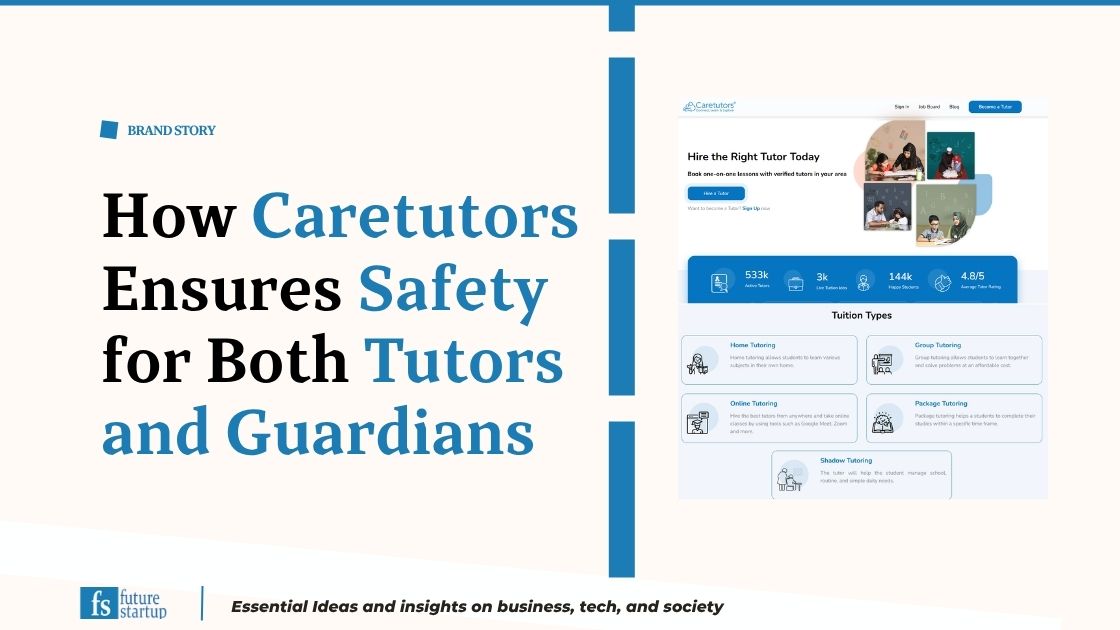
Caretutors, Bangladesh’s largest online tutoring platform, is built on the understanding that the tutoring market's one of the core dysfunctions has been a safety and trust problem. There are always enough tutors. There are always enough families who need them. The missing piece has been a reliable intermediary whose revenue depends on trust being maintained and quality service being delivered to both ends of the market.
"In business, reputation is the most important capital," Caretutors founder and CEO Masud Parvez Raju told Future Startup. "If I lose trust once, this journey will be difficult for me."
Caretutors has built around that constraint for fourteen years. It has helped develop a set of specific mechanisms, a layered system that addresses the vulnerabilities of both guardians and tutors at different points in the tutoring relationship.
In this article, we take a closer look at those mechanisms of Caretutors that ensure trust and safety for both tutors and guardians, what they are, how they work, and where they still fall short.
Naturally, guardians and tutors have different types of safety concerns, but structurally, they are related. Understanding them separately is important to understand how any platform can effectively address both.
For guardians, the primary concern is identity and character. The tutor entering your home will spend hours alone with your child. A guardian wants to know: who is this person, are their credentials real, is their character what their presentation suggests, and so on. Unfortunately, these are exactly the questions the informal market can’t always reliably answer.
The structure of the traditional tutor matching mechanism makes it difficult. Agents or acquaintances provided tutors based on availability. They usually don’t run verification checks. They, in fact, don’t have a process for running verifications. Consequently, no mechanism existed for a guardian to check whether the BUET claim was real, whether the home address given was accurate, or whether the person's record on previous tutoring jobs was good or bad.
For tutors, the concerns are financial and contractual. A student who has come to Dhaka from Cumilla or Mymensingh to study, and needs tutoring income to manage his expenses, faces a specific uncertainty: he can show up at a guardian's home in good faith, teach well for four weeks, and then be told that the salary will come next month or not come at all.
The terms of every tutoring arrangement in the informal market are verbal. There is nothing to point at when a guardian decides, a month in, to change the agreed schedule, reduce the fee, or simply stop calling back.
Caretutors has built a safety infrastructure to address these challenges on both sides, at both the selection stage and the ongoing relationship.
A complex system usually has more than one point of failure. That’s why dealing with a complex system is a hard problem. You are dealing with a system that has multiple points of failure. Solving for a single point of failure is not enough.
This reality is true for a platform like Caretutors. Hence, if Caretutors is to address a challenge like building enduring trust, it has to build a layered system that can work as a checkpoint across various points of failure.
That’s what Caretutors appears to have done to ensure guardians' safety and interest. The company says it has built a layered system to ensure thorough verification for tutors, which ensures the platform meets the trust, reliability, and quality expectations of guardians. In this segment, we examine the mechanism.
First, the profile completion gate. A tutor must complete their profile on the Caretutors platform to be able to apply for tuition. Without completing their profile, no one can apply for tuition. This simple step filters out incomplete or unverifiable applicants before they reach the guardian at all.
This basic verification step covers academic credentials, current location, teaching history, and supporting documentation. It means guardians reviewing applicants are seeing profiles that have cleared a minimum completeness threshold, which is already a different quality of information than the alternative.
Second, a complete, manual verification process. Profile completeness is the floor. Above it sits the actual verification process, which Caretutors operates through a dedicated team. "In some instances, we do the extended beyond the initial verification. In those instances, when a guardian hires a tutor, we take them through the verification process and then send them to the guardian," Raju said in our 2026 interview. "During this verification process, we check their address, academic information, and all other relevant information. We have a specialized team of seven people who work only on verification."
The point Raju is making is that the verification isn't a one-time checkbox at registration. For new tutors and for sensitive placements, Caretutors runs checks after a guardian has selected a candidate. A team of seven people at Caretutors, whose full-time job is to run those checks, runs a slow, deliberate, and resource-intensive institutional verification operation. And it is not scalable at the same rate as profile registration. It is hard for an informal agent to run a similar operation because they usually have neither the process nor the incentive.
Third, guardian control over selection. When a guardian posts a requirement, relevant tutors are notified and can apply. The guardian reviews up to five shortlisted profiles — credentials, location, experience, rating — and invites candidates for trial classes. This allows a guardian to truly judge a potential tutor and then make a decision. It allows a guardian to make a deliberate choice.
Fourth, trial classes before any commitment. Selecting a profile is not hiring a tutor. The platform's standard workflow includes a trial class. One session in which the tutor teaches and the guardian observes before any confirmation is issued. A trial class shows a guardian how this particular person behaves in her home, with her child, under the specific conditions of her household. If it doesn't go well, she has the option to move to the next shortlisted candidate.
Fifth, the digital confirmation letter. Once a guardian decides to hire, Caretutors generates a digital confirmation letter signed by both parties. This letter records the agreed salary, subjects, schedule, and other terms of the arrangement. For a guardian, this creates a reference point that didn't exist before. If a tutor's behavior changes, if attendance drops, if conduct becomes a concern, the formal record of what was agreed can be found in the platform. The letter doesn't guarantee anything. However, it provides a written basis for discussion in the case of disputes.
Sixth, attendance tracking and digital class monitoring. The Caretutors app includes an attendance feature that provides guardians with real-time updates about tutoring sessions. When tutors arrive for a class, they check in through the app, instantly notifying guardians about the tutor’s arrival. After the session, tutors check out and submit lesson details, including what was taught and the plan for the next class, which guardians can review directly from the app.
The system also records check-in and check-out locations, adding an extra layer of accountability. In addition, guardians can download monthly or previous attendance records. By combining live notifications, lesson tracking, and attendance history, the feature creates a transparent tutoring experience for both users.
While tutor trust and safety often get less attention, it matters just as much. Caretutors says it has built processes to ensure tutors on its platform are protected.
First, guardian requirement verification. Before a job posting goes live on the board, Caretutors' backend team verifies the guardian's requirements. A tutor browsing the job board isn't responding to unverified, potentially fraudulent listings. The posts that appear have been checked. The informal market had an equivalent problem on the guardian side: students paying agents for tuition listings that turned out to be fabricated or already filled.
Second, post-hire platform fees. The platform charge tutors pay comes after they receive their first month's salary from the guardian. The specific terms from the Caretutors website: verified tutors pay the platform charge "at the end of the tutoring month, after receiving payment from the guardian/student." In the informal market, an upfront fee is a genuine financial risk for students with limited income. Caretutors' model removes the risk entirely for tutors. The platform earns when the tutor earns. A tutor with multiple confirmed jobs on the platform puts it this way: "The best part is that we can pay the platform charge after receiving the month's salary. So tutors like us do not feel extra pressure."
Third, online tutoring advance payment. For online tutoring, Caretutors collects the full first month's salary from the guardian in advance on behalf of the tutor, before sessions begin. This protects tutors from the scenario, common in many informal online arrangements, where a guardian receives weeks of sessions and then disputes payment or disappears. The platform holds the money. The tutor teaches that knowing the first month's income is secured.
Fourth, the digital confirmation letter from the tutor's side. The confirmation letter protects tutors from the informal market's most common form of tutor exploitation: the verbal agreement that a guardian unilaterally changes after the relationship begins. On Caretutors, salary, schedule, and subjects are all recorded and signed. When a guardian tries to reduce the fee in month two or add sessions beyond what was agreed, the tutor has a documented reference point. This isn't a legal contract in the formal sense. In a market where tutors had nothing, it's a material improvement.
Fifth, cancellation and refund protections. The platform's terms include specific provisions for tuition job cancellations. If a job is cancelled before the end of the first month, and the tutor has already paid a platform charge, the charge is adjusted to reflect only the amount the tutor actually received. The excess is refunded within one month. These provisions exist because the informal market had none; a tutor placed in a household that ended the arrangement after two weeks had no claim on any portion of the fee they'd paid.
Sixth, a platform support team. Multiple tutor testimonials mention response time from the Caretutors team as a specific reason for their trust in the platform. "Whenever I need help, they respond immediately and assist properly," one tutor said. "The representatives here are incredibly helpful, and their behavior is both nice and professional. They respond promptly to solve any problem," said another. This isn't a safety feature in the technical sense. It's institutional availability, a tutor can contact when something goes wrong, which the informal market structurally couldn't provide.
While the safety infrastructure Caretutors has built is substantial compared to anything the informal market could produce, it isn't complete. Despite its best efforts, the platform runs into certain pesky challenges. Some of these problems are hard to solve, no matter how hard you try. Others are solvable, but hard to see an apparent solution in the near term.
Verification at scale has a ceiling. With 500,000 registered tutors, the extended manual verification process is necessarily selective. The seven-person verification team handles new tutors and highly sensitive placements. It is not every tutor on the platform who goes through the extended check. The profile completeness gate filters out the most obviously incomplete applications, but completing a profile accurately is still partly the tutor's choice. Self-reported information can be false. A motivated bad actor can construct a plausible-looking profile.
The digital confirmation letter is not a legally enforceable contract in any formal sense. If a guardian refuses to pay, the letter gives the tutor a record but not a remedy. The platform can remove a guardian from the system and decline to serve them again. It can't collect on their behalf.
The feedback and rating system, which is one of the ways platform users develop portable reputations, depends on feedback actually being submitted. Tutors who teach one job and leave, or guardians who disengage before leaving a review, don't contribute to the reputation data that makes the platform's quality signals meaningful over time.
As we mentioned above, some of these are structural limits. Others will take time and more creative solutions to address. No platform can run full background checks on 500,000 people. No matching system can guarantee character. What Caretutors can do, and has done, is make the baseline significantly safer than the informal market while acknowledging that the remaining gap is real.
Safety in this market isn't a feature Caretutors added on top of a matching service. It's the reason the matching service has any value at all. A platform that matches tutors and guardians without addressing the trust problem doesn't solve anything. It just digitizes the same dysfunction that the informal market already produced. The value Caretutors provides, to a guardian who lets a tutor into her home, to a tutor who shows up at an unknown address, is the structured reduction of the specific risks each party faces in the other's presence.
"We are working hard to make people understand that Caretutors is not a traditional tuition medium," Raju said in an earlier interview. "We are providing you a service which is connecting you with the right tutor or the trainer for anything and everything that you want to learn, along with other benefits such as qualification matching and of course verification."
Verification is mentioned alongside qualification matching, not as a secondary concern. The market Caretutors operates in is not one where safety is assumed, and convenience is the differentiator. It's one where safety was structurally unavailable and had to be built from scratch. Caretutors has done it through a seven-person verification team, a digital confirmation system, post-hire fee structures, attendance tracking, and a feedback loop that creates visible accountability over time.
Fourteen years of consistent execution on these mechanisms is what has produced the referral rate Caretutors now enjoys. Roughly 20% of its new business arrives through existing users recommending the platform to people they know.
That kind of referral rate takes more than marketing. It's the accumulated evidence that the safety infrastructure works well enough, consistently enough, that guardians and tutors trust it to work for the people they care about.
That, more than any individual feature, is what a safe platform looks like.