
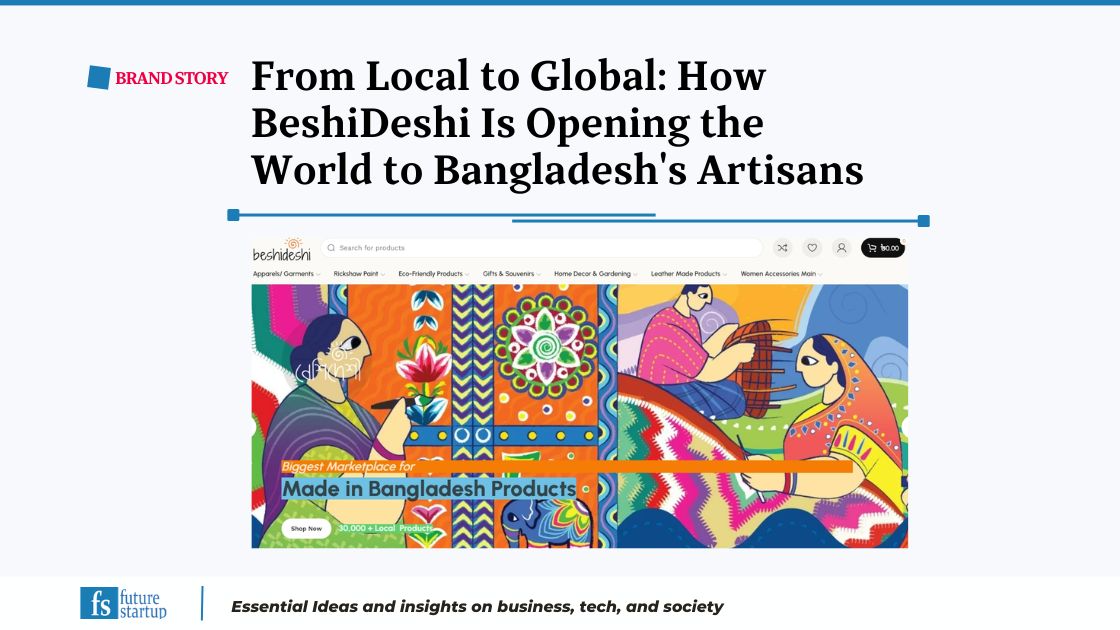
Before BeshiDeshi shipped a single product internationally through a formal export channel, its artisan goods were already traveling. Diaspora buyers would visit Bangladesh, purchase products from the platform, carry them back to the UK, the US, Canada, and the Gulf, and sell and share them within their communities. The whole thing happened organically without an active effort on the part of BeshiDeshi.
Zeeshan Khurshed Mazumder, founder and CEO of BeshiDeshi, describes this as one of the clarifying moments of the company's journey.
“Diaspora buyers and wholesale partners would purchase products locally in Bangladesh and then carry them abroad themselves to sell within their networks,” he says. “This informal flow of products was an early signal that global demand already existed.”
BeshiDeshi has spent the intervening years building the infrastructure to serve that demand reliably, at scale, with quality that holds up when a product travels from a workshop in Rajshahi to a customer in Seattle.
However, that journey has been longer and harder than what that early signal suggested. While the company has formally exported to the United States and Singapore and has partnerships developing in several other markets, Zeeshan is careful not to overstate where the international operation currently stands.
Formal exports are still a smaller share of total sales.
The larger share of export is still largely driven by an informal channel that predates any of BeshiDeshi’s structured export work: diaspora buyers purchasing locally in Bangladesh and carrying products abroad.
We have been following BeshiDeshi since its early days. We covered the company’s founding and early years in 2019 and again in 2020.
Earlier this year, we published a two-part in-depth interview with Zeeshan covering how much the company has evolved and how it has built an ecosystem around its platform for artisans. We wrote long pieces on its Inventory Investment Program that solves for artisan working capital, and on its Bengali-language mobile photography and e-learning platform for artisans.
In this piece, we focus on something we haven’t covered about the company before: how BeshiDeshi is helping Bangladesh’s artisans access international markets, what that journey looks like in practice, and what it takes to export handmade goods from a village in Teknaf or Rajshahi to a customer in Singapore or Seattle.
One of the things you hear Zeeshan repeat is that the artisan problem in Bangladesh is widely misunderstood.
One assumption is that artisans need better skills. Give them training, teach them new designs, and show them how to make jute bags. Then the market will follow.
However, as BeshiDeshi dug deeper into the market, he found that Bangladeshi artisans were often exceptional in craftsmanship.
The challenges were elsewhere.
A master weaver in Rajshahi or a hand-painter in Teknaf was not the weak link. The weak links were everywhere else: how the product was photographed, how it was packaged, how it was priced, whether the artisan had working capital to fulfill a large order, and whether they understood what customers in Dhaka, let alone in the United States, actually wanted.
“In many cases, the craftsmanship itself was excellent,” Zeeshan says. “The real gap was market linkage, systems, and exposure.”
The dominant development model he observed had a specific failure mode. Organizations would train women in underprivileged communities to make something such as jute bags, embroidery, and hand-stitching. They’d provide a design template. Then the program would end.
“Few of these programmes address how participants might sell their creations,” he observes. “Artisans must find nearby shops where they can leave their products. Often, they don’t determine the price, the shopkeeper or wholesaler does.”
Without pricing power, without a sustainable sales channel, the training produced nothing lasting.
BeshiDeshi’s original insight was that selling had to come first. Artisans who get sales come back. They improve. They refer others. The word-of-mouth that has driven much of BeshiDeshi’s artisan growth comes from one thing: the platform actually sells.
“At the end of the day, after training and everything, they want money. They want to know whether we can sell. That’s the number one criterion,” Zeeshan told FS in a recent conversation.
The ecosystem BeshiDeshi has today — training, capital, design support, photography, packaging, market linkage — was not designed upfront. It grew from problems that the business kept running into.
Photography came first.
As artisans joined the platform, it became clear that product images were a bottleneck. Professional photography was expensive and inaccessible to most artisans outside Dhaka. DSLRs were not an option.
BeshiDeshi’s response was to develop what appears to be Bangladesh’s first Bengali-language mobile photography curriculum, specifically built for artisans — practical, short-form, in Bangla, teachable on the phones artisans already own.
Find natural light. Try different angles. Keep the background clean. Today, roughly 95% of the 30,000 product photographs on the platform are taken by artisans using their phones.
Mst. Sadia Alam Setu, a hand-painter with disabilities, illustrates what this meant in practice.
Before the training, she would hold her colorful artwork up to her phone camera and get dull, flat images. Customers scrolled past. After the photography module, her brand Attoja began receiving orders from outside her local area. The visibility changed everything.
Design consultation came next. Once artisans could photograph their work, the following constraint appeared: many were making products that reflected local aesthetics but did not match what broader markets wanted.
BeshiDeshi began offering design trend guidance and consultations, helping artisans understand color palettes, finishing standards, and product utility that resonated with urban and international buyers.
The goal was that the products with the strongest international traction, rickshaw art-inspired hand-painted items, Jamdani sarees, and jute-based lifestyle goods would retain their cultural authenticity while adapting to contemporary form.
Capital was the deepest structural problem. When large wholesale orders arrived, many artisans could not fulfill them. They had the skill. They had the time. They did not have the cash to buy raw materials. Banks were slow. NGO loans carried high interest rates. Zeeshan noticed that without capital, artisans cannot accept larger orders; without larger orders, they cannot build the capital to grow.
BeshiDeshi’s response became its Inventory Investment Program, a mechanism to provide working capital against confirmed work orders. Artisans get fast capital without navigating the formal banking system. The physical inventory serves as collateral.
BeshiDeshi handles quality monitoring, sales facilitation, and, in the event of trouble, early intervention to find alternative channels before losses materialize.
“Talent is everywhere, but capital is not,” as Zeeshan puts it.
Across all of this, BeshiDeshi has also built a broader Bengali-language e-learning platform, developed in partnership with Oxfam and iDE, covering product pricing, basic accounting, inventory management, e-commerce operations, and design thinking.
The courses are segmented by artisan type: what a weaver in Rajshahi needs to learn is not the same as what a potter in Cox’s Bazar needs.
The platform is mobile-first, in Bangla, and designed to start with concrete, immediately rewarding skills. Photography worked as an entry point precisely because the results were visible almost immediately.
When an artisan’s photos improved and orders followed, learning stopped feeling like an obligation and started feeling like a tool.
The timeline of BeshiDeshi’s international journey is longer than it first appears. As noted at the outset, international deliveries — informal, diaspora-driven — were happening as early as 2019.
Our 2020 coverage noted that BeshiDeshi was “working towards exporting products to the USA and European markets.”
That aspiration took several years to become a structured reality. The first formal export shipments to the United States came later, as did partnerships developing in Singapore, Canada, and Australia.
The gap between the 2019 informal deliveries and today’s formal export operation is the story of what it actually takes to turn latent demand into a reliable channel.
As we noted above, the mechanics of how BeshiDeshi reaches international buyers today operate on two distinct tracks.
The first is formal export: structured shipments coordinated by BeshiDeshi, with product preparation, quality checks, packaging, logistics coordination, delivery tracking, and post-sale support handled end-to-end. This track serves the United States and Singapore and is where BeshiDeshi’s quality and logistics systems are most directly tested.
The second track is the informal-diaspora channel that predates the formal one. Bangladeshi diaspora communities in the UK, Canada, Australia, the UAE, and Gulf markets find BeshiDeshi products through the website, purchase them domestically in Bangladesh, and distribute them abroad through their own means. Wholesale partners do the same.
This channel generates international reach without BeshiDeshi bearing the full logistics burden, but it also means BeshiDeshi has limited visibility into the end customer and limited control over the final presentation of the product.
Formal exports remain a smaller share of total sales. The informal channel is where the global footprint is actually larger than the numbers suggest.
On market and consumer response, different international markets respond to different things, and BeshiDeshi’s communication adapts accordingly.
Diaspora buyers connect with cultural heritage and familiarity. The Jamdani saree sold to a Bangladeshi in London carries a kind of meaning that goes beyond the product itself.
Broader lifestyle markets in the West respond more to sustainability, craft authenticity, and design quality.
Jute-based eco-friendly products have found particular traction in markets where sustainability shapes purchase decisions. Rickshaw art-inspired hand-painted items, initially selling mostly through local fairs, began reaching international buyers who valued the aesthetic precisely because it was unfamiliar.
The barriers to international access are mostly operational. Consistency is a major challenge. When a buyer abroad receives a well-made product, they return for more if they can be confident that the next order will match the first.
For handmade goods, this is a challenge.
An artisan in Teknaf might not be able to find the same shade of thread they used last month. They might substitute, thinking the difference is minor, without understanding that a customer who saw a specific color in a photograph has that color in mind.
“Customers always expect consistency,” Zeeshan notes. “So we need to ensure that the person who made that beautiful product can repeat it. This has been a major challenge for us since the beginning, especially with artisans from outside Dhaka.”
Logistics requires careful coordination for every international shipment — product preparation, quality checks, packaging, shipment coordination, delivery tracking, and post-sale support.
Because artisan products are small-batch and unique, the process cannot be standardized in the way a manufacturing export operation might be.
What BeshiDeshi has built is less a logistics department than a quality orchestration system: continuous feedback loops, packaging guidance, customer response sharing, and gradual improvement over time.
BeshiDeshi is seven years old. It has gone from a small e-commerce experiment to a platform with over 5,000 craftspeople and 30,000 products. It has built training programs, a capital investment mechanism, and now a growing international presence.
The company has done this largely by staying close to the actual problems artisans face and building specific responses to those problems, rather than implementing a solution designed in advance.
Bangladesh’s artisan economy is often framed as a development challenge. BeshiDeshi’s experience suggests it is more accurately understood as a market-building challenge.
The demand is there, including internationally. The supply is there. The missing piece has been the connective infrastructure: digital presence, training that connects directly to sales, access to capital at the right moment, and quality systems that make reliability possible.
BeshiDeshi has been building that infrastructure, one problem at a time.
“When someone buys from a Bangladeshi artisan, they are not just purchasing a product,” Zeeshan says. “They are supporting a journey of skill, resilience, and creativity. These artisans are not asking for charity — they are asking for visibility, fair markets, and recognition for their craftsmanship.”
The harder question, whether BeshiDeshi can scale this model to the hundreds of thousands of artisans across Bangladesh who remain commercially invisible, is the one that the next few years will begin to answer.
The foundation is more solid than it was.
The international channel is open. The infrastructure exists. The ecosystem has been built. What comes next depends on whether BeshiDeshi can maintain the same quality of problem-solving at a larger scale that has made it work at the scale it has reached.
You can read our full two-part interview with Zeeshan Khurshed Mazumder here and here. The BeshiDeshi Inventory Investment Program is covered in depth here, and the e-learning platform story is here.