
Only 10% of Bangladeshi adults have ever used artificial intelligence, according to a new Gallup survey. Nearly two-thirds of Bangladeshis say they are not aware of AI. Among those who know about it, Bangladeshis also have some of the lowest expectations for what AI will do for the country.
Apparently, Bangladesh's AI adoption is still in its early stages.
Only 1.8% of Bangladeshi adults say they use AI daily, according to a new Gallup survey conducted as part of its global research with Microsoft. Another 3.4% use it weekly, and 4.9% use it monthly or less.
Together, that means only 10.1% have ever used AI for work or personal purposes.
Another 25.7% are aware of AI but have never used it. The remaining 64.2% say they are not aware of it.
Across the 37 countries in Gallup's first round of research, the median share of adults who have ever used AI is 43%.
| AI engagement | Bangladesh |
| Daily use | 1.8% |
| Weekly use | 3.4% |
| Less than weekly | 4.9% |
| Aware but never used | 25.7% |
| Not aware of AI | 64.2% |
| Ever used | 10.1% |
The numbers put Bangladesh near the bottom of the global table.
| Country | Daily | Weekly | Monthly or less | Ever used |
| Singapore | 45.9% | 16.3% | 16.8% | 79.0% |
| Vietnam | 11.9% | 20.9% | 10.4% | 43.2% |
| Indonesia | 10.4% | 10.4% | 8.2% | 29.0% |
| Nigeria | 8.5% | 6.5% | 4.6% | 19.6% |
| Egypt | 8.6% | 5.9% | 7.1% | 21.6% |
| Bangladesh | 1.8% | 3.4% | 4.9% | 10.1% |
| Malawi | 1.0% | 1.2% | 0.6% | 2.8% |
Singapore sits at the top of the table where almost eight in 10 adults have used AI, and nearly half use it daily. Vietnam has an ever-use rate of 43.2%. Indonesia is at 29%.
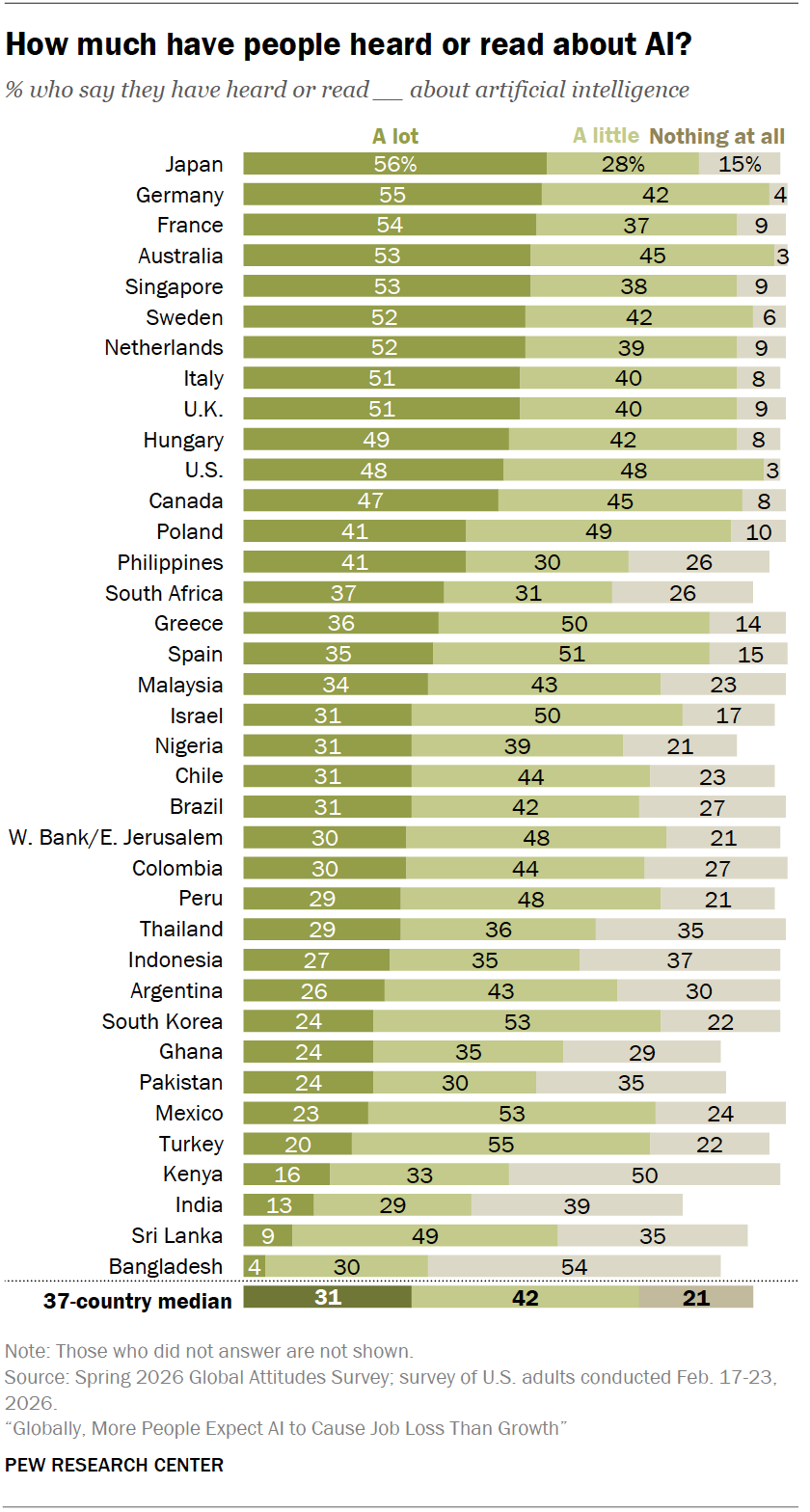
Another survey by The Pew Research points in the same direction. In a survey of 42,151 people across 36 countries conducted between February and May this year, only 4% of Bangladeshi adults said they had heard or read a lot about AI.
Bangladesh was among the countries with the lowest levels of AI awareness in its 36-country study.
Pew also found that awareness tends to rise with income and education.
However, there is a caveat to this analysis. While the national numbers can make Bangladesh's AI activity look almost nonexistent, it only tells half of the story. In Dhaka, an AI ecosystem is beginning to take shape. This is only visible if you live in this market, as we do.
Companies are building AI products and services across layers of the AI stack. Training providers are running practical workshops. Universities are investing in AI infrastructure and research. Organizations are bringing trainers in to teach employees how to use generative AI for everyday work.
The government has also started several initiatives. The Department of Youth Development is running a free basic AI training program across all 64 districts. The program targets young people aged 18 to 35 and is designed around AI and ICT skills. In September, more than 103,000 people applied for 1,600 places in the program's selection process.
The scale of the response suggests that demand for learning about AI may be considerably greater than current AI usage suggests.
It means Bangladesh is not starting from zero. But, understandably, the activity is mostly concentrated in a relatively small part of the economy and population.
One observation about the current development is that much of the visible training market is still concentrated around the first layer of adoption: understanding generative AI tools, writing better prompts, producing content, summarizing documents, researching faster, and improving workplace productivity.
There are some advanced efforts, such as AIUB establishing an AI research lab with high-performance computing infrastructure for research and education. But there should be more of these initiatives.
The more surprising finding comes next.
Among people in Bangladesh who are aware of AI, only 34% expect it to mostly help people in the country. That is the lowest figure among all 37 countries in the Gallup study.
The corresponding figures are 93% in China, 91% in Vietnam, 77% in Singapore, and 68% in Nigeria.
Bangladesh also records the lowest share expecting AI to make their own daily lives better, at 32.5%.
| Country | AI will mostly help the country | AI will make daily life mostly better |
| China | 93% | 92.7% |
| Vietnam | 91% | 91.4% |
| Singapore | 77% | 83.3% |
| Nigeria | 68% | — |
| United States | 36% | — |
| Egypt | 35% | 34.8% |
| Bangladesh | 34% | 32.5% |
These figures apply to people who are aware of AI, so they do not describe the entire Bangladeshi population. Nonetheless, Gallup reports that optimism about AI's impact on the country is lowest in Bangladesh.
There is an interesting wrinkle here. AI optimism does not simply follow adoption. Nigeria, for example, has an ever-use rate of about 20%, yet 68% of AI-aware adults expect AI to help the country. Vietnam has an ever-use rate of 43.2%, while 91% expect AI to help.
Bangladesh has both low usage and low optimism.
While the data does not tell us why, one possibility is exposure. It is difficult to form a meaningful opinion about a technology that has barely entered your life. For many Bangladeshis, AI may still be something they encounter through news, social media, or conversations about ChatGPT. It has yet to become a routine tool at work or in personal life.
For instance, while AI has already become part of the daily workflow for a software engineer working with international clients, that is not the case for most parts of the real economy. For a small retailer, factory worker, farmer, or informal business owner, the path to understanding the impact of AI is less obvious since there has not been much adoption.
What problem does AI solve? What does it save? Who introduces the tool? Who pays for it? What happens when the output is wrong? Those questions will determine adoption in the wider economy.
The other aspect is widespread concern about job loss to AI. This concern has created a negative perception about AI and its impact among some segments of Dhaka’s tech community.
For instance, Bangladesh has a large freelancing community and tech outsourcing industry, the most active users of AI. These two communities have seen some adverse impact of AI on demand for such work. Coupled with media narrative, it has created some negative perception about AI in the country.
While the Gallup survey tells us whether people use AI, it does not tell us how deeply Bangladeshi companies use it. That difference will likely become an important factor as the technology moves from experimentation into business processes.
Asking ChatGPT to rewrite an email is one form of AI use. Using AI for customer support, demand forecasting, quality control, procurement, accounting, logistics, software development, or internal knowledge management is another.
The second kind of adoption can produce measurable changes in productivity and business models.
It also requires more than access to an AI model. Companies need usable data, defined processes, and people who know where AI fits into the work.
Bangladesh has a large base of companies that could eventually experiment with these applications. We do not yet have a good picture of how much of that is happening. That may be the next important question for Bangladesh's AI story.
For now, the numbers point to a country still near the beginning of the adoption curve.
Most Bangladeshis have never used AI. Nearly two-thirds say they are not aware of it. And among those who know about it, only one-third expect AI to mostly help the country.
At the same time, demand for AI training is already strong, companies are experimenting, and universities are beginning to build research capacity.
The interesting story will take place in the gap between those two realities, and AI moves from a technology used by a small, digitally connected group into something that changes how the wider economy works.