
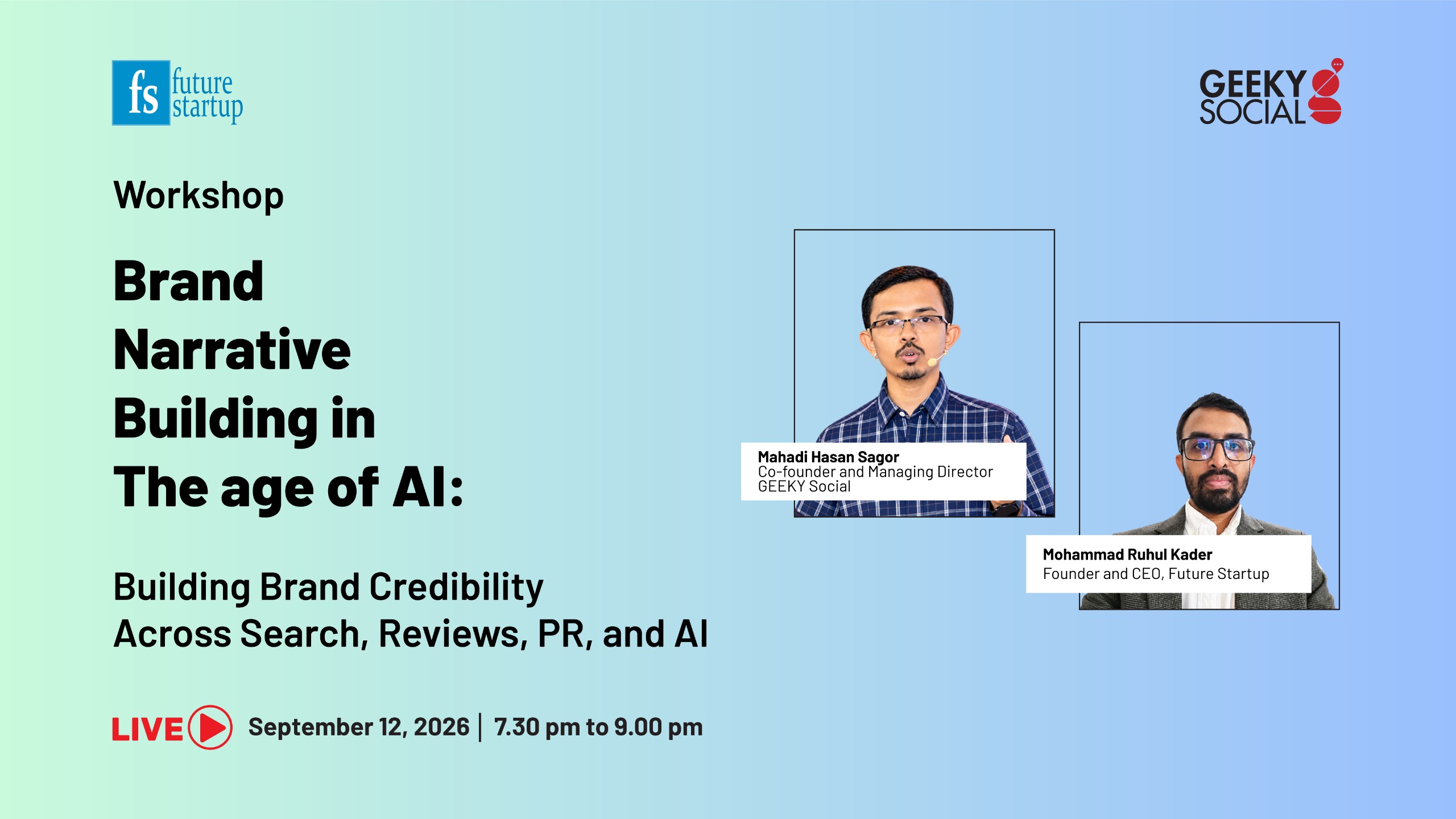
Postponed. We'll announce a new date and open applications later.
Every company has a story in the market, whether it deliberately builds one or not.
It is the story people encounter when they search for the company, read its reviews, come across an article about it, hear what others say, or, these days, ask an AI what it knows about the company. That is the story that shapes what people believe the company is, what it is good at, and whether it can be trusted.
This issue of trust, or lack thereof, has an anecdotal connection to the idea that every company has two businesses: The first is the business it actually operates, and the second is the business people perceive and understand. In other words, how employees, consumers, investors, partners, and stakeholders view that company.
And these two businesses are often very different. We see many outstanding companies remain misunderstood and struggle in the market because they fail to tell their story in a manner that builds perception and understanding. On the other hand, many ordinary companies gain the market’s trust by explaining themselves well.
This gap between what a company does and the story the market understands about it is not a novel phenomenon - it has been there for ages. However, over the past decades, how this story gets built has changed dramatically.
AI is here to change it again.
These days, when someone asks an AI assistant or LLM which accounting software to use, which hospital to trust, or which agency to hire, the AI doesn't simply repeat what the company says about itself. It synthesizes an answer from what it can find across reviews, articles, forum threads, press coverage, social conversation, and other sources.
In other words, AI increasingly turns all the scattered pieces of your public reputation into a single answer.
Before AI, Search and social media changed the trajectory of traditional narrative building.
A decade ago, understanding of brands traveled through a few controlled channels. Communication was mostly one way. You as a brand spoke. Customers listened. A company ran some ads, gave a few interviews, and largely decided what version of itself reached the market.
Google and Social Media turned discovery into a public, ongoing negotiation between a brand and everyone talking about it: customers, reviewers, journalists, competitors. A company no longer got to write its own story alone. It got to influence it, if it did the work.
Now AI has started disrupting that process again.
The brand with the clearest, most consistent, most corroborated story tends to win that synthesis.
The brand with a scattered or contradictory story tends to disappear, even when its product is excellent.
This makes brand narrative much more than storytelling. It is the deliberate work of making sure that what a company actually is, what it wants to be known for, and what the wider information ecosystem says about it increasingly point in the same direction.
Don’t get us wrong, this is not to say that merely telling a better story will deliver you success. Narrative without substance can only take you so far. You must deliver high-quality and exceptional products and services.
But while quality is the prerequisite, quality alone is not enough. You must tell a story of your quality that resonates with your people.
Because trust comes from both substance and how clearly the story behind that substance travels.
And today, that story has to travel across far more than your own communication channels. It has to hold together across search results, reviews, PR, media coverage, social conversation, and AI-generated answers.
This makes narrative building a strategic asset, not a communications afterthought.
This is a widespread problem in Bangladesh. Most companies, including genuinely strong ones, have never built a deliberate narrative. Positioning happens by accident. A coherent narrative is treated as optional.
That is becoming increasingly expensive. As self-discovery becomes the default way people evaluate businesses, companies are being judged by an information ecosystem they only partially control. AI makes that ecosystem even more consequential by interpreting it on the customer's behalf.
If the story is clear, credible, and repeatedly corroborated, the company becomes easier to understand and trust. If it is fragmented, inconsistent, or largely absent, the market fills in the gaps.
This is the problem Future Startup and GEEKY Social built a workshop to address together.
A customer today rarely follows the path to purchase a product according to a company's design. She follows her own. She searches, reads, compares, asks an AI assistant/LLM, checks a review, and arrives at a decision mostly on her own, long before a salesperson enters the picture.
A company doesn't get to walk her through that journey. It can only try to be well-positioned at each point along it.
That journey moves through several stages that roughly look as follows:
Discovery. A company has to be findable where a customer starts researching, whether that's Google, a review site, a forum, or an AI assistant/LLM.
Understanding. Once found, a customer needs to quickly grasp what a company or product does, why it does it that way, and how it's different.
Perception and Trust. Understanding reduces uncertainty, but trust needs more: transparent explanations, real stories, and visible evidence of how a company actually thinks and works.
Authority. Trust compounds into authority when a company, along with delivering quality, builds a consistent, recognizable body of knowledge in its category, so its thinking shows up wherever a customer looks.
Compounding value. Every piece of that story reinforces the next. A company with a coherent narrative gets discovered easily, gets trusted faster, and remembered longer.
Unfortunately, most companies stop at the first stage. They chase visibility through boosted posts, ads, and occasional press mentions. They keep doubling down on promotional spend, driving their CAC through the roof. But mere visibility without understanding rarely earns trust, and trust is what a customer and now an AI assistant/LLM weighs when recommending a brand.
The second aspect is that customers often don’t trust what brands say about themselves. They trust what the internet says, and increasingly, what AI says. Meaningful press coverage, PR, SEO, reviews, and social media have long run as separate marketing functions, each with its own calendar and metrics. That separation no longer holds. Brands now have to be present across touchpoints so that a brand can meet customers where they are.
Moreover, AI platforms often tend to recommend brands based on their entire digital footprint; a business needs one consistent narrative that carries it through discovery, understanding, trust, and authority at once.
This is where this workshop comes in. You will learn technical SEO, but it is not about SEO alone. We plan to deliver a strategic session built around how credibility, consistency, and authority shape both human decisions and AI-generated recommendations, and how meaningful narrative building and Digital PR can function as a long-term business asset rather than a campaign that ends when its budget does.
Mahadi Hasan Sagor, Co-founder and Managing Director, GEEKY Social
Mahadi Hasan Sagor co-founded GEEKY Social in 2014, one of Bangladesh's earliest specialized digital marketing agencies. Over a decade, he has run campaigns for more than a hundred brands and built GEEKY Social into a full-service digital marketing company. Future Startup has covered GEEKY Social's journey more than once over the years. He now brings that on-the-ground marketing experience into a conversation about what makes a brand credible in the age of AI.
Mohammad Ruhul Kader, Founder and CEO, Future Startup
Ruhul Kader founded Future Startup in 2012 and has spent over a decade researching and writing on business, technology, and entrepreneurship in Bangladesh. Through Future Startup's editorial work and its narrative-building practice, he has helped founders and brands turn what they do into a story worth trusting. He brings that experience directly into this workshop.
Registration is open now.
Please make your payment of Tk 900 to 01735668846 [personal bKash number] (Send Money) through bKash, then fill out the registration form below. Provide your bKash transaction ID in the field provided.
Seats are limited. Please register early to secure your spot.
This workshop is a joint initiative of Future Startup and GEEKY Social. GEEKY Social is a full-service digital marketing agency. You can check out their services here. Future Startup also runs a narrative-building practice that helps brands build the same kind of long-term credibility this workshop teaches.