
In 1984, University of Chicago psychologist Benjamin Bloom published what became known as the 2 Sigma Problem. His finding: students who received one-to-one tutoring performed, on average, two standard deviations better than students taught in conventional classrooms. Two sigma. That is the difference between an average student and one performing better than 98% of their peers, produced not by innate ability or a better curriculum, but purely by the method of instruction. A human being, sitting with another human being, attending to their specific confusions and adapting in real time. The problem Bloom identified was not that tutoring didn't work, but that nobody could figure out how to scale it.
In Bangladesh, that problem is set against a context that makes it feel even more acute. Private tutoring here is not supplementary. It is, for most families, the primary academic support structure, the real education system running alongside the formal one. Millions of families navigating the SSC and HSC examinations, university admission tests, depend on private tutors to fill the gaps that classrooms reliably leave. And for hundreds of thousands of university students, tutoring is one of the only flexible, decently-paid forms of work available during their studies, a training ground as much as an income source.
The market that results is vast, deeply entrenched, and, until recently, almost entirely unstructured. No verification. No standards. No accountability. Tuition agents who charged fees and sent strangers into homes. Tutors who paid for listings and received nothing. A shadow economy that everyone used and nobody trusted.
What was missing from this picture was not tutors or the demand, but a platform, a place where students could find real, verified opportunities, where guardians could find reliable tutors, and where the whole transaction was governed by something more reliable than a neighbour's word.
This is where Caretutors, a Dhaka-based online tutor matching platform, comes in. In 2012, Masud Parvez Raju, a 22-year-old from Chittagong, decided to build the platform in response to the above-mentioned problem, with 18,000 Taka, a 3,000-Taka website, and a founding insight that turned out to be correct: this market was not broken because of a shortage of tutors or demand. It was broken because of a shortage of trust. Parents didn't know who was showing up at their door. Students didn't know whether the opportunity being offered was real. The agents in the middle had no systemic incentive to be honest with either side. A platform that solved for trust, through verification, accountability, and consistent execution, would not just improve the experience. It would become the market.
That is what Caretutors has spent the last thirteen years building. And the thesis has only expanded with time. What started as academic tutor matching for SSC and HSC students has grown into a 13-category lifelong learning tutor matching marketplace spanning language learning, music, dance, arts, fitness, coding, special needs support, and professional skill development, operating across almost all major divisional cities in Bangladesh and in more than twelve countries, serving Bangladeshi diaspora communities from Riyadh to Toronto. The Bloom thesis, in other words, applied not just to school curricula but to the full spectrum of human skill development, at every stage of life.
Caretutors is not an edtech company in the conventional sense. It offers no recorded videos, no AI-powered content, and no one-to-many courses. It offers something harder to build and harder to copy: a trusted, human, personalized learning marketplace, where the tutor and the student are the product, and the platform's job is to make sure they find each other safely and reliably every time.
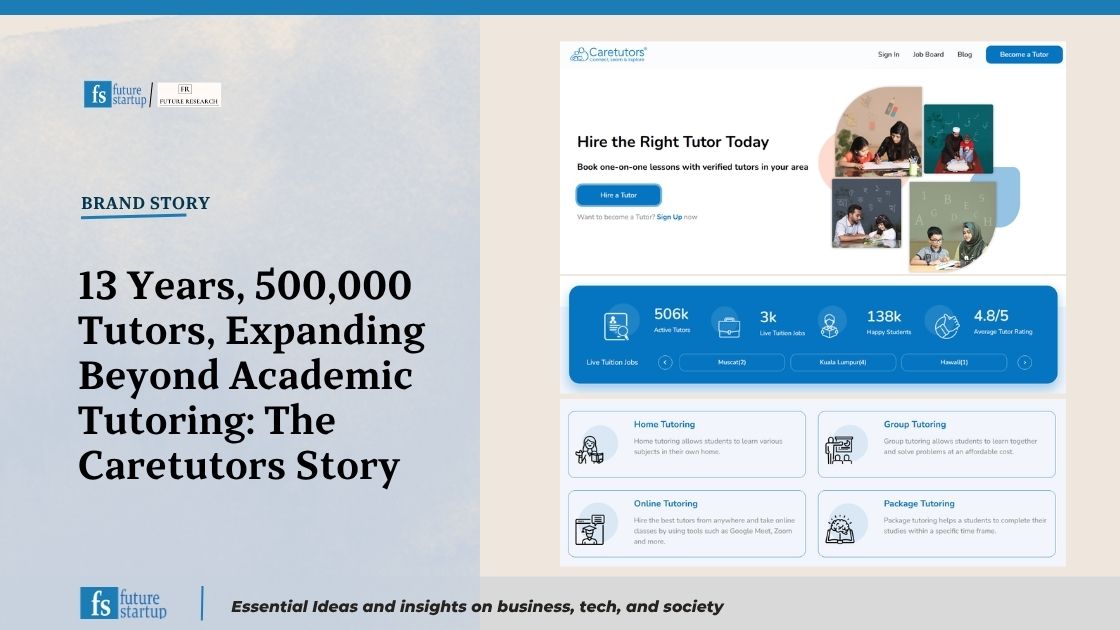
Thirteen years in, the platform has over 500,000 registered tutors and more than 125,000 students and guardians. It has been profitable every year since recovering from COVID. The referral flywheel, driven by families telling other families, accounts for one in every five new customers. The students who joined as tutors in 2014 are now guardians hiring tutors for their own children. Less than 1% of an addressable market of 38 to 40 million active students has been served.
The moat is not tech but an ever-renewing commitment to serve customers well. That is a harder thing to replicate than it looks. And it is the story this piece is about.
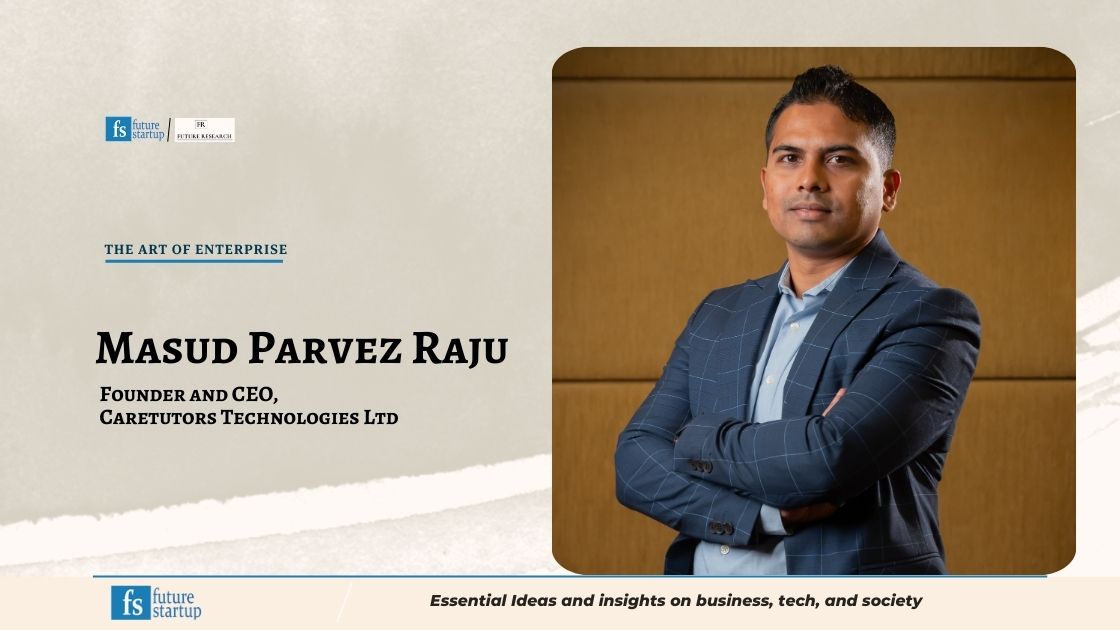
The founding story of Caretutors begins not with a breakthrough, but with a constraint. Masud Parvez Raju was a BBA student at Independent University Bangladesh (IUB), newly arrived from Chittagong and living carefully on his father's measured allowance. Most of his university friends were earning money through private tutoring. He got curious about how they found students. What he discovered was a tour through the market's dysfunction: tuition agents who charged upfront fees and sometimes sent unverified candidates, seniors who passed referrals for a cut, an informal system held together by personal trust that was both essential and easily exploited.
He spent four to five months investigating, talking to guardians who had paid agents and received the wrong tutor, and to students who had paid for tuition and heard nothing back. The more he looked, the clearer it became: the problem wasn't a shortage of tutors or a shortage of families who needed them. It was the absence of any reliable intermediary between them.
In 2012, Raju and a classmate pooled their savings: 10,000 Taka from Raju, 8,000 from his partner, for a total of 18,000 Taka, roughly $150 at the time. A senior with web skills built them a website for 3,000 Taka: 1,000 for the domain, 1,000 for hosting, and 1,000 as a favour. Initially, it was more like a directory: a list of tutors with their university affiliations and contact information.
The name, Caretutors, came from a marketing classmate. The logic was simple: tutors, with an element of care baked in. The domain was registered on day one.
For distribution, Raju found the newspaper hawker who delivered to Gulshan, Dhaka's most affluent neighbourhood, and paid him 150 Taka to insert 500 leaflets into the morning papers. Hours later, the phone rang. Two guardians called. They wanted tutors.
However, there was one problem. Caretutors had no tutors.
Rather than building supply before demand, or demand before supply, Raju improvised. He called university juniors whose character and capability he could personally vouch for, placed them with the two families, and collected the first platform charge. The system was manual. Matches were tracked on Excel. The volume was tiny. But the flywheel had turned its first rotation.
Raju graduated from IUB in December 2013. Caretutors was still a side project, generating some income, but not enough to live on. He joined Grey Advertising Bangladesh as an intern and was offered a full-time role upon completing it. Grey was, at the time, one of the country's leading advertising agencies. Raju was assigned to the GlaxoSmithKline account, the Horlicks portfolio, a brand dominant enough to require managing multiple product variants simultaneously, and absorbed into one of the more intense work environments in Dhaka's professional scene.
He thrived in it. "I never disliked the pressure," he said. "I felt that the harder I worked, the more pressure I took, the more I would learn. I never had it in me to stay in a comfort zone."
He applied this principle twice over. Days at Grey. Evenings and nights at the Caretutors office, which by 2015 had moved to a small space at Gulshan Link Road, courtesy of a third co-founder who had joined, invested some money, and given them a room.
"My office at the time was at Gulshan-1. Every day, after work, I went to the Caretutors office between 7 and 8:30 PM and worked till 11:00 or 12:00 at night."
This phase also produced a pivotal relationship. Caretutors began working with Oployeelabs Ltd, a software development firm, to rebuild the platform properly. The company's CEO was Abdul Matin Emon, who would later go on to lead Praava Health. Emon recognized something in Raju, a seriousness of purpose, a work ethic, and began to mentor him without expectation of return.
"Meeting Emon bhai was a turning point for Caretutors," Raju said. "He had vast knowledge about tech and business, and he helped us to get a better understanding of different aspects of our business."
The inflection point came in 2015, when Raju attended an entrepreneurship event organized by LightCastle Partners and met its then-Managing Director, Ivdad Ahmed. The conversation was blunt: you have your feet in two boats. Neither will work.
Raju heard it. He went home, thought it through, and in November 2015, three years after printing the first leaflets, left Grey to work full-time on Caretutors.
Three months later, the founding team dissolved.
What happened next is, in Raju's own telling, the hardest period of the entire journey. It deserves full attention, because it reveals the founder's character more clearly.
Both co-founders, one who had been with the company since the beginning, and another who had joined in 2014, told Raju they were leaving. They had other plans. The timing was extraordinary. Raju had just resigned from a stable, promising job. The company was finally showing momentum. And the two people he depended on most, one running technology, one running design, both functions in which Raju had no training, were gone simultaneously.
"The sky fell on my head," he said.
He borrowed money from a friend, bought back their shares, and found himself running Caretutors alone. He was in his mid-twenties. He cleaned the office himself. Made the tea. Managed the Facebook page. Chased software engineers for progress updates. Handled every customer call.
With the challenge came self-doubt. The question "Am I the right person for this?" haunted him through the following months. He had already discovered something important about himself: he could be patient. He could sit with unanswerable questions and resist the urge to force premature resolution.
"I've learned from life that when you can't find the answer to a particular problem, you should just learn to live with the question. When the time passes, the answer to the question will automatically come to you."
Day by day, then week by week, then month by month, the answer crystallized as a gradual recognition: this was his thing.
By 2017, he had rebuilt. A team of four to five people, freshers trained from scratch. Emon, alongside a friend who was also a successful entrepreneur, invested in Caretutors, solving Raju's financial problem. Monthly operating expenses were kept at 70,000 to 80,000 Taka. The team that joined in 2017 and 2018 is still with Caretutors today.
Between 2017 and 2019, Caretutors was, by conventional metrics, a slow-growth business. Roughly break-even. Improving product, limited geographic reach. To anyone watching from outside, it might have looked like a business that had found its ceiling early.
What was actually happening was something more valuable: the building of infrastructure.
Raju hired his first software engineer in 2018 and launched the Android app the same year. The iOS app followed in early 2020. The platform migrated from manual operations to a fully technology-enabled system. By 2019, the architecture that would eventually support hundreds of thousands of users was taking shape.
More importantly, Caretutors was beginning to compound trust. Every tutor who had a good experience became a source of referrals. Every guardian who found a reliable tutor told their neighbours. The repeat-and-referral rate climbed.
"We got 10 clients, let's make 15 clients out of them. We got 25, let's make 40. Slowly, phase by phase, Caretutors' business came to this scale."
By early 2020, the results of three years of foundation-building were becoming visible. The team had grown to 30 people. Traction was real and building.
Then COVID happened.
The story Raju tells about the COVID years is not primarily about business strategy. It is a story about what it means to be responsible for other people.
When lockdowns began in 2020, Caretutors' core business, in-home tutoring, stopped. The momentum achieved through the hard work of the previous three years evaporated in weeks. Revenue collapsed. Raju found himself trying to hold together a 30-person team through a crisis with no definite end date.
He called everyone individually. Those he could not pay, he spoke to honestly and asked to look for other work temporarily, making clear they could return. Those who stayed accepted reduced salaries. Raju's own compensation fell below that of several team members. His office landlord paused rent for six months.
"Keep Caretutors alive," he told his team. "When the situation returns to normalcy, we'll have a good time again."
Of the 30-person team, roughly half left over the following months. The team Raju had spent four years building was, again, largely gone. He had lost everything before and rebuilt. He knew it could be done again.
During this period, Caretutors experimented with online tutoring. And when the lockdown finally lifted, he and his team got to work to regain the momentum. Slowly, demand returned. By 2022, Caretutors had returned to profitability. Since then, it has been profitable every year, with profits growing annually.
Caretutors has not raised significant capital since 2017. It has not cut corners on verification. It survived a global pandemic, lost half its team twice, and continued building, slowly, patiently, without fanfare, into one of Bangladesh's quiet but consequential technology companies.
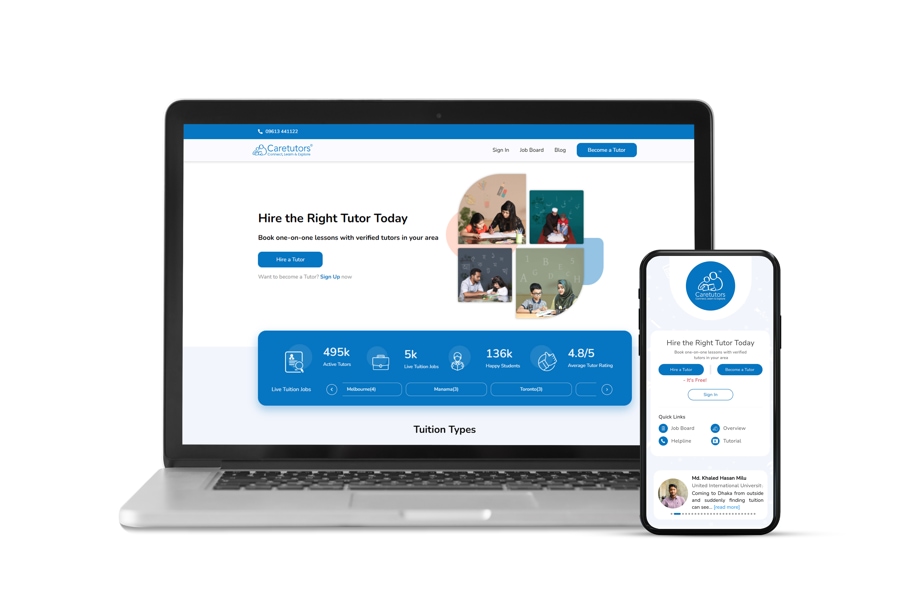
Caretutors is a two-sided marketplace connecting learners with tutors across 13 learning categories. The platform operates on a commission model: tutors pay a fee upon successful placement; students and guardians post requirements and receive applications at no cost.
The matching process: A guardian posts a tutoring requirement: subject, level, location, schedule, and budget. Caretutors backend team verifies the post, and it then goes live on the job board. Relevant tutors receive a push notification filtered by location and category. Tutors who have not completed their profiles past a minimum threshold cannot apply.
When applications arrive, the guardian reviews CVs, selects candidates for a trial class, and, upon confirmation, a digital agreement letter is issued. An attendance tracking feature allows guardians to monitor sessions going forward.
For new or unverified tutors and for high-sensitivity placements, a dedicated six-person verification team runs extended checks: home address, academic credentials, and identity documents. The safety infrastructure is a core part of the product.
Five service formats:
Home Tutoring: The original offering. One-to-one, in-person, at the student's home. The foundation of the business.
Group Tutoring: Three or four students at the same level share a tutor and split the cost. SSC and HSC candidates are the primary users. The unit economics work for everyone: tutors earn the same or more, and students pay less.
Online Tutoring: Launched during COVID, producing unexpected network effects. Bangladeshi tutors now teach students in the United States, Canada, Saudi Arabia, and the UK, primarily for Bangla and Arabic language instruction. The diaspora market comes to Caretutors; it requires no geographic expansion.
Shadow Tutoring: Launched in 2025. Designed for dual-income households where both parents work. A Shadow Tutor spends extended daily hours with the child: school pickup, play, and teaching. It functions somewhere between tutor and trusted nanny. The market for it is structurally growing as urban dual-income households become more common across Bangladesh.
Package Tutoring: Package Tutoring is a service for a fixed period, such as SSC/HSC final preparation, university admission tests, IELTS, or job preparation, etc. It helps students prepare effectively within a short time, usually 3–4 months.
The evolution of Caretutors' thesis is a fascinating story of constant evolution by listening to one's customers.
From 2012 to 2016, the platform focused exclusively on academic tutoring: Bangla medium, English medium, and English version. In 2017, guardians started asking for things the platform had never offered. Arabic tutors. Coding teachers. Gym trainers who could come to the home.
Raju's approach was consistent: validate demand first, then build the category. Arabic arrived first, driven by religious observance and the practical needs of families. Drawing and painting followed, then music and dance. Then, fitness, coding, professional skills, special needs, and Madrasa instruction.
Today, Caretutors operates across 13 categories:
| # | Category |
| 1 | Bangla Medium (K–12 academic) |
| 2 | English Medium (K–12 academic) |
| 3 | English Version (K–12 academic) |
| 4 | Religious Studies |
| 5 | Admission Test |
| 6 | Language Learning |
| 7 | Arts (painting, drawing, handwriting) |
| 8 | Test Preparation |
| 9 | Professional Skills Development |
| 10 | Uni Help |
| 11 | Madrasha Medium |
| 12 | Special Skills Development |
| 13 | Special Child Education |
The original thesis remains the same, just applied more broadly. As Raju puts it: "We are a platform that connects learners/students/guardians with teachers/tutors to learn skills/subjects, be it academic or non-academic, where in-person tutoring is a superior method of learning than other alternatives."
The underlying belief, that personalized human instruction is categorically better than alternatives for most learning contexts, is empirically grounded. Bloom's 2 Sigma research remains among the most replicated findings in educational psychology. Oxford and Cambridge organize their undergraduate teaching around small-group tutorials for exactly this reason.
What Caretutors is attempting, at its most ambitious reading, is to democratize access to a model of learning historically available only to the privileged few, and to extend it beyond school curricula to the full spectrum of human skill development.
The supply-side thesis matters equally. For Bangladesh's large population of university students and recent graduates, navigating a job market where educated youth unemployment is a well-documented challenge, tutoring has long been a primary income source. Caretutors' platform transforms this informal arrangement into something more structured: a verifiable professional profile, a steady stream of matched opportunities, and a system that treats tutoring as a legitimate vocation.
Consider the supply side.
500,000 registered tutors offer a structural advantage that compounds with time. Every new tutor strengthens the platform's value proposition for guardians, offering more options, better matches, and a higher probability of the right fit. Every guardian who posts a job creates an opportunity for tutors, which makes registration more valuable, which attracts more tutors.
The roughly three-to-one tutor-to-guardian ratio might look like demand underperformance to a conventional marketplace analyst. In a market where match quality matters enormously, supply abundance is a feature. Guardians can receive 20 to 200 tutor applications for a single post. That volume of choice, filtered through verification and matching systems, is the service.
The financial model is straightforward: commission on placement.
Package Tutoring, a defined syllabus over a fixed period, carries a lower platform charge. Shadow Tutoring, requiring extended daily commitment, carries a premium. Online tutoring opens the geographic surface to near-unlimited expansion with no incremental infrastructure cost.
What is known of the financials: the company says it has been profitable since 2022, profits are growing annually, and it has sustained a 60-person operation entirely from revenue since 2017.
"We have always tried to be efficient and effective as a company," Raju said. "A core value of our culture is doing more with less."
Caretutors enjoys several structural and operational advantages.
First-mover advantage with network effects. At 500,000 tutors, Caretutors has a supply base shaped by years of interaction with the platform's verification processes, norms, and community. The social proof at this scale is self-reinforcing in a way that capital alone cannot replicate.
Trust infrastructure that takes time to build. Caretutors vouches for tutors. The verification systems, automated checks, manual review for sensitive placements, and a six-person dedicated team represent years of operational learning about what can go wrong and how to prevent it. A competitor can hire verifiers; it cannot instantly acquire the institutional knowledge of what to verify for.
The referral flywheel. Approximately 20% of sales come from existing customers recommending the platform to friends and family, word-of-mouth earned through execution, compounding without proportional cost.
Demographic compounding. Students who used Caretutors between 2013 and 2018 are now parents. They return. As Raju notes, "Before, maybe a brother hired a tutor for his sister. Now that same brother is taking a tutor for his child." This cohort effect intensifies with every passing year.
Market knowledge that cannot be purchased. "Over the years, we have developed unique insights about this market that you can only gain through operating in a market for years." The knowledge of what customers actually want, not what they say they want, but what they keep returning for, accumulates in organizational intuitions built over a decade.
On AI tutoring: Raju does not see it as an existential threat. Children do not simply absorb content from tutors; they absorb discipline, attention, and behavioral modeling. The relational dimensions of effective instruction are not replicable by current AI systems.
Over the past five years, as AI tutoring tools have proliferated globally, Caretutors' user base has grown every year. AI will help the company improve its matching and verification operations. It is unlikely to displace the product.
| Metric | Figure |
| Registered tutors | 500,000+ |
| Registered students & guardians | 1.35 lakh+ |
| Divisional cities (Bangladesh) | 12 |
| Learning categories | 13 |
| Countries served (online tutoring) | 12+ |
| Sales from referrals | ~20% |
| Full-time employees | 60 |
| Profitable since | 2022 (every year) |
| External capital raised | One round (2017); none since |
| Estimated addressable market (students, BD) | 38–40 million |
| Market served to date | <1% |
Caretutors operates on a deliberate and somewhat contrarian hiring philosophy. Rather than competing for experienced talent, the company says it hires primarily for appetite, people with hunger to learn who may lack the credentials established companies demand. It trains them, gives responsibility early, and waits.
The company's HR lead started in customer service. Several team members who joined in 2017 now hold senior positions. Retention is high.
"We try to hire people with an appetite for learning and personal growth, train them, give them opportunities to learn and grow, and we have seen that they eventually generate the best output."
The organizational structure: an engineering team maintains three platforms (desktop, Android, iOS); a marketing team; a business development team; an HR team of two; and a 36-person operations group that covers verification, safety, sales, and customer relationship management.
The customer relationship team, whose sole function is proactively calling existing users to understand their experience, is expensive relative to automated alternatives. It is precisely what builds the trust that drives the 20% referral rate.
The company says its annual planning begins every October. Roadmaps cascade into quarterly, then monthly targets. Every month ends with a structured review: what worked, what didn't, why, and what to change next month.
As Caretutors consolidates its existing business, the company looks into an ambitious but gradual expansion plan.
Raju says divisional expansion is the most immediate priority, bringing Dhaka-level operational depth to the other seven divisional cities. Not just registered tutors (which already exists), but the verification infrastructure, local brand presence, and customer relationship capacity to match the Dhaka standard.
International growth has been seeing an organic traction. Families in Saudi Arabia, the UAE, Canada, and the UK are already using the platform. Caretutors has not yet invested heavily to accelerate this. When it does, international could become a meaningful revenue share, at potentially higher unit economics, given diaspora households' demonstrated willingness to pay for quality home-country instruction.
Raju says ecosystem expansion is the longer-term play. Caretutors has a large, trusted user base of parents, students, and tutors. These users have needs beyond tutor matching: educational materials, financial products, and health services. Raju is measured, "we want to focus and do one thing at a time," but the logic is compelling. The right adjacencies deepen value for existing users without distracting from the core.
Capital, eventually. Raju doesn't dismiss raising institutional funding but is specific about conditions: revenue challenges or a decision to grow faster than organic profitability allows. When that moment arrives, Caretutors will present an unusual investment profile: a profitable marketplace with 13 years of market knowledge, a defensible supply base, a compounding demographic flywheel, and less than 1% of its addressable market served.
Caretutors is not, at its surface, a technology story. There is no breakthrough algorithm, no novel interaction paradigm. What it is, at its core, is a trust story, which is to say, a fundamentally human one.
Bloom's 2 Sigma finding was a challenge to education systems: if one-to-one tutoring produces dramatically better outcomes, what are we doing about it? The economics of scale, they say, make universal tutoring impossible.
Caretutors offers a different solution. You cannot tutor 40 million students at once. But you can build a platform that connects every one of them, reliably, safely, across every subject and skill, to a tutor who is right for them. And you can do it not just for SSC Math, but for Arabic calligraphy, classical guitar, gym training, and the special needs child whose classroom cannot reach her.
That is the vision. The execution, thirteen years in, has covered less than 1% of it. Compounding at the human scale is slow. It is also, ultimately, more durable than almost any other form of competitive advantage.
Thirteen years ago, a 22-year-old from Chittagong paid 150 Taka to a newspaper hawker to stuff leaflets into morning deliveries in Gulshan. He had no tutors, a 3,000-Taka website, and a conviction that the market deserved better.
Today, Caretutors has 500,000 tutors, operates in multiple cities in Bangladesh and more than twelve countries, and is profitable on the strength of patient execution and the refusal to spend money it didn't have. The market it operates in has barely been touched.
We should pay attention.
Caretutors is available on the web, Android, and iOS. This article draws on a comprehensive interview with founder and CEO Masud Parvez Raju, published by Future Startup in February 2026. All quotes are drawn directly from that interview.