
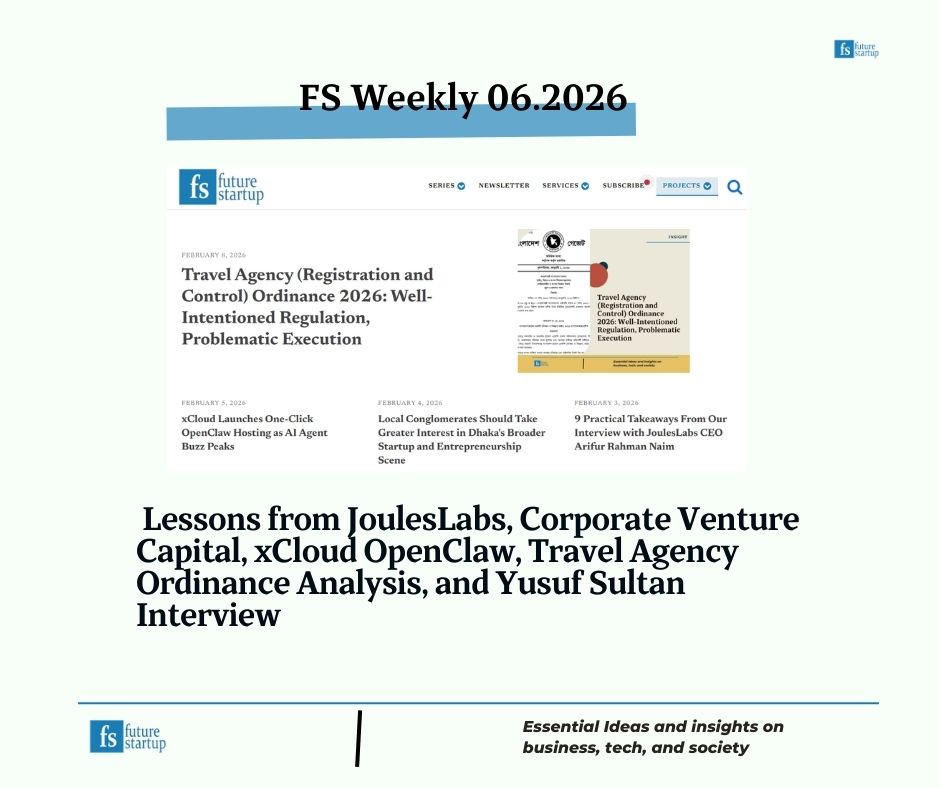
This week’s FS weekly features some fascinating stories across founder lessons, why Bangladeshi conglomerates should pay attention to Dhaka’s growing entrepreneurship scene, an analysis of the new travel agency ordinance 2026, and an interview from our archive with IFA Consultancy co-founder Yusuf Sultan.
All links are below.
Last week, we published a wide-ranging conversation with Arifur Rahman Naim, co-founder and CEO of JoulesLabs, where we explored his unconventional path from a village near Kuakata to running a 25-30 person engineering agency. The interview covered everything from his personal journey, his take on building enduring institutions, the mechanics of partnership, the reality of building a services business in Bangladesh, and the ongoing challenge of creating sustainable organizations.
JoulesLabs started in October 2017 as a sole proprietorship, landed its first contract through serendipity in Thailand, and has since worked with clients ranging from FundedNext and the Bangladesh Navy to Europe-based EV companies. But what makes this story worth examining isn't the client list or the survival, it's the texture of decision-making underneath, the pattern of choices that separates companies that last from those that don't.
We've pulled nine takeaways from the interview that speak to common challenges in venture building. Specific, practical insights about how work actually gets done, how partnerships actually function, and how founders actually learn.
Bangladesh remains what social scientists call a low-trust society. We're hesitant to collaborate with people outside our immediate networks, and we assume the worst about unfamiliar partners. This cultural characteristic, while perhaps protective in certain contexts, limits our ability to build the kind of ecosystems that drive innovation and growth.
Successful startup ecosystems require collaboration across institutional boundaries. They need angels who invest in companies they don't personally manage. They need corporations willing to partner with ventures they don't control. They need mentors who share knowledge without demanding equity. Building this collaborative infrastructure requires us to develop greater institutional trust.
The economic case for corporate engagement with startups extends beyond individual returns. When established companies invest in and partner with startups, they strengthen the entire entrepreneurship ecosystem. They provide capital that enables more ventures to launch and scale. They offer expertise that helps founders avoid common pitfalls. They create exit opportunities that encourage more people to start companies.
OpenClaw has become 2025's breakout open-source project, surpassing 100,000 GitHub stars within two months with demos of an AI agent that can actually control your digital life through Telegram or WhatsApp. But getting it running has been a different story. Docker, environment variables, API configurations, and the barrier to entry have kept casual users on the sidelines.
xCloud, the Bangladesh-based all-in-one hosting platform, is betting enough people want to experiment without the technical headache. This week, the company launched OpenClaw Hosting in beta, offering one-click deployment on managed servers with 4GB+ RAM.
On January 1, 2026, Bangladesh's government published amendments to the Travel Agencies (Registration and Control) Ordinance, 2026. Issued by presidential order, the ordinance arrives after at least three online travel agencies collapsed between 2024 and 2025, allegedly defrauding customers of hundreds of crores in ticket payments. The government earlier published a draft of the same to get feedback from the stakeholders.
The regulatory response is comprehensive, addressing beneficial ownership transparency, false bookings, pricing opacity, and financial guarantees. These are legitimate concerns. But the ordinance also exemplifies a recurring pattern in Bangladesh's regulatory evolution: well-intentioned interventions that impose requirements calibrated for sophisticated, well-capitalized operators on a market where most participants are small, resource-constrained businesses operating on thin margins.
The result will almost certainly be market consolidation, the exit of smaller players, and higher barriers to innovation. Whether this represents good policy depends on what you're optimizing for.
Mufti Yousuf Sultan is the co-founder of IFA Consultancy, a pioneering institution in Bangladesh that provides training and consultancy on Islamic finance, aiming toward a Halal and Sustainable Economy.
In this fascinating interview with Future Startup’s Ruhul Kader, Mr. Yousuf talks about his journey to what he is doing today, the origin of IFA Consultancy, Islamic finance and venture capital, the history of Islamic finance, the origin and making of IFA Consultancy, the challenges of building an Islamic finance education and services company in Bangladesh, how IFA Consultancy works as an organization, the metaphysics of growth, the ambition of IFA Consultancy, the real measure of success and much more.