

Today, we live in an increasingly digital world, where having an online presence is crucial for businesses and individuals alike. Yet the process of hosting, setting up servers, and managing websites remains overwhelming for many users. Especially those without technical expertise face challenges when scaling their websites, managing multiple sites, or dealing with server configurations.
Enter xCloud, a fast-growing hosting platform designed to simplify server and website hosting and management for users of all levels, whether agency, developer, business, or individual. xCloud allows users to create, host, and manage their servers and sites from a single dashboard while accessing the advanced features. xCloud claims it provides enterprise-grade security, seamless automation, a user-friendly interface, competitive pricing, and robust support.
The platform utilizes NGINX and OpenLiteSpeed (OLS) as web servers, and supports multiple versions of PHP, including PHP 8.4, to ensure compatibility with a wide range of applications. For database management, xCloud employs MySQL and MariaDB. Redis caching enhances performance through faster data retrieval and reduced server load. The entire system operates on Ubuntu, known for its stability and security.
Additionally, xCloud integrates with various cloud providers, including DigitalOcean, Google Cloud Platform, Vultr, AWS, Linode, Hostinger VPS, and Hetzner, allowing users to choose their preferred infrastructure.
This combination of technologies, the company claims, delivers a seamless hosting experience while eliminating the traditional complexities.
The company says it caters to both technical and non-technical users. It automates repetitive tasks that typically consume significant time and resources, such as PHP setup, MySQL installation, security configurations, plugin maintenance, and backups, improving efficiency and freeing users to focus on their core work.
xCloud has used a combination of constant user feedback and community engagement to fuel its growth. By incorporating user feedback into product development, xCloud has built a reputation for reliability and customer satisfaction. The platform says it now powers more than 100,000 websites globally.
Perhaps most compelling is xCloud's approach to pricing and support. It's flexible and transparent pricing starts at just $5 per month. The platform provides 20+ hours of daily live support across multiple communication channels, including WhatsApp and Telegram notifications, and an active community. The company says it aims to transform customer service from a transactional experience into a collaborative partnership.
Created by Startise, a technology conglomerate with over 6 million users and an established reputation in the WordPress community, xCloud aims to redefine how people host, build, and deploy websites and applications.
Like many of the products of Startise, xCloud was born from an internal need. Its founders, managing hundreds of websites across multiple platforms, each with its own control panel, security protocol, and performance quirk, set out to create a solution that could simplify this complexity.
Traditional hosting has long suffered from one-size-fits-all solutions that create friction for agencies, multi-site managers, and non-technical users. Many platforms impose site limitations, provide fragmented management interfaces, demand extensive technical expertise, and charge premium prices for basic services.
Afshana Rahman, co-founder of xCloud and CMO of Startise, captures this frustration: "Traditional hosting services aren't really friendly for founders and agencies managing lots of websites. We wanted to build something where we could manage all of these things in one platform."
With this goal in mind, xCloud was created to simplify server and website management and empower users to focus on their businesses. The xCloud team spent a significant time speaking with customers, testing the technology, and the market before formally launching the service.
Hosting is a highly competitive market. The industry has multiple large players. Some of them are multi-billion dollar companies. Moreover, it is a complex technical challenge. The xCloud team took a meticulous approach to building a world-class product anchored in solving problems of customers.
An alpha version was first tested by the close network of the xCloud founders. After the initial feedback, a beta version was released to an extended community of users. By the time xCloud was launched in 2024, the platform had gained attention from the industry, managed to build an active community, and a growing user base.
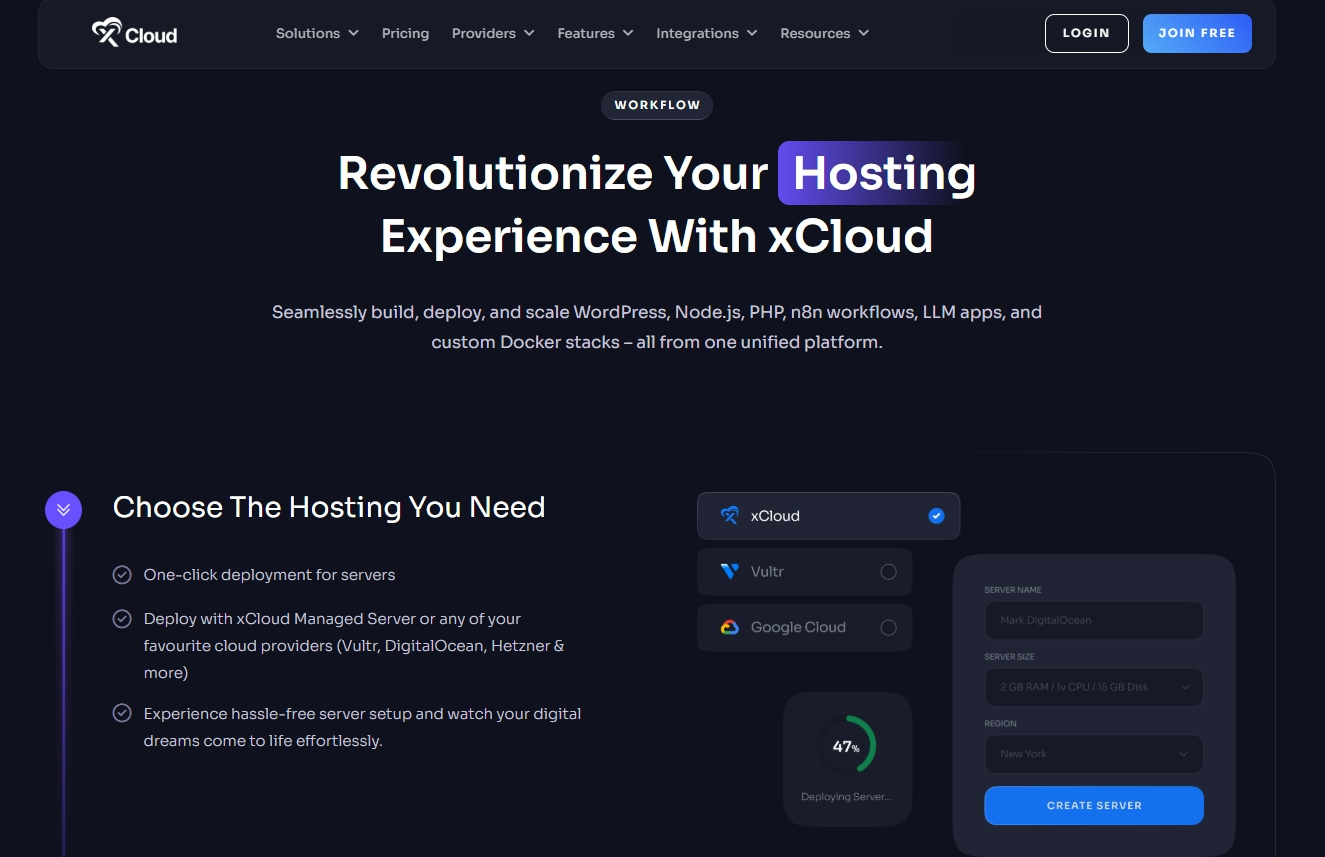
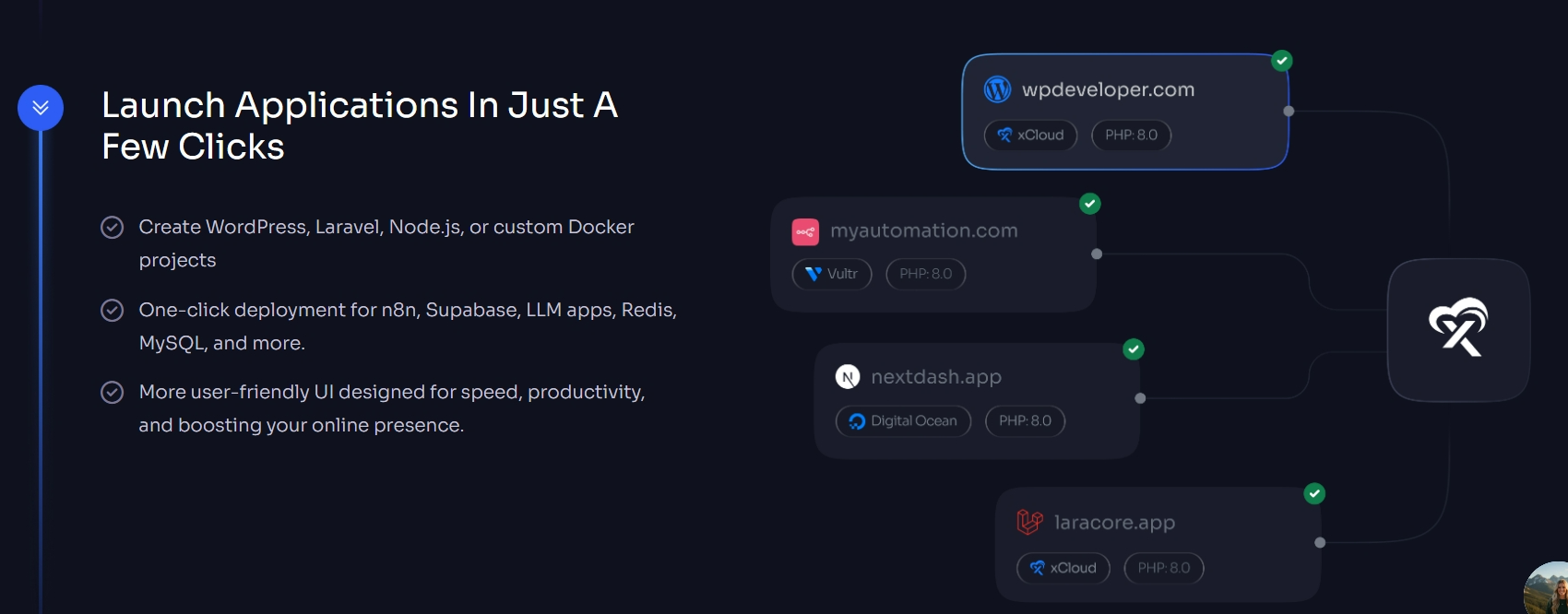
xCloud simplifies setting up and managing servers and websites across multiple application types. It automates the technical complexities of server setup and application deployment, allowing users to launch websites, Node.js applications, Laravel projects, n8n workflows, LLM applications, and even custom Docker stacks with just a few clicks.
Users can choose xCloud Managed Servers, available in both regular and premium configurations with high-frequency 3GHz+ Intel Xeon CPUs and NVMe storage, or bring any popular cloud services like Vultr, Google Cloud Platform, DigitalOcean, AWS, Linode, Hostinger VPS, or Hetzner and manage them with ease. xCloud handles the technical details, letting users focus on their core work.
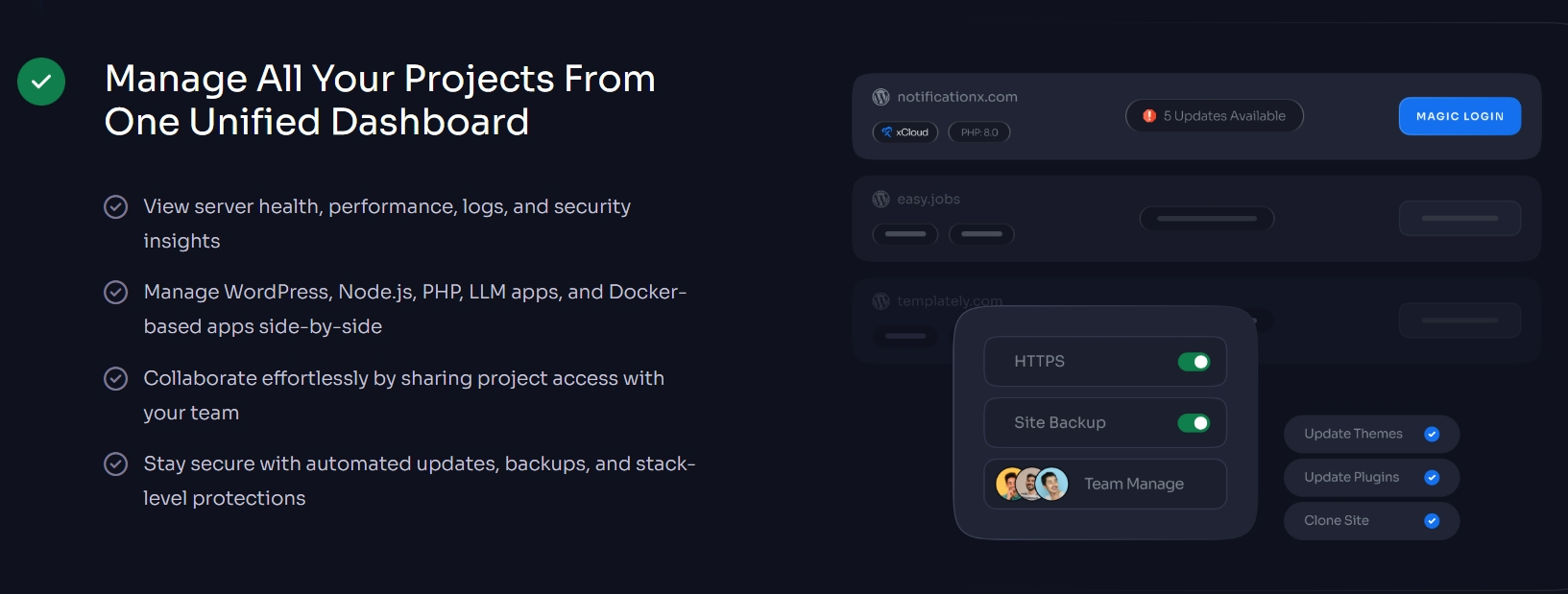
The platform's unified control panel offers real-time monitoring, one-click deployments, and comprehensive server and site management features, all seamlessly integrated with automated updates and maintenance protocols.
Let’s take a closer look at some of the key features of xCloud.
Flexible infrastructure: One of xCloud's distinctive features is its infrastructure flexibility. The platform offers fully managed xCloud servers as a turnkey solution with easy setup and maintenance, available in both regular and premium server configurations.
For users who prefer to have control over their infrastructure, xCloud provides the option to bring your own VPS, with seamless integration with cloud providers.
According to the company, xCloud manages server setup, optimization, and maintenance regardless of the underlying infrastructure choice, making it accessible to both technical and non-technical users. Servers include dedicated IPs and root access, allowing users the flexibility to customize server settings according to their needs, while xCloud ensures seamless management.
Multi-application support: While xCloud started as and excels at WordPress hosting, the platform has evolved into a comprehensive hosting solution supporting multiple application types. For WordPress and WooCommerce, xCloud offers fast, secure hosting with automated updates, backups, and optimizations for high-traffic e-commerce sites that the company claims can handle millions of checkouts per minute.
Laravel hosting comes with Laravel-optimized environments, staging capabilities, SSL certificates, and streamlined deployment tools. Node.js hosting enables users to deploy modern JavaScript applications with full server-side rendering support, direct Git integration, and optimized runtime environments.
xCloud also provides PHP application hosting with fully managed servers built for smooth, efficient performance. For automation enthusiasts, n8n hosting offers managed environments with optimized performance, free SSL certificates, and custom domain support for powerful workflow automation.
The platform has also ventured into LLM hosting, providing a high-performance infrastructure for hosting large language models, allowing users to self-host LLMs with OpenWebUI or Ollama.
Additionally, users can deploy and manage custom Docker stacks with full control over their containerized applications.
xCloud's One-Click Apps feature allows users to deploy various applications instantly, including n8n, Supabase, Redis, MySQL, Umami Analytics, LibreChat for AI chat interfaces, Nextcloud for self-hosted storage, Mautic, and more. According to xCloud, this feature significantly reduces deployment time and technical complexity, enabling users to launch production-ready applications in minutes rather than hours.
Advanced management tools: xCloud has introduced several advanced management tools that streamline operations for agencies and developers managing multiple sites. The Updates Manager allows users to update WordPress core, plugins, and themes across all sites simultaneously from one central dashboard, ensuring consistency and security across entire portfolios. Git Provider Integration enables users to connect GitHub accounts and deploy sites directly from repositories, facilitating modern development workflows and continuous deployment practices.
The Command Runner feature allows users to execute commands directly from the control panel without needing SSH access, streamlining server management.
For scaling and testing purposes, xCloud offers full server cloning capabilities, allowing users to duplicate entire server setups in just a few clicks, perfect for creating testing environments or rapidly scaling infrastructure.
Website migration and performance optimization: xCloud's free migration plugin provides straightforward website transfers from other hosting providers. If any issues arise during the migration process, xCloud's expert team provides complete support to ensure smooth, disruption-free migrations, even supporting bulk migrations at no additional cost. The company aims to transform the typically stressful migration process into a stress-free experience.
Performance optimization is another area where xCloud focuses its efforts. With server-level caching, database optimization, and strategic content delivery network (CDN) integration with Cloudflare, xCloud claims to ensure that hosted websites and applications run at peak efficiency.
The platform offers NGINX FastCGI caching that can be activated with one click, serving pages at what the company describes as lightning speed by bypassing PHP processing. Redis object caching helps handle more visitors without slowing down, and users can clear the cache directly from xCloud.
The platform's efficient resource allocation and monitoring tools provide users with visibility and control over their digital infrastructure.
Enterprise-grade security: Security is a top priority for xCloud, and the company has implemented a comprehensive security framework to protect user websites and applications. The platform provides automated security updates through proactive monitoring and automatic application of security patches to protect against vulnerabilities.
The WordPress Vulnerability Checker scans websites for security gaps and potential threats, while Vulnerability Shield Pro, powered by Patchstack, offers advanced threat protection.
xCloud also offers IP address management capabilities, allowing users to whitelist and blacklist IP addresses to control server access by specifying trusted sources. The AI Bot Blocker protects sites from malicious bot traffic on both NGINX and OpenLiteSpeed servers. Fail2Ban protection comes enabled by default on all servers to block unauthorized access and protect against brute-force attacks.
For encryption, xCloud provides one-click free SSL certificates or the option to add custom SSL certificates, with automatic configuration and renewal. The platform also implements site isolation, keeping each website separated from one another by creating distinct system users, ensuring that security breaches on one site cannot affect others.
This proactive approach, the company explains, ensures that users can trust xCloud to maintain a secure environment for their websites and applications.
Enhanced communication and integrations: xCloud offers seamless integrations designed to maximize performance and streamline workflows. The WhatsApp integration enables users to receive instant alerts and updates delivered straight to WhatsApp, while Telegram integration provides server performance updates via Telegram notifications.
For team collaboration, Slack alerts allow users to connect to Slack for real-time performance and event notifications.
On the performance side, Cloudflare integration enables users to deliver content at top speed worldwide with built-in CDN capabilities. Git provider integration connects repositories and enables automatic deployments from Git projects.
For backup management, Google Drive storage allows users to securely store automated backups in their Google Drive accounts, while Wasabi integration provides a cost-effective storage option for remote backups.
xCloud also integrates with tools to enhance application performance. Object Cache PRO helps speed up WordPress applications, while Mailgun integration enables WordPress sites to send transactional emails easily.
Mailbox feature: The xCloud Mailbox Feature provides what the company describes as premium business mailboxes starting from just $1 per month. Features include email aliases, forwarding, automatic DNS record management with Cloudflare integration, IMAP/POP configuration, and SMTP for transactional emails—making professional email management affordable and accessible for small businesses and individual users.
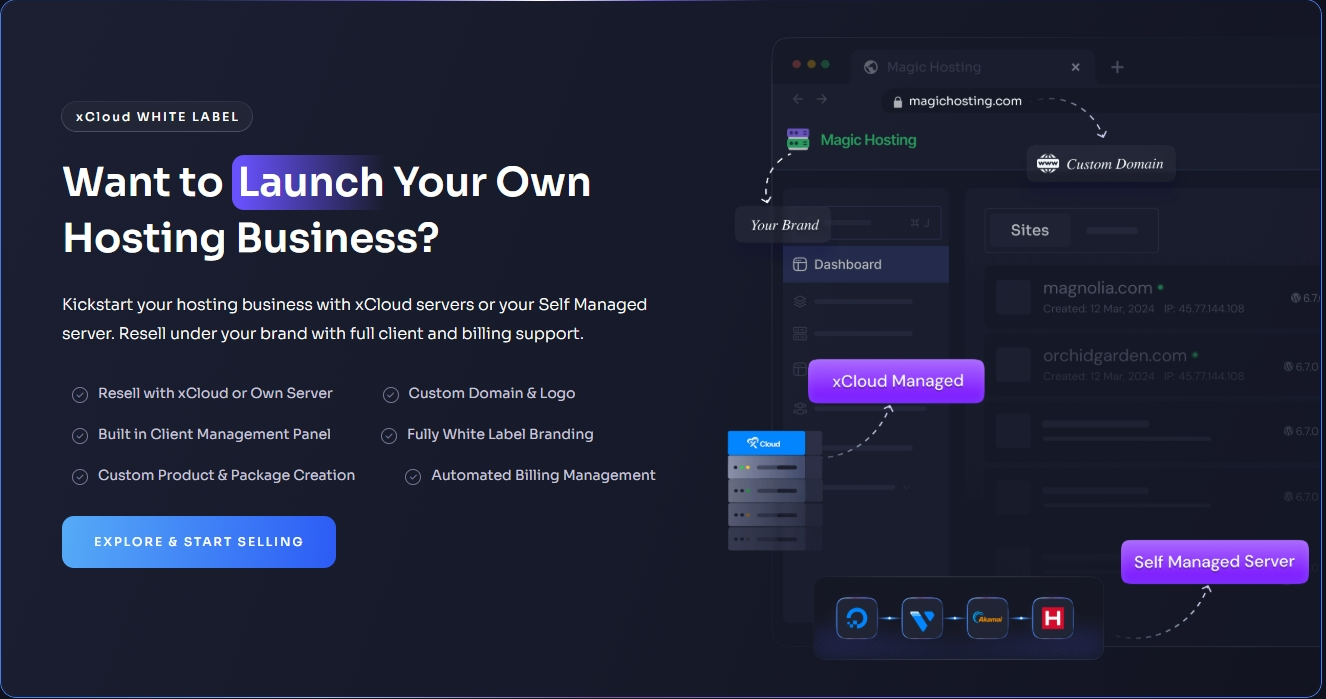
White label for agencies and resellers: xCloud White Label is designed for individuals, developers, and agencies who want to start a hosting business and resell hosting under their own brand. With fully automated billing, server setup, and client management tools, xCloud enables resellers to provide a seamless, branded hosting experience for their clients.
The White Label program includes custom domain and logo branding, a built-in client management panel, fully white-label branding across all touchpoints, custom product and package creation, and automated billing management.
Notably, the program also offers self-managed server integration, allowing resellers to connect servers from Vultr, DigitalOcean, Hetzner, or Linode to their white-label reseller panel, providing flexibility in infrastructure choices while maintaining a unified management experience.
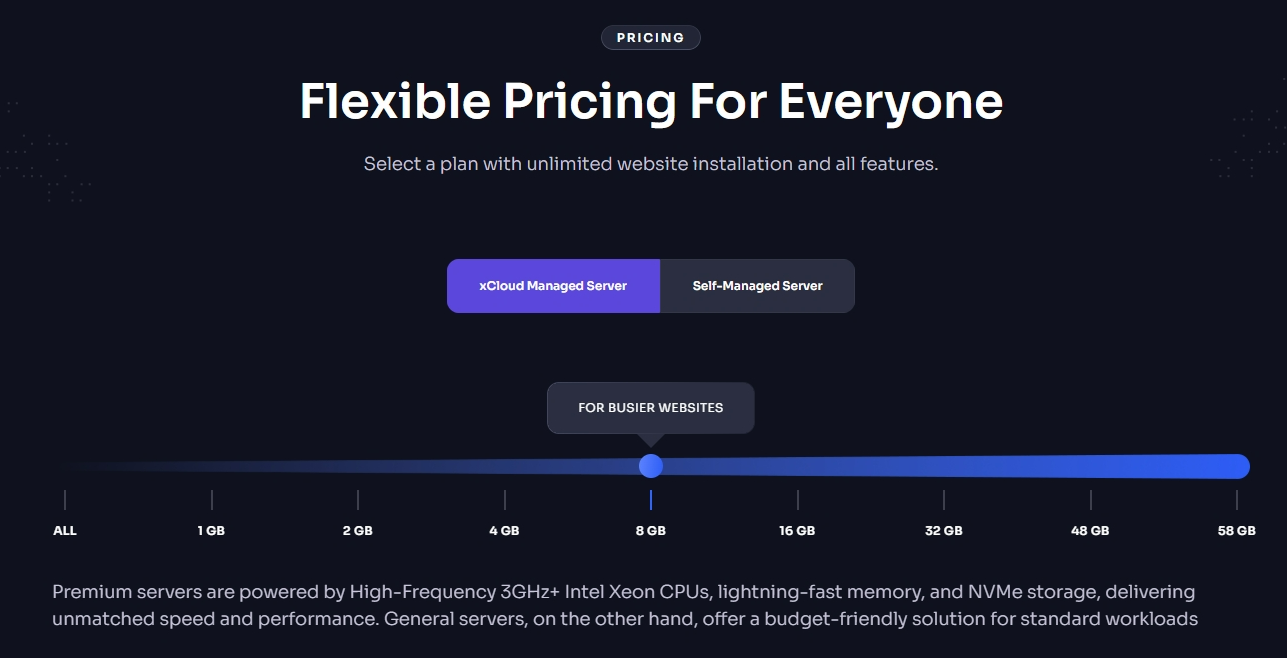
Flexible pricing and redefining customer support: xCloud's pricing model is designed to offer flexibility across different user needs. Plans range from $5 per month for the Newcomer plan to $395 per month for the Quantum plan, with both regular and premium server options available.
Along with its fixed pricing plans, the platform offers flexible pricing options for self-managed servers, where users pay only the management fee when they bring their own VPS. This approach, the company says, means users can choose the most cost-effective option for their specific requirements.
xCloud's pricing model includes no site limitations per server, which allows flexible resource allocation based on actual needs rather than arbitrary restrictions.
For agencies and power users, xCloud's ability to host multiple websites on a single server—based on resource requirements—makes it a cost-effective choice compared to traditional hosting providers that often charge per site.
Understanding the critical nature of hosting services, xCloud places a strong emphasis on support and has implemented what it describes as a comprehensive support system.
The company provides 20+ hours of live support each day, with dedicated teams for critical issues. Users have access to comprehensive documentation, multi-channel support including live chat, WhatsApp, and Telegram, as well as a vibrant Facebook community where users help solve each other's problems.
This multi-layered approach, xCloud explains, ensures users receive timely support when needed, regardless of their technical expertise level.
Looking at the platform holistically, xCloud offers several advantages that differentiate it in the competitive hosting market.
The platform is beginner-friendly, designed as a no-code solution with an intuitive UI that allows anyone to manage complex server and site management tasks without technical expertise.
For unified management, users can manage all servers and websites—whether WordPress, Laravel, Node.js, PHP, n8n, or custom Docker applications—from a single dashboard, eliminating the need for multiple control panels. Even resellers have access to manage their clients from an all-in-one dashboard.
The platform's multi-application support enables hosting and management of diverse application types from one platform, reducing operational complexity.
In terms of cost efficiency, xCloud provides access to enterprise-grade features at competitive prices without the limitations traditional hosting providers impose, with plans starting at just $5 per month.
Users gain technical freedom through the choice between xCloud Managed Hosting (regular or premium) or bringing their own VPS from multiple providers, maintaining complete control over their infrastructure.
For time savings, the platform automates routine tasks and server management, allowing teams to focus on core business activities. Features like Updates Manager and Command Runner significantly reduce manual work.
Enterprise security comes built-in, with advanced security measures, automated vulnerability scanning, and regular updates without manual intervention.
The platform offers scalability, enabling users to grow their hosting infrastructure seamlessly without technical complications or service interruptions, with full server cloning making expansion effortless.
Finally, white-label opportunities allow entrepreneurs to launch their own hosting businesses with fully automated client management and billing systems.
xCloud is more than a hosting solution; it's a comprehensive platform that aims to solve real-world challenges faced by digital professionals, industry leaders, and experts. Its success within a relatively short time demonstrates that solving user problems, combined with excellent support and community engagement, can create significant value and establish a foothold even in competitive markets.
The platform’s growth and commitment to excellence have attracted recognition within the WordPress and hosting communities. It has been nominated for Best WordPress Hosting at the WP Weekly Awards 2025 and the Monster Award 2025, and won a Bronze award in 2024. These recognitions validate xCloud's position as an innovative player in the hosting industry, though the company remains relatively young compared to established competitors.
The platform now empowers over 10,000 servers and powers more than 100,000 websites globally, with a thriving community of users who actively engage, share knowledge, and support one another.
Looking ahead, xCloud continues to expand its capabilities with regular feature releases. Recent additions like the Updates Manager, Git Provider Integration, One-Click Apps for LLMs and AI chat interfaces, and Self-Managed Server Integration for white-label resellers demonstrate the platform's commitment to continuous innovation based on user feedback.
The company says it aims to become a comprehensive digital infrastructure partner for businesses of all sizes, continually adding support for new application frameworks, expanding integrations, and developing AI-powered management tools.
With a clear roadmap driven by user feedback and a proven track record of consistent delivery, xCloud is positioning itself to compete in the next generation of cloud hosting and server management solutions.
Whether it can maintain this momentum and scale effectively against well-established competitors with deeper resources remains to be seen, but its early traction suggests the platform has identified genuine pain points in the market and developed solutions that resonate with users.