
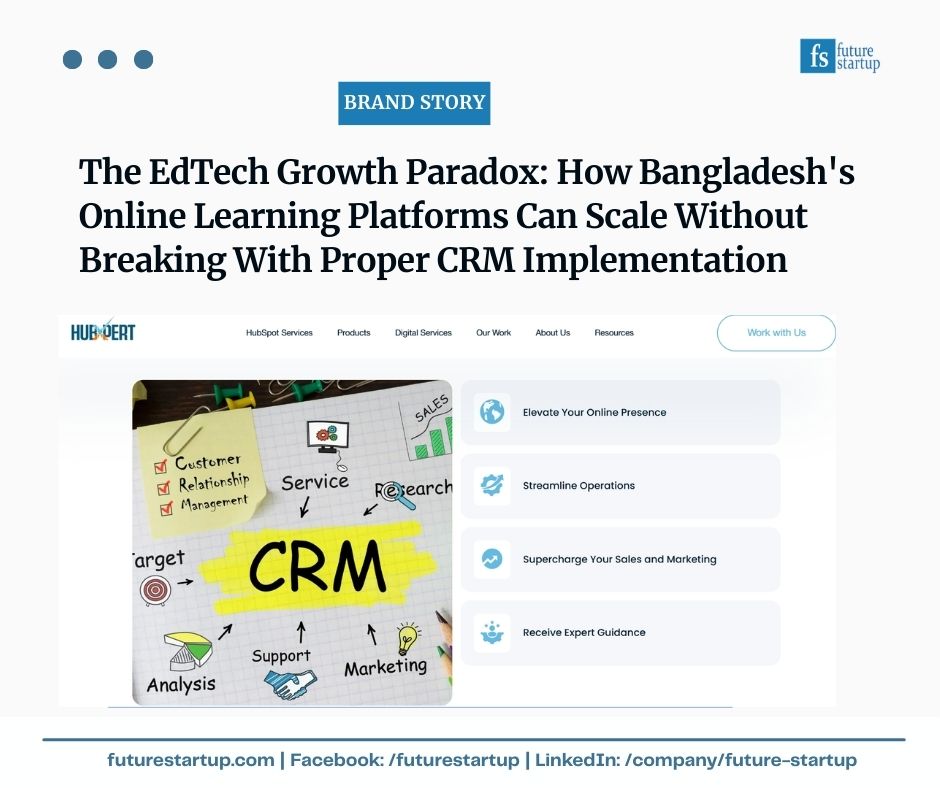
When Fazle Rabbi, COO of Hubxpert, meets with EdTech founders, he hears the same story repeatedly. Their platforms are growing, sometimes doubling users quarter over quarter. Revenue is climbing. New courses launch weekly. But beneath this success lies a crisis: leads vanishing into spreadsheets, students asking the same questions twice, sales teams working blind, and growth that makes operations worse rather than better.
"If we receive 50 leads via Facebook or Messenger, and a team member forgets to input them into the CRM, they're lost," Rabbi explains. For companies processing hundreds of daily inquiries, these operational failures translate into millions in lost revenue.
This is the EdTech growth paradox.
Bangladesh's online learning industry has seen meaningful growth in recent years. With a population of over 170 million people, of which a large portion is under the age of 26, a growing penetration of the internet and mobile phones, and the government's focus on digitization, there has been a meaningful growth in the use of technology in education.
From virtual classrooms to online learning platforms, edtech has gained mainstream awareness and has slowly been changing the way education is delivered in Bangladesh. The edtech market is projected to reach tens of billions of dollars in the coming decade. There has been a proliferation of edtech players across verticals and education value chains.
Behind this impressive growth, however, lies a less glamorous reality. As EdTech companies scale, they're discovering that rapid growth without operational infrastructure creates its own crisis. As platforms scale from thousands to hundreds of thousands of users, many are discovering that manual processes adequate for 500 students become catastrophically inefficient at 50,000. The solution, according to Hubxpert and its clients, isn't simply working harder; it's implementing systems designed to scale.
A typical student discovers a course through Facebook, messages the platform's page, perhaps calls the helpline, receives email information, and eventually browses the website. Each touchpoint lives in a different system, managed by different team members, with no unified view. Rabbi describes the consequences: "When they use Google Sheets or basic custom systems, there's a real possibility of losing data. If someone calls asking about a course and the team member forgets to note it, that lead is gone."
The problem compounds across thousands of interactions. A student who inquired six months ago and reaches out again gets treated as completely new. "They are asked all the questions from the beginning," Rabbi notes, a frustrating experience.
The mathematics becomes brutal at scale. If a platform loses 30% of leads through poor follow-up, a figure Rabbi considers conservative based on client assessments, a company processing 500 monthly inquiries hemorrhages 150 potential students. If you consider the average course value, that represents a significant amount in monthly lost revenue from purely operational failures.
Not all EdTech companies experience such dramatic losses. Well-organized operations with disciplined manual processes can maintain better conversion rates. But Hubxpert's experience suggests that most growing platforms underestimate how many leads slip through the cracks, particularly as volume increases and team members manage multiple communication channels simultaneously.
The paradox intensifies as companies scale. A platform managing 1,000 students can function with spreadsheets and manual coordination. Scale to 10,000 students, and those same systems create chaos.
"If we have 100 or 1,000 leads, of which 100 are potential and the rest are not potential right now, we need systems to segment and nurture them differently," Rabbi explains. Without automation, platforms face an impossible trade-off: hire more people to manage manual processes, destroying unit economics, or accept that most leads receive inadequate attention, destroying conversion rates.
Sales team management illustrates this clearly. Most EdTech companies employ counselors and sales representatives who guide students through course selection and enrollment. But management typically lacks visibility into actual performance.
"Previously, the entire sales team had 10 members working, and management had no track of how many calls they made per day," Rabbi describes. "Management had to trust whatever they said. The sales representative could give a note even without calling manually."
This information vacuum prevents optimization. Companies struggle to identify top performers, understand effective messaging, or spot bottlenecks.
The result, according to Hubxpert's assessment, is that many platforms operate inefficiently not because their teams lack capability, but because their systems don't surface the data needed for improvement.
Student communities create both value and operational challenges. A vibrant community where learners help each other can differentiate a transactional course purchase from deep platform loyalty.
Most Bangladeshi EdTech companies build communities on Facebook, pragmatic given its ubiquity. But this creates complications. Currently, most companies maintain their communities on Facebook and other third-party platforms. "There is relatively less control there," Rabbi notes. Third-party communities exist separately from operational systems. A student asking questions in Facebook groups, submitting assignments through email, and requesting support via WhatsApp creates three disconnected data streams. Understanding which students struggle, which are highly engaged, and which risk dropping out requires synthesis across multiple systems, increasingly difficult as enrollment grows.
The challenge isn't insurmountable. Some platforms successfully manage these complexities through disciplined manual processes and dedicated community managers. But as scale increases, maintaining consistency without systematic tools becomes progressively harder.
HubSpot CRM, according to Hubxpert, addresses these challenges through fundamental changes in how EdTech companies manage relationships at scale.
The most immediate transformation happens in lead management. "What happens if we use a CRM?" Rabbi asks. "If a calling platform is integrated, everything will be recorded automatically, and the entire history will be maintained automatically."
Every Facebook message, website form, phone call, and email enters a unified system with complete attribution and history. This eliminates lead loss while creating new capabilities. When students who inquired months ago return, counselors immediately see a complete interaction history. "They can see the activity and lead history. There is no opportunity for lead loss," Rabbi claims.
The platform enables lead prioritization impossible with manual systems. After collecting 100 leads from an education fair, HubSpot can automatically score them based on predetermined criteria. "If I have 10 such criteria, he's a student, he just finished inter-level, he lives in Gulshan, Dhaka, I can give them high priority for calls," Rabbi explains. Sales teams focus on high-probability leads first, theoretically maximizing conversion rates. More importantly, HubSpot’s growing addition of AI tools makes it even more convenient and effective for users.
However, the effectiveness depends heavily on proper setup and team adoption. A CRM only works if team members consistently use it, something that requires training, change management, and ongoing reinforcement. Simply purchasing software doesn't guarantee results.
HubSpot's marketing automation capability, Hubxpert argues, allows platforms to maintain personalized relationships with thousands of students simultaneously, something impossible manually.
"Suppose we have 100 or 1,000 leads, of which 100 are potential, and the rest are not potential right now," Rabbi describes. "We can run marketing automation. We can educate them about our courses through HubSpot's email marketing platform."
The system operates with sophisticated logic. After initial contact with students not ready to enroll, HubSpot automatically creates segmentation and begins an educational journey. "The first email goes, then it waits 10 days. Did the lead reply, view, or click? If they view, we take them to one panel. If they don't view, we take them to another panel."
Each interaction triggers different pathways. Students who click receive personalized follow-up. Those who don't view receive different educational content. This multi-path nurturing might span months, gradually building trust.
"When we follow up through this automated process, educating them and showing them case studies, when we give the final offer, they are compelled to take it," Rabbi claims. The automation handles complexity that no human team could manage across thousands of leads.
The approach isn't without considerations. Email marketing effectiveness depends on message quality, timing, and relevance. Automation can feel impersonal if poorly executed. Success requires strategic thinking about content, segmentation, and student psychology, areas where Hubxpert claims to guide implementation.
The reporting capabilities, according to Hubxpert, transform business intelligence from guesswork to precision.
"How many consultations a consultant has given, and how many students converted, we can track the consultant's activities as well as our team members' activities," Rabbi describes. This visibility creates accountability previously impossible.
Channel attribution becomes clear. Companies can see "from which channel how many leads were generated, how many customers converted, how many were lost, what were the reasons for loss." This intelligence enables marketing spend optimization.
Call tracking adds another layer. "Everything is tracked automatically: how many calls they made today, the outcomes, how many were lost, and how many potential leads came in." When sales teams realize comprehensive reporting exists, "their efficiency will naturally increase. They won't sit idle now," Rabbi suggests.
The transparency can create management challenges. Some team members may resist systems that expose their performance. Successful implementations require careful change management, explaining how data helps everyone improve rather than simply monitoring for punishment.
HubSpot's Customer Portal feature, Hubxpert explains, enables more sophisticated community experiences than Facebook groups while maintaining operational control.
"If we enable this Customer Portal system, a student submits a form on the website, and a profile is automatically created," Rabbi describes. "They can see all the courses. All information and history, which course they purchased or viewed—will appear."
The system tracks engagement granularly. "If they visit a course landing page, just a visit without action, we can track that. We can see how much of the course details they read and how much video they watched."
This data enables optimization. "Management can see the heat map—what people are watching. Based on this data, they can make decisions about how to organize and refine the system," Rabbi explains.
For community building, companies can create dedicated landing pages where students share ideas and problems. "We can create a community page where everyone can post. Top performers can solve problems shared by others," Rabbi describes.
Integration is key. When someone enrolls, "they will be added to that community automatically." For prospects who haven't purchased, automated emails can promote the community, demonstrating value before asking for commitment.
EdTech success depends heavily on reputation. HubSpot, according to Hubxpert, enables systematic trust-building that compounds over time.
"Whenever a customer converts, an automatic email will go saying, 'Please give us a review. If you give a review, you'll get a gift,'" Rabbi explains. The system manages multiple follow-ups, gradually building testimonials.
The platform also enables personalization that demonstrates expertise. When students browse specific programs, they receive targeted information. "If they're browsing our a certain product page, we can send them a personalized message specific to that product," Rabbi describes.
This creates experiences that feel consultative rather than promotional—critical in an industry where trust determines purchase decisions involving significant money and life-changing educational choices.
However, the most sophisticated software becomes worthless without proper implementation. As we have written before, many companies purchase CRM software but fail to see results due to implementation gaps.
Rabbi regularly encounters this when EdTech companies attempt self-implementation. "In Bangladesh, IP calling isn't effective due to regulations," he notes, referencing complications from aggressive telemarketing that damaged the industry's reputation.
These local nuances require expertise that generic implementations don't provide.
Hubxpert, as Bangladesh's first Platinum HubSpot Partner—a designation held by less than 1% of HubSpot partners globally—claims to combine technical expertise with an understanding of local market dynamics.
"We have a local team that can provide in-person training until their team learns HubSpot and becomes proficient," Rabbi emphasizes. This addresses the reality that most EdTech companies lack internal technical resources for complex software implementations.
Implementation typically spans several weeks, with Hubxpert's team working alongside company staff to configure workflows, integrate systems, migrate data, and train team members. This collaborative approach ensures the system matches specific needs rather than forcing operations into generic templates.
The financial case for CRM implementation, according to Hubxpert, becomes compelling when viewed against current inefficiency costs.
Rabbi regularly encounters EdTech companies losing 30% or more of leads through poor follow-up. For a platform processing 500 leads monthly with a meaningful average course value, preventing just 30% of losses represents millions of taka in monthly recovered revenue.
HubSpot's Sales Hub Professional costs roughly BDT 30,000 monthly for a typical EdTech company. The breakeven requires preventing fewer than 10 lost students monthly—a threshold Hubxpert claims most companies exceed within weeks. Moreover, it allows businesses to build upsell and cross-sell campaigns that can drive further revenue growth.
Long-term value compounds through continuous optimization. As companies collect more data about what works, they can refine marketing messages, improve sales processes, identify top channels, and eliminate bottlenecks. These improvements create competitive advantages that grow over time.
However, ROI isn't automatic. Success requires actual changes in team behavior, consistent system usage, and strategic decisions informed by the data. The software enables these improvements but doesn't guarantee them.
Despite economic benefits, Rabbi encounters consistent resistance—typically from senior management rather than operational teams.
"Their marketing and sales teams were very interested, but the decision-makers didn't proceed," Rabbi observes. "Many CEOs are quite old-school," he notes, describing decision-makers who view CRM systems as "just an unnecessary cost increase" rather than revenue optimization tools.
This perspective, according to Hubxpert's analysis, ignores hidden costs of lost leads, inefficient processes, poor team performance, and missed optimization opportunities that far exceed visible CRM subscription costs.
The generational divide reflects broader patterns in Bangladeshi business. Senior executives who built successful companies through personal relationships and manual processes often struggle to see how systematic approaches could improve what already works. But what worked at 1,000 students becomes inefficient at 50,000.
Bangladesh's EdTech industry, according to industry observers and Hubxpert's assessment, is approaching maturation, where operational excellence will increasingly determine winners. Early entrants succeeded largely through market timing and basic service delivery. The next phase may reward companies delivering superior student experiences while operating at higher efficiency.
Companies implementing sophisticated CRM systems potentially gain advantages that compound over time: faster response times, more personalized service, better follow-up consistency, and data-driven optimization.
As leading companies implement better systems, they may set new standards for response time, personalization, and service quality that students expect.
The window for early-mover advantages, Hubxpert suggests, is narrowing. Within years, sophisticated CRM usage may become table stakes rather than a competitive differentiator. Companies acting now can potentially establish operational excellence as a sustainable advantage. Those delaying may spend the same money just to catch up to a standard that competitors have surpassed.
Bangladesh's EdTech market is projected to reach several billion dollars by 2030. This growth trajectory will likely continue as more middle-class families view technology-enabled education as accessible and necessary, and as the shift from traditional coaching centers to digital platforms accelerates.
However, the next phase of growth may require operational sophistication matching the industry's financial scale and social impact. Platforms relying on spreadsheets and manual processes may find themselves increasingly uncompetitive against firms investing in proper systems and data-driven optimization.
The choice facing EdTech founders is straightforward: invest in operational excellence now, while advantages remain significant, or gradually lose market share to competitors already making these investments. In an industry where student success depends on platform performance, there may ultimately be no choice at all.
The business of transforming education through technology requires systems worthy of those ambitions. For Bangladesh's EdTech industry, that transformation is no longer optional; it's becoming essential for survival and for delivering on the promise of accessible, quality education at scale.