
On June 4, 2026, Khondoker Rashed Maqsood resigned as chairman of the Bangladesh Securities and Exchange Commission. All four commissioners resigned the same day. The BSEC building was emptied of its entire leadership in a single afternoon.
Within hours, the Ministry of Finance issued a new set of appointments under Section 5(2) of the Bangladesh Securities and Exchange Commission Act, 1993.
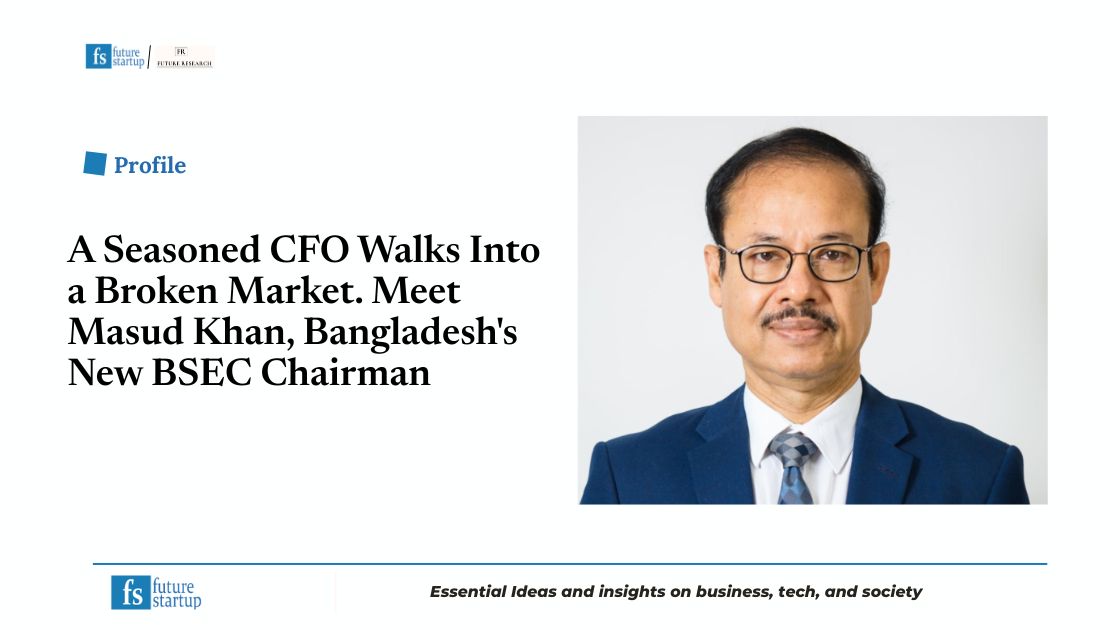
Masud Khan took over as chairman for a four-year term.
The new chairman pick has drawn meaningful appreciation from the industry stakeholders across the board. While it is hard to be hopeful about Bangladesh’s stock market given the historic track record, many industry veterans have expressed optimism that the current team under the leadership of Mr. Khan should be able to deliver meaningful reforms and change the trajectory of the market given that political will exists.
In this profile, we take a look at the journey of Mr. Khan and the task he has at hand.
Who is Masud Khan?
Mr. Khan is a chartered accountant. He holds a Bachelor of Commerce (Honours) from St. Xavier’s College, University of Kolkata, and cleared the all-India CA examination in 1977, earning a silver medal. He later qualified as a Cost and Management Accountant and is a Fellow of CMA Australia and New Zealand.
His career spans 45 years in the private sector. He spent 20 years with British American Tobacco, working across finance roles in Bangladesh and abroad. He then joined LafargeHolcim Bangladesh as Chief Financial Officer, where he stayed for 18 years. He served as an independent director at Singer Bangladesh, Community Bank Bangladesh, and British American Tobacco (BAT) Bangladesh. Most recently, he was Chief Advisor to the Board of Crown Cement PLC and chairman of Unilever Consumer Care Limited. He has also been a lecturer at the Institute of Chartered Accountants of Bangladesh for 45 years.
One important distinction of this appointment is that Mr. Khan’s predecessors came mostly from academia and the financial bureaucracy. Mr. Khan came from the boardroom. He has spent his career as a CFO and independent director, the precise vantage point from which you see the gap between what regulators demand and what listed companies can actually deliver. His stated priority of reducing compliance costs comes from his lived experience more than from some ideal policy positions.
Finance Minister Amir Khosru Mahmud Chowdhury signalled the direction of travel before the appointments were made. Speaking at an Economic Reporters Forum event titled "Budget 2026-27: Expectations and Reality," he said BSEC would be restructured within two weeks with professionals who are skilled and experienced in the capital market. Mr. Khan fits that description more precisely than any BSEC chairman in recent memory.
Parliament cleared legislative ground for the appointment by passing the Bangladesh Securities and Exchange Commission (Amendment) Bill, 2026, abolishing the existing age limit of 65 for appointing the BSEC chairman and commissioners. Mr. Khan is in his late 60s.
Three new commissioners joined alongside him: Advocate Nahid Mahtab, a former deputy attorney general; Tanvir Habib Rahman, finance director of ASA International; and Md Nafiz Al Tarik, managing director of Dhaka Bank Securities Limited.
The market he inherits
To understand what Mr. Khan is walking into, start with a number. According to MSCI cumulative index data calculated to December 2025, an investor who put $100 into Bangladesh equities over the long run lost nearly 59% of the original value in US dollar terms. The MSCI Bangladesh Investable Market Index gross return stood at $50.39, against $235.35 for frontier markets overall and $428.49 for the MSCI All Country World Index. This is not about a particular bad year; it is more of a structural issue.
The benchmark index of the Dhaka Stock Exchange has not even hit the heights of 2010, when it soared to a record high of 8,918 points. Over the past 14 years, the market has been unable to muster enough strength to cross its previous highest position.
The foreign investor base has been leaving steadily. Foreign investments in Bangladesh's stock market plunged by 70% over the past five years to $914.58 million at end-December 2025. Holdings dropped from $2,995 million in 2020 to $1,925 million in 2021, $1,263 million in 2022, and $1,085 million in 2023, before falling further to $865 million in 2024. There was a small uptick in 2025. It did not offset the cumulative loss.
The DSEX dropped 16.49% in 2024, and market capitalization fell by over Tk1 lakh crore during the year. The market had briefly spiked after the political change of August 5, 2024, then fell again as investor confidence deteriorated. DSE Brokers Association president Saiful Islam attributed the decline directly to the failure of BSEC's reform process under the previous commission to restore trust.
The structural problems are not new. Rampant manipulation erodes investor confidence. Poor-performing or junk stocks routinely appear at the top of the gainers list or dominate turnover. People buy them anyway, mistaking volume for quality. Well-performing stocks get crowded out. The BSEC has investigated manipulation in the past, but has often handed out light punishments. Without meaningful deterrents, the cycle repeats.
This is the inheritance.
What he plans to do
Mr. Khan held a press conference at BSEC headquarters in Agargaon on June 4. He came prepared with a specific diagnosis of what had gone wrong and a specific set of fixes. Six themes ran through it.
His diagnosis: the capital market has failed to keep pace with Bangladesh's economic growth for two decades. Investor confidence is low. Quality securities are scarce. Institutional participation is thin. Foreign investment has declined. The market does not reflect the size of the underlying economy.
The first is about regulation. He said the current practice of requiring quarterly reports that go beyond international standards imposes high costs on listed companies and often creates unnecessary compliance burdens. The BSEC will review those requirements and align them with IAS 34, the international standard for interim financial reporting, while maintaining transparency and investor protection. IPO applications, bond and sukuk approvals, and licensing procedures will shift to digital platforms. “Our philosophy is simple: regulate where necessary, simplify where possible.”
The second is listings. Khan announced plans to actively encourage multinational companies, state-owned enterprises, and large local corporations to list on the stock exchanges. The BSEC is working with the National Board of Revenue to introduce a "Listed Company Advantage Programme" providing incentives for public listing, including greater tax benefits for listed firms, simplified tax administration, and faster dispute settlement mechanisms. Bangladesh's listed company base remains thin relative to the size of the economy. Many of its most profitable businesses, private banks, consumer goods companies, and manufacturing conglomerates remain unlisted or lightly traded. The market cannot reflect the economy until more of the economy is in the market.
The third is surveillance. The BSEC will work with the Dhaka and Chattogram stock exchanges and CDBL to establish a modern real-time surveillance system capable of detecting and preventing market abuse. The commission will adopt a strict stance against insider trading, circular trading, and pump-and-dump schemes. Technologically, this is a feasible plan, but whether the light punishments of the past give way to meaningful deterrents will remain a question until a different culture appears.
The fourth is price discovery. Mr. Khan was direct on this. No new floor prices will be imposed in the future. Existing floor price mechanisms will be withdrawn gradually, allowing market forces to determine valuations. Floor prices were introduced during the COVID period and became one of the most controversial regulatory interventions in the market's history, artificially propping up prices while trapping sellers and discouraging institutional entry. Removing them is both technically correct and politically sensitive.
The fifth is institutional participation. Mr. Khan acknowledged that confidence in the mutual fund sector has eroded. He pledged reforms to governance standards, disclosure practices, and asset valuation methodologies. The goal is to increase participation from pension funds, insurance companies, and mutual funds, reducing the market's dependence on retail investors who are more vulnerable to manipulation cycles.
The sixth, implicit throughout, is the question of foreign investment. The 70% decline in foreign equity holdings over five years is a structural red flag. Mr. Khan's surveillance commitments and price-discovery language are both aimed at the conditions international institutional investors require before re-entering. Whether they come back will be one of the clearest indicators of whether his reforms are working.
The persistent structural problem
Mr. Khan's agenda is coherent. Several items on it were also on his predecessor's agenda. Mr. Maqsood, speaking at a market seminar in March 2026, had called for bringing top-tier firms into the fold as his primary objective. The IPO pricing mechanism had reportedly been reformed. The results were not sufficient.
The deeper structural problem is that the BSEC chairmanship has never operated with full institutional independence. Regulatory courage requires the ability to punish politically connected listed companies, reject politically convenient IPOs, and enforce against manipulation by parties with influence over the regulators' own continuity. No chairman has been able to sustain that consistently.
Mr. Khan's private-sector background is an asset here. He does not owe his credibility to the institutions he is now regulating. His 45-year career was built in the corporate sector, not through proximity to the capital market apparatus. That independence may give him more room to act than predecessors who were more embedded in the ecosystem.
The new commissioner team also carries different backgrounds from previous configurations. Advocate Nahid Mahtab is a former deputy attorney general, relevant if enforcement actions face legal challenges. Tanvir Habib Rahman ran finance at ASA International, a large microfinance institution. Md Nafiz Al Tarik was the managing director of Dhaka Bank Securities. Between them, the commission has legal, development finance, and brokerage experience simultaneously.
The right framework
Mr. Khan rightly said at his press conference that trust cannot be built through speeches or administrative intervention. It must be earned through integrity, transparency, accountability, and fair enforcement.
That formulation apparently rejects the tools his predecessors reached for most readily: price floors, administrative guidance on index levels, interventions to prevent short-term declines, and correctly locates the problem in institutional credibility, not in market mechanics.
Bangladesh's economy has grown substantially over the past two decades. Its capital market has not kept pace. The gap is not primarily a technology problem or a reporting standards problem. It is a governance problem. The accumulated consequence of a regulatory environment that prioritized short-term stability over long-term investor trust.
Mr. Khan has diagnosed that correctly. He has the professional background to understand it from the inside. He has four years.
The BSEC chairmanship has historically been a politically sensitive post. Shibli Rubayat Ul Islam, who served from May 2020 to August 2024 under the previous regime, left under significant controversy. Khondoker Rashed Maqsood lasted 21 months before resigning, citing personal reasons, though his departure was abrupt and simultaneous with all four commissioners.
Finance Minister Amir Khosru Mahmud Chowdhury, speaking at an ERF event just days earlier, had described the incoming team as professionals with capital market experience. As we noted above, Mr. Khan fits that description more cleanly than most of his predecessors. He is a CFO and board-level operator who spent his career inside some of the largest companies doing business in Bangladesh.
The question hanging over any new BSEC chairman is whether the institution will behave differently or whether structural constraints (political pressure on listings, concentrated retail investor base, weak enforcement infrastructure) will limit what any individual can accomplish. Mr. Khan acknowledged as much on day one, as we noted above, that trust must be earned through actions rather than through speeches or administrative intervention.
Whether the next four years deliver on it is what we will be watching.