
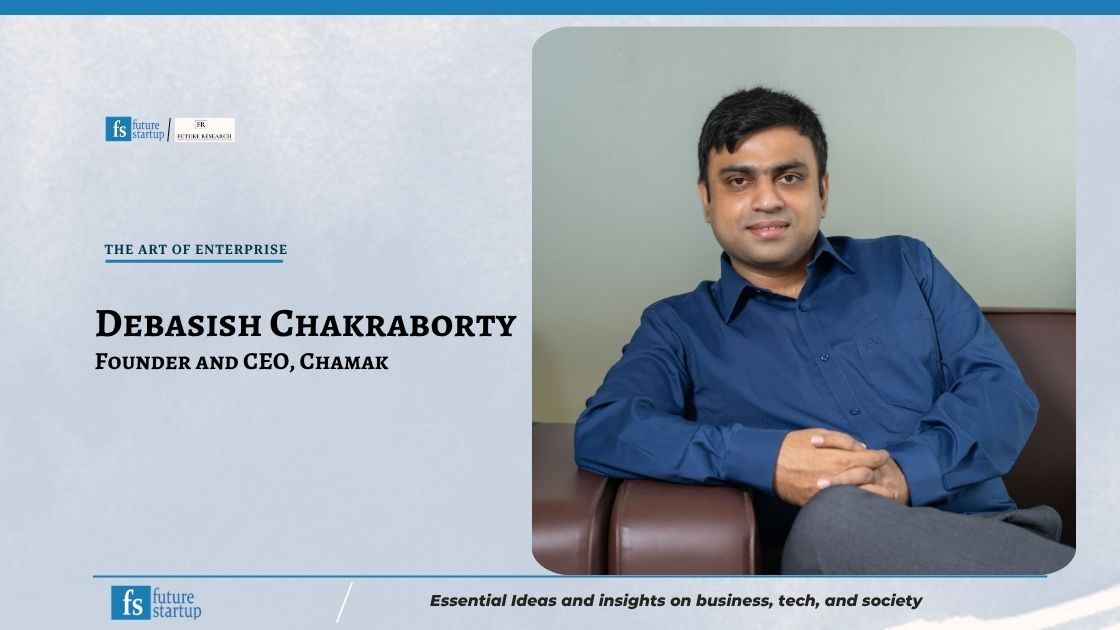
Debasish Chakraborty is the founder and CEO of Chamak, a Dhaka-based financial technology company building the trade finance infrastructure that connects small businesses to formal financing in Bangladesh. Before Chamak, Debasish built and exited Tedfo, a profitable export marketing and management company he ran from 2016 to 2021. He holds a master's degree from Cornell University, where he and his wife and co-founder Sangita developed the initial thesis for Chamak and received a grant from Cornell's eLab Accelerator. Earlier in his career, he worked in procurement at City Group, one of Bangladesh's largest conglomerates, where he gained his first deep exposure to entrepreneurship and business building. He grew up in Madaripur and studied business at East West University in Dhaka.
Chamak sits between two groups that need each other but can't easily reach each other: small businesses that struggle for short and ultra-short-term working capital and are structurally excluded from formal institutional credit, and financial institutions that are willing in principle to serve them but lack the underwriting infrastructure to do so at scale. Chamak builds that infrastructure, using AI to read unstructured transaction data and generate reliable credit assessments, then connects eligible businesses to banks and financial institutions, manages disbursement, and handles repayment collection. It charges a management fee per transaction and takes no lending risk of its own. Since launching commercially in January 2024, the company says it has worked with 350 businesses and facilitated annualized disbursements of around $4 million.
In this fascinating conversation, we cover a lot of ground. We begin with Debasish's upbringing in Madaripur, the joint family, the long daily commutes to access quality education, and the ethics of hard work that those early years instilled. We talk about his student startup that failed, his years at City Group working directly with founder Fazlur Rahman, and the lessons about commitment, patience, and focus he drew from watching a first-generation entrepreneur who built a multi-billion taka empire. We go deep into the Tedfo story, how it started, why it worked, and what Debasish carried from that experience into Chamak. We then examine Chamak in full: the original idea, the pivot to trade finance, the AI-driven credit model the company is building, and what working directly with small businesses has taught the company about a segment the formal financial system has long misunderstood and underserved.
The final part of the conversation explores the ideas and frameworks that have shaped Debasish as a founder over ten years: effectual entrepreneurship and the principle of affordable loss, the beachhead strategy, the discipline of talking to five customers every week, and why founders who trust intuition over customer feedback tend to build things nobody needs.
This is a brilliant read in its entirety. For anyone interested in fintech, SME finance, or patient work of company-building, this conversation is well worth your time. Happy building. Enjoy!
Mohammad Ruhul Kader: Thank you for agreeing to this interview. I think we can start by talking about your personal background and path to what you are doing today. Where did you grow up? About any early influences that have shaped you as an individual, the way you look at the world, and work. And also, doing business isn't exactly the dominant career choice here. We have a very small subset of a subset of people who eventually go out and try to build things. Was there any influence like that in your early life?
Debasish Chakraborty: Thank you for this opportunity. I was born and raised in Madaripur. I spent my early years and did my early education til SSC there. Then I came to Dhaka Residential Model College, where I did my Intermediate. Then I went to East West University for my undergrad in Business Administration.
After that, my first job was at Abdul Monem Limited’s Igloo Sugar Unit. I joined Igloo on March 2nd, 2013. I remember the date because my convocation was on February 27th, and I joined the company a day after my convocation. I was absolutely lucky that I could manage a job right after convocation.
After working for a while at Abdul Monem, I went to City Group, the company that owns the Teer brands across several consumer goods. I had an interesting role there, working in international procurement and B2B sales directly with the Chairman of the company, Fazlur Rahman.
Working with him led to the realization that if one works hard and sticks to one thing for a long time, big things can be done. Mr. Fazlur Rahman was a regular person in demeanor, yet he built a massive empire. I felt that part of the reason was that he was extraordinarily consistent and stayed at it for a long time.
I worked at City Group until February 2016. Then I quit my job, wrote a huge resignation letter to him explaining, "Sir, I want to start my own business, I wouldn't be able to continue in this job." After that, I started Tedfo.
Ruhul: This is fascinating. I have a few more questions about this. Before that, please tell us more about your early years in Madaripur, your family, your parents, and the environment you grew up in, etc. What was your childhood like?
Debasish Chakraborty: I grew up in what you can call a remote village in an extended family. My father and uncles—six of them—everyone lived in the same house. Our village is called Dhuasar. Our family has been living there for over 100 years. My grandparents lived there, and their fathers before them. I think our family relocated there a long time ago from somewhere that I don't know.
I studied at the village school during my primary and high school years. I had to walk about 2.5 kilometers to get to school and back. When I eventually came to Dhaka, I calculated that I had walked almost 10,000 kilometers by Class 10 just to go to school! One particular difficulty was that we had to go to the District town or the Thana (sub-district) town to get English or math tutoring. There were days when, just to learn math or English, I traveled 40 kilometers besides going to school. Because you couldn't find teachers in those local areas, you had to go to the thana or district town to get a good education. I’d wake up at 6:00 AM, go to Madaripur Thana town—called Kalkini—come back, and go to school at 10:00 AM. After school finished at 4:00 PM, I’d take a bus to Madaripur district town, and come back at 8:00 PM. We did this for three or two days a week.
While it was a bit tough, that journey actually helped build my educational foundations in terms of learning that many others in the village didn't usually have access to. So I saw myself as privileged.
After SSC, I came to Dhaka.
Those are some of the recollections from those days. The thing was, we grew up in an educated family. My father and uncles were mostly graduates. I came to Dhaka to study HSC partly because my youngest uncle was studying at Dhaka University. Before that, a few of my uncles studied in Dhaka, but not at Dhaka University. We had this assumption that if I did my HSC in Dhaka, getting into Dhaka University would be easier. I came with that assumption.
Ruhul: Extended families are very interesting, relatively rare now.
Debasish: We are still technically an extended family, but not like before, where everyone lived together. Everyone has relocated to different places.
Ruhul: As you mentioned, you had to travel quite a distance to access quality tutoring. Obviously, it required a lot of hard work. How do you see it now when you look back?
Debasish: Back then, we thought of it as an opportunity and a privilege. Looking back, I think those trips actually helped build a strong foundation. That was possible because of our family and my parents. The money for it, the setup, and the fact that our family was somewhat educated and financially solvent allowed me to access that education.
Even now, I often think about those I went to school with. The fact that many of them couldn't do what I’m doing today isn't because of merit alone. It is partly because of the family background. Since my family was relatively more educated and somewhat financially stable, I had better opportunities than many of my friends. Technically speaking, you can't judge this by talent alone.
Ruhul: This reminds me of what Malcolm Gladwell wrote about in his book Outliers. He asserts that success is more than a function of talent alone. Access to opportunities to realize our potential plays a far greater role in how people turn out in life.
Debasish: Yeah. I always think that perhaps we don't succeed in Bangladesh because of merit alone. Family backup, family education—these things significantly help uplift people in life and career.
Ruhul: That seems to be the truth everywhere.
Debasish: I don't know everywhere, but in my context, it seems so. I had many friends in school, some of them now have local jobs or haven't settled in their careers in the way we define it, because their families weren't as educated or financially solvent. They couldn't access the right education at the right time.
Ruhul: That’s a realistic view. I can relate. I’m from Moheshkhali, where electricity reached our village only around 2009/2010. I was studying at university at the time. I think that many of my friends and people I knew couldn’t make it because of the lack of access to opportunities.
Debasish: Similar story. Our electricity came a long time ago, around '89, but you couldn't really use it. Until a certain time, electricity in Bangladesh was just for running fans and nothing else. It wasn't stable.
Ruhul: Were there any entrepreneurs in your family? Did anyone do business?
Debasish: Not exactly. My father was kind of a businessman. He did contract work, a government contractor. But my other uncles were all jobholders.
Ruhul: What was your relationship with your father like?
Debasish: It was good, but we didn't see him much. Because of the contracting business, he had sites in different parts of the country. To manage those, he spent most of his time in those places. He’d come home maybe once every month or every two months. We mostly grew up with my mother.
Ruhul: Any significant memories or stories about your mother? What did you learn from your parents?
Debasish: I never thought about it in this manner. If I think about it, we learn a lot from our parents. My mother—and I think like most mothers—focused on education. "You have to study." I think that influence continues to shape me to this day. Maybe I didn't like it back then, so much pressure, but now I think that pressure—to study and—was important and it shaped me in a particular way. My father also used to put a lot of importance on our education. No one from our area usually went to study in the district town. But my father always insisted: "You have to study with a good teacher, no matter how much money it costs."
When I came to Dhaka, I studied with a teacher named Khan Kolimullah. He was a textbook author for math. Luckily, he had been my father's teacher. He used to teach at Adamjee Cantonment back then. He wrote the math book we studied in school. After my SSC test exams, I studied privately with him for three months. He didn't actually teach private students, but since my father requested it, he did it for me.
We internalized the importance of knowledge and how knowledge could uplift a middle-class family from my father.
This has been the most enduring influence of my parents on me—an intense desire to study and learn. I have tried to study throughout my journey until now.
Ruhul: Then you came to Dhaka, did college, and then got into university. Any significant memories from that time?
Debasish: One relevant story could be: while at university, I started a company with two other friends. While the business didn't work out, it was a good experiment.
Ruhul: What were you trying to build?
Debasish: We thought we'd open a consultancy business to help people invest in the stock market. I was studying the share market a bit at that time and gained some basic ideas about technical analysis. I always prefer learning by both studying and doing. As such, I thought I could use this idea to serve people. So two of my friends and I formed a Private Limited company called Firm Share Limited. We’re still students.
Ruhul: You registered it as a private limited company.
Debasish: Yes. But by the time we finished everything [registration], the share market crashed [2010 crash]. Our customer base vanished from the market overnight. So, we had to shut it down. However, it was a good attempt.
While I always wanted to do business, there is an interesting story behind this. When I was at East West University, we had a faculty member named Faridul Alam. He now teaches at AIUB. In one of the classes, he showed us a calculation: If someone saves 1,000 Taka daily, it takes 27 years to save 1 Crore Taka. Conversely, if you spend 1,000 Taka daily, it takes 27 years to spend 1 Crore.
This gave me an interesting insight and an inspiration.
Growing up in a middle-class or lower-middle-class family, saving 1,000 Taka a day doing a job—meaning saving 30,000 Taka monthly—is a difficult challenge. Very few people can do it. So I thought, "I have to do business." I have to at least try so that it doesn't take me 27 years to save one crore.
Ruhul: Was this purely an economic motivation?
Debasish: I would be honest, yes, economic motivation, of course, was there. I come from a middle-class background, so financial security is always a thing. Somehow, I had this inclination towards business from an early age. I studied business studies in SSC and HSC. I’m not sure why I chose business studies; I probably did it myself, or I might have been influenced by some seniors. I never really thought about it that deeply. Maybe when I'm old, I'll have time to reflect.
Ruhul: How do you think growing up in a joint family influenced and shaped you as a person?
Debasish: Definitely. In an extended family, interpersonal skills get better. We were two brothers and one sister, but with my cousins, we had many siblings. This makes you good with people. You understand people better. I feel like I can deal with all kinds of people. I lived and met many different types of people after coming to Dhaka. I think I did it with skill. Growing up in an extended family helped me in those instances.
I think growing up in an extended family helps grow your interpersonal skills. You learn to navigate interpersonal relationships with greater skills. You deal with conflicts more skillfully. You learn to understand that people have different preferences, and it is alright to be different. You grow tolerance for interpersonal issues and inconveniences. You don't get offended easily.
Moreover, in an extended family, seeing others succeed inspires you. It acts as a lifting mechanism. Like, my uncle went to Dhaka University, so I have to go to Dhaka University too. It, in fact, happened to me and many of our family members. My father couldn't do it because he was the eldest son and had to shoulder certain family responsibilities, which made it difficult for him to go beyond a certain stage. But his younger brothers did better. We, the next generation, have to do even better. That feeling comes naturally.
Ruhul: You started your first company while at university, and it failed. How did you take that failure? Do you have any regrets about the company failing?
Debasish: Not at all. It was a good learning experience. I learned about teamwork and so on. And it is not unusual in university life. So failure was okay. We now realize it was meant to fail because the foundation wasn't perfect. We just worked on an idea and then thought, why not sell to others, and tried to open a small business.
My other two co-founders didn't actually want to come into business. I kind of forced them in because one person couldn't do it alone. After it was gone, they didn't mind because, honestly, we didn't have much to lose. Just the registration cost. We also didn't do any real work. We were building our product/service proposition to manage portfolios, but by the time we were ready, the market had crashed. We didn't find any customers. We found one, but due to the crash, it didn't go anywhere. The demand was there, many still do portfolio management, but our life priorities have changed. We didn't try it after that.
Ruhul: You graduated, worked at Igloo, and then joined City Group. Any reflections on working with Mr. Fazlur Rahman? What have you learned from him?
Debasish: A lot. I got to see a business from the top for the first time while working with him. I still remember his words. One piece of advice he gave everyone: "While eating, never look at another person's plate. If you do, you can't eat your own food." One philosophical meaning of this may be: When we work on our own things, we should focus on that. Focusing on others hampers your productivity. This is more relevant in today’s age of social media, where we are constantly bombarded with how great other people are doing.
I also learned about the value of commitment from him. He never broke a commitment if he could help it. Other people might have a different experience, but I never saw him break any commitment. He used to say, if you keep your commitment, you build trust. And that trust is your most valuable capital.
I learned about export-import for the first time while working at the City Group, which eventually led to Tedfo.
There is so much I can talk about my time at City Group. If I summarize, Fazlur Rahman played a key role in my entrepreneurship journey. If I hadn't seen him, maybe I wouldn't have started a business.
Ruhul: Building something enduring and of a certain scale is immensely interesting. The number of people who have done something like that in Bangladesh is slim. Working with him and also seeing City Group from the inside, what are your reflections on what it takes to build something of significance?
Debasish: It takes time. Today, you see City Group on its 54th anniversary. They started in 1972. The business picked up in 1990. There’s a long period in between—about 20 years. We often miss this in businesses. The startup world is fast. Despite that, those with previous experience and domain knowledge may do better. And previous experience comes from working in depth.
My first business, Tedfo, I started based on my experience at City Group. If I didn't have that experience, I couldn't have done that business. If you think from that perspective, business requires experience, and you gain experience only by working.
Again, the work I'm doing now partly came from my experience running a Bank Asia Agent Banking outlet in Mirpur DOHS. The outlet has grown significantly over the years. It has now become the nationally number one agent banking outlet of Bank Asia. In terms of deposits, it has almost 8,000 customers and the highest deposit among all of its 5000+ outlets.
The idea for Chamak came from providing banking services to the masses of customers. We came to see how banks operate financial services, where the lack is, why it happens, etc. We often complain that banks don't give loans to small businesses. After running an outlet for years, I realized that it's not a lack of intent, but the structure itself doesn't support it. Regulators have created a structure where banks cannot go to that small scale. It becomes expensive. Systems are built that way. When serving small customers, it creates frictions that can't be overcome in the last mile.
I think for small businesses, a new way of banking and financing infrastructure is needed, which we are doing at Chamak. Facilitating real business-to-business (B2B) financing transactions, but following a totally different way.
Ruhul: We'll get to that story in a moment. So, you worked with Fazlur Rahman until Feb 2016, left, and started Tedfo. Tell us about Tedfo and that period of your journey.
Debasish: I worked primarily in machinery procurement at City Group. The work pressure in my department came in phases—extremely busy periods followed by a short lull. Once a deal is signed, execution takes time, so there wasn't much work in between. During this period, I would look for work to do. After exploring for a while to find more work for myself, I decided to try exporting. The problem was that most City Group items were restricted for export by the government. The only thing left was industrial by-products.
I started looking for customers for two of our industrial by-products. Luckily, I found two customers—one in China, one in India--for the first time. At that time, those products weren't really exported from Bangladesh as far as we knew.
Doing that, I felt that the way we managed the customer and product, this service could be given to everyone looking to do export business. That's when I thought for the first time to build an export marketing and management services company. I left my job and took the risk. That’s how Tedfo started. Tedfo was a profitable company from the start. We found international customers for Bangladeshi manufacturers and managed their shipments. A blend of an advertising agency and logistics management for exporters. A combination of the two, a one-stop solution.
We were doing very well. But in 2021, when COVID started, it led to a global shipping crisis. The export and import business around the world came to an almost overnight halt. It seriously affected our business.
When I was at East West University, I had an ambition to study at an Ivy League university. While sitting at home amid the COVID lockdown and business shutdown, I wondered what to do. I started applying to a few US universities for a Master's and got an offer from Cornell University. As I said, everything was shut down. I wasn't sure how long Tedfo would be on hold due to the crisis. I thought it’s the right time to take an exit. So, from 2016 to 2021, we did Tedfo. Then I took a professional exit and went to the USA in 2021 for higher studies.
I don't feel comfortable doing two or three things at once. When I do something, I need to go all in. Since I was going to study, I decided to go full-time. I could build a business when I come back again.
Ruhul: What are some of your biggest lessons from the Tedfo journey?
Debasish: Many, many lessons actually.
Ruhul: You built a profitable business without raising much external funds.
Debasish: We initially thought we would, but we didn't need to. We found product-market fit early in the business. I could also use my previous experience from City Group. So we didn't have to burn money to find product-market fit.
Ruhul: Were you serving City Group, too?
Debasish: Indirectly, in some cases, but mostly other customers.
Ruhul: That was your first proper entrepreneurship experience. As I was asking, any reflections in terms of how that experience changed you as a founder? What are some of your lessons from that journey that you carry with you today?
Debasish: We always delivered excellent customer service at Tedfo, which is something we are now doing at Chamak. It helps tremendously. We always put customers' interests first. Although that was a B2B business, we made sure we took good care of our customers, and the rest followed from there.
We theoretically know that if you serve your customers well, the rest will take care of itself. But we applied that idea in practice at Tedfo at that time. That understanding transformed our business.
The second is how you build and run a team. Your team ultimately builds your business. We were lucky to build an excellent team. Some of the people who worked with us at Tedfo still work with us. If you can acquire good team members, they will help you for life. Nizam and Tareq of WeDevs were with us at Tedfo, and I hope they got good returns.
Ruhul: You took an exit from Tedfo and went to the US for higher studies. Why did you come back?
Debasish: (Laughs) I tell everyone jokingly that I promised the Visa Officer I’d return!
The truth is, we conceived the idea of Chamak while in the USA. While at Cornell, my co-founder, Sangita, who is also my wife, and I pitched the idea of Chamak to the Cornell eLab Accelerator program, an accelerator program at Cornell University. We proposed a model to increase the income of small businesses and received a small grant.
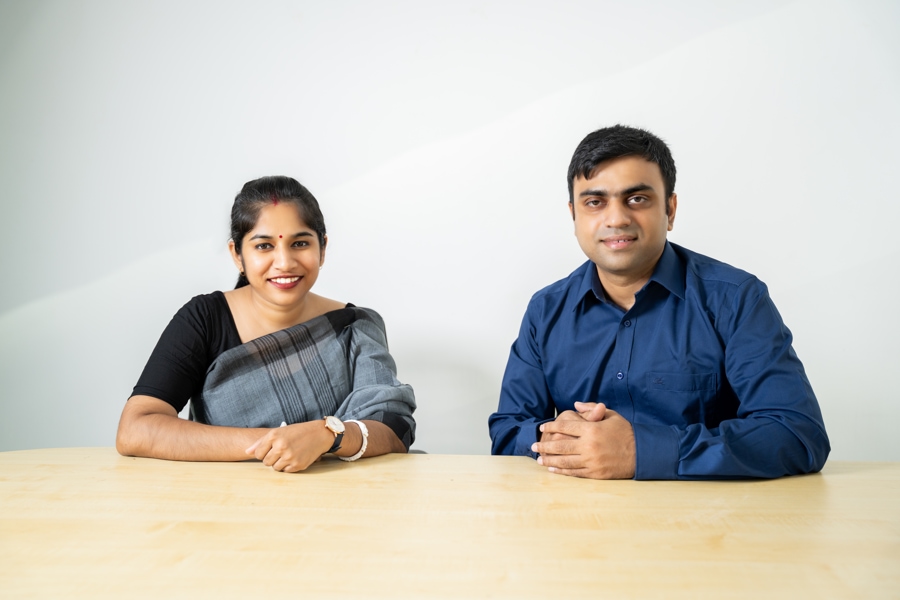
It is relevant to mention here that Sangita also went to Cornell with me. We studied together at the same university, which was an absolute advantage in life—studying with your spouse or partner at the same university. This was an extraordinary experience for us. We learned a lot. So we went to Cornell and started working on the Chamak idea. Later, Md. Nayeem Reza from BUET, a brilliant technology mind, also joined us on our journey, and we are now working together.
The reason for returning was that we felt the problem Chamak solves—facilitating trade finance—has a massive opportunity in Bangladesh. Trade finance has a very large addressable market, and we are a highly experienced team to execute this business. Our thesis has proven to scale in different markets.
We realized from our previous experience that there is a massive opportunity in this space. We felt that it was better to build this in Bangladesh. It’s good for us personally, and the company has a chance to get very big.
Ruhul: Reflection on education: You studied in Bangladesh and then the US. What are the differences? What can our education system learn from them?
Debasish: (Laughs) That would take all day. Let me try anyway. They have a very market-oriented approach. You learn things that are in demand and necessary to get your work done in the market rather than mere theories, which I feel is one of the core differences.
For instance, at Cornell, I did a course on Project Management. They teach what is currently practiced globally in the industry. They include that in the course so that when you finish, you can use that skill immediately.
Similarly, my major was public administration. In the public administration course, most of the assignments were about writing an office memo. The reason was that if you work in public administration, you have to write day-to-day office memos every day, so they want you to at least acquire that skill.
I can talk about similar examples for almost every course. Everything has an applied side to it.
For instance, in entrepreneurship, we learned about the beachhead strategy. Paul Graham, founder of YC, also studied at Cornell. He has a theory called do things that don't scale. These things are actually at the execution level.
Let me explain the beachhead strategy. At Tedfo, we tried to acquire customers in multiple geographic locations. When studying beachhead strategy, we learned that every business should focus on a particular geography in the initial days and serve a pinpoint customer group. Over time, as you learn from that customer group, you scale to other locations and other customer segments following an adjacent market strategy. Because startups are resource-constrained organizations, operating with a certain focus ensures maximum utilization of our resources.
The beachhead strategy came from Second World War history, from an event when the Allied forces attacked the beaches of Normandy. They chose one head of that beach to attack Germany and gradually move to Berlin instead of attacking different parts scattered. Our professors thoughtfully used this example to explain its relevance in startup strategy as well.
There are many other things. But this is one of the things that I still remember. I think that is the core difference; it has an applied nature to it.
In Bangladesh, our education, the faculty teaches what's in the book. They don't update on whether students can use it in the real industry right now, or if it has changed.
In the US, they treat it more like a training program. They look at the current skill trends seriously and then teach that. "I will teach this subject, and the student must be able to do any task related to this subject."
Our courses here generate output (we taught you, it doesn’t matter whether you could put it to any use or not). Their courses focus on outcome (what happens after you learn).
Ruhul: Coming to Chamak, what was the idea when you first pitched it?
Debasish: We actually started with a different idea—Virtual Distribution Platform. We aimed to connect underutilized vehicles with distributors who were struggling with delivery capacity. After operating for a few months, we discovered that delivery capacity was not the primary problem for our customers; rather, they needed working capital to generate more sales. Since then, we have pivoted.
We observed that there was no real shortage of capital in the economy. Rather, we realized that the lack of infrastructure was what hindered business financing at scale. This was the problem we set out to solve from the beginning.
During our time in the US, we saw that in many developed markets, this issue is effectively addressed through invoice factoring, discounting, and work order financing. These are mostly provided by banks and financial institutions. There are also startups like Drip Capital, CredAble, and ProducePay building similar infrastructure in this space.
We thought that if we could build a similar solution for this segment (SMEs) in Bangladesh, we could unlock cash flow and help them grow. That was the initial idea.
We started with a beachhead strategy by working with a small number of businesses in only one geographic location, Madaripur. That’s another thing I learned. Start small. We have since expanded to work with some businesses in Mirpur.
We returned from the US in October 2023. You can say we started officially in January 2024. Before that, we were pitching the idea to accelerators in the US to firm up the idea. It was not commercial at that time; it was just trying different ideas.
Ruhul: How many businesses were you supporting then?
Debasish: We started by working with 10 businesses. Now we support almost 350 businesses.
Ruhul: What were you giving to those 10 businesses?
Debasish: We created a very unique model where we facilitate trade finance between financial partners and their customers using our technology infrastructure. We manage customer selection, onboarding, disbursement, collection, and end-to-end underwriting.
Ruhul: Why would a bank work with you? What kind of guarantee were you giving to the banks?
Debasish: We have a multiple risk-sharing structure depending on the risk tolerance level of capital providers. Risk sharing depends on the agreement with them.
Ruhul: Usually, if you go to a bank and say, I'll be the guarantor for a small guy and give them some loans, they won't do it. How did you convince the first bank to work with you?
Debasish: They wouldn't. But we built a few models for them that make it safe for them.
Ruhul: Which banks did you work with first?
Debasish: I won't name names, but we work with 2-3 banks in Bangladesh. From the start, we wanted to be a Financial Technology company, not a Financing company or a bank. We wanted to address the shortage of financial technology in the market that limits the financial institutions from working with these SMEs. We wanted to bridge that gap. We finance through collaboration.
We basically provide financial technology that can help banks or capital providers work with SMEs and small businesses. Our tech enables them to do it and do it better. Without our tech, their structure doesn't support it. Guarantee is a major factor in this. In many instances, small businesses can't manage this guarantee. By providing this guarantee, we help make them secure for the banks.
Ruhul: For people who are not essentially familiar with your work, tell us about the problem you are solving and the thesis behind the company.
Debasish: We operate as a financial technology company, not as a bank or financial institution. Our technology enables real-time data visibility and automated disbursement for credit transactions with full authentication, allowing financing partners to fund genuine B2B transactions with confidence. We have also developed a virtual underwriting engine that can assess business customers in real time and continuously, ensuring stronger control and transparency throughout the financing process.
We can draw a fine line in terms of categories of businesses, such as bankable businesses and non-bankable businesses. Bankable business usually means you have at least three years of financial statements, you can offer collateral, and maybe have a factory. So you can access formal finance from banks and other financial institutions. These are our typical industry standards. However, we work with non-bankable businesses that have a proven track record but are often overlooked by traditional financiers.
Although the difference between bankable and nonbankable businesses is minor, the difference in their participation is huge. There are perhaps fewer than 1% bankable businesses in the entire industry, based on the standard parameters, and the rest 99% are non-bankable businesses. Because a majority of businesses don't have financial statements and other details to access finance from formal channels.
We solve this problem by creating access to data. For instance, many businesses that don't have a financial statement may have transaction data that can't be turned into a statement but can be used to determine their creditworthiness and credit limit. We use AI ( such as OCR) to read their transaction history (which isn't in a statement format) and create a credit limit based on which these businesses can be financed.
We're further working on this tool. We feel that in the coming years, credit risk managers can be replaced and assisted with AI tools. We are developing this and digital contract technology so that financial institutions can participate in the financing of small businesses at scale.
Ruhul: One of the major challenges of nonbankable businesses now is the lack of documentation. They don't maintain proper income statements and similar documents that are necessary for accessing bank financing.
Debasish: That is the initial challenge.
The second challenge is around transaction-based financing. For instance, you are a small business. You delivered an order to a business client and will receive the payment for it after 90 days, which is a common practice in many B2B settings in Bangladesh. Now, for this interim 90-day period, you need new funds to finance and deliver new orders. This financing support is not widely available in Bangladesh. Particularly for small businesses.
We are focused on that portion of transaction-based financing where a transaction has taken place, or that would happen in case of an order received, and for that, a business needs financing support.
So, yes, we solve the documentation problem for non-bankable companies and, in the process, help them to be eligible for formal financing. And we facilitate transaction-based financing. A bill might be paid in 90 days. You need funds for those 90 days. We facilitate that.
Ruhul: How do you manage your own risk?
Debasish: We have developed an internal system to address this. We started working on this tool from day one of our operation. We have a mathematical model that helps us reliably assess companies that we work with, which ensures our safety. When we assess a business using our system, we can determine the creditworthiness of that business with more than 95% confidence.
We have built this mathematical model based on our previous experiences. It uses some linear equation models, locally available data, not the bank-level data, and some other relevant details to determine the creditworthiness of a business.
Every business generates data. Some of this data you can't explain with a financial statement. For some specific segments of businesses, we have identified the key data requirements, converted them into mathematical equations, and through that, we generate insight which we call the credit limit. The financing transaction happens against this limit.
The interesting part is that our model can dynamically adjust this limit based on new data, which means this limit can change at any time based on new data availability.
Ruhul: Are these data business-specific?
Debasish: Yes. These are category-specific. We currently work across 3-4 sectors, for which we have perfected our model. We prefer not to go outside of these segments. However, as we expand, we may include more sectors going forward.
Ruhul: How does your business model work?
Debasish: We take management fees from the financing partners—banks and financial institutions. We help these organizations to find customers, identify credit limits for these customers, disburse funds, and collect repayments. We charge a fixed fee per transaction against these four services from our partners. When a financial institution does these things, it has a cost. When we do it for them, they pay that cost to us.
We work with many different types of financial institutions. Banks and NBFIs are there. There are NGOs, MFIs, and several other types of financial institutions that provide loans and similar services to small businesses.
We are building a platform for all these financial institutions that want to provide financing to small businesses.
We are an aggregator in a sense. Chamak is in the middle, and on one side, you have small businesses that come to Chamak for financing support, and on the other end, you have financial institutions that seek to provide finance to small businesses. Chamak validates the small businesses, checks their eligibility, identifies their credit limit, and sends these businesses to financial institutions based on their valid business transactions. Financial institutions participate/provide the finance, and we take care of the rest of the work, such as repayment collection.
Ruhul: What happens when a failure happens in this process?
Debasish: We have a set procedure where we take responsibility for some failures, and the respective financial institutions take responsibility for some failures.
Ruhul: So you enter into an agreement under which you work with these institutions.
Debasish: We are not in financial lending. Our core value proposition is that we facilitate asset-backed financing. We only facilitate financing when a transaction takes place, be it an order or a supply. We are not providing a substitute service for banks. We are not competing with financial institutions. Our service is enabling financial institutions to provide lending to small businesses.
Some banks provide similar services, but they face challenges when it comes to small businesses. Moreover, banks have certain requirements that make it hard for small businesses to access these services from banks, such as having bank accounts in the same bank, etc. We ease these constraints for both parties.
So far, we have worked with 350 businesses. We plan to work with 1000 businesses this year.
Ruhul: Tell us more about this market. How big is this market? How does the market work now?
Debasish: This is a huge market. We facilitate B2B trade financing. The economy is $465 Billion. $120 Billion is export-import. If 25% needs financing, that's over $100 Billion annually. Banks serve maybe 80% of the corporate/large needs. The remaining 20% (approx. $20 billion) is the addressable market for short-term asset-backed transactions.
Ruhul: You mentioned you cover a few sectors now. What are those sectors?
Debasish: FMCG and Manufacturing (small scale, like oil, brake shoes). Companies that manufacture but have to wait 30-90 days to get paid.
Ruhul: We now have several alternative financing companies in the market, such as Biniyog, Drutoloan, etc. Many of these businesses target SME and similar businesses. Some of these companies follow some type of crowdfunding model. One significant difference between Chamak and these other players is that you work with financial institutions. You don't deal with financing yourself.
Debasish: The first difference is that we are a financial technology company. We build and provide infrastructure that helps financing partners to finance with ease.
Ruhul: It means many of these companies are your potential customers.
Debasish: Yes. Exactly. We are, in fact, in conversation with some of these companies. Over time, we hope we will be working with some of them.
Ruhul: They can use your model for credit score and things like that. That's the engine you are trying to build.
Debasish: Yes. We also see many other scopes over time. As more businesses use these platforms and generate more data, it will give us access to more data, which will in turn help people better underwrite.
Ruhul: Give us an overview of the company today in terms of team, operation, and business.
Debasish: We are still a small operation. Geographically, we operate in Mirpur, Dhaka, and Madaripur, where we started. Our annualized disbursement last year was around $6 million. We are currently a team of 12 people. That's about it.
Ruhul: What are some of your core operational pillars?
Debasish: The key to our business is understanding the customer, which is actually our main business. In this part, we are building a virtual underwriter. A virtual credit analyst of sorts. Our tech involvement is high. There was a time when data was scarce. Now, data is available, but you have to read and understand it. We are building that ability to read and understand data.
We are developing a tool called "C-Sense" (Chamak Sense). It's an AI-intelligent virtual credit analyst. It can read unstructured data (sales statements, purchase statements, handwritten notes) and convert it into a mathematical equation to generate an insight: "This customer can have a credit limit of X amount based on this model."
Our 50% involvement is there to help our partners determine, analyze, and identify the credit limit of a business before providing lending. The other 50%, we work with our partners to scout businesses that need trade finance and determine their source of finance.
Ruhul: You also help your partners with repayment collections. How does that work?
Debasish: We do collections through banks. The entire thing happens through the bank. We have no human collection.
Ruhul: You have been working with more than 350 businesses since January 2025. This should be very interesting. You can see all kinds of patterns. Repayment patterns and so on. Any insights there?
Debasish: When people work with small businesses, everyone thinks small businesses mostly default. Surprisingly, we see an opposite trend. We see these customers are very healthy. We can serve these customers because banks can't serve these businesses with their traditional model. We use this alternative model and provide them with this service. Otherwise, they are extremely good customers. They are just "outsiders" to the banking system due to structural flaws of the banks, not intent.
People talk about defaults and things like that. It doesn't happen in our model. Our customers, who are usually termed as small businesses, don't default as much as people perceive. When these businesses fail, it often happens because of the structural flaws of the banks. But we tend to blame the small business when that happens. Our experience has been entirely different. When we started, we had similar doubts. But after working with all these businesses, we have come to see that these businesses pay on time, and they are very good at that.
We are also seeing an excellent impact of our work. Let me give you an example. We disbursed over $4 Million (50 Crore Taka) last year. If we assume 10% value addition by our partner businesses, they earned an additional 5 Crore Taka just because of this finance. If you divide that by the number of businesses we worked with, it is several lakhs taka in additional revenue without doing anything additional.
Ruhul: What are the typical sizes of businesses you work with?
Debasish: Usually, we have seen that many of these businesses have 30-50 lakh taka monthly turnover on average.
Ruhul: How much do you finance per transaction?
Debasish: This varies business to business. We currently facilitate finance up to 10 lakh taka per transaction.
Ruhul: Are there other players doing similar things to yours in the market?
Debasish: Not exactly this way. There are alternative financing companies, but everyone does it differently. Crowdfunding exists, etc. But we work with Financial Institutions. We are actually building technology solutions that financial institutions can use to finance small businesses. I don't know any other company in Bangladesh doing something like this.
Ruhul: Finance is a highly regulated industry. What does the regulatory landscape look like in your vertical?
Debasish: Although our impact happens in financing, we are mainly a technology company. We are building a technology solution that financial institutions can use to finance small businesses. A software provider doesn't need a banking license. We work as a technology provider in a sense, working with regulated financial institutions such as banks and financial institutions to bridge the gap that enables these institutions to work with small businesses. So we don't necessarily need a financing license. We are also open to regulation, and if our business model can fit within a licensing framework, we would be happy to come on board.
Ruhul: But you also need to build an operation as part of the repayment collection support.
Debasish: This is actually part of the service. We do it because sometimes our financing partners can't manage it.
Ruhul: Does it make your operation complex? Because it means you are no longer only a technology partner.
Debasish: Not at all. We assess customers mostly digitally. Reconciliation and payments mostly happen digitally. Reminders and follow-ups are automated. We assign an RM for about 100 customers for communication and other needs. This is quite insignificant.
Most of these businesses only ask for help during the application process. Many of these businesses are not IT-heavy, so they need some help to navigate our system. Our people provide that. Our people mostly educate our customers where needed.
Ruhul: What are the major challenges for Chamak now?
Debasish: As a fintech platform, building trust takes time. That is the most important challenge. We think we provide good service. But we will have to work for a bit longer to gain the trust of our partners. We are in a much better position now than a year ago. I hope things will get better in the next year. Trust takes time to build in this space, which is fair and logical. But once trust is built, it doesn't go away easily. Trust takes time to build, but if you can build it once, you can benefit from it for a long time.
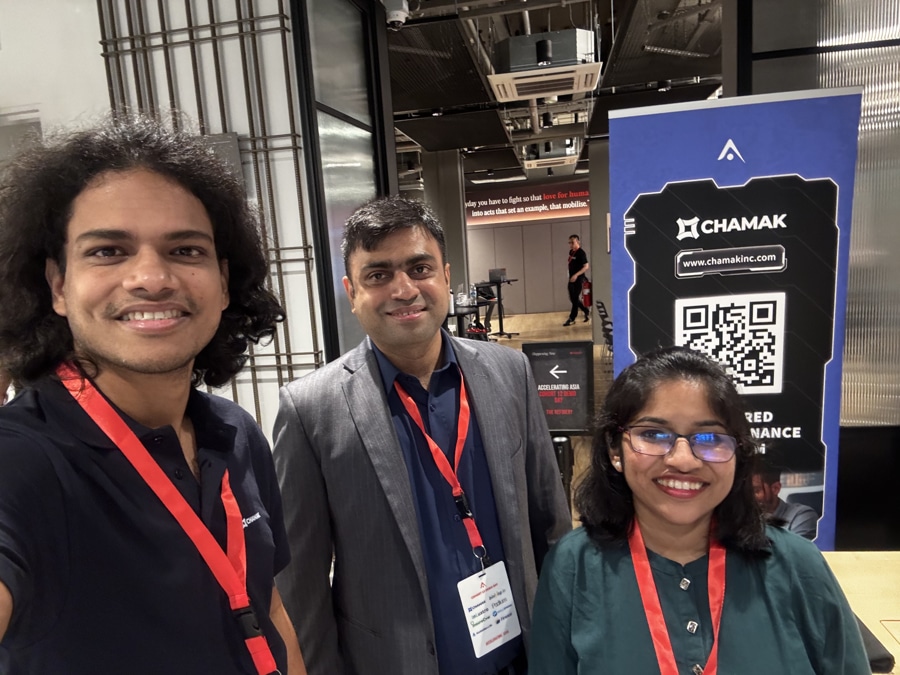
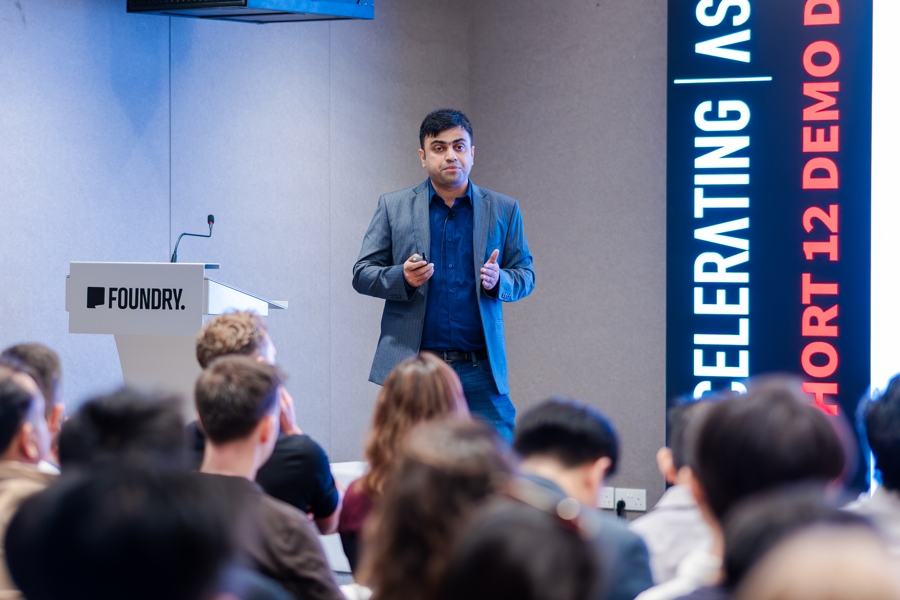
We are working on our communication to address this challenge. We have recently graduated from Accelerating Asia, which I think adds to our credibility. These things should improve our financial stability and help us gain trust in the market.
Ruhul: How does your communication work now, both for small businesses and financial institutions?
Debasish: Mostly referrals. Referral marketing works best for us, since we mostly work with B2B customers. So far, we have received excellent responses. We experimented with digital marketing for a while, but so far, referrals have worked better for us. We plan to engage in digital marketing later as we expand our operation.
Ruhul: How do you run the organization? What do you think about culture and running the organization?
Debasish: I personally follow the Eisenhower Matrix (Important/Urgent), which we have also adopted throughout the organization.
We give our people a lot of freedom. We truly empower them with both responsibility and authority. And I believe whoever does the work is the sole decision-maker. We just track the outcome.
One of my professors at Cornell told me, " If your company can't operate without you, it is not a business, it is a job. We are a small business in size. But we are building in a manner where people operate with a lot of freedom, grow and build their independent decision-making ability, have opportunities to experiment and provide feedback to improve things. We have tried to build a culture with those ideas in mind.
We also follow the idea of doing things that don't scale. We start small, iterate, take feedback from the market, and then gradually go for tech development. I see many founders build things without interacting with customers. We don't do things like that. We start with customers. We take their feedback, and then only do we go to build a product and scale it. This is the culture we want to maintain as we move forward.
Ruhul: This is your third company. You have built and sold one company before Chamak. How much have you evolved as a founder? How do you think differently about building a company now?
Debasish: The first thing: don't believe your intuition. Always talk to customers. As a founder, this is your core responsibility. We actually work for our customers. We solve problems for our customers. If you don't talk to your customers, don't visit them, don't try to see a problem from their perspective, you can't build a great solution.
When I started my first business, I used to think my ideas and way of thinking were the most appropriate. But now I think my customers are actually always right. My job is to transform their problem into a solution. I think this is one major shift in how I think about venture building.
Ruhul: Talking to customers is not easy, actually. Do you have any approach of your own for doing it well?
Debasish: I have a system where I try to speak with five customers every week. I do it in a number of ways. If it is my existing customer and is based nearby, I try to visit them in person. Otherwise, I call them.
If we are working on a new product and need feedback from someone we don't know, we try to find references to make an introduction so that they give us some time.
We also offer incentives, such as a gift, to our customers for feedback.
Ruhul: What do you ask in these conversations?
Debasish: Our main goal is always to understand how a customer sees and explains a problem. Let me explain it with an example, which I did in my previous company. We created a document creation tool, which allowed our customers to create automated export and import documents. In export and import, you need about 33 documents to complete one transaction. The basic format was the same for all these documents. So we felt that if we created the basic formats, it would make the lives of our customers easier.
The interesting thing was that the customers we spoke with before creating this tool were our close circles. We knew them. Instead of giving honest feedback, they tried to make us feel good. So the tool didn't work by giving biased feedback. While we created the tool, our users didn’t need it. So it was a failed experiment.
We have since changed our approach; we try to collect honest feedback. We try to sell even before building a product to check customer sentiment. This allows us to get genuine customer feedback, whether the product actually has a market need and whether it solves customer problems. Whatever you are building, you can only learn whether something will work or not when you go to sell it.
Ruhul: What are some common mistakes founders make when it comes to building a business?
Debasish: As I mentioned earlier, not talking to customers is a common mistake we all make. We tend to prefer listening to our own assumptions without validating them. It is always useful to take your ideas to the market and seek customer feedback.
As I mentioned earlier, we now try to sell directly before making a complete product. Of course, you have to invest some resources, and there are always risks. To that, we can take an affordable risk. We use this principle of affordable loss for validating an idea. This is a principle of effectual entrepreneurship, a concept first explained and later expanded by Professor Saras D. Sarasvathy.
The idea is that we should take risks that we can afford. We can then learn from that experience and grow further. If the hypothesis proves right, we can expand. If it proves wrong, we can pivot, and our cost remains affordable.
Ruhul: That is beautifully put. After many years of covering entrepreneurship, I feel learning is the bottleneck when it comes to entrepreneurship. Any books you recommend?
Debasish: Learning is, of course, a bottleneck. One of my favorite books is Adarsha Hindu Hotel by Pather Panchali author Vibhutibhushan Bandyopadhyay. It’s an amazing articulation of how businesses grow in this part of the world, in countries like Bangladesh/India/Pakistan. The book suggests that in this part of the world, expertise plays a major role in building a successful business. People with domain expertise usually do better. The book tells a story of how a cook becomes the owner of a restaurant. If you look around, I think you can find examples of this expertise-driven success across industries.
Jono Oronno by Shankar is another of my favorite books. There is a movie based on it by Satyajit Roy.
Old Man and the Sea by Hemingway is a book that inspires me whenever I face an obstacle. The book has an interesting part where an old man goes fishing at sea. Initially, he keeps failing. After some 70-80 days of trying, he manages to catch one fish, and when he goes to bring it home, a shark eats the fish. He brings the skeleton as a symbol of his success. In many instances, for those of us in business, we can only manage to get the skeleton, but still, the skeleton is the symbol of success.
I also enjoyed Built to Last by Jim Collins. Fazle Hasan Abed's biography, Hope Over Fate, is another book that inspired me a lot in recent times.
The Alchemist by Paulo Coelho is also a book that inspires me a lot. These are some of my favorite books.
Ruhul: As a founder, how do you approach learning and personal growth?
Debasish: Let me share a story here, told by one of my Cornell professors, Neil Tarallo. He said when we start a business, in the beginning, it is like we are in a jungle. As the business grows, we then go from that jungle to an unpaved village road, which connects a local highway, which in turn connects a national highway, which leads to a regional highway, and so on.
His hypothesis is that our business career follows a similar trajectory. He says this is a typical cycle. We start small and move up gradually. When we are in the jungle, we develop better skills to be able to navigate the unpaved road. When on an unpaved road, we prepare for the local highway and so on.
As an entrepreneur, when you are navigating these different roads, you need different driving skills. You can't use the driving skill useful for one road to drive on another road. As we move along in our journey and enter a new phase of our business, we either have to acquire these new skills or hire people with these skills.
I see entrepreneurship through this lens. That's why I went to Cornell for my master's. After growing to a certain level, I felt that I was stuck. I wanted to grow further. I wanted to understand and overcome my limitations. That's partly what motivated me to pursue a master's at this old age (laugh).
Ruhul: You have been building businesses for the last ten years. Built and exited one. Failed at one. Now building another. Tell us some of your biggest lessons from your journey so far. Maybe ten lessons from ten years of entrepreneurship.
Debasish: Ten lessons would be difficult. Regardless, let me try to share a few ideas.
One lesson is that we should be careful about burning money. Those of us building businesses in markets like Bangladesh have to be mindful about how we spend money. We have to be frugal and should focus on earning from day one.
I understand it is not easy to earn from day one in many businesses. You need to experiment, iterate, and fail to find a product market fit. In those instances, we should learn by making an affordable loss, as I was saying earlier. But we must not take it to an excessive level. You wouldn't be able to find the right business idea on the first try. You have to experiment and learn. In those scenarios, experiment affordably. Everything has a low-cost version. Find those low-cost options to experiment and learn.
This has been a major learning experience for me. Whatever business we start, our goal is to generate revenue from day one.
Another lesson, which I already mentioned, is not to believe your intuition too much; validate it with customers’ feedback and data. Talk to customers. We work for our customers. So we should listen to them to understand what they need and want.
Beachhead strategy, which I mentioned earlier, is also an idea I have found extremely useful. Start small and grow strategically.
Don't look at what others are doing. Focus on your own thing. Something that I learned from Fazlur Rahman, Founder of City Group.
Another lesson I learned from him, as I mentioned, is that commitment is the key. We take it very seriously in our business. I have been in business for more than ten years. We don't have any record of not paying salaries to our people on time. There are exceptions, of course, but we make sure we pay our people on time. This is our commitment to our people.
Similarly, when we commit to a vendor that we would pay on a certain date, you wouldn't find an instance where we didn't follow through. This is something I learned from Fazlur Rahman. It genuinely makes our lives easier.
These are some of the lessons I can think of. I think I'm just getting started. Maybe more lessons in the future.
Ruhul: Future plans, both short and long-term plans.
Debasish: In the short term, we want to serve 30,000 to 50,000 customers in the next 3-5 years. This should allow us to reach the Series B round.
After that, we want to start cross-border trade finance for Bangladeshi exporters and importers. We have found scopes in cross-border transactions where we see opportunities to significantly reduce transaction costs using certain tools and mechanisms.
In the long run, we want to replace two things. One is human-based underwriting with an AI underwriter. We feel the amount of data available is challenging for human credit analysts to process effectively. AI and human collaboration can be a better alternative to that. Similarly, we want to replace LC in global trade. We already have a proven model for this. But we will have to reach a certain scale to get there. If we can reach around $20-30 million in revenue, we should be able to tap that opportunity.
Ruhul: That’s ambitious. I think this is a good place to end today’s conversation. Thank you so much, Debasish bhai. This has been an enlightening conversation for me.
Debasish: Thank you. Let's have lunch now!