
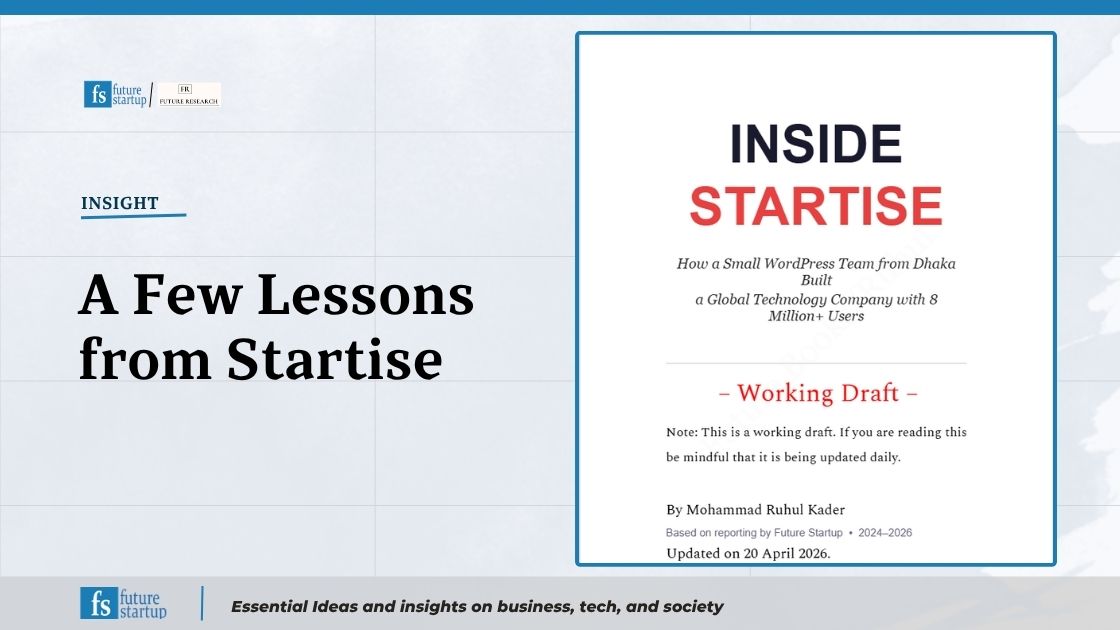
This is an excerpt from our upcoming book on Startise. If you want to be notified when the book comes out, fill out this form.
Startise's story is specific to its context. The company started as a WordPress company and then expanded into several directions, built in Bangladesh, in a particular window of the internet's development.
The lessons that are actually portable are the ones rooted in principles rather than tactics. Here is what I think is genuinely generalizable.
Start lean and achieve profitability before you scale marketing. The discipline this creates—making decisions based on what actually works rather than what shows well in growth metrics—compounds over time into a fundamentally different kind of company. The companies that grow slowly and sustainably tend to last longer and build more durable competitive positions than the companies that grow fast and then plateau.
Find a community and become a genuine participant before you try to sell to it. The brand trust that Startise has built in the WordPress ecosystem was built through years of actual contribution, actual help, and actual engagement with what users needed. There is no shortcut to this. You can buy distribution. You cannot buy trust.
Make your product complementary to something that is already growing. Attaching to an existing distribution is almost always faster and more capital-efficient than building a new distribution. The key constraint is that you have to be genuinely complementary—not just adjacent. A product that makes another product meaningfully better is something users have a reason to seek out. A product that is merely related is not.
Understand which stage of growth you are in and design your strategy specifically for that stage. The failure mode here is applying what worked at a previous stage past its useful life. Growth feels different at 10,000 users than at 100,000, than at one million. The skills, the systems, and the priorities that are appropriate at each stage are genuinely different. The transition between stages is usually the most dangerous moment, because the old approach is still working well enough to feel adequate.
Invest in documentation, education, and user success before you invest in acquisition. The most durable growth channel for most products is word-of-mouth from users who are genuinely getting value. Users who can't figure out how to use your product don't generate word-of-mouth, regardless of how good the underlying product is. Documentation is marketing.
When competitors copy you, your response should be to deepen quality and trust, not to accelerate feature development. Features can be copied. A reputation for consistency and reliability, built over years of not shipping broken things and of actually solving users' problems, cannot be manufactured quickly.
Hire for learnability and cultural alignment over current skills. The most important meta-skill in a fast-changing industry is the willingness and ability to learn. A person who can learn can acquire any skill the company needs. A person who has the right skills but cannot learn will become obsolete. This is especially true in early-stage companies where the skills required will change significantly as the company grows.
Invest in growing people internally. The returns are slower than hiring externally but they compound in ways that external hiring cannot replicate: cultural coherence, institutional knowledge, retention, and the loyalty that comes from genuine investment in someone's development. Over four years, Startise has lost almost nobody. In an industry where 20-30% annual turnover is normal, that is an extraordinary outcome, and it is not accidental.
Give people real ownership and authority over their work. Accountability without authority produces resentment. Ownership—where someone genuinely controls the outcome and is genuinely responsible for it—produces a different quality of work than assignment. The profit-sharing model and the progressive delegation philosophy at Startise are two mechanisms for creating genuine ownership. What the specific mechanism is matters less than whether ownership is real.
Build products that solve real problems, ideally problems you are experiencing yourself. Everything else—growth, revenue, users, brand—follows from this. The companies that drift from this principle, that begin to build for metrics rather than for problems, tend to end up with impressive dashboards and declining products. The companies that stay close to the problem they are solving tend to keep finding reasons to improve.
Don't accept the ceiling that geography or ecosystem imposes. The constraints of building from Bangladesh were real: a shallow talent market, no venture ecosystem, distance from customers, and low expectations of the global market for products from the region. Startise navigated all of them. Not by ignoring them, but by building organizational solutions to each: the internal training model for talent, the community investment for distribution, the quality standard for credibility. The ceiling is real, but it is not fixed.