
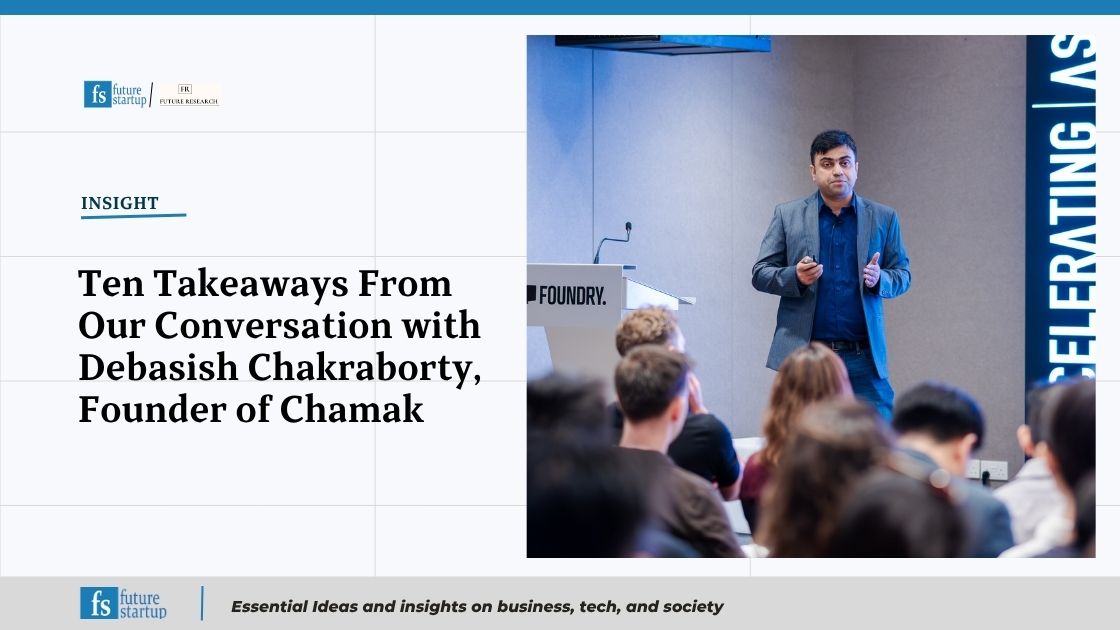
Debasish Chakraborty has been building companies for more than ten years.
He started Tedfo in 2016, an export marketing and management company, ran it profitably without raising meaningful external capital, and exited in 2021.
He then went to Cornell for a master's degree, conceived the idea for Chamak with his wife and co-founder Sangita, returned to Dhaka in October 2023, launched commercially in January 2024, and by the time we spoke, had worked with 350 businesses and facilitated annualized disbursements of around $4 million.
What makes this conversation worth reading is the quality of thinking behind Debasish's approach to building. He has a set of operating insights, some learned from watching Fazlur Rahman run City Group, where he worked for a few years, some from failing at a student startup, some from Cornell, some from running Tedfo into a crisis and deciding when to stop, that are consistent across ten years and two very different businesses.
Below are ten of those insights, drawn from our recent in-depth conversation with him, written for founders, operators, and anyone in the early stages of building something.
Debasish's path to Chamak is not a story of vision preceding execution. It is a story of competence accumulated in sequence, each layer making the next possible.
His time in international procurement at City Group gave him his first exposure to export-import mechanics. That exposure is what made Tedfo viable. He didn't need to spend the first year figuring out how the industry worked. He already knew. Tedfo found product-market fit quickly and was profitable from launch because the founder understood the operational texture of the business before he started it.
Running a Bank Asia Agent Banking outlet in Mirpur DOHS gave him a ground-level view of how small businesses interact with the formal financial system. That experience is what gave him the founding insight for Chamak: that banks don't fail to serve small businesses out of indifference, but because the operational structure makes it too costly and too risky to do reliably. Chamak is built entirely on that observation.
Debasish cites Bibhutibhushan Bandyopadhyay's novel Adarsha Hindu Hotel as one of his favorite books, partly because it captures this pattern: a cook who becomes the owner of a restaurant. The trajectory is not from idea to execution. It is from deep competence to expanded application of that competence.
In markets like Bangladesh, where capital is scarce and the margin for error is small, expertise-driven businesses tend to do better than idea-driven ones. The question worth asking before starting is not "what problem do I want to solve?" in the abstract. Maybe a better question is "what do I actually know how to do that other people need?"
Debasish is direct about this: "Whatever business we start, our goal is to generate revenue from day one."
Tedfo was profitable from the beginning. Chamak was designed to generate transaction fees from its first customers. It is a deliberate strategic choice rooted in a specific constraint: operating in a capital-scarce environment where burning money to find product-market fit is a strategy most founders cannot afford to run for long.
The discipline of targeting early revenue changes how you scope your first product. It forces a level of specificity about who you are serving and what they will actually pay for, which a longer runway can obscure. Founders with large initial raises can sometimes defer that question. Founders without them cannot.
There is also a second-order effect. Designing for early revenue requires the habit of asking "would someone pay for this?" before building it. That question, asked consistently, filters out a large category of well-intentioned but commercially hollow ideas before they consume time and capital.
Debasish draws on the concept of effectual entrepreneurship, developed by Professor Saras D. Sarasvathy, and specifically on the principle of affordable loss. The idea is that under uncertainty, the right question is not "what is the expected return on this bet?" but "what can I afford to lose if this bet is wrong?"
This functions as a constraint that shapes how you design experiments. If you can only afford to lose X, your experiment must cost less than X and still generate enough signal to tell you whether to continue. It rules out building the full product before you know whether anyone needs it. It rules out bets that would be fatal if wrong.
Debasish explains: "Everything has a low-cost version. Find those low-cost options to experiment and learn." This is about an approach to building things where you grow the habit of asking, before any significant commitment of time or money, whether there is a cheaper way to learn the same thing.
In a well-funded ecosystem, founders can sometimes paper over weak assumptions with capital. In Bangladesh, that option is mostly unavailable so far. The constraint forces a discipline that turns out to be an advantage.
Related to affordable loss but distinct from it: Chamak's specific mechanism for de-risking a product hypothesis is to try to sell it before building it.
Affordable loss tells you how much risk to take. Pre-selling tells you whether the risk is worth taking. Selling exposes the actual demand structure in a way that asking about demand does not. People say yes in a conversation. Their real preferences come out when asked to commit money or time.
The lesson came from a failure at Tedfo. The team built an automated document creation tool for exporters that would generate all 33 documents required to complete an export transaction. Before building, they consulted customers they already knew. Those customers gave encouraging feedback, partly out of goodwill rather than genuine demand assessment. The tool launched and found almost no takers.
After that experience, the rule became: before building, try to close a customer. If you can't get anyone to commit to buying it, that is the signal. If you can, you have both validation and your first reference customer.
Debasish has a specific weekly practice: five customer conversations every week. Some are in-person visits. Some are phone calls. When the goal is feedback on something the company hasn't built yet, the team finds a reference to make a warm introduction rather than approaching cold.
There is a difference between this and "staying close to customers" as a general aspiration. Five is a number. Every week is a cadence. It forces the activity into the schedule rather than leaving it to intention. Founders who say they talk to customers regularly but have no fixed number or frequency tend to do it less than they think.
The purpose of these conversations is also specific. The goal is to understand how a customer sees and explains a problem instead of trying to sell something. These require different conversational postures. The first requires listening without an agenda. The second tends to produce confirmation of whatever the founder already believes.
Chamak also offers small incentives — a gift — for customers willing to give detailed feedback. The reasoning is that honest feedback is a service the customer is performing for you, and treating it as such changes the dynamic of the conversation.
Chamak launched in Madaripur, Debasish's hometown, a small district several hours from Dhaka, before expanding to Mirpur. This was a deliberate choice, rooted in a framework Debasish learned at Cornell: the beachhead strategy.
The strategic logic is to pick one specific geography and one specific customer segment, serve them until you understand them deeply, and only then expand to adjacent markets.
Startups are resource-constrained. Scattered experiments across multiple geographies and customer segments consume resources faster than they generate learning. A tight initial focus ensures that the resources you have go toward producing the signal that actually matters: Does this work for this specific customer in this specific context?
At Tedfo, the team made the mistake of trying to acquire customers across multiple geographies simultaneously. The result was scattered effort and shallow learning across all of them. The beachhead framework gave Debasish a name for the mistake and a corrective principle.
For Chamak, starting in Madaripur meant working with a cluster of businesses the team could understand deeply, visit regularly, and monitor closely. The credit model the company is now building, sector-specific, calibrated to the transaction patterns of FMCG and small manufacturing businesses, is only as reliable as the quality of learning from those early customers. A broader initial launch would have produced more data, but a shallower understanding of any of it.
The first business principle Debasish names when asked how he has evolved as a founder is this: "Don't believe your intuition. Always talk to customers."
Founders, especially first-time founders, tend to weigh their own assumptions more heavily than market evidence. The pattern is understandable. You have thought about the problem deeply. You have built a mental model of the customer. That model feels accurate because it is detailed.
The Tedfo document tool failure is the clearest illustration. The founders consulted people they already knew. Those people gave encouraging feedback. The founders proceeded. The market disagreed. The mental model was wrong, and the feedback process was not designed to catch it.
The corrective is to structure customer conversations so that honest disagreement is possible, approaching people who have no relationship obligation to you, asking about behavior rather than opinion, and pre-selling rather than pitching.
When COVID disrupted Tedfo's business in 2021, Debasish did not try to keep it running at reduced capacity while building something new in parallel. He took a clean exit and went to Cornell. When he returned for Chamak, he returned fully.
He explains: "I don't feel comfortable doing two or three things at once. When I do something, I need to go all in."
For founders managing a side project alongside a day job, or operators trying to run two initiatives in parallel, this is the uncomfortable part of the conversation. Going all in is not always possible. But divided attention tends to produce two mediocre outcomes rather than one good one, and the decision to split attention is often made implicitly rather than honestly evaluated.
This applies at the company level as well. Chamak works in 3 to 4 sectors and has built its credit model specifically for those sectors. Debasish says explicitly: "We prefer not to go outside of these segments."
The beachhead applies not just to geography but to focus. Expanding the number of sectors the company works in before the model is solid in the current ones would dilute the quality of the underwriting, the core product.
Watching Fazlur Rahman run City Group gave Debasish a concrete lesson in the operational value of keeping commitments. Rahman's practice was simple: if he committed to something, he honored it. Payments to vendors on the agreed date. Salary to employees on time.
Debasish transferred this practice to Chamak with some precision. Over ten years of running businesses, there is no record of paying salaries late. Vendor payment commitments are treated with the same seriousness.
Debasish views this as an operational position. Commitment builds trust. Trust, in a B2B market where your partners are banks and financial institutions, is a prerequisite for the business to function at all. A reputation for honoring commitments is worth more than most marketing expenditures in a market this size.
The inverse is also true. The reputational cost of a broken commitment in a small, interconnected market is disproportionately high. Relationships that take years to build dissolve faster than they form. Rahman's lesson — "if you keep your commitment, you build trust, and that trust is your most valuable capital" — is a description of how the balance sheet actually works in a relationship-driven market.
Neil Tarallo, a Cornell professor, described the trajectory of a business career as a sequence of roads: jungle path, unpaved village road, local highway, national highway. Each stage requires different skills. The skills that help you navigate the jungle are not the skills that help you drive a national highway. And you cannot learn highway driving by going deeper into the jungle.
Debasish used this framework to explain why he went back to school after building and exiting Tedfo. He recognized that the skills that got him to a certain point were not the skills that would get him further. He had hit the ceiling of what he could learn by doing more of what he already knew how to do.
The learnings he came back with, effectual entrepreneurship, the beachhead strategy, and the discipline of pre-selling before building, have direct operational fingerprints across how Chamak runs. The Cornell investment paid off in a specific set of mental tools suited to the next stage of the road.
The principle is not that every founder needs a master's degree. It is that at some point in every founder's journey, continued growth requires a deliberate change in environment rather than more effort in the current one. The honest question at any given stage is: "What kind of road am I on now, and do I have the skills to drive it?" If the answer is no, more driving in the same direction won't close the gap.
Read our full conversation with Debasish Chakraborty at futurestartup.com.