
Hello there, This is Future Startup Letter, a newsletter about entrepreneurship, expertise, and doing good work. You can read past issues here and subscribe here.
At FS, we are on a mission to help create a more entrepreneurial world, empowering people to find and apply their agency. We are privileged to have you with us on this journey. Please feel free to send us your suggestions to improve our work by replying to this email.
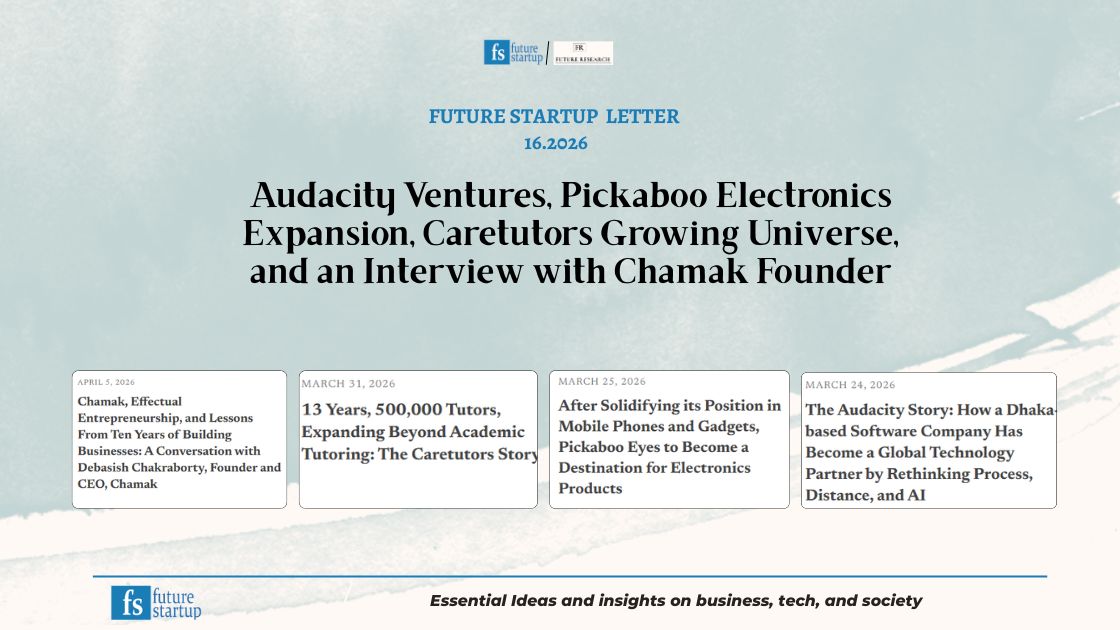
Over the past two weeks, we published four in-depth pieces on four fascinating companies across four different industries: Audacity, Pickaboo, Caretutors, and Chamak that cover a lot of insider stories and insights that you wouldn’t find anywhere else.
Each of these stories is unique and follows a unique arc. At the same time, they also share a lot of similarities and patterns. For instance, if you take all four stories together, an underlying theme emerges: how companies evolve and build enduring business.
To learn more, read the stories. All four links are below.
Happy Building. Enjoy.
Audacity offers an answer to a question that has long vexed software development: how do you combine cost efficiency with quality and trust across geographic and cultural distance? Through systematic process discipline, meaningful AI adoption, globally distributed teams, and what Audacity Co-founder and Director Abu Bakar Siddiq calls an "overdelivery philosophy," Audacity has built a service business where both company and client incentives align around long-term success rather than short-term project completion.
In this deep dive, we unpack the trajectory of the company, its operational dynamics, how it delivers exceptional quality to its customers, and lessons companies and operators can learn from it.
Read the full article here.
In Dhaka's fast-evolving e-commerce landscape, Pickaboo’s recent expansion into electronics can be viewed as an interesting case study in strategic expansion to an adjacent market. Founded in 2016 as a mobile phone and gadgets-focused online retailer, Pickaboo has made significant inroads into consumer electronics over the past two-plus years, a market valued at approximately $9.7 billion in 2024 and projected to reach $13.5 billion by 2029.
This is not to say that Pickaboo never errs. Like every other business, the company has its share of failures, false starts, and missteps. However, its move into electronics is notable for several reasons, including that it is a strategically well-thought-out move to an adjacent market and the company has applied a calibrated approach to execute it.
The result: by 2024, Pickaboo was selling several hundred air conditioners daily during peak season at prices roughly 20% below traditional retail, obviously enabled by procurement scale, a volume and pricing dynamic that, the company claims, has influenced market-wide pricing for consumer electronics.
In 1984, University of Chicago psychologist Benjamin Bloom published what became known as the 2 Sigma Problem. His finding: students who received one-to-one tutoring performed, on average, two standard deviations better than students taught in conventional classrooms. Two sigma. That is the difference between an average student and one performing better than 98% of their peers: the method of instruction. The problem was how do you scale tutoring?
In Bangladesh, that problem is set against a context that makes it feel even more acute. Private tutoring here, for most families, is the primary academic support structure, running alongside the formal one. Millions of families navigating the SSC and HSC examinations, university admission tests, depend on private tutors to fill the gaps that classrooms reliably leave. And for hundreds of thousands of university students, tutoring is one of the only flexible, decently-paid forms of work available during their studies.
The market that results is vast, deeply entrenched, and, until recently, almost entirely unstructured. Missing from this picture was a platform where students could find verified opportunities, and guardians could find reliable tutors, and the whole transaction was governed by something reliable.
This is where Caretutors, a Dhaka-based online tutor matching platform, comes in. In 2012, Masud Parvez Raju, a 22-year-old from Chittagong, decided to build the platform in response to the above-mentioned problem, with 18,000 Taka, a 3,000-Taka website, and a founding insight that turned out to be correct: this market was not broken because of a shortage of tutors or demand. It was broken because of a shortage of trust. And the thesis has only expanded with time. What started as academic tutor matching for SSC and HSC students has grown into a 13-category lifelong learning tutor matching marketplace spanning language learning, music, dance, arts, fitness, coding, special needs support, and professional skill development, operating across almost all major divisional cities in Bangladesh and in more than twelve countries, serving Bangladeshi diaspora communities from Riyadh to Toronto.
Thirteen years in, the platform has over 500,000 registered tutors and more than 125,000 students and guardians. The moat is not tech but an ever-renewing commitment to serve customers well. That is a harder thing to replicate than it looks. And it is the story this piece is about.
Read the full article here.
Debasish Chakraborty is the founder and CEO of Chamak, a Dhaka-based financial technology company building the trade finance infrastructure that connects small businesses to formal financing in Bangladesh. Before Chamak, Debasish built and exited Tedfo, a profitable export marketing and management company he ran from 2016 to 2021.
Chamak sits between two groups that need each other but can't easily reach each other: small businesses that struggle for short and ultra-short-term working capital and are structurally excluded from formal institutional credit, and financial institutions that are willing in principle to serve them but lack the underwriting infrastructure to do so at scale. Chamak builds that infrastructure, using AI to read unstructured transaction data and generate reliable credit assessments, then connects eligible businesses to banks and financial institutions, manages disbursement, and handles repayment collection. It charges a management fee per transaction and takes no lending risk of its own. Since launching commercially in January 2024, the company says it has worked with 350 businesses and facilitated annualized disbursements of around $4 million.
In this fascinating conversation, we talk about Debasish's upbringing path to what he is doing today, examine Chamak in full: the original idea, the pivot to trade finance, the AI-driven credit model the company is building, and what working directly with small businesses has taught the company, explore the ideas and frameworks that have shaped Debasish as a founder over ten years and much more.
Read the full interview here.