
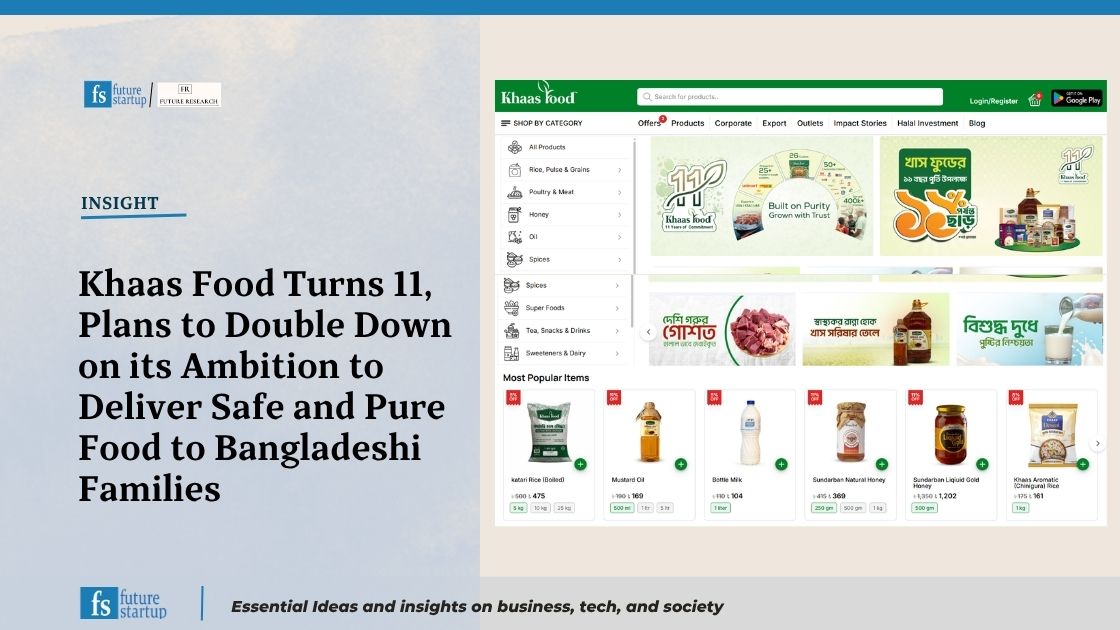
Eleven years ago, three friends from Dhaka University started a Facebook page to sell honey and milk to people concerned about what they were eating. They delivered the orders themselves, packed products in a one-room borrowed place, and financed their tiny operation with meagre capital they put in from their combined savings.
Today, Khaas Food, a leading safe food brand in Bangladesh, is a multi-channel food brand that serves more than 400,000 families across Bangladesh, operates 26 branded retail outlets nationwide, maintains a presence in over 25 modern trade channels, and serves more than 50 corporate clients. The company has also expanded internationally, with exports now reaching the United States, Saudi Arabia, and the UAE.
This week, the company turned 11.
In a press release sent to Future Startup, the company said it has celebrated its 11th anniversary under the campaign "11 Years of Commitment to Safe and Pure Food," marking over a decade of work to bring pure, responsibly sourced, and halal food to Bangladeshi consumers.
The anniversary is worth pausing on, not because milestone numbers are inherently meaningful, but because Khaas Food's trajectory tells us something specific and underappreciated about how a certain kind of consumer brand gets built in Bangladesh.
The problem that started it all
The founding logic of Khaas Food was simple and serious. Food adulteration in Bangladesh is a pervasive, structural problem that has been getting worse for years. Formalin in fish, adulterants in spices, diluted honey, and chemically treated fruits. For urban families with money and concern, finding food they could actually trust had become genuinely difficult.
Habibul Mustafa Arman, Managing Director of the company, described it plainly in an early interview with Future Startup: the founders were sufferers of the problem themselves. That personal grounding matters. A lot of startups build solutions for problems they have read about. Khaas Food was built by people who had lived the frustration of not being able to find clean food for their own households.
The early product range, honey, dry fish, black seed oil, ghee, and spices, included categories with high adulteration challenges and strong consumer concerns. The company was not trying to reinvent food. It was trying to restore something that had been lost: the basic confidence that what you are eating is what it says it is.
How the business is built
Khaas Food's early model was direct-to-consumer through Facebook, which was, in 2015-2016, still a genuinely effective commerce channel for reaching Dhaka's urban middle class. Orders came in through the page, were packed manually by the founders, and were delivered by the founders themselves. The first "office" was co-founder Tauhidul Islam's house.
This is the part of the story that matters because it helps understand the company's operating culture. Khaas Food did not raise a large round and build a distribution infrastructure. It bootstrapped, grew carefully, and expanded only when the previous layer was working. The founders' own savings and family support funded the early operation. When orders grew too large to pack in someone's house, they rented a room. When that grew too small, they added a second room. This kind of disciplined, constraint-driven growth tends to produce companies with a better feel for what customers actually want, because growth was never disconnected from real demand.
By 2016, the company had moved into a dedicated space and was operating with a small team. By 2019, it made its first major strategic shift: opening physical retail outlets, starting in Dhaka and then Chittagong. At a moment when many digital businesses in Bangladesh were going the opposite direction and doubling down on e-commerce exclusivity, Khaas Food recognized that for its particular value proposition: safe food that people can trust. The physical experience of a branded store offered something the digital channel could not fully replicate. A customer who walks into a Khaas Food outlet and sees how products are stored, labeled, and presented is receiving a form of quality signal that is hard to communicate through a product page.
The outlet expansion continued steadily. Six outlets in 2019. More through 2022 and 2023. Two new ones, Cumilla EPZ and Banasree, as recently as September 2025. Twenty-six today.
The retail expansion bet
The most strategically significant move Khaas Food has made in the past year is: the company has quietly started building a traditional retail distribution network.
The signal was the November 2025 launch of a Tk 10 honey sachet, an 8-gram single-serve format designed specifically for traditional retail. The launch brought together over 100 distributors from across Bangladesh. For a company whose entire brand identity was built on controlled quality and direct consumer relationships, this was a meaningful inflection point.
The logic is worth understanding. Khaas Food has spent a decade building trust through high-touch, high-margin, controlled channels: its own outlets, its own e-commerce platform, modern trade partnerships with Unimart and Meena Bazar. That model has worked, but it has a natural ceiling. The families it can reach through those channels are, by definition, urban, digitally connected, and already paying a premium for quality. The 400,000-family figure is real, but Bangladesh has roughly 40 million households.
The sachet format is a vehicle for testing whether Khaas Food's brand equity can travel into the general trade. At Tk 10, the price point removes the typical barrier to trial. The 8-gram serving is calibrated for practical daily use, a morning tea, a child's tiffin box, rather than bulk pantry purchasing. And the single-serve unit economics work well for small-format traditional retail, where display space is limited, and inventory risk per SKU needs to stay low.
The honey category is also an interesting product choice to lead with. Bangladesh produces an estimated 15,000 to 30,000 metric tonnes of honey annually, and the domestic market is dominated overwhelmingly by foreign brands. Dabur alone holds around 70% of the market. This is not because Bangladeshi honey is inferior; it regularly meets EU export standards and is shipped to Japan and India. It is because local brands have not been able to build the distribution and trust infrastructure to compete. Khaas Food is betting that its accumulated brand credibility gives it a genuine opening in a market where consumer trust remains the central constraint.
Managing this expansion without degrading the quality signals that built the brand in the first place will be the hardest part. Traditional retail is fragmented, relationship-driven, and difficult to control. Channel conflict, between the outlet network, modern trade, and general distribution, is a real strategic risk that the company will need to actively manage.
These are not insurmountable problems, but they are real ones, and how Khaas Food navigates them over the next few years will largely determine whether it becomes a genuinely national brand or remains a premium urban one.
The operational depth
Beyond outlets and e-commerce, the company has been working on a manufacturing facility in Bogura. It has built a supply chain with direct farmer relationships. It employs over 160 people. It has developed an export operation reaching three international markets, the USA, Saudi Arabia, and the UAE, which is not trivial for a food company that started with a modest operation.
The corporate client segment, 50-plus businesses, is also worth noting. Corporate gifting and institutional procurement represent a meaningfully different revenue stream from retail, with longer sales cycles but higher order volumes and lower acquisition costs. The fact that Khaas Food has built this channel alongside its consumer business suggests a degree of go-to-market sophistication.
The modern trade presence across 25-plus outlets, which would include partnerships with organized retail chains, gives the company shelf presence in shopping environments where its category positioning works naturally. Consumers who are already in a Unimart or similar store have self-selected for a certain willingness to pay for organized, quality-assured retail. Khaas Food products sit well in that context.
What do eleven years mean
Building a food business in Bangladesh for eleven years without major venture capital, without a viral growth moment, and in a category where consumer trust is genuinely difficult to build, that is not a simple thing.
The safe food segment in Bangladesh is littered with early efforts that did not survive. The problem that Khaas Food's founders identified in 2015, that urban families wanted clean food and had nowhere reliable to get it, was real, and the opportunity seemed large. But operating a supply chain that can actually guarantee purity, at scale, at affordable price points, requires a kind of sustained operational discipline that most early-stage companies underestimate.
Khaas Food has survived long enough to become the category reference point. When consumers in Bangladesh think of safe food as a brand category, Khaas Food is typically among the first few names they reach for. That kind of mental positioning, earned through years of consistent delivery rather than marketing spend, is genuinely difficult to replicate.
"Our journey over the past 11 years has been guided by a simple commitment: to ensure that people have access to food they can trust," said Habibul Mustafa Arman, Managing Director, at the anniversary. "We are grateful to our customers whose trust has helped us grow, and we remain committed to continuing this journey with even greater responsibility."
The anniversary campaign, an 11-day sale with discounts of up to 11% across outlets and e-commerce, alongside community engagement and in-store activations, is a reasonable way to close the loop with customers who have been part of the journey.
Where it goes from here
The company's founding ambition was to make safe food accessible to every household in Bangladesh. For eleven years, it pursued that through premium channels, branded outlets, e-commerce, and modern trade, reaching the top end of the urban consumer market. The retail distribution push is the first serious attempt to extend the mission toward its full stated scope.
The manufacturing facility in Bogura, when fully operational, will give the company a different kind of supply chain control, the ability to process and package at scale rather than relying entirely on sourcing and curation. That matters for cost structure as you move into lower-margin general trade channels.
The export operation is a smaller but meaningful signal about how the founders are thinking about the long run. Building a brand that is trusted enough to sell in international markets, particularly in competitive diaspora-serving food categories in the USA and the Gulf, is a different kind of credibility test than domestic retail. It also opens a revenue stream that is partially insulated from domestic market pressures.
The next five years will likely involve more outlets, deeper retail penetration, continued modern trade expansion, and the gradual development of what could become a genuine FMCG operation with national distribution. Whether the brand's quality promise survives that scaling, or requires meaningful reformulation to work at a mass market price point, is the central strategic question.
Eleven years in, Khaas Food has earned the right to ask that question seriously. We’ll be following closely to see what the company does next.
Future Startup has covered Khaas Food since 2017. Read our full archive of coverage at futurestartup.com/tag/khaas-food.