
Hi there, I'm Ruhul, and this is Future Startup Letter, a newsletter about entrepreneurship, expertise, and doing good work. You can read past issues here and subscribe here.
At FS, we are on a mission to help create a more entrepreneurial world, empowering people to find and apply their agency. We are privileged to have you with us on this journey. Please feel free to send us your suggestions and feedback to improve our work by replying to this email.
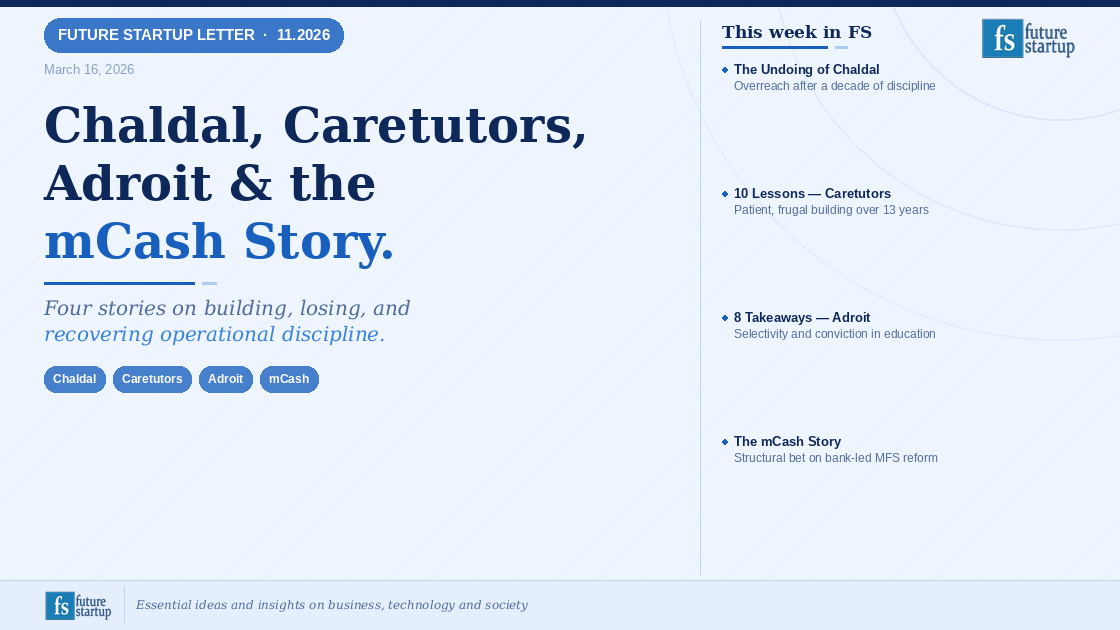
Over the past two weeks, we published four pieces that cover a lot of ground—a hard look at what went wrong at one of Bangladesh's most admired startups, two distillations of lessons from our recent founder conversations, and an analysis of a strategic move in the MFS space that deserves more attention than it has received.
Taken together, the pieces are about the same underlying thing: how companies build, lose, and recover operational discipline. What makes Chaldal's story so instructive is not that it failed in an obvious way but that it was, for a long time, doing everything right. The Caretutors and Adroit takeaways sit on the other side of that coin, two founders who held the line on focus, trust, and frugality and built quietly consequential businesses as a result. And the mCash deal is interesting because it's a structural attempt to solve a governance problem that has dogged bank-led MFS in Bangladesh for over a decade.
All four links are below. Happy Building. Enjoy.
In early March 2026, news broke that Chaldal employees at its Jashore facility had gone unpaid for three to four months. Several hundred workers staged demonstrations. The company was simultaneously sitting on a Tk40 crore working capital shortfall, had cut its workforce from 3,300 to 2,200 over the prior year, and had written to Startup Bangladesh requesting emergency bridge financing.
The story that followed on social media was entirely predictable. Skeptics declared vindication. Supporters blamed the macro. Both camps argued past the most important point.
In this piece we tried to ask the harder question: how does a company that spent nearly a decade doing everything right, lean operations, capital efficiency, deep supply chain integration, proprietary technology built in-house, end up in a position where it cannot make payroll?
The answer, as we trace it, is not the macro environment, though that is real and consequential. It is the cost of losing focus after years of hard-won discipline. The post-pandemic expansion into seven cities, two acquisitions, multiple new verticals, a payments product, and a logistics arm, fragmented management attention in ways a grocery business, which runs on the relentless micro-optimization of hundreds of daily variables, simply cannot absorb.
For anyone building in consumer markets in Bangladesh, or trying to understand how operational excellence can give way to strategic overreach, this is required reading.
Following our full interview with Caretutors founder Masud Parvez Raju, we pulled out the ten lessons that felt most practical, specific, operational insights about building in resource-constrained environments, creating trust in markets where trust is absent, and growing sustainably without significant outside capital.
Raju started Caretutors in 2012 with 18,000 Taka and a 3,000-Taka website. Thirteen years later, the platform has over 450,000 registered tutors and operates profitably across multiple service categories and geographies. He did this largely without raising outside capital after a small 2017 investment, surviving a founding team departure in 2016 and the COVID collapse in 2020 through patience, frugality, and what he calls a bias toward execution over analysis.
The lessons are practical. Execute before you fully understand. Patience is a superpower. Solve for trust before you solve for scale. None of these are new ideas. What makes the Caretutors story useful is that you can trace each one through a specific decision Raju made in a specific hard moment.
If you are in the early or middle stages of building something and want a grounded, honest account of what patient company-building actually looks like in Bangladesh, this is a great read.
Similarly, following our full conversation with Shahreer Zahan, we distilled the eight most interesting ideas from the Adroit Education story.
Since 2017, Adroit has helped students secure over $100 million in scholarships to institutions like Princeton, Stanford, MIT, and Yale. It has done this while deliberately keeping cohort sizes small and growing entirely through referrals without paid marketing or outside funding. The company has a near-perfect success rate across eight years. It is bootstrapped. It is profitable.
The takeaways go into how Shahreer thinks about hiring people who genuinely care versus people who merely have the right credentials, why saying no to volume is often the most important strategic decision, and how physical discipline through Muay Thai and long-distance running directly shapes the quality of his business decisions. There is also a clear-eyed discussion of why passion for the problem matters more than the size of the opportunity, and what happens when founders get those two things in the wrong order.
Islami Bank has spun mCash out into a standalone subsidiary and approved, in principle, a deal that would bring in US-based B100 Holdings as a strategic investor holding up to 48.99% of the company. If it clears regulatory approval from Bangladesh Bank, the deal would raise mCash's paid-up capital from Tk 50 crore to Tk 500 crore. Islami Bank's stock moved up nearly 10% the following day.
The market liked it. But the more interesting story is structural.
For over a decade, bank-led MFS in Bangladesh has been trapped in what Clayton Christensen called the innovator's dilemma: parent banks consistently deprioritize their MFS subsidiaries not because they are incompetent but because the rational, well-managed thing to do is to keep investing in the profitable core business. Every bank-led MFS player in Bangladesh has followed this pattern: early ambition, stagnation, renewed investment, stagnation again.
bKash escaped this trap partly because it was founded by outside founders and consistently operated with meaningful independence from BRAC Bank. What Islami Bank is attempting with the mCash spinoff is a structural bet that it can achieve something similar.
Bangladesh's MFS market handles over 8% of global daily mobile money transactions. The question of whether mCash can carve out a meaningful position in a market dominated by bKash and Nagad is one worth watching closely.
That's it for this week. Thank you for reading and for being part of this journey with us. If you found these useful, please share with someone who would benefit from them.
Happy Building.