
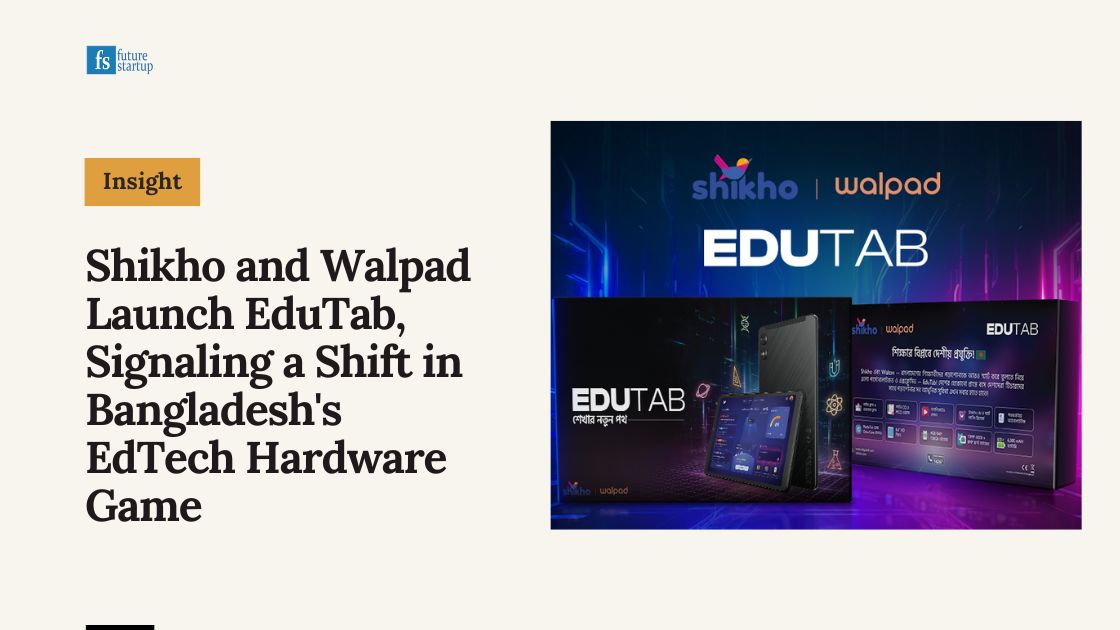
Two Bangladeshi companies have launched what they describe as the country's first truly localized learning-focused tablet, “a device built in Bangladesh and shaped by a close understanding of how the country’s students study and how teachers teach”. Shikho, a digital education platform, and Walpad, a concern of electronics giant Walton Group, unveiled EduTab this week—a device that runs on Android but comes preloaded with curriculum-specific content designed for Bangladesh's national curriculum learners.
The tablet operates like any standard Android device with full Google Play Store access, but it comes with Shikho’s learning platform built directly into the experience. Students get animated video lessons, exam practice tools, interactive live classes, and AI-powered support built directly into the experience. The companies say this approach reflects years of studying how Bangladeshi students actually learn and the constraints they face.
For many parents and teachers, tablets have come to symbolize distraction more than learning. EduTab tries to shift that perception not by making high-quality academic content the easiest and most natural part of its use. The companies say the goal is to turn a familiar piece of technology into a dependable study companion. Whether this actually changes behavior patterns remains to be tested in real-world use.
The EduTab model echoes successful digital learning initiatives elsewhere, particularly Japan's GIGA School program, which distributed devices to every student and showed meaningful learning improvements when hardware, software, and teaching practices aligned properly. Similar programs in South Korea and Estonia have demonstrated that technology works in education when it's tightly integrated with actual curriculum and classroom practice rather than treated as a generic add-on.
EduTab follows a similar logic, but with a hyperlocal software layer built for Bangladesh’s curriculum and daily learning realities.
EduTab enters the market as a direct-to-consumer product. The device is positioned as an affordable, practical option for students at home, in coaching centers or in classrooms. This creates both opportunity and risk. Families gain access to structured learning content without waiting for systemic education reform. But without teacher involvement or parental tech fluency, devices can easily become expensive distractions. To that end, the product's success may depend less on its technical capabilities and more on whether Shikho can create compelling enough content that students choose it over entertainment alternatives.
The collaboration brings together two distinct capabilities from established players. Shikho has built one of Bangladesh's largest ed-tech platforms. The company raised $6.3 million in Series A funding in 2023 and has spent years refining its content for Classes 6 through 12, aligning closely with national curriculum requirements and local exam patterns.
Walpad, as part of the Walton Group, brings significant manufacturing credibility and distribution reach. Walton has spent years building its electronics manufacturing capabilities across multiple product categories, and Walpad already operates as an established tablet line in Bangladesh's consumer electronics market. EduTab appears positioned as a specialized offshoot of this existing product line—a distinct offering aimed specifically at the education market rather than general consumer use.
The partnership structure is interesting. Rather than a startup attempting hardware manufacturing from scratch, Shikho is working with one of Bangladesh's most established electronics manufacturers. Walton's existing supply chains, quality control systems, and retail presence give EduTab immediate advantages in production and distribution that purely digital education companies typically lack.
The device itself doesn't lock students out of regular tablet functions. They can still access other internet sites such as YouTube, games, or social media. But the integration means learning content appears prominently and works smoothly even with intermittent connectivity, a crucial consideration given Bangladesh's uneven internet infrastructure outside major cities.
The companies position EduTab as an affordable option, though specific pricing wasn't disclosed in their announcement. Bangladesh's tablet market is already crowded with cheap Chinese devices and premium options from Samsung and Apple. Walpad's existing tablet line competes in this space, but EduTab needs to justify differentiated pricing through software value—the argument that Shikho's integrated content is worth paying extra for compared to a standard Walpad tablet.
This creates an interesting test case for Bangladeshi ed-tech. Can locally developed educational software command a premium in a price-sensitive market? Or will families opt for regular Walpad tablets (or other brands) and access learning apps separately?
Walton's extensive retail network—hundreds of brand shops and thousands of retail touchpoints across Bangladesh—provides EduTab with distribution advantages that most ed-tech hardware startups could only dream of. But distribution alone doesn't guarantee adoption. The product still needs to convince parents that the educational integration justifies choosing it over Walton's own standard tablet offerings.
The coaching center market represents another potential channel. Bangladesh's private tutoring industry is massive, with families spending significant portions of household income on supplementary education. If EduTab can partner effectively with coaching centers—providing tools for teachers while engaging students—it might find traction beyond individual consumer sales.
Several challenges loom. First, content quality matters enormously. Shikho has built a substantial library, but maintaining engagement across subjects and grade levels is difficult. If students find the content boring or less helpful than expected, the device becomes just another tablet.
Second, while Walton's manufacturing capabilities reduce typical hardware startup risks, product differentiation creates its own challenges. EduTab needs to be distinct enough from regular Walpad tablets to justify its existence as a separate product line, but not so specialized that it limits market appeal. Finding that balance is tricky.
Third, the Android openness they tout as a feature could become a liability. Once students discover they have full access to entertainment apps and games, will they maintain focus on academic content? The bet is that good educational content can compete for attention, but human nature—especially teenage human nature—suggests otherwise.
Finally, there's the ecosystem question. A device succeeds when it fits into how people actually work and learn. EduTab needs to integrate with how teachers assign homework, how parents monitor progress, and how schools assess learning. Without that integration, it remains an isolated tool rather than a connected learning environment.
Despite these challenges, EduTab represents something important: Bangladeshi companies attempting to build education technology suited to Bangladeshi realities rather than adapting foreign models. The partnership between a leading ed-tech platform and an established electronics manufacturer suggests a maturing ecosystem where different players recognize the value of collaboration over isolated efforts.
The global ed-tech industry is littered with expensive failures—tablets distributed to schools that sat unused in closets, apps that promised transformation but delivered marginal results, platforms that worked brilliantly in pilots but collapsed at scale. There are examples of similar experiments in Bangladesh, including an experiment of a similarly named product. Success requires not just good technology but careful attention to how people actually behave, what motivates them, and what constraints they face.
If Shikho and Walpad have genuinely observed and understood those realities, EduTab could establish a model for Bangladesh and similar markets. Walton's manufacturing scale and Shikho's content expertise create potential for something more sustainable than typical ed-tech hardware ventures.
If they haven't, it becomes another well-intentioned device competing for attention in an already crowded tablet market, potentially cannibalizing Walpad's own existing product line without creating new value.
The answer will emerge over the coming months as families use the device in their homes. For now, EduTab stands as an intriguing bet that local knowledge, combined with established manufacturing capabilities and solid execution, can create education technology that actually works for Bangladeshi students.
Disclosure: This article is based on company-provided information. Future Startup has not independently tested the EduTab device.