
In a modest office in Vancouver, British Columbia, Abu Bakkar Siddiq pulls up a screen showing a brain-training game his team recently built. The app features smooth animations, word-matching puzzles, and a subscription paywall, the kind of well-made product that typically takes a quarter to develop. His team delivered it in less than two months.
"If we designed and developed this app using a traditional process, it would have taken a minimum of a quarter to six months," Siddiq says. The difference isn't only about speed but also about a shift in how software is built and where value comes from, in an age when artificial intelligence has permanently changed knowledge work.
Siddiq is the co-founder and Director of Audacity Ventures Inc. The Dhaka-based software services company has spent the past decade evolving from a small web and mobile app studio to a globally distributed operation serving clients from Perth, Australia, to San Francisco and New York, USA.
With teams spanning three continents and expertise in building everything from fintech to entertainment platforms, Audacity has built an interesting new model for software development, one where meaningful process enables excellent service delivery across geography, and where human judgment becomes more valuable precisely because AI has made execution relatively faster and cheaper.
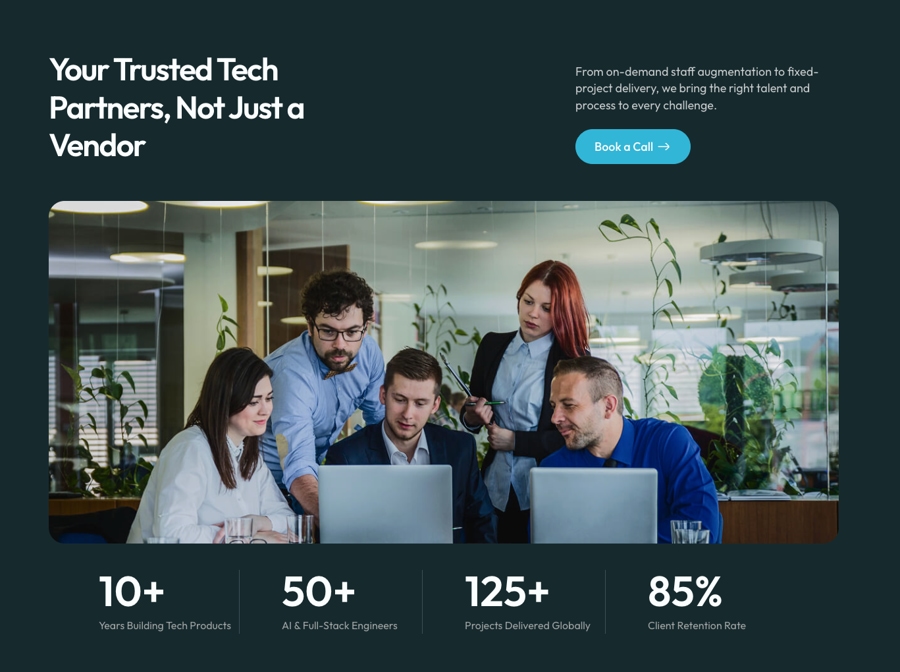
Today, the company employs 50+ professionals across Vancouver, Dhaka, and Australia, delivering 125+ projects for clients from early-stage startups to large corporations.
But these numbers tell only part of the story. What separates Audacity in an increasingly competitive software services market is something harder to quantify: an 85% client retention rate, with relationships that often start at $5,000 and grow to over $1 million across multiple project phases. The company has built a systematic approach to client success and early and comprehensive adoption of AI tools. It has built a unique operational model that combines the cost advantages of Bangladesh and global quality standards, a hard-to-build combination of well-structured processes with agility.
Audacity offers an answer to a question that has long vexed software development: how do you combine cost efficiency with quality and trust across geographic and cultural distance? Through systematic process discipline, meaningful AI adoption, globally distributed teams, and what Siddiq calls an "overdelivery philosophy," Audacity has built a service business where both company and client incentives align around long-term success rather than short-term project completion.
In this deep dive, we unpack the trajectory of the company, its operational dynamics, how it delivers exceptional quality to its customers, and lessons companies and operators can learn from it.
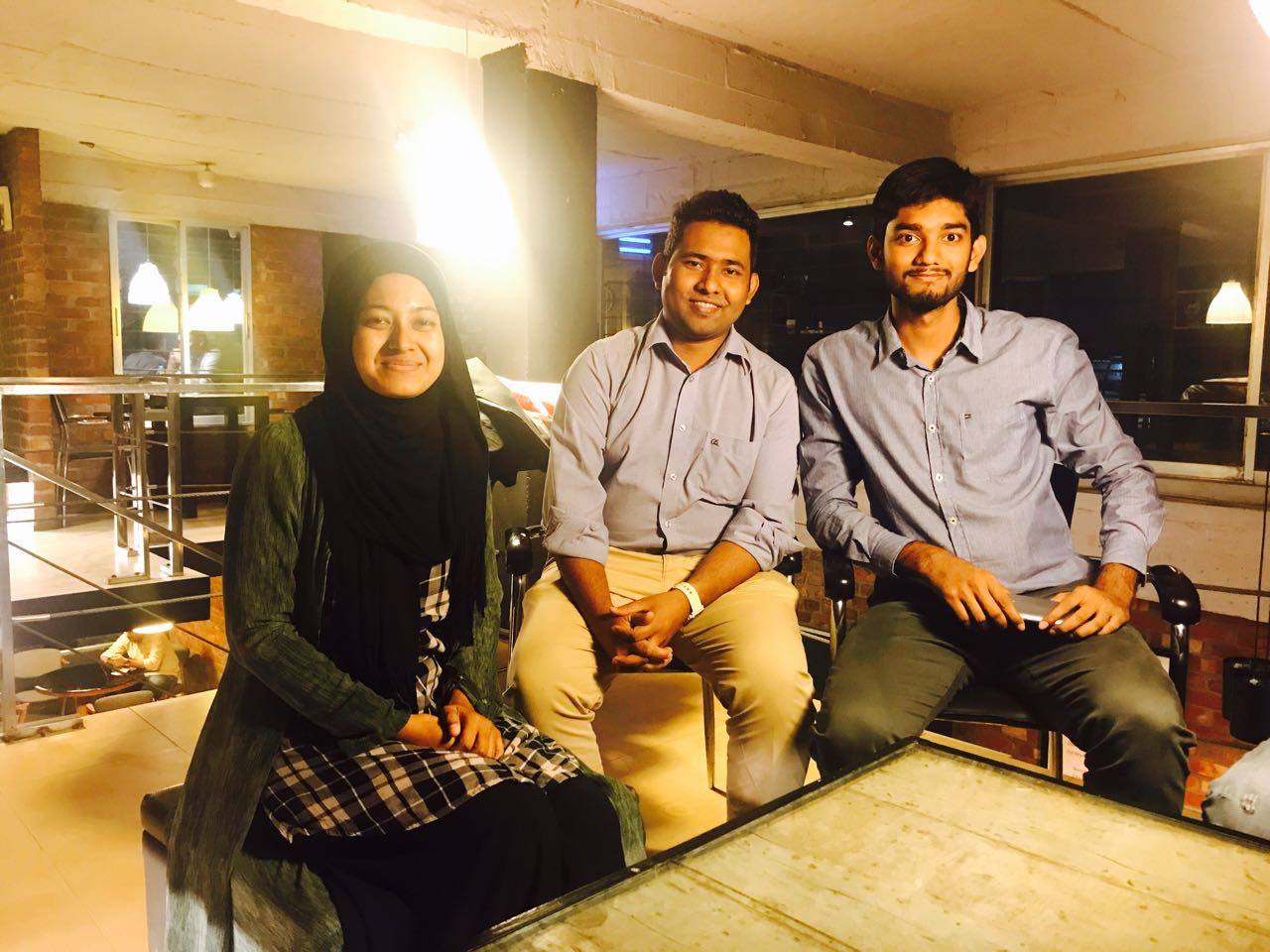
Audacity's journey began in 2015 in Dhaka, Bangladesh, with an initial focus on mobile applications and UI/UX design. "When we started in 2015, we solely focused on the Bangladesh market. We also narrowed down our focus to only work on mobile apps and design," Siddiq recalls. While the narrow focus limited its opportunity in those early days, it also allowed the company to build deep expertise and deliver quality work for early clients. Done right, focus is always an advantage.
The transformation into a global operation came through both intention and opportunity. By 2020, Audacity had built a substantial Bangladesh client base and a team of 30-40 people. Then COVID-19 hit. When local clients put projects on hold, Siddiq decided that rather than laying off his team, he would find new markets. "I asked for 2-3 months' time from the team and started focusing on the global market," he explains.
The timing proved fortuitous. While Bangladesh was entering crisis mode, North America and Australia were beginning their recovery from COVID lockdowns. "The efforts paid off. I started getting work from North America and Australia. By the end of the year, 2020 became our highest revenue year," Siddiq recalls.
That pivot reshaped the company. Today, Audacity operates as a Vancouver-based company with engineering teams in Bangladesh, senior engineers, QA, and Project Management in Canada, and business development in Australia. This global structure allows geographic presence, enables the company to deliver round-the-clock service, and combines diverse expertise.
"We started hiring some team members in Vancouver," Siddiq explains. "Some of them previously worked with companies like Amazon, PayPal, Samsung, Microsoft. It has enriched our culture and improved the outcome of our projects."
The growth changed Audacity as a company in a number of ways. It now has customers across markets. It provides a comprehensive range of software development solutions. With its expansion across geography and service scopes, the company has also expanded its model of how it works with customers.
Audacity offers two distinct engagement models, each designed for different client needs.
For entrepreneurs and companies with ideas but no technical team, Audacity provides end-to-end product development, operating as their extended technology team. "You have an idea and want to build it, but you don't have an engineering team. We’re here to build for you. You focus on your idea and business, we take care of all your engineering needs, working as an extension of your own team," Siddiq explains.
In this model, the company takes an extended role, helping clients figure out what to build and how. The engagement starts at the idea stage. “When you come with only an idea that you want to turn into a product, you often are operating on certain assumptions, without proper market validation. We try to help our clients navigate this phase. Starting from idea validation, we help with design, development, maintenance, deployment, and everything in between," adds Siddiq.
This comprehensive approach means clients aren't just buying development hours; they're getting a strategic partnership.
Similarly, there are clients who come with deep product ideas, including roadmaps. In those cases, Audacity comes in as an execution partner. “In many instances, clients even provide us the wireframe, and we do the custom design and the backend logic," because that's what the product needed to succeed. This type of engagement can be called a project-based engagement model, where a client has a project, and Audacity executes it. This one approach Audacity engages with clients.
The project-based engagement model covers idea validation and refinement, UI/UX design and prototyping, full-stack development, quality assurance and testing, DevOps and deployment, and ongoing maintenance and support.
The second engagement model Audacity uses to engage with clients is staff augmentation. For companies with existing teams, Audacity provides curated technical talent through staff augmentation. "We help companies to expand their teams without going through the challenges of hiring the right people and then managing them," Siddiq notes. "They don't have to take the trouble of hiring or other team management related challenges. We provide highly capable team members with global working experience based on the needs of our clients."
For staff augmentation, Audacity has developed specialized hiring processes across technologies, starting with Flutter and Native Android, then expanding to Java Enterprise, QA, Golang, and other in-demand technology stacks.
One of the challenges of staff augmentation is finding the right people for the right roles. Cultural fit matters as much as technical skill. "When working in staff augmentation, the engineering aspect is obviously important but culture fit is also equally important, if not more.” Audacity has built processes and systems keeping that in mind that allow the company to deliver high-quality staff augmentation solutions. The company says its goal with the staff augmentation is to make talent discovery super efficient for its partners.
However, while Audacity continues to refine its client engagement models, an even more fascinating aspect about the company is how it has systematically expanded its capabilities. Let’s take a closer look at its technical capabilities.
Over the years, Audacity has built excellent capabilities across the technology stack. However, perhaps the most significant competitive advantage it has built in recent times is its comprehensive adoption of AI tools across the entire development lifecycle. This transformation in capabilities fundamentally changes how Audacity thinks about technical expertise—a rethinking of how software gets built and what clients should expect in terms of delivery speed and quality.
"Previously, we used to work with language preferences, meaning preferring some specific languages over others. We moved away from that framework of thinking after 2022," Siddiq explains. The reasoning is pragmatic: "We think language and technical details should be decided based on the needs of a project. Similarly, in the time of AI, language is not that important anymore."
This shift has also changed Audacity's hiring approach. "In team members, we now look for a core engineering knowledge base and problem-solving skills. We believe if someone is good at fundamentals, they can work well across skills and languages." Alongside engineering fundamentals, we also look for AI tool proficiency. We are putting a lot of importance on AI tools proficiency." The company invests heavily in AI tooling.
The impact shows in delivery timelines. The recent brain-training game, mentioned at the beginning of this article, with word-matching mechanics, complete animation, and paid features, was "built and deployed within one month. Including everything: animation, application development (Android, iOS), and even idea generation."
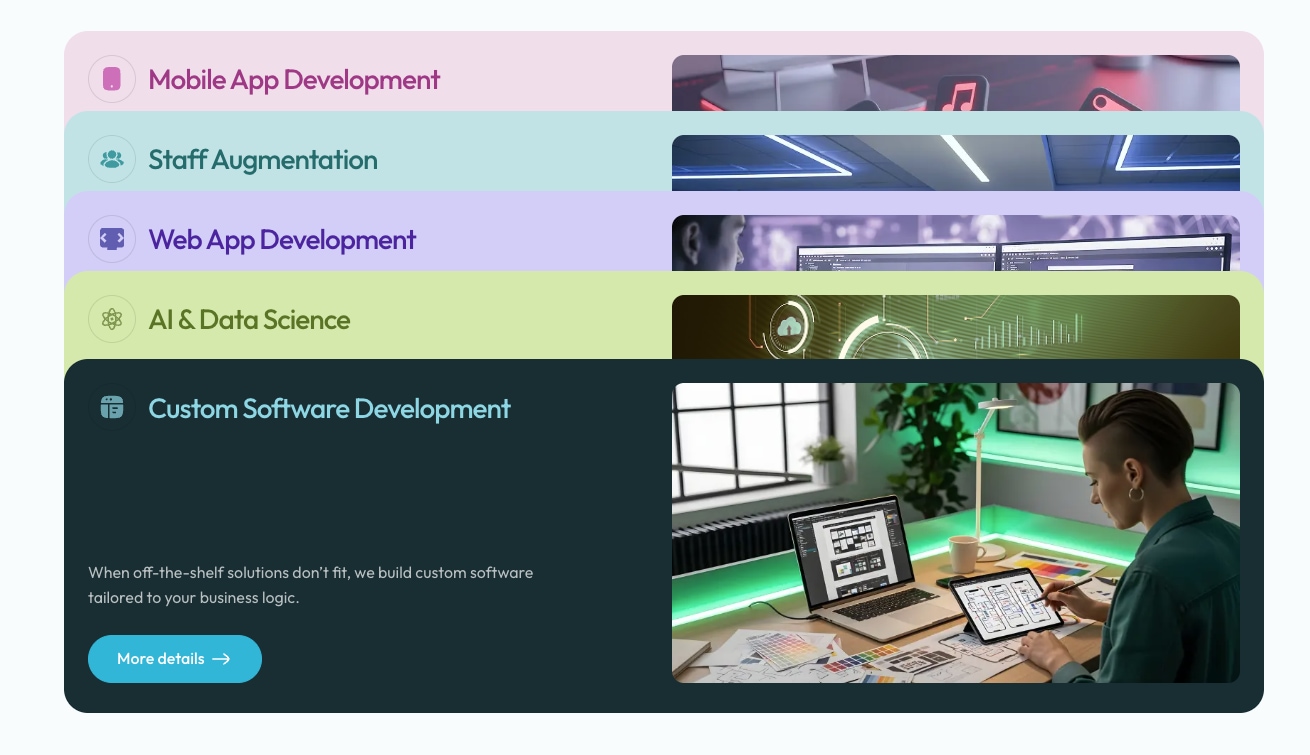
Audacity uses AI tools across design, rapid prototyping, and design-to-frontend conversion, development, content creation for automated image and video generation, deployment with AI-assisted DevOps tools, and marketing automation, including social media management.
However, the company understands and is conscious of the limitations of AI. It has developed a nuanced understanding of where AI excels and where it falls short and operates accordingly. "After a certain level, you’ll see that AI is not cutting it. It can’t deliver what you exactly want or need. Our approach is collaborative. AI systems are used as collaboration tools."
This balanced approach, leveraging AI for speed while applying human expertise and taste for differentiation, gives clients both efficiency and quality. Clients get rapid delivery on standard features and custom quality where it matters most for their brand.
But technical capabilities only produce intended results when used in a meaningful manner. For Audacity, it has developed a unique approach to working with clients that helps amplify its capabilities for the benefit of its clients.
One of the most common frustrations in software development partnerships is what you may call a "black box" problem, a lack of meaningful collaboration between the development company and the client during the development process. Work happens behind closed doors for months, then a product emerges that doesn't match expectations. It creates all kinds of problems and complexities for both parties. For the client, how do you know the team you've hired is building what you need? For the development company, how do you prevent the nightmare scenario where months of work yield a product that misses the mark or that the client doesn’t like?
Drawing on agile methodologies refined through years of working with global clients, Audacity has designed its process to eliminate this problem. The company assumes client involvement throughout the development process as a default approach rather than treating it as optional.
"When a client comes with their ideas, they initially want to do many different things. We begin with helping them narrow down their ideas," Siddiq explains. The product and design teams work with clients to define clear initial milestones. For clients who come with abstract visions, which is most, Audacity builds design prototypes first.
"We convert the ideas into design. When the client sees the actionable prototype, total flow, client gets a better understanding of how his idea would be implemented. Then he approves the design and we go into development."
The development process emphasizes continuous communication. Clients receive bi-weekly demonstrations. "We always have bi-weekly demonstrations. It's not like he gets a release after three or six months." Internally, the team conducts weekly demos and retrospectives to review progress and identify improvements. Daily standups ensure team members stay synced.
Deployment follows a staged approach: "We first deploy to staging. QA team rechecks. The codebase is moved to the production side after final approval."
Audacity maintains a deliberate buffer in what they show clients. "We don’t show everything in our bi-weekly client demonstration. We calibrate according to our timeline and try to stay a bit ahead."
This buffer ensures clients always see steady progress, even when development faces unexpected challenges.
The evolution of this process has been noticeable to long-term clients. James of MyPremo captured the transformation: "From working on just ideas on paper to fully built products, the way Audacity has adopted new processes, improved operations, and aligned with how Australian teams work is admirable. The difference between how they worked on our initial project and projects today is chalk and cheese."
This approach to working in a constant collaborative manner with clients allows Audacity to incorporate feedback in real time during the development process and deliver superior quality work.
Audacity has also been innovating how it operates. One important operational strategic change is its approach to working with partners for expanding capabilities.
Audacity has developed an operational structure that balances capability with flexibility. The company maintains the core engineering in-house. For other functions, it collaborates with partners, for which it has built a network of specialized partners. The model allows for both quality control and rapid scaling.
"We focus on engineering and have partnerships for other relevant needs," Siddiq explains. "We narrowed it down to our core focus, and for other areas, we have partners who are experts in those areas."
For instance, Audacity works with three partner teams for design. "Based on the project at hand, we choose which partner team to work with. And we take proposals from all three. We take a diversified approach to partnership so that we can avoid over reliance on one single partner and our partners also can enjoy flexibility." The same approach applies to QA, with partner teams handling testing while Audacity maintains internal quality oversight. "We only focus on engineering and engineering-related things. The rest goes to the partner team. But the process is collaborative and we get involved to ensure our clients get the best possible service."
This structure provides several practical advantages. Audacity can rapidly expand capacity for large projects without permanent overhead. Clients get access to specialists matched to their specific needs rather than generalists. Competition among partner teams drives quality improvements. Different projects can draw on different specialized resources, ensuring the right fit for each engagement.
The result is a company that can serve enterprise clients with complex requirements while maintaining the agility and cost structure that makes it accessible to startups and mid-sized companies.
Audacity has been a relentless company. From its early days, the company not only tried to expand its business, but it has also invested similar relentless effort in building an ever-evolving organization that delivers quality to clients. It has applied constant evolution to the needs of the market as a competitive moat. It shows in its track record.
Audacity's portfolio spans consumer apps with millions of users, enterprise platforms, and complex B2B solutions. The company has delivered 125+ projects globally, working with companies from early-stage startups to established corporations across fintech, entertainment, travel, education, and mining sectors.
MyPremo, a music and entertainment platform, shows the end-to-end product engineering Audacity provides. Built from concept through scalable production, the project involved data-driven systems for creator and content management, with architecture designed for future monetization and close collaboration across global stakeholders.
Acceler8 Training, a training marketplace for the mining industry, demonstrates Audacity's ability to handle complex integrations. The platform features third-party API integrations, automated workflows, and seat management systems, serving both learners and administrators with intuitive interfaces while handling sophisticated backend logic.
Turbo Secure VPN shows Audacity's consumer app expertise, a privacy-first VPN product optimized for performance, security, and connection reliability. The app features subscription-ready architecture and has achieved strong ratings on both the App Store and Google Play.
Y2Y Travel shows the company's flexibility in matching approach to client needs. When the client prioritized speed over custom design, "we chose a template base, connected it with their branding, and launched it", a willingness to apply the most practical solution rather than pushing unnecessary services.
On the corporate side, Audacity has provided staff augmentation services to major organizations, including one of the world's largest mobile financial services, IDLC Finance, BCC, Rokomari, and Grameenphone. It shows the company’s ability to work within enterprise environments and meet stringent security and compliance requirements.
Audacity proves the popular sentiment: the reward for good work is more work. To that end, part of Audacity’s growth can be attributed to how it approaches client collaboration.
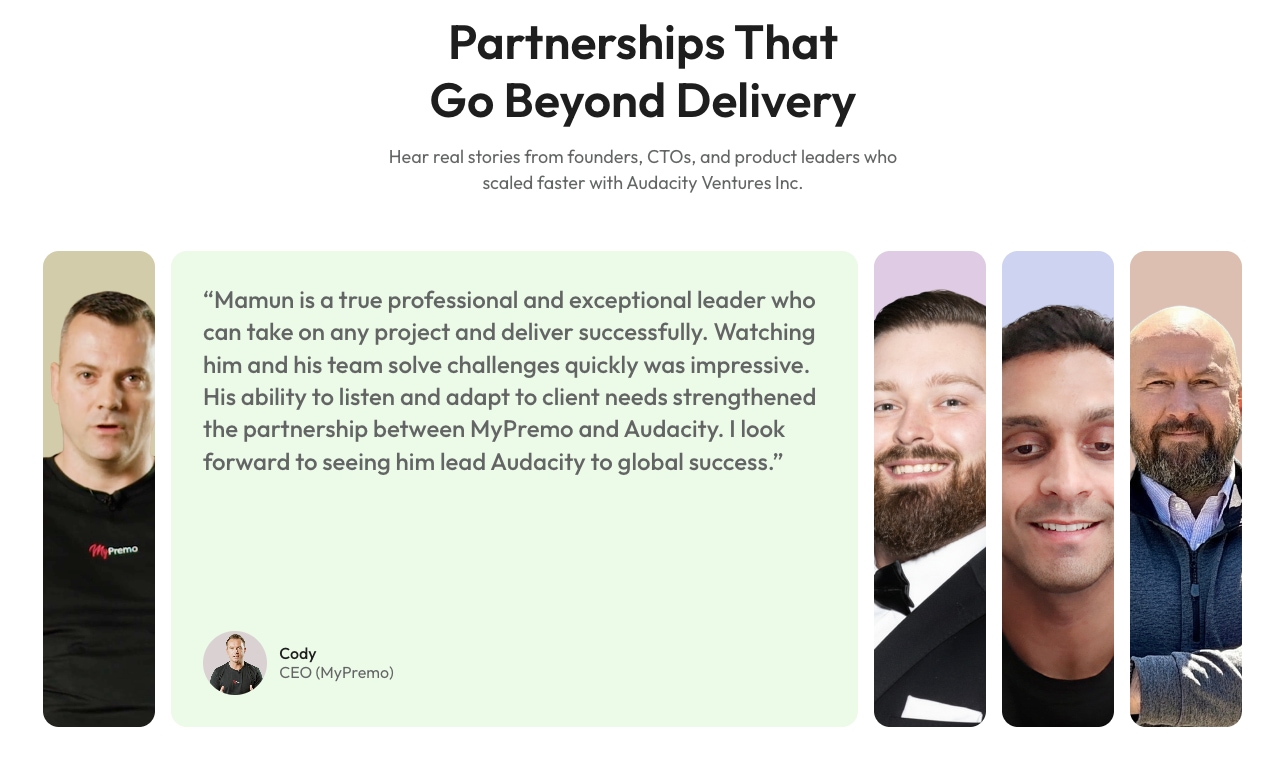
One of Audacity's operational strategies is systematic overdelivery. The company even deploys more resources than commitment to ensure quality and client satisfaction. While this might seem unconventional, it reflects a deep understanding of service business economics and the lifetime value of client relationships.
"Since last year, we have tried to do this. If we commit three people, behind the scenes we add four people. We add one additional resource. If we promise one QA team member, we add two. If we’re supposed to add one designer, we add two designers," Siddiq explains.
This approach does reduce short-term margins. "This reduces our margins in the short term. But it ensures quality of work, and the client can rely on us. And relying means he will give us more extended work and referrals."
The strategy extends beyond contractual obligations. Charles, a founder who has worked with Audacity across multiple projects, shared a memory in a recent testimonial that illustrates the philosophy.
"While working with you (Audacity), at one phase, we had an issue with investment," he recalled. "We needed to build a feature but didn't have the investment. When I shared the idea with you guys (Audacity team), you said, 'we are doing it, you pay us later.' You did the demonstration, released it, and after that we managed to raise an investment. I will never forget that."
Siddiq is quick to clarify that this was a thoughtful relationship investment. "It was not like that was our first work with Charles. We had done a number of projects with him and we had an excellent relationship. We understood he had constraints. It was no brainer for us to do it for him."
The numbers validate this approach. One client relationship that started with a $5,000 project has grown to over $1 million in ongoing work, now in its sixth project phase. "This focus is important... delivering high quality output, keeping the client happy. When you do it, ultimately the return becomes much higher."
This consistent investment in relationship-building has transformed Audacity's business model. The company now works with a relatively limited number of clients simultaneously, a change from its earlier years. Most clients are on 1-2 year retainer models, with dedicated teams that build institutional knowledge over time.
"When we work on a project, we build a team for it," Siddiq says. “So we try to work on projects where the client is willing to work for a long term basis, like one-two years with that team.”
The retention rate of 85% speaks to the effectiveness of this approach, with many team members having worked on the same client accounts for 3-4 years.
This structure creates mutual benefits. Clients get dedicated teams that deeply understand their business through continuity and institutional knowledge. The continuity is particularly valuable in complex domains like fintech, where understanding regulatory requirements and business logic accumulates over time.
They get predictable costs and priority access to Audacity's expertise. For Audacity, it means stable revenue and planning capability. It also means deeper client relationships that yield better outcomes, opportunities for strategic partnership beyond pure execution, and higher lifetime value per client relationship.
This development also speaks to Audacity’s culture, both in terms of how its culture has played a role in this success as well as how these different approaches and models have helped it create a unique organizational culture that reinforces everything.
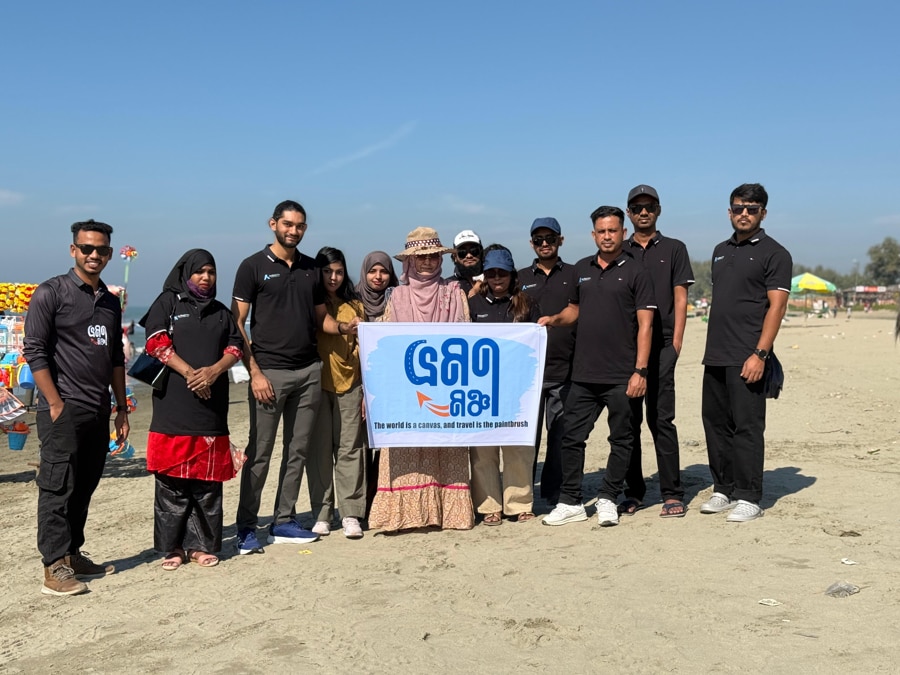
Speaking of culture, one of the challenges for any Bangladesh-based company serving global markets is meeting international expectations around communication, timeliness, and process discipline. Audacity has addressed this through a team structure, integrating Vancouver-based senior engineers with Bangladesh development teams on the same projects to create knowledge transfer through daily collaboration.
"If we could have done this blending, connecting our Bangladesh and international teams and creating an environment for cross-cultural learning earlier, perhaps our growth would have been at a different level today," Siddiq reflects.
The mixed-team approach has elevated operational standards across the organization.
The result is a team that operates on global standards while maintaining Bangladesh's cost advantages. A combination that's valuable for clients but difficult to achieve without the kind of integrated team structure Audacity has built.
The cultural bridging works in both directions. Canadian team members are learning to work asynchronously across time zones, and Bangladesh team members are absorbing the communication patterns and deadline discipline common in North American corporate environments.
Client testimonials reflect this cultural fit. Charles Brands, Founder & CEO of an Australian startup, noted: "With Audacity Venture, you're working with real people who genuinely care about your journey."Another client emphasized the technical culture: "We admire their balance: enterprise-level security and compliance, startup agility, CI/CD expertise, and SOC2 audit-ready codebase delivery."
Jayden, partner at Waitui Scooter, captured this in his testimonial: "I didn't have a clue where to start or which direction to take. But once I connected with Audacity, everything changed. The communication was smooth, and through our conversations, I learned so much."
Audacity's strategic roadmap focuses on deepening global presence while maintaining the close client relationships that have been the key to its success. The company is expanding its presence in key markets for practical client service advantages.
"We are trying to expand our global team... it could be that we hire the sales team in North America and in Perth besides the Bangladesh team. We can keep product managers and project managers in Vancouver, beside the engineering team," Siddiq explains.
This geographic expansion creates tangible benefits. Having product managers and project managers in client time zones, supported by engineering teams in Bangladesh, enables high-touch client service during business hours while maintaining efficient delivery. The model also facilitates in-person meetings when needed, particularly important for enterprise clients.
The company is also evolving its service mix in response to AI's impact on the software development market, reversing an earlier decision to focus only on staff augmentation, to focus on both staff augmentation and fixed price models. “We have evolved our strategy after seeing the rise of AI,” adds Siddiq. “We’re now doing both."
The reasoning reflects a clear-eyed analysis of market trends. As AI tools make basic development easier and less expensive, the value shifts to strategic product thinking, where Audacity guides the entire journey from idea to market. Highly specialized technical expertise is now more valuable and commands premium rates. The company is well-positioned to serve both needs.
Standing in his Vancouver office, Siddiq pulls up another screen, this one showing client testimonials that his team has collected. One video runs nearly 30 minutes. He skips ahead to a specific moment where a client describes Audacity building a feature on credit when the investment fell through. "I will never forget that," the client says on screen. Siddiq nods.
It's a telling detail. In an age of AI-assisted development and globally distributed teams, the human elements of trust, communication, and mutual investment become paradoxically more valuable, not less. A decade after starting in Dhaka, that commitment to relationships, paired with operational excellence and AI-powered efficiency, has become Audacity's defining advantage in a market that is in constant flux.