
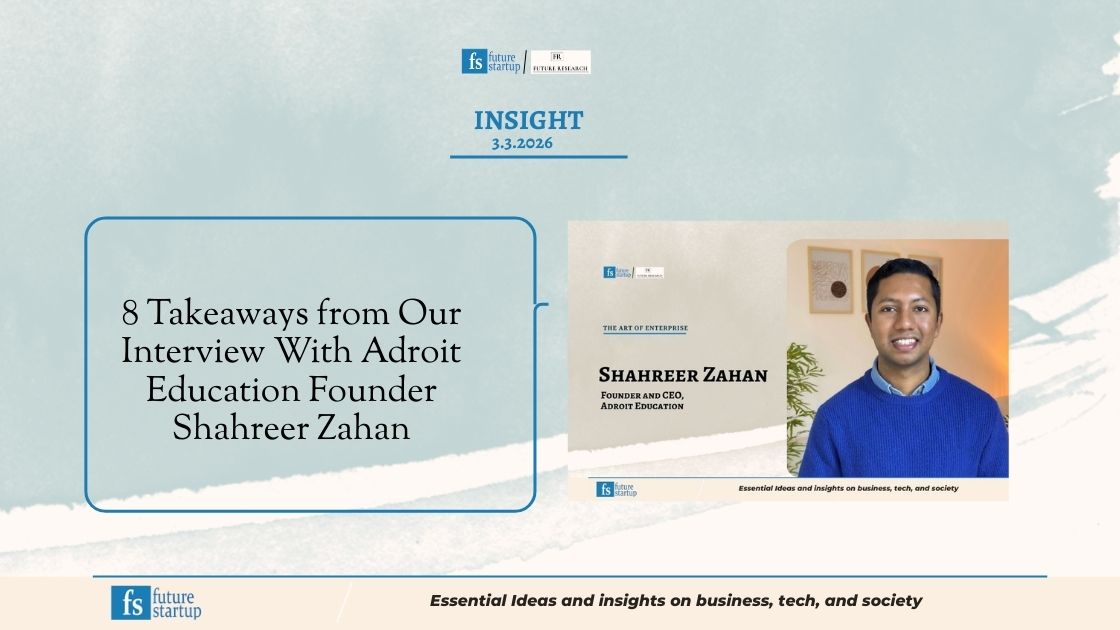
Last week, we published an in-depth interview with Shahreer Zahan, founder and CEO of Adroit Education, where we explored a counterintuitive approach to building a business: deliberately staying small, building lasting differentiation, and refusing to scale in ways that compromise quality.
Since 2017, Adroit, a Dhaka-based mentorship-driven education consultancy company that helps Bangladeshi students access top American universities, has helped students secure over $100 million in scholarships from institutions like Princeton, Stanford, MIT, and Yale, while maintaining a near-perfect success rate across eight years. The company works with only 50-60 students per cycle, selected from 500-600 applications, and has grown mostly through word-of-mouth.
In our fascinating interview, we look into the mechanics of how Adroit actually works. The four-pillar methodology, the deliberate selection that helps maintain the success rates, the cohort system that builds community, and the organizational history that compounds market power. The interview offers valuable lessons around intentional business and business model design, competitive positioning, market creation, and sustainable differentiation.
In this article, we've pulled eight takeaways from this conversation, specific insights about building service businesses that resist commoditization, creating competitive moats through depth rather than scale, maintaining quality while growing, and solving problems you've personally experienced. Enjoy!
Mr. Shahreer didn't start Adroit because he saw a market opportunity. He started because he lived the problem. His near-miss with financial aid at Rochester and NYU inspired him to research the US university admission process intensively. He spent months in libraries understanding which schools offered full aid to international students, which admission strategies worked, and how to navigate application processes. When he started helping others, he wasn't selling expertise he'd learned from books or courses. He was sharing knowledge he'd gained by necessity, refined through his own disappointment.
This creates a different kind of competitive advantage. It's not about superior skills or better marketing. It's about authenticity that can't be faked. When Mr. Shahreer talks to students and parents about navigating the admission process, he's sharing what he learned the hard way. That authenticity shows up in every interaction. Parents sense it. Students feel it.
The deepest expertise often comes from personally experiencing the problem you're solving. This doesn't mean you need to have lived every client's exact situation. But having navigated similar challenges yourself creates an understanding that external observers can't match. You know which details matter. You know which advice is theoretical versus practical. You know what actually works because you've tested it on yourself. This is partly why many experts suggest one of the best ways to find ideas to start a business is by solving a problem that you have.
Adroit receives 500-600 applications annually. It accepts 50-60 students, turning away roughly 90% of applicants. This is more of a deliberate strategic choice than a mere capacity constraint. The company sees that serving a limited number of students means it can serve them well, and at the same time, it can also pick the best students with a greater chance of success. Combinedly, it increases its overall success rates, which helps it to attract more students for the next cohort.
Most service businesses view rejection as something to minimize. They want to serve everyone, maximize revenue, and capture market share. Growth means serving more customers. Adroit inverts this logic: growth means serving the right customers better. Saying no to most applicants allows Adroit to say yes completely to those they accept.
Adroit claims near-100% success rates. This outcome is only possible because it is extremely selective about who it accepts. If it worked with students who didn't have the academic foundation or commitment level, its success rate would drop. As the success rate drops, word-of-mouth referrals decrease. The entire model depends on maintaining quality, and maintaining quality requires saying no.
This creates a competitive moat that's hard to replicate. Newer mentorship programs can copy Adroit's four-pillar methodology, hire good people, and market similar services. But they can't quickly replicate the track record. And they likely won't have the discipline to turn away paying customers to maintain quality. When you're new and revenue-hungry, saying no to 90% of applicants feels impossible. But that's exactly what creates the results that eventually drive growth.
Adroit says it spends almost zero on paid marketing. Yet it receives 500-600 applications annually and turns away most applicants. How? Word-of-mouth referrals account for 95% of its business.
It happened because the first students succeeded and told everyone. Aadib went to Rochester Institute of Technology for Electrical Engineering. Ishraque got into Colgate and is now doing his PhD in Geophysics at Princeton. Anuva chose St. Lawrence and is pursuing her PhD in Planetary Science at Arizona State with prestigious NSF and NASA fellowships. These students came from the Astronomy Olympiad community. When they succeeded, they told their friends in that community. The news spread organically.
The pattern repeated. Each cohort succeeded and referred to the next. When you solve someone's high-stakes problem exceptionally well, they tell people facing the same problem. In Adroit's case, the problem is clear and urgent, and the outcome is verifiable. Either students get, or they don't. There's no ambiguity.
This creates a virtuous cycle. Strong results generate referrals. Referrals bring more students. High selectivity maintains strong results. The cycle continues. But notice the prerequisite: you must solve the problem so well that people actively want to tell others. Merely adequate service doesn't generate word-of-mouth. You need outcomes that feel exceptional.
If you're spending heavily on customer acquisition while providing average service, you're treating symptoms instead of causes. The real problem isn't that people don't know about you; it's that people who do know about you aren't compelled to tell others. Fix the service quality first. Make the results so strong that clients naturally want to share.
One of Mr. Shahreer's recurring themes: "Adroit is not an agency. It is a mentorship program." This distinction is structural. Agencies, in most cases, optimize for transactions and volume. Mentorship optimizes for outcomes. The goal is the right placement with the right support. There's no commission structure. The value comes from helping students discover their authentic stories, develop genuine capabilities, and access opportunities that fit their actual goals and financial constraints. Success is measured not by how many students you place but by whether students end up where they genuinely should be.
This creates different operational models. Agencies can scale easily: hire more counselors, work with more universities, and process more applications. The process is standardizable because it's transactional. Mentorship can't scale the same way. It requires deep engagement with each student's unique story, sustained attention over time, and genuine investment in outcomes. You can't productize authentic mentorship.
The market confusion is understandable. Most families in Bangladesh have only experienced the agency model. When they hear "education consulting," they assume it's an agency. Explaining the difference takes time. Shahreer notes that every initial meeting with prospective students includes explaining what mentorship actually means and how it differs from what they've seen elsewhere.
But this confusion creates opportunity. Markets dominated by one business model often have unmet demand for a fundamentally different approach. Some customers will always want the transactional model; it's faster, cheaper, and more straightforward. But others want something deeper, and they'll pay premium prices for it once they understand what you're offering.
If you're entering a commoditized market, don't compete on the same dimensions as incumbents. Create a fundamentally different business model. Agencies compete on placement volume? Build a mentorship model optimized for outcomes. This requires more work to explain, but it also creates defensibility.
When newer mentorship programs emerged, some founded by Adroit's own alumni, Mr. Shahreer had to articulate what made Adroit defensible. His answer: depth. "We have eight years of institutional knowledge. We understand not just the application process, but the nuances of how different universities evaluate students, how financial aid policies have shifted over time, and which strategies work in which contexts. We have conducted extensive research on universities, tracking admission trends, aid patterns, and outcomes."
This is a competitive moat through accumulated learning. New programs can copy Adroit's structure: four pillars, small cohorts, selective admissions. They can hire talented people and create similar processes. But they can't replicate eight years of pattern recognition. They don't know which essays worked at which universities, which extracurriculars resonated with which admission committees, which financial aid strategies succeeded in which years. That knowledge compounds annually and can't be quickly duplicated.
The alumni network compounds similarly. Adroit's former students are now at Princeton doing PhDs, at Microsoft and Google as employees, at Jefferies as investment banking analysts, and founding Silicon Valley startups. Many return to mentor current students. This creates value for new students that new programs simply don't have. You can't manufacture an authentic network quickly.
The established processes matter too. Over eight years, Adroit refined how they mentor students, run workshops, provide feedback, and build cohorts. It has solved problems that new programs are just encountering: how to manage student expectations, how to balance individual attention with group dynamics, how to maintain quality as you grow, and how to handle difficult parents. New programs will eventually solve these problems, but they'll spend years doing it.
In most businesses, depth often beats scale. Yes, larger competitors can afford better marketing and more locations. But if your service depends on accumulated expertise, nuanced understanding, and authentic relationships, depth creates moats that scale struggles to overcome.
Mr. Shahreer's first lesson to other founders: "Passion for solving a problem matters more than chasing money. If you start a business just to make money, you will compromise when it becomes convenient. But if you are genuinely trying to solve a problem you have lived, the mission sustains you through difficult decisions."
This is a practical observation about what enables long-term commitment. Money as motivation works until you have enough money. Then what? If profit is the only goal, you'll optimize for short-term gains even when they damage long-term outcomes. You'll take on clients you shouldn't serve. You'll cut corners that harm quality. You'll make decisions that maximize revenue but undermine mission.
When your goal is solving a problem you care deeply about, money becomes a means rather than an end. Profit matters; you need sustainability, but it serves the mission. This creates different decision-making.
Entrepreneurship is hard. There are long periods where progress feels slow, where challenges feel insurmountable, and where quitting seems reasonable. During those periods, what keeps you going? If the answer is money, but you're not making much money yet, motivation fails. If the answer is solving a problem you genuinely care about, the work itself provides motivation.
This doesn't mean ignoring revenue. Adroit is profitable and "generates strong revenue relative to operating costs and maintains healthy profit margins." But profitability serves the mission; it allows them to continue serving students well, pay the team fairly, and reinvest in the program. The mission isn't compromised for profit.
When choosing what to build, prioritize problems you're genuinely passionate about solving. This sounds obvious, but most people chase opportunities that seem lucrative without asking whether they actually care about the problem. Caring matters more than most realize.
Most founders treat health as something to optimize around work: exercise when you have time, sleep when you can, eat when convenient. Mr. Shahreer inverts this: "Health is everything. Staying fit and healthy is the greatest blessing from the Creator, and it directly affects how you build your business. When you are physically strong, you think clearly, you handle stress better, and you approach challenges with optimism instead of anxiety."
He practices Muay Thai, runs long distances, and maintains 10,000 daily steps. During walks, he listens to founder podcasts. Physical activity creates mental clarity that desk work doesn't provide.
The connection between physical health and business performance isn't metaphorical. Physical fitness affects decision quality. When you're exhausted, stressed, or unhealthy, your judgment suffers. You make reactive decisions instead of strategic ones. You handle conflicts poorly. You miss opportunities because you lack the mental bandwidth to notice them.
The common mistake is treating health as a luxury you'll invest in "after the business succeeds." But that's backwards. Health enables the business to succeed. Without it, you're operating at diminished capacity. With it, you have energy and clarity to solve problems effectively. This pattern appears repeatedly among founders who build sustainable companies. They prioritize exercise not because they have extra time but because it's essential infrastructure for everything else. The exercise creates energy, clarity, and resilience that multiply effectiveness in all other domains.
Mr. Shahreer includes this in his list of biggest mistakes: "sacrificing health for hustle. I used to think working around the clock proved my commitment. It did not. It just led to burnout, poor decisions, and diminishing returns. You cannot build something sustainable if you are running on empty."
Mr. Shahreer's fourth lesson to founders: "You are not the center of the world. Everyone has their own priorities, their own struggles, their own version of reality. As a founder, it is easy to think everyone should care about what you are building, but they do not, and that is fine."
This connects to his second biggest mistake: "seeking validation from others. In the early days, I spent too much energy trying to convince people who did not understand what we were building. I wanted schools to partner with us, agencies to respect us, and skeptics to believe in our model. That was wasted effort."
This is a common pattern among founders. You're building something you believe in deeply. You want others to see its value. When they don't, when schools won't partner, when competitors dismiss you, when potential customers don't understand, it feels personal. You spend energy trying to convince them.
But most people genuinely don't care about your business. They have their own concerns. Schools are focused on getting students through exams, not on post-graduation outcomes. Agencies are optimizing their commission model, not evaluating mentorship alternatives. Skeptics have already made up their minds. No amount of explanation will change these realities.
The practical question becomes: where should you invest energy? Trying to convince skeptics? Or serving people who already want what you offer? Mr. Shahreer chose the latter: "Focus on your work. Serve the people who need what you offer. Do not waste energy trying to convince people who are not ready to listen. Your job is not to be understood by everyone. It is to stay focused on the problem you are solving and the people you are serving."
This creates clarity. Stop trying to convert skeptics. Stop seeking validation from people who won't give it. Stop explaining yourself to those who aren't listening. Instead, find the people who genuinely need what you're building and serve them exceptionally well. They'll tell others. The word will spread. The skeptics either come around eventually or don't matter.
Identify early who your actual audience is, the people who genuinely need what you're building. Serve them intensely. Let results speak to skeptics. Don't waste energy on validation from people who aren't ready to listen. Your job is solving the problem for people who have it, not convincing everyone the problem exists.
What stands out across these eight lessons is a coherent understanding of how businesses should operate. Not as transaction processors optimizing for volume, but as craft practices optimizing for outcomes. Not scaling through more customers, but through better results.
This approach requires different capabilities than typical business thinking. You need deep expertise from lived experience. You need discipline to say no to revenue when serving certain clients would compromise quality. You need patience to build through word-of-mouth instead of paid acquisition. You need conviction to maintain your mission when profit-maximizing choices are available. You need personal health and clarity to sustain effort over the years.
The question for anyone building a meaningful business: are you optimizing for volume or outcomes? For revenue or mission? For quick scale or sustainable quality? The typical answer is volume, revenue, and quick scale because that's what popular models reward. But Adroit demonstrates an alternative: one that might be harder initially, but creates more defensible businesses and more meaningful impact. Mr. Shahreer's closing insight captures this: the first lesson is that passion for solving a problem matters more than chasing money.
These are only a handful of the lessons from our in-depth interview with Mr. Shahreer. The interview is a fascinating read in its entirety. Read the full interview here.