
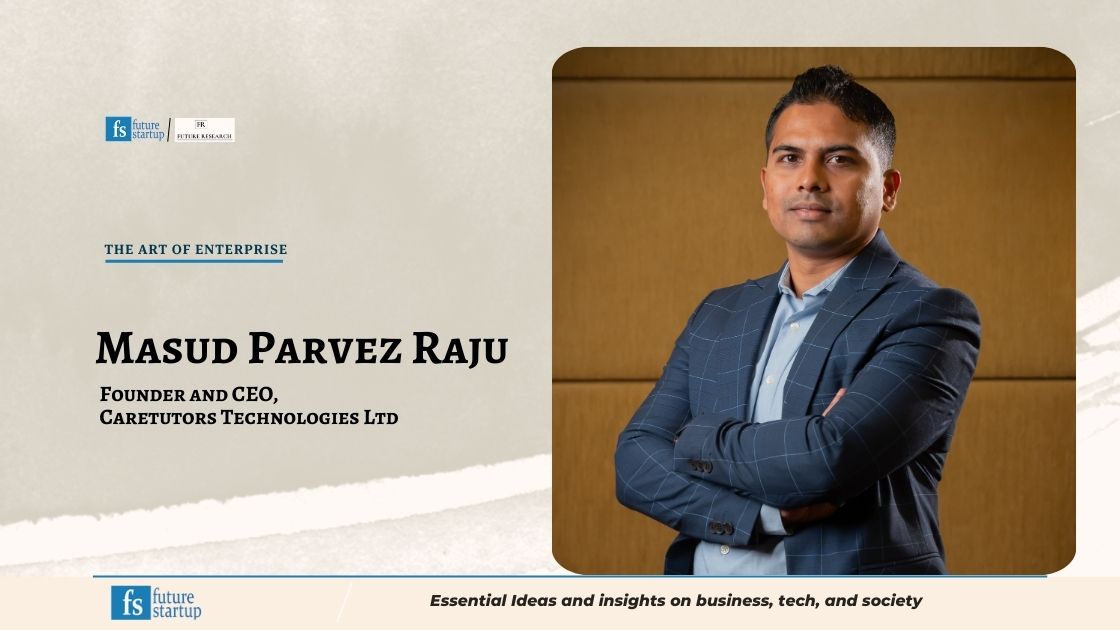
Masud Parvez Raju started Caretutors in 2012 with 18,000 Taka, a 3,000-Taka website, and a handful of leaflets slipped inside morning newspapers delivered to Gulshan. He was 22 years old, a BBA student at IUB, and working part-time at an IT firm to supplement his living expenses in Dhaka, a city he had moved to only recently from Chittagong.
The problem he was trying to solve was unglamorous but real: the private tutoring market in Bangladesh was entirely unstructured. Parents couldn't find reliable tutors. Students couldn't find tuition. The intermediaries, agents, and tuition media were opaque, often unreliable, and occasionally risky. Mr. Raju thought technology could fix this. He wasn't sure how exactly. He was just certain the problem deserved a solution.
Thirteen years later, Caretutors is one of Bangladesh's most quietly consequential startups. The platform has over 450,000 registered tutors, more than 125,000 registered students and guardians, and operations spanning Dhaka and several divisional cities, with a growing international footprint serving Bangladeshi communities across the Middle East, North America, Europe, and Asia.
The company is profitable. It has been profitable every year since recovering from COVID. It got there largely without raising much external capital. Mr. Raju raised a small investment in 2017, has taken no significant outside investment since, and built the entire operation by staying lean, training people from scratch, and refusing to spend money he didn't have.
What makes Caretutors' story particularly worth paying attention to is not the scale, though the scale is real, but the methodology. Mr. Raju's central insight is that this market runs on reputation. Guardians have to trust that the tutor showing up at their home is who Caretutors says he is. Tutors have to trust that the platform will find them real, reliable opportunities. That trust, Mr. Raju understood early, compounds slowly, through consistent execution and honest dealing, or it doesn't compound at all.
The company has also evolved in ways that reveal a maturing thesis. What started as an academic tutoring marketplace has expanded into twelve categories, Arabic language learning, music, dance, painting, gym training, coding, and more, and now encompasses four distinct service formats: home tutoring, group tutoring, online tutoring, and the recently launched Shadow Tutoring, designed for working parents who need a trusted person to spend extended hours with their child.
Caretutors is not trying to become an edtech platform in the conventional sense. It is building the other thing: a marketplace for human, in-person, personalized learning, a category Mr. Raju believes is not only durable but irreplaceable, and where he sees no meaningful competition.
In this wide-ranging conversation, our second interview with Mr. Raju, we begin with Raju's personal background, his childhood in Chittagong in a joint family, his deeply influential father, and his move to Dhaka to escape an overgrown social circle that was getting in the way of his ambitions. We talk about his two years at Grey Advertising, where he learned what a serious work culture looks like. Then we move into the Caretutors story in full: the early experiments, the patient years of 2017 to 2019 laying foundations, the COVID crash just as traction was building, and the recovery that followed.
We go deep on the business itself, how the matching process works, how Caretutors thinks about trust and verification, how the company has expanded into skills categories and international markets, and how Mr. Raju thinks about competition and the threat of AI to his core offering. We discuss the organizational structure, the culture he has built over thirteen years, the financial discipline that has allowed the company to survive and grow without external capital, and his philosophy on hiring and developing people. We also spend time on what Mr. Raju believes Caretutors can become in the next decade.
In the final section, we reflect on the lessons Mr. Raju has drawn from thirteen years of building, his reading list, his influences, and his advice for young people starting from outside Dhaka with neither connections nor capital.
For anyone building in consumer markets in Bangladesh, thinking about marketplace businesses, or simply interested in what patient, trust-driven company building looks like in practice, this conversation has a great deal to offer. Enjoy. Happy building!
Mohammad Ruhul Kader: Thank you so much for agreeing to this interview. We last spoke with you back in 2017. Caretutors is a completely different company today. In that interview, we didn’t talk much about your personal background. We’ll talk about the company in a moment. Before that, I want to talk about your personal background—your early life, education, and where you come from.
Masud Parvez Raju: Sure, Bhai. Thank you.
I was born in Chittagong—Fatikchhari, to be precise. When I was two years old, we moved to Chittagong City. I attended Nasirabad Government Boys' High School till my SSC in 2006. For my HSC, I attended Chittagong City College. In both cases, I studied Business Studies. I always felt a knack for business. From an early age, I used to follow my father, who was in business. My surroundings were full of businesspeople. So, it seemed to them—and to me—that I would do well if I pursued business.
After HSC, my family wanted me to study law and become a Barrister. I actually took admission to a university in Chittagong to study Law. After attending classes for about a month, I realized it wasn't for me, and I quit that program. My family wasn't happy about it. But they eventually let me do as I wanted. After that, I came to Dhaka and took admission at Independent University (IUB) to study BBA with a major in Marketing and a minor in Media and Communication.
I completed my BBA in December 2013 and joined as an intern at Grey Advertising Bangladesh in 2014, my first formal job. I was given a job there after the internship. Since I studied Marketing, and Media and Communication, I thought spending the first two to three years of my career in advertising would be good for my future. It was partly influenced by one of our teachers at university, one of my favorite teachers. He always encouraged us that "Those of you studying marketing should work in advertising for at least the first two or three years of your career."
Back then, you had Asiatic, Grey Advertising, Bitopi, Ogilvy—these were doing well. Among them, I’d say Grey was the best. Luckily, I got an internship and then a job there. Listening to my teacher helped. Very few people from our batch eventually went into advertising. I was one of them.
Those two years at Grey were a huge learning opportunity for me. The work pressure was extreme. But I enjoyed it. I never disliked the pressure. I never felt like, even when working as an intern, "Oh, I came to do an internship, why should I work so hard?" I felt that the harder I worked, the more pressure I took, the more I would learn. I never had it in me to stay in a "comfort zone" or work in a relaxed manner. I always felt that being too comfortable would be bad for my future. I felt that the more effort I put in during my early years, the better my future would be.
At Grey, I worked with the GSK (GlaxoSmithKline) team. Everyone knows Horlicks, right? I used to oversee the Horlicks portfolio: Junior Horlicks, Chocolate Horlicks, Women’s Horlicks, Light Horlicks—Horlicks had many variants. The regular Horlicks sold the most. Since Horlicks is such a huge brand, they had a massive marketing budget. Working at Grey was a great learning experience. I am grateful to Grey for that opportunity.
Let me give you an example of my time at Grey. At Grey, our office used to start at 10:00 AM, but my boss told me the office was at 9:30 AM. He probably meant something like I should start at 9:30 or try to reach the office around 9:30. I don’t know. But I used to go at 9:30. I never changed my timing even after learning about the timing. Often, we had to work late into the night. We had a lot of shoots. Many of these shoots took place in the evening, going on until 3 or 4 AM. But just because I worked until 4 AM didn't mean I could come in late the next morning. You had to be on time in the morning. If there was work until 4 AM, that was your responsibility.
Friday and Saturday were holidays, but I remember I went to the office on most Saturdays. Since I had this urge to learn, I went. I always welcomed any opportunity to learn and grow. I still have relationships with my bosses and colleagues from that time.
Since I started Caretutors in 2012, when I was still a student, I was running it on the side of my studies. When I started working full-time after graduation, I started to give time after work. At that time, it was a small operation.
I felt that the harder I worked, the more pressure I took, the more I would learn. I never had it in me to stay in a "comfort zone" or work in a relaxed manner. I always felt that being too comfortable would be bad for my future. I felt that the more effort I put in during my early years, the better my future would be.
Ruhul: We’ll come to the Caretutors story in a moment. Before that, I want to ask a question or two about your early life. What was your childhood like? Were your parents very strict about studies? You’ve been running Caretutors for 13-14 years now. That’s a specific way of doing things. I think some of these things come from our early lives. How have your early life experiences shaped your view of the world and work?
Raju: My mother is a housewife. My father was a businessman. He had his business in Dubai, where he lived, on and off, for 35 years. My father passed away in 2012. We didn't get to see my father very much; he would stay in the country for six months and abroad for six months. Since we are from Chittagong, Chittagong has this tradition where many families are Middle-East bound. My father went there at a young age. Although I didn't get to spend a lot of time with my father, he has been the biggest influence in my life. He was a natural leader; I think I got some of it from him.
We are three brothers and one sister. I’m the middle child. I have an elder brother and an elder sister, both married, and a younger brother, two years younger than me. Everyone is settled in Chittagong; I am the only one from the family settled in Dhaka.
You could say we were upper-middle class. We had our own house in Chittagong. I never saw any lack or poverty growing up. But my father kept us very tight. He didn’t raise us in luxury. He gave us what was necessary, but never gave us what wasn't needed. He wanted us to live within our means and achieve everything through hard work.
We have many memories with my mother since she raised us while my father was abroad. One thing about Chittagong is that most families are practicing muslims. My family was like that, too. My mother was very sincere, and my father was very strict. Hujurs (religious teachers) and Sirs (tutors) focused a lot on manners and etiquette. My father tried to ensure we grew up right.
We grew up in a joint family. My grandmother, parents, uncle, aunt—everyone lived together. In a joint family, children get to mix a lot with cousins and grandparents. There were always a lot of people in the house. So we had a very happy childhood.
My father had a lot of acceptance both in our village and where we lived in Chattogram. So, be it arbitrations, village meetings, from our village to the city is about a 1.5-hour journey, and everyone came to our house. I grew up seeing all this. My father always had connections with good people—local Chairman, MP, etc. My father wasn’t highly educated—his academic credentials were little—but he was very sharp. He commanded a lot of respect.
We, his children, received formal education, but we could never fool him. Whenever I tried to lie to my father about something, he would catch it. Let me share a story. When we were in Class 3 or 4, we used to watch TV in the evenings. One evening, we were watching TV, and suddenly, my father rang the bell. He arrived home early. We ran from the TV room to the study table! (Laughs) All of us opened different books to show that we were studying. I started doing Math. When he came in, he sensed that we had just rushed there and hadn't been studying before. He asked me, “Where are you doing that math from? When I lied that "I took it from the book," he asked me to show it in the book. He made me check the whole book, and I couldn't find that exact problem anywhere. I actually wrote the math randomly. I didn't have time to open the book and copy a problem.
He caught me. In many such matters, you know how children tell little lies to get money. Whenever I tried to tell him something, he caught it. But with my mother, since we were always with her, we could convince her… "I need 10 Taka, 20 Taka, 50 Taka." My mother was a bit easier in that regard, but my father was very strict. He never compromised on manners, prayers, decency, and education. Since he couldn't guide us academically himself, he tried to ensure we had all the resources and studied properly.
Academically, I was an average student. But I was good at sports, and I always had a circle of friends. I was good with people. You know, in a circle of friends, there’s always one boy who automatically becomes the Captain, on whom everyone relies. I was like that without me trying. My friends listened to me. I was often offered to lead. I also started to feel that when I do this, things stay organized. From that, I felt I might have some leadership qualities in me that I could use to do something good further down the line.
My first inkling of business, I think, happened in class nine. In class nine, we had a subject called Business Entrepreneurship, where we had stories of entrepreneurs such as Zahirul Islam, the first industrialist of Bangladesh. I found those stories fascinating.
Then college came. As usual, I always had a large circle of friends. In school, I had many friends because I played sports. Moreover, we were local boys, so we had a massive circle—school, college, everywhere. And in the circle, I was usually the center.
After my HSC in 2008, I had so many friends that I felt like if I continued like this, I wouldn’t make progress on my studies. When you have too many friends, you are usually spending a lot of time doing nothing productive. I felt my parents raised me in a certain way; they have certain expectations of me, but if I carry on like this, my future won't be very good. Somehow, I felt that I needed to get out of that.
I told my father that I want to go abroad for higher studies. At that time, many students from our batch were going to Australia and the UK. My father spoke to our home tutor. He said, "Ask him to study in the country for now. After his Honors, send him abroad. No need to send him now." My father respected our tutor a lot. So, he didn't permit me to go abroad. He said, "Study Law here, if you want to study Bar-at-Law abroad, I will support you."
As I told you, when I got admitted [to Law], I felt I couldn't do it. Meanwhile, I didn’t feel good about my growing circle. I convinced my father that if you don't send me abroad, send me to Dhaka. I couldn't tell him what my problem in Chittagong was. That I couldn't study if I stayed in Chittagong. Instead, I told him I wouldn't study the subject. He finally agreed. I came to Dhaka in 2009. I told you about IUB and my BBA, etc.
Ruhul: What happened after that? How did you land on the idea of Caretutors?
Raju: When I came to Dhaka, my father gave me measured expenses so that I couldn't do anything excessive. So I tried to find something part-time for some extra income. After some tries, I got a part-time job at an IT firm of some seniors from North South University and joined there in 2011. They used to sell software and develop websites. Tech was a new thing in Bangladesh, and very few people understood software or websites. However, as I was working at the company, I felt that tech would be big in Bangladesh in the future.
While I was working part-time, most of my friends did tuition. And they earned good money. In fact, some of them earned more from tuition than I did from my part-time job. So I was curious about how they got the tuition and so on. I would ask them from time to time about how they found the tuition and so on. I wasn’t exactly looking for tuition, but I was curious to learn. After some informal conversations, I came to learn about seniors and tuition media who provided tuition for a fee and sometimes for a portion of the salary. I also met people who were teaching English medium kids for higher pay, saying they also come from an English medium background, although they did not. Many students did it because they studied in an English medium [university], it paid well, and the tuition providers asked them to do it. I also met others who didn’t get a tuition despite paying money to these tuition media or agents. This back and forth gave me a good sense of the problem. I also got quite interested in it.
I started to have an inkling that there might be a technology-driven solution for it. That tuition is a big problem for both students and parents in Bangladesh, as it is difficult to find tuition for students and to find reliable tutors for parents/guardians. I investigated this for 4-5 months. As I dug deep, I realized it was a completely unstructured market. Consequently, both students seeking tuition and guardians seeking tutors suffer. Many students go to these agents or tuition media but don't get enough support. On the other hand, parents are given wrong information. Lack of proper vetting means that if an accident happened, there was no safety mechanism. When I visited Chittagong during my vacation, I saw the same problem.
I eventually felt that there was good potential here if we could offer a solution where students could find tuition and guardians could find tutors. That’s when it clicked. I thought this was a big problem, and I could solve it. I had a friend who studied at IUB with me. I shared the idea with him. He also needed money, and we agreed to work together. We put together an initial capital of 18,000 Taka, combining our savings—I gave 10,000, he gave 8,000.
We made a website for 3,000 Taka, where we could put the names of tutors and their university information. We knew a senior brother who worked in tech. He made it for us. If you do it seriously, 3,000 taka doesn't get you a website. He bought the domain for 1,000, hosting for 1,000, and took 1,000 as his remuneration. Just a brotherly gesture, "Okay, I'll do this for you." It was a basic website, but it did the job.
We chose the domain: Caretutors.com on day one. We spent a bit of time brainstorming the name. A friend at IUB who studied marketing suggested the name, and we liked it. He reasoned that since it’s about tutors, and there is an element of 'Care', Caretutors would be a good name.
Once we had the website, we had to figure out how to reach out to people. After much thought, we decided to make some leaflets and distribute them. Our university campus was in Bashundhara, where we knew hawkers who delivered newspapers in the morning. I contacted one of them and told him that I would give you these 500 leaflets, insert them inside the newspapers, and deliver them to Gulshan, where he used to deliver newspapers. We paid him about 150 or 200 Taka. Once he delivered them, calls started coming in immediately! Two guardians called. "I received a leaflet like this. Do you have tutors?"
While we took the requests, we didn't have tutors! We had leaflets, we had a website, but we had no tutors. But as soon as we started getting requests, we got to work. For the first six or seven months, we onboarded our juniors from the university as tutors. But we maintained a certain quality standard. We could understand who would tutor well and send tutors accordingly. We did it with our juniors at the university because if we gave it to someone else, say XYZ, whom we don't know, they might not pay our commission. We did this for the first 7-8 months with people we knew. However, we realized that if we wanted to scale, we had to expand our tutor pool and go outside of our current circle.
Then slowly, we started recruiting outside tutors. We distributed leaflets in different schools, created a Facebook page, and promoted it in different university groups. That’s how tutors started joining our platform. Slowly, tutor requests started coming in. However, the whole thing was still done manually in Excel files, from maintaining details of the tutors to matching tutors. The scale was very small. Two to three jobs a month. Sometimes five came, then ten. Caretutors was growing slowly, and amid that, our university life ended. I told you, in 2014, I joined Grey.
During these days, pretty much everyone at our university knew we were doing something like this. Many wanted to join us, but we wanted to be selective. Around this time, a university friend, who worked at a local consumer tech company, showed interest in joining us. He shared his thoughts about our website and explained how we should do it to make it work. He eventually joined us in 2014. We became a founding team of three people. He also invested some money and brought his experience. We used that money to rent a small office space at Gulshan Link Road—Baishakhi Sarani. In fact, our new partner lived in the same place, and he gave us a room which we used as an office.
My office at the time was at Gulshan-1. Every day, after work, I went to the Caretutors office between 7 and 8:30 PM and worked til 11:00 or 12:00 am at night. After two years of working like this, the system started to take shape.
In the meantime, we came across a software firm called Oployeelabs Ltd and approached them for building a new system for our platform. And we started working together. We would go to their office on Fridays and Saturdays, sit with them, tell the software engineers, "Do this, do that." That’s when we started understanding how technology works. Abdul Matin Emon, who is now the CEO of Praava Health, was the CEO of that company. Meeting Emon bhai was a turning point for Caretutors. He had vast knowledge about tech and business, and he helped us to get a better understanding of different aspects of our business. He could see our dedication, and he started to mentor us and share his experience with us. He did it sincerely without any interest. Since we were a client of his company, he tried to help us as much as he could. This was the beginning of 2015, and by mid 2025, we had a well-made product. Traffic started coming to our website. We moved from manual to a tech-enabled system.
Around mid-2015, we met LightCastle Partners. Around this time, they invited us to a program organized for new entrepreneurs, and I attended that event. We had a good acquaintance with Ivdad Bhai, the managing director of LCP at that time. After the program, I spoke to him about our business. He told me, "You have your feet in two boats. You are doing a job here and doing business there. Neither will work. If you continue this way, you are in danger. You have to compromise on one. Either do the job or do the business."
After that conversation, I started thinking about it seriously. Caretutors was slowly taking shape. I discussed the idea of going full-time with my team. That we should consider leaving our jobs and focus fully on the business. If we continue like this, we won't be able to get far. We were around 25 years old at that time. I reasoned that if we didn't take risks at that age, it would limit our ability to take risks a few years later. We would grow older. More responsibilities would be added. Taking risks would become costlier.
However, my two partners were unsure. They wanted to work on the side. I thought about it. Since I came up with the idea and was more passionate about it, I realized that I have to make the sacrifice first. I told them that I would leave the job, start working full-time, and I would draw a minimum salary from Caretutors to cover my expenses. They agreed. So I left the job and started working full-time on Caretutors in November 2015. In December, we shifted our office from Gudaraghat to Baridhara DoHS. I started working there from 10 am to 10 pm. Initially, I worked mostly alone, and then I hired a friend who started working part-time. Within 2-3 months, the response started to grow without us investing much in marketing. Our customers were coming back and referring us to others.
As the business started to see some growth, the most tragic time of my entrepreneurial life arrived. My two partners, who had been with me from the early days, one I started with, the other joined two years later, told me they want to quit. They told me, " We have other plans, you go ahead. This was a huge blow to my morale. I left my job just three months ago. We decided it together. I had no idea what would happen if they left the company. We ran the company together for more than three years. Although I was the only one working full-time at the time, all three of us were involved in operations. I looked after the operations, and my two partners looked after the technology and design, two functions I had no idea about. Moreover, I didn't know how to work alone. I didn't have the confidence to work alone. I was young. I was comfortable working with the team. The sky fell on my head.
It was the most difficult period of my journey. Since they decided to leave, I bought back their shares. I borrowed some money from a friend who started working with me around that time and paid back the money to my two partners as they left the company. One of my partners left in mid 2016, and another later in 2016.
Throughout this time, I was in touch with Emon bhai. He guided me during this period. He encouraged me and gave me courage. The following 7-8 months were extremely difficult. But I persisted. I started learning the skills I didn't have, recruiting people one by one. Gradually, I came to realize that I could manage it myself. I learned the basics of tech so that I could navigate the tech-related challenges. It took me 5-6 months to regain my confidence.
By 2017, I managed to grow the team to four to five people. In the meantime, since I had a relationship with Emon Bhai, he invested in Caretutors along with a friend of mine who is also a successful entrepreneur. We were a small team, and this solved my financial problem.
With the new capital, I tried to organize Caretutors. We were a lean operation with monthly operating expenses of around 70-80 thousand Taka. We had (continue to have) a frugal culture at Caretutors. We never indulged in luxury. We did what was necessary. We didn't buy posh office furniture or hire expensive resources. I kept the expenses very low. We recruited freshers, trained them, and turned them into good resources. Those who joined me in 2017-18 are still with Caretutors. And they currently hold good positions at Caretutors.
So, in 2017-18, I worked hard to build the team. I told you, somehow I feel I can influence people. I tried to instill confidence in my team members that we could make it. Over time, that trust was built. Alhamdulillah, we have an excellent retention rate. We have people who have been working at Caretutors for a long time. They understand the business and are taking Caretutors forward quite well.
Overall, I spent 2017-18 organizing the company. We were operating at break-even. In 2019, we tried a bit harder to operate better. And then we started getting a very good response at the beginning of 2020. We spent 2017, 18, 19—three years—building the foundation, developing the market, organizing the team. In 2020, that work started paying off. We grew to a 30-person team within a short time.
However, that momentum did not last. I was in for another bad time—COVID happened. It was a disaster. I worked so hard for so many years... just when I started getting a response, COVID hit. I felt like Caretutors was on the runway all these years, just started to take off, and immediately the plane crashed.
However, I knew the feeling. I had previous experience of losing everything and getting it back. I felt, "I lost it again, I can recover this again." I knew that if I held on, I could recover.
We moved to remote work, downsized the team, and prepared a survival plan. I spoke to every team member. Those I couldn't pay, I asked them to look for jobs elsewhere. But I made sure all these happened cordially and with mutual understanding. Since I had a good relationship with my team, I told them, "I can't do it any other way. Give me two or three months. When the situation becomes normal again, I will bring you back." They had limited other options. So they held on. Those who were in trouble, we tried to support as best as we could. I received a tremendous amount of support from my team and everyone around me at the time. My office landlord paused the rent for six months. He said, " You don't need to pay now, pay later. My team, my office landlord, and everyone stood up in such a way that Caretutors survived. We tried hard to make sure we survived. Those who were taking salaries took a minimum salary. I told my team, "Keep Caretutors alive. When the situation returns to normalcy, we’ll have a good time again, insha’Allah. Then, probably two or three months later, the lockdown opened up, and we started to receive some responses again.
We were around 25 years old at that time. I reasoned that if we didn't take risks at that age, it would limit our ability to take risks a few years later. We would grow older. More responsibilities would be added. Taking risks would become costlier.
Ruhul: That was an intense journey. You started Caretutors when you were still a student. At what point did you feel like this could become the thing that I could do as a business? When did that thought cross your mind?
Raju: It never crossed my mind that I would become a multi-millionaire by doing this. Throughout my entrepreneurship journey, money never seemed that important to me. What always seemed important was how much impact and positive change I could create.
As I told you, it felt like there was a problem, so I tried to solve it. From this urge to solve the problem to starting Caretutors, how it happened, I actually didn't realize. I think this is true for many others who embarked on an entrepreneurship journey. You are passionate about something. You keep trying different things and eventually end up on a trajectory before you know it.
I was just into it. Within this process, Caretutors' business scenario changed, the user base grew, clients increased, the team got bigger, and the business got bigger. I am still inside that challenge. I have to solve this problem. I have to create a positive impact. I have to change the lives of many people.
Ruhul: This was and still is a new market. When you started, nobody was really trying to do anything like Caretutors. Even now, I don't see anyone trying it at your scale or your thesis. The way you are thinking about learning and tutors—a tutor-based learning platform, where a tutor teaches you across all subjects, which I think is a superior form of learning, I feel this is unique. To get to this place, you went through many challenges. What were some of the hardest parts of this journey?
Raju: To me, as I told you, the toughest moment of my entrepreneurship life was in 2016. I had quit my job, but my founding team, whom I depended on heavily, suddenly disappeared. Everything was there, but suddenly I felt like everything was gone.
At that time, I questioned myself, "Am I actually... for this journey... Am I the right person?" It was a terribly tough period.
I had to negotiate with myself and convince myself that let's try one day at a time. Day by day, time passed, and it became clear to me: "this is my journey. Maybe I came into this world for this journey." It took roughly a year and a lot of patience and courage to get to this answer from that struggle period. But I allowed myself time, thinking, "Let me try and see." I wasn't worrying too much. I thought, "Okay, let this month pass. Okay, let two months pass. Okay, let six months pass." The more I moved forward, the clearer the picture became to me. "Okay, this is my thing. I can try." I regained that confidence in myself.
I’ve learned from life that when you can't find the answer to a particular problem, you should just learn to live with the question.
Ruhul: Regarding those difficult days, two questions. What were some things you did that helped you stay positive? Another is, in the business, what decisions did you make to get to a stable condition? Like, "I will focus on these four things for the next year or this period so the business reaches a certain stability"?
Raju: I have always felt that I can be patient. This is one of the things I learned about myself. I am very persistent and can be very patient. I think these two things saved me. I had a job, I quit the job, and I had a team with co-founders. Suddenly, I had none of those things.
I had other personal struggles, too. In 2016, when the founding team broke up, my grandmother, whom I was close to, passed away. It was a challenging period. One was my entrepreneurship journey, another was my personal life.
However, you know how they say, "When you have no one, you have Allah"? That’s what I felt. I sought Allah's help, kept faith in Him, and tried my best. I thought, let the time pass. Allah surely has kept something good for me. After holding onto patience, slowly, slowly, the pictures became clear to me.
I talked to those in my surroundings as much as needed. But I actually know myself well. I mostly held onto patience at that time.
I’ve learned from my life that when you can't find the answer to a particular problem, you should just learn to live with the question. Let the time pass. When the time passes, the answer to the question will automatically come to you.
For example, you are taking an exam on a subject. You can't answer a question. You shouldn't really waste time trying to come up with an answer at that time. You can't force it. You will only lose time. You move to the next question. When you keep solving these problems, you will see that the solution for the one you couldn't do appears on its own. I applied this throughout my life. The question I couldn't find an answer to, I just left it. I didn't try to find the answer. I thought I'd be patient, keep faith in Allah, and let the time pass. I'll look for answers to the other questions. Then I saw, when time passed slowly, the answer came to me. Whether it was "Is this for me?" or "Is this not for me?" So, that's the thing.
The biggest thing, I would say, is patience. Being able to be patient helped me a lot to cross that phase. You mentioned 14 years, 14 years is okay, but I still have the same mindset I had in 2012. I have that same patience. I put in that level of effort. I haven't entered a comfort zone yet.
Ruhul: Tell us about your approach to working in those days. You had a small team, and you were doing everything mostly alone. Tell us how you worked and how you maintained your motivation. Patience, of course, but still, there are ups and downs. Entrepreneurship is like constant ups and downs. In the morning, you feel that everything is going great, and by the afternoon or evening, you feel that nothing will happen. How did you deal with that?
Raju: I was actually doing it almost all alone. When you are alone in the office, you do everything—you are the peon of the office, you clean the office, make tea, get snacks when a guest comes, and also do all the operational work. From managing the Facebook page to everything... I actually did it all single-handedly.
We didn't have an in-house tech team. We worked with external software firms until 2018. So I had to also deal with challenges related to tech development. I hired my first software engineer in 2018.
During the challenging times, I derived inspiration from other founders. In 2012-13, when I started my journey, Steve Jobs' story inspired me a lot. I found his famous speech at Stanford very inspiring. How a man can change everything... what level his patience was.
Alibaba's Jack Ma inspired me a lot. Because he is a non-tech person. A school teacher. Walking and acting as a tour guide for people... showing them different places. From that, he developed his English skills. He couldn't get a job. Being a non-tech person... his way of speaking, his thinking... inspired me a lot. There were many similar inspirations during my early days that inspired me. I tried to learn from how big entrepreneurs overcame their challenges.
Every one of us goes through a certain trajectory. You had a childhood, you had a teenage phase, you had youth, and you will have old age. The same applies to Jack Ma, Steve Jobs, Mahatma Gandhi, Nelson Mandela, and son. What you did in your childhood, Nelson Mandela might have done the same things. I tried and still try to study, understand, and learn from their stories. These stories helped me a lot.
Ruhul: One final question from that period. There was an established mechanism for finding tuition—as you said, going to a teacher or seniors, there were tuition media where you could pay a fee, and they found you a tuition. For guardians, this existing approach was more predictable. Guardians would tell an existing tutor, or someone they knew, "Get me a tutor," and they would provide one. When Caretutors launched, you were doing an online thing... which was new. Initially, how did you convince the guardians? Say the first 100 guardians, what was the messaging?
Raju: Out of the first 10 requests for tutors posted on our system, I guess 7 got cancelled. We somehow convinced 3 people and served them.
We have always tried to serve our customers the best, giving them such an experience through customer service, through good tutor selection, and by motivating the tutor so they deliver a good service… so that our existing clients refer us to others.
We had to work to gain the trust of our people. It was a challenge. Even now, there is a massive trust issue. In Dhaka, out of the requests we get, a specific portion we can't serve. Trust is also a challenge outside Dhaka.
Our strategy has been that once someone enters our system, we give them such an experience that they recommend Caretutors to their community. 20% of our total sales come from Friends and Family. Our existing clients are marketing us. The client who comes once is a repeat client. He is taking repeated service.
Since the business is already 14 years old, those who were connected with Caretutors as tutors or students between 2013 and 2015 are now guardians in many instances. Since they had a good experience, they are now taking our service.
I always thought that those who are tutors today will one day convert into customers. This circle will keep rotating. Before, maybe a brother hired a tutor for his sister; now that same brother is taking a tutor for his child.
The same goes for our tutors. We work extra hard to make sure we serve them well, and they are satisfied with our service. As a result, they recommend Caretutors to their community.
We have always tried to serve our existing users in a manner that they help us in our marketing. I would say we have succeeded at that. We have slowly achieved the trust of both groups of our users. It didn’t happen overnight. Since we could never spend excessively on promotion, it took a lot of hard work, and we still have a long road to go. But we always thought, "we got 10 clients, let's make 15 clients out of them. We got 25, let's make 40." Slowly, phase by phase, Caretutors' business came to this scale.
Ruhul: You worked hard from 2017 to 2019 and built a foundation. You started getting good traction towards the start of 2020. And then COVID happened. What happened after that?
Raju: As I was saying, my biggest challenge was sustaining my team. I tried to talk to every team member individually. I would try to have at least one conversation with my team every week. They didn't have many options to go elsewhere because it was COVID time. Opportunities were limited. My main thought was that if Caretutors survives, my employees would survive. I explained this to my team: help the company survive. If the company survives, we will survive. I tried to negotiate new salaries with some of them. For instance, I would ask a teammate who was working full-time to turn part-time for now and take a salary cut.
In this way, I tried to retain them. Most of them accepted that. As I said, I have always tried to gain the trust of my people. I feel that my team is my main strength. They are the ones taking Caretutors forward. If they somehow get demotivated, it will be difficult for me to run Caretutors. At that time, my team played a critical role in the survival of the company.
When COVID came, we were a team of 30 people. 3-4 months into COVID, out of those 30 members, almost 15 were gone. Some of them needed jobs, and many left Dhaka. I had to let some go because I couldn't pay salaries. We had to bring down the team. The team I built in 4 years was suddenly gone. When things slowly became normal, lockdown ended, and I tried to find a way to rebuild.
We survived 2020 like this. The situation started to normalize in 2021. 2020-21, we basically survived. In 2022, our business started becoming normal again, and we started getting some traction.
And we went into profit again in 2022, the profit we were supposed to make in 2020, which didn’t happen because of COVID. It was a survival struggle. After 2021, we have been profitable every year. I wouldn't say we make a lot of profit. We started modestly, and that profit has been increasing every year.
My investors trusted and supported me throughout this time. They acknowledge our efforts. I am always grateful to my team and my investors. I think without that trust, my journey would have been very difficult. And I have tried to honor their trust.
I feel that in business, reputation is the most important capital. If I lose trust once, this journey will be difficult for me. Maybe today I am leading Caretutors, next year or two years later, I might work on another startup. If people don’t trust me, I won't be able to build anything new. I have always felt that achieving people's confidence is very important for an entrepreneur. If people trust me, people will help me in whatever initiative I take.
Ruhul: True. I think trust and reputation are the ultimate capital for an entrepreneur.
Raju: And you have to achieve it over time. It can't be achieved in one or two years. What happens with many people, I've seen, is that they want to rise quickly using shortcuts. I have never taken shortcuts. There were times in my journey when I had employees who received higher pay than I did. I could have taken a higher salary, but it wouldn’t have served the long-term future of the company. I’ve always put the company first and our team first.
I had to make these sacrifices in my life. I never complain about this. I think this is my life. I have chosen this life myself. I can’t complain. I need to be honest with myself. If I am honest, I will get the result today or tomorrow.
I would say our original thesis still holds. We wanted to connect tutors and students more reliably and predictably. Our focus remains the same. It is only that we are now doing it for skills beyond academics. We are gradually addressing the entire spectrum of learning. If you want to learn a skill or study a subject from a tutor instead of doing it through online learning, be it academic or beyond, we have you covered.
Ruhul: Caretutors started in 2012. In the early days, it operated more like an online directory. Caretutors has evolved into a completely different company over the years. Not only has the platform changed, but you have expanded in several ways. Today, you offer four different types of tutoring services. You have also expanded beyond academics to matching tutors for various skills. You have your own mobile app. You have expanded geographically.
Raju: We are offering tutors in 12 categories—academic and several important skills.
Ruhul: Tell us about the major evolutions in the product and the reasoning behind all these expansions.
Raju: As you said, the directory type thing was basically from 2012 to 2014. In 2014, we first launched a functional website with basic features where you could create a profile, post a job, and apply. That new version also allowed us to see things on the backend and maintain back-office functions.
Ruhul: You were offering just one type of tuition category-wise—academic tuition.
Raju: Until 2016, we focused only on academic tutoring. Within academics, we covered the English version, the Bangla version, and the English medium. Partly because until then, we didn't feel that there was a market demand for others.
In around 2017, we started getting some requests for some skills-based tutors, such as language learning. Our users would ask whether you have Arabic tutors? Whenever we received consistent requests for tutors for a category, we took it as a market signal for an existing demand, and we worked on it. One thing led to another. After Arabic, we started getting requests for tutors for skills like painting, drawing, dance, music, gym trainer, and so on. This is how our categories have grown one by one to 12.
When we realized mobile usage was increasing, we launched our Android app in 2018. As mobile users grew, we launched iOS in early 2020. In 2022, we had four versions of our platform—One for iOS, one for Android, one desktop version, and another mobile version (web).
We had a small three-person engineering team. Maintaining four different platforms was not easy. I also felt that we had too many technology platforms. It was becoming difficult to maintain. Our back office operation was and is huge. After a while, we identified that we no longer needed the mobile web. It was redundant but needed maintenance. We shut that down. We are now focused on Desktop, Android, and iOS apps. Our desktop version has an excellent mobile version.
Before, we had our mobile app and a dedicated mobile web— m.caretutors.com, despite having a desktop version that was mobile-friendly. That was a wrong decision both from a usage point of view and a maintenance point of view. Maintaining three different platforms itself is not easy; four should, of course, be difficult. Moreover, the user journey actually doesn’t mandate a middle mobile web when you have a mobile version of the desktop and separate mobile apps. This was a wrong decision on our part. We felt we were doing more work, but ultimately, the user goes to the app. And we added unnecessary work for our team.
Ruhul: Similarly, you launched several categories of tutoring: Shadow, Online, Group, and package tutoring. Tell us more about these different types of tutoring and how they work.
Raju: Academic home tutoring was there from the beginning, one-to-one. At one point, we started getting requests for group home tutoring—three or four friends in Class 9 or HSC want to study together. We thought this was interesting. We can offer Group Tutoring. If you study Physics alone for 3 days a week, you might have to pay 8,000 to 10,000 Taka to a tutor. It can be costly for one student. If you study in a group, you can split that amount among three or four of you. The tutor is getting the same amount, and for the students, it’s more affordable. That's how our Group Tutoring came into being.
Group Tutoring is usually taken by SSC, Class 9-10, HSC, and University students.
We launched online tutoring during COVID. Since lockdown more or less stopped our home tutoring service and we were seeing a rise in online education, we launched online tutoring. The traction was quite immediate. We also started seeing quite interesting trends emerging out of this. Our tutors from Dhaka started teaching students in Chittagong. We now have Bangladeshi tutors teaching students in the USA. Requests are coming from Canada and Saudi Arabia, and many other places where there are Bangladeshi communities who want to teach their kids Bangla, Arabic, etc. We’re seeing a bit of demand for online tutoring.
Package Tutoring is also a result of our users asking for new options. Let me explain it in this way. For instance, you’re an HSC candidate or a university admission candidate. You want to study for maybe three to four months and complete a certain syllabus. The tutor will help you finish your syllabus in a package within 3-4 months. We call this Package Tutoring. The platform charge for package tutoring decreases because the tutor won't teach for a long time. Since he will be teaching for a short period, he pays us half of the regular platform charge.
We launched Shadow Tutoring last year. We have been seeing that there are guardians who are very busy and can't give time to the children. For example, Home Tutoring finishes within one and a half to two hours. In Shadow Tutoring, the tutor stays with the student for a longer period of time. We thought this was a growing challenge for a growing number of people where both parents work. Shadow tutors spend longer hours based on your needs. Shadow tutors play with the child, take him/her to school, and then teach the child at home. The payment is also higher. We thought this was a good solution for parents and young graduates. Parents can find someone who can take care of their children, and these young people find a job that earns them a decent income.
Ruhul: Very interesting. You have also expanded internationally. What are some markets where you have a presence now?
Raju: We are getting good responses from several countries where there are sizable Bangladeshi communities. Especially from the Middle East—Saudi Arabia, UAE, Qatar, Oman as well as from the USA, UK, Canada, Japan, Malaysia, etc.
Our target is Bangladeshi communities living across the world who are using our service mostly for language learning—Bangla and Arabic.
Ruhul: This is understandable and interesting. This can become a significant market for you over time. How does your online tutoring work? Does the delivery happen through your platform?
Raju: We don't offer the platform. Tutors do it using their own tools/platforms. Our system works as a platform where we connect both parties.
We, in fact, contemplated this once whether we should build a tool ourselves. However, there are so many online meeting/class tools available since COVID, we felt that the expense of doing so has no meaning. Those who are teaching do so via Zoom and Google Meet. Currently, Google Meet is very popular.
Similarly, we don’t handle the payment either. The guardians pay the tutor directly. It's a contract between the student and tutor. We thought about this, but eventually decided not to get into it. It would take significant investment and is quite a different business.
Ruhul: I would like to push a little bit. Suppose you don't build a tool yourself. Instead, you integrate existing video conferencing tools and allow both the tutors and students to do the tutoring on your platform. Maybe offering batches online. Do you think that would have made sense product-wise?
Raju: That might happen later. We are experimenting with a few ideas. In fact, we did a pilot of something similar around 2020-21. We didn't get a very good response. We felt that we were good at what we are doing. If we expand into an online learning platform, it adds meaningful complexities to our operation.
We believe learning from a tutor in person or in a small group is one of the best forms of learning. This is not something that we’re claiming; this is something that has been proven by hard evidence. To that end, our thesis today is that we are a platform that connects learners/students/guardians with teachers/tutors to learn skills/subjects, be it academic or non-academic, where in-person tutoring is a superior method of learning than other alternatives.
Ruhul: That makes sense. Now your product is much, much richer than when you started. At the same time, your thesis has evolved significantly. Your initial thesis for the company—the problem you were trying to solve—was connecting tutors and students, mostly academic. That has broadened now. Now it covers quite a bit of the learning spectrum. If you articulate your founding thesis today, 2012, versus today's operating thesis in 2026, how would you describe Caretutors?
Raju: In 2012, when we started, our main focus was on academic tutoring—connecting students/parents and tutors. We saw there was a challenge in the space. Parents struggled to find qualified tutors reliably. Students struggled to find tuition, which is one of the main sources of income for a large segment of the student community in Bangladesh. We saw that tutoring is widespread in the academic scene in Bangladesh. I would say we have done a good job in that space, building a platform where parents/students and tutors can find each other.
However, as our platform grew over the years, we started to see requests for tutors for all kinds of learning needs beyond academics. We started receiving requests for tutors for language learning, then tutors for music, dance, exercise, and so on. As we started catering to some of these needs, it has dramatically expanded our scope as well as the thesis.
I would say our original thesis still holds. We wanted to connect tutors and students more reliably and predictably. Our focus remains the same. It is only that we are now doing it for skills beyond academics. We are gradually addressing the entire spectrum of learning. If you want to learn a skill or study a subject from a tutor instead of doing it through online learning, be it academic or beyond, we have you covered.
The idea is that learning is everything. There is no end to learning. We learn every day from birth till death. And it can be any subject—academic, non-academic, everything.
We believe learning from a tutor in person or in a small group is one of the best forms of learning. This is not something that we’re claiming; this is something that has been proven by hard evidence. To that end, our thesis today is that we are a platform that connects learners/students/guardians with teachers/tutors to learn skills/subjects, be it academic or non-academic, where in-person tutoring is a superior method of learning than other alternatives.
The other part of our thesis is the students/tutors. There is a large student community—college and university-going young people, who don’t have a lot of opportunities to work and earn while studying, which is common in many other parts of the world. Even after graduation, unemployment is a major problem in Bangladesh. In fact, in many instances, the unemployment rate is higher among educated youth groups.
Tuition has been a means of earning for students as well as for recent graduates in Bangladesh for a long time. However, the market was largely unstructured and informal. We thought that if we could build a platform, we could create opportunities and make this profession a reliable one for many people.
Now it has expanded. We can also create opportunities for many other skilled tutors across skills and subjects, such as music, dance, and so on. So you can mix that up with our original thesis.
I would say our thesis remains the same; it has just expanded in scope and opportunity. At the same time, in the initial days, we were only serving a few pockets in Dhaka—Gulshan, Banani, and so on. And we have now expanded to several divisional cities and internationally.
Ruhul: When did you start expanding from an academic tutoring platform to include other skills like music, language, cooking, etc?
Raju: I think we first expanded beyond academics in 2018. That year, we started getting requests for tutors for different skills. We used to get different types of requests. For example, a guardian would reach out with a request for a coding tutor. When such a request came, we said yes because we knew many software engineers who would love to teach coding, and so we connected them. Then someone reached out with a request for a gym trainer—I want to work out at home, can you help? We thought, why not?
That’s how our new categories came into being. We feel that we can do it for every skill.
Ruhul: What are some of the most popular categories today?
Raju: Academics 100%. Outside academics, the most popular is Arabic language tutoring, and then skills like painting and drawing, handwriting, music, dance, etc.
We try to hire people with an appetite for learning and personal growth, train them, give them opportunities to learn and grow, and we have seen that they eventually generate the best output.
Ruhul: How have your communications changed as you expand beyond academics? Before, it was much simpler. If you need a tutor for Math, you go to Caretutors and hire one. Now it's like, anybody who needs, say, I want a gym trainer, I can also go to Caretutors. Does that make your communication work more challenging?
Raju: Platform-wise, our system hasn’t changed much. We have added some additional technical changes to improve security for both parties. Apart from that, our platform remains the same. We have just added several new categories.
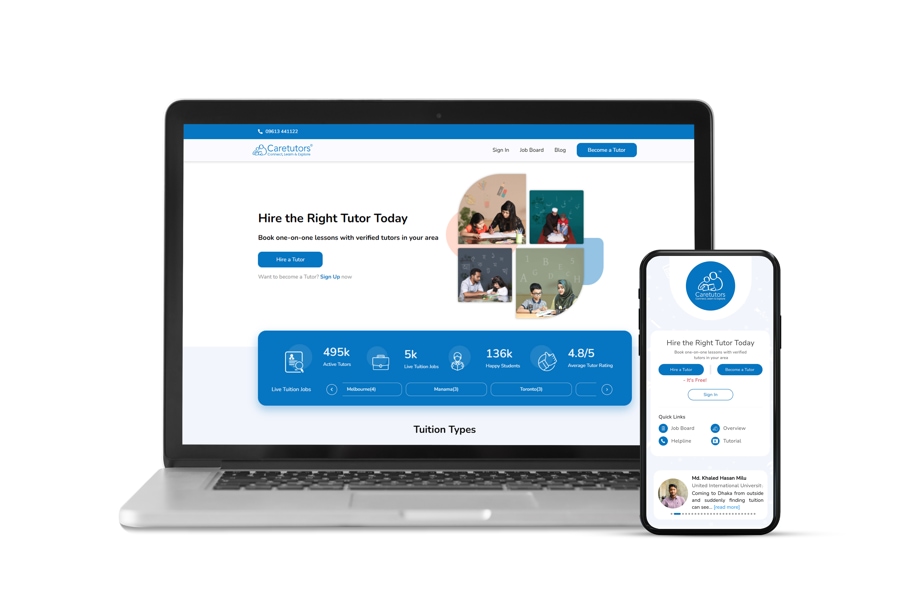
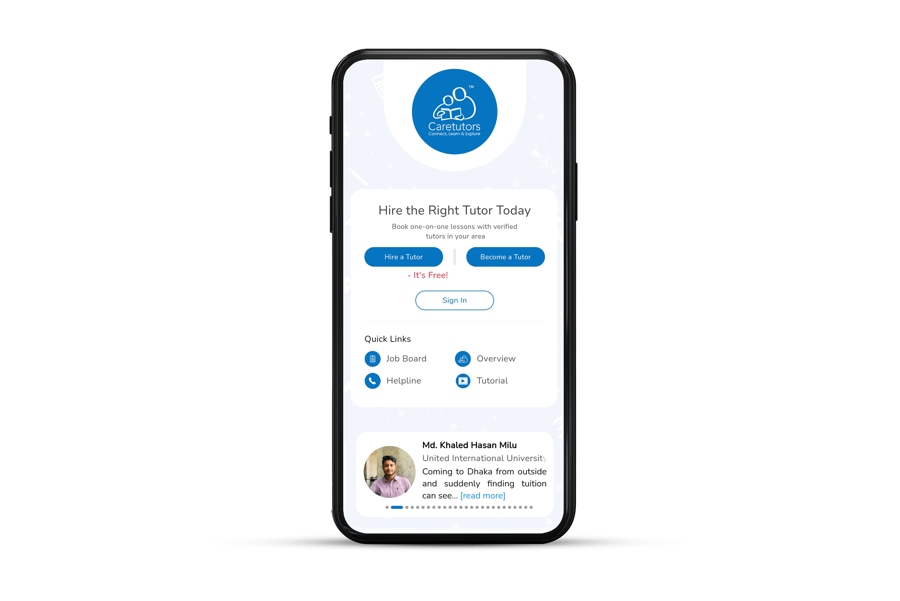
For example, you posted a job in our system for a music tutor. We will make it live on our job board. Relevant tutors on our platform and beyond (if needed) will get a notification that a job post for music has appeared; interested tutors can apply. When tutors apply, you can see and review the applications from your account. You can select one or two people, work on a trial basis, and finally hire one.
We have developed a digital identity that helps you to verify the tutor and then confirm. This means both parties understand the right match for a job.
Ruhul: Does a notification go out to registered tutors when a job is posted?
Raju: If a new job is posted, a notification goes out to relevant tutors in nearby locations. You live in Mohammadpur. You sent a request for a job in Mohammadpur. When the job goes live, tutors from your nearby location will receive a notification from our system immediately. Interested ones can apply.
Guardians can see who is applying and select a tutor based on their preference for a trial class from their app. Then, if the tutor comes for the trial, teaches well, you can hire the tutor. If the tutor doesn't teach well, you can go for another tutor. Sometimes you may receive 70-200 applications for a job. So you have options.
Ruhul: You have about 4.5 Lakh registered tutors on your platform. It is a significant scale. How do you ensure quality? Then there are questions of safety, profiling, verification, etc. You briefly touched on these, but if you want to shed some more light on these.
Raju: This number is increasing every day. For home tutoring, we allow registration only from the cities where we have a presence. Now, if you want to do Online Tutoring, then you create a profile from Rangamati. There is no restriction for that. If you chose Online Tutoring when creating a profile, it wouldn't ask for your location.
Regarding safety and security, we have established a process for verification. We have both automated verification systems in place, where our platform verifies basic information of a candidate, and manual verification, where we check details of a candidate individually.
For some new candidates, we run a verification before placing them on a job. For those who have done one or two jobs, this is usually not needed. During the verification process, we try to see whether the information the tutor provided is accurate. Manually verifying 4 lakh tutors' data at once is not possible. So for some of our tutors, we do the extended verification beyond the initial verification when a guardian hires him/her, and then we take them through the verification process and then send them to the guardian.
During this verification process, we check his home address, his academic information, and all his information. We have a specialized team of six people who work only on verification.
Ruhul: How does your international service work? Is the product different for these international services or the same platform?
Raju: Same platform. You can post from Chittagong, you can post from outside the country the same way. The same is true for applying for a job. For in-person tutoring, you have to be in the same city or a nearby location.
Ruhul: Let's talk about the business model and the market. How big is the private tutoring market in Bangladesh? In terms of the number of students, tutors, and monetary size? And if you think about Caretutors' position today, what percentage of the market do you own?
Raju: I don't think Caretutors serves even 1% of the total market. This is a huge market. It is hard to talk in numbers because data is hard to get. One proxy to understand the size of the opportunity can be to look at the number of our active students per year. For 2025, the total number of active students in Bangladesh across all levels of education is estimated to be approximately 38 to 40 million. That is a huge number.
You add skills-based tutoring needs across 12 of our skills-based categories. Together, it is a huge market, and we think the market will grow significantly in the coming years.
Of course, we can’t claim this entire number is our addressable market. Some students can’t afford home tutoring, and there are others who want to use alternative tutoring methods. Yet other groups may avail other solutions. But it offers us a signpost to get a sense of the size of the opportunity.
So far, we have only served a very tiny segment of this market, and we believe we have a long way to go before we serve a significant percentage of this market.
Ruhul: You have a supply and demand asymmetry, I feel. You have 4 Lakh 50 thousand registered tutors. And the number of registered students is around 1 Lakh 25 thousand. The ratio is a bit skewed. More tutors but fewer students. Do you see this as a challenge? How do your tutor acquisition strategy and student acquisition strategy work?
Raju: To me, this doesn't seem like a problem. Because not everyone will be able to afford a tutor. Everyone can’t be a tutor either. You can be a good student, but being a good student and being a good tutor are not the same thing. Everyone cannot be a good tutor. And if there are more options for the guardian, it's better for the guardian. The more options means they can hire the best tutors. If I split, I think 60% of our marketing happens online and 40% offline. But we have a presence on both channels.
For acquisitions, we have a comprehensive strategy. We focus a lot on online channels, doing both organic and paid advertisements. We do a lot of offline marketing as well. You will see a lot of our shop signs in Dhaka and our stickers on buses. You can also find our shop signs in many divisional cities outside Dhaka.
Additionally, we run activation campaigns at schools and participate in different fairs to connect with guardians. We also run ads online. Plus, we go to universities. Universities have fairs at different times where we try to put up booths to promote Caretutors.
Ruhul: You have been mostly bootstrapped for so long. You raised one round of capital at the beginning. What are your thoughts on institutional fundraising?
Raju: I didn't feel the necessity to raise additional capital. I felt that it let us grow slowly. I also felt that I would not have been able to deal with it if we had raised more money. I felt I didn't have the capacity, or Caretutors didn't have the capacity.
Our operations remain lean compared to our growth over the years. We have tried to be mindful in growing our operation while being frugal in how we deploy resources. We tried to be strategic. We have always tried to cut our coats according to our clothes.
When it comes to raising capital, I always feel that we have a stable and growing business, so why should I go to raise extra capital? We have a healthy and growing business. We have predictable and growing revenue. So I didn’t feel raising capital was necessary. If we had revenue challenges or wanted to grow at a faster rate, I think that would have necessitated another raise.
Ruhul: That's very interesting. You match tutors and students. Tell us more about how that process works. From the moment, say, a guardian posts a requirement to tutor placement, how does this entire process work? What role does technology play here?
Raju: Without technology, we would not have been able to do it. The entire process is made possible by technology. Guardians/students post a job. Tutors apply for the job. We enable a match, and finally, the student/guardian chooses a tutor. Let me share an overview of the process.
Suppose you are a Guardian. You need a tutor. You create an account on our platform and make a post: I need a tutor for such and such category. Our backend team verifies it to ensure it is not a fake job, and then the job goes live on the job board. Tutors can see all the live jobs. We also send notifications when a new job goes live to the appropriate tutors on our platform.
If you give your location as Bashundhara, when a job is posted for the Bashundhara area, a notification will go to you saying that a post has been made in your location and for your category. If you study in English medium, you will get notifications for jobs specific to English Medium. If you teach Arabic, you will get Arabic-related notifications.
If a tutor is interested in a job, he/she can apply. However, before applying to a job, tutors have to complete their profiles on our platform. We have several criteria before a profile gets approved. When a tutor’s profile is 100% complete, he/shee gets access to the job board. An incomplete profile can’t apply. We have set a specific profile completion percentage; below this percentage, a tutor cannot apply.
Anyways, when there is a job post, eligible tutors apply. Once the application window closes or even before, guardians can review all the applications on our app and hire one tutor through a trial teaching method from the select pool. Once you confirm a tutor, you send a confirmation letter to the tutor, signed digitally on our platform. The Confirmation Letter works as an agreement between the two so that no confusion arises in the future. We also have features like attendance features on our app, where guardians can track the attendance of the tutor after the appointment.
I want to mention here that we are also offering additional benefits to our users—both students/parents and tutors. We are building these affiliations and partnerships with different brands and organizations where our users can have discounts. For example, Toggi Fun World in Bashundhara City, we have a partnership with them where our users get a discount. We have similar partnerships with a growing number of organizations across services. We aim to continue to expand these partnerships to offer more and more benefits to our users.
Ruhul: This is interesting. I actually thought that you could go into e-commerce or partner with some companies for products and services relevant to your growing user base of guardians/students and tutors, such as stationery, books, etc. I think you have built a platform that can now turn into an ecosystem, and you can build on top of it with more solutions and services for your users.
Raju: We have plans. We have a growing traffic, including tutors, guardians, and students. Since we have this growing user base, we are thinking about how else we can serve them. We have some ideas that we plan to try. But we want to focus as well and do one thing at a time.
Ruhul: Give us a sense of Caretutors as an organization today. How big is the team? How are the different functions structured? How do the operations work? What are some of the major pillars of your operations?
Raju: Let me begin by providing an overview of the organization. Since we are a technology-based company, we have a small engineering team of five people—three work on the web and two work on the app. A team that handles business development, working on initiatives around growth—field activities, partnerships, acquisition campaigns, campus activations, onboarding new tutors, and guardians. Another team of six people looks after our marketing, including social media management, query management, and other marketing-related work. The team also includes designers, strategists, and content writers.
We also have an HR team with two HR personnel.
We are currently a 60-person team. The HR team oversees operational matters, employee benefits, and other related issues for these 60 people.
We have an operations team consisting of 36 people across five different teams. One team handles user verification—verifying guardians and tutors. As I mentioned, authenticity is very important to us. Safety has been a key priority. Two teams work to ensure there are no safety challenges on either end, and if any challenges arise, they go in to minimize them.
One team works on sales. Another team works on customer relationships. They regularly call our customers, talk to them, and try to understand their needs and any challenges they may face. They call our tutors as well. This team works solely on building relationships.
At the end of every month, we sit down and review our monthly targets—we analyze what went well and what didn’t, and why and how we can do better the next month. We make sure we constantly learn and maintain a recursive feedback loop so that our execution improves every month. It allows us to recover if we fall behind somewhere.
Ruhul: How do your operations work? Please walk us through a month or something like that of how you operate.
Raju: In October 2025, we put together our plan for 2026, preparing an overall projection and plan for the year, including a technology roadmap, business development goals, marketing plans, resource requirements for the year, etc. This is something we do every year. Every October, we prepare an annual plan for the coming year. Based on that, recruitment happens, and responsibilities are distributed among different teams. That annual plan then dictates our operations throughout the year. For instance, our 2026 plan guides our operations and strategy throughout this year.
Based on the annual plan, we prepare quarterly plans for our teams and individual team members. The quarterly plan then gets converted into a monthly plan. This way, we break down the annual plan into monthly plans so we create an execution rhythm. It gives us goals and targets for every month. We know what I need to achieve in January, February, and March, and so on.
At the end of every month, we sit down and review our monthly targets—we analyze what went well and what didn’t, and why, and how we can do better the next month. We make sure we constantly learn and maintain a recursive feedback loop so that our execution improves every month. It allows us to recover if we fall behind somewhere.
We take our financial planning very seriously, which happens every six months. We have our budgeting done well ahead of time. I always have a plan for the next six months—what I am going to do, my expenses for each month, potential revenue, operational expenses, salaries, everything. There is a yearly plan, but we do financial planning in six-month blocks.
Ruhul: That's very interesting. You've been running this company for 13 years without major fundraising. What are some of the biggest operational lessons in terms of staying lean and growing sustainably?
Raju: We have always tried to be efficient and effective as a company. A core value of our culture is doing more with less. This reflects in how we work as a team. Our people are always assigned multiple tasks. We always want to operate in a manner where we are understaffed, a few people short in the team, where each of us is having to do multiple tasks and stretch ourselves. Each of us at the company is doing multiple tasks. It does require stretching on the part of individuals, but it also helps us to grow and expand our capabilities. I think it is good for both our people and for the company.
When hiring, we try not to go for expensive resources. Instead, I prefer people who probably don’t have a lot of skills at the moment or experience from established companies, or don’t have great academic credentials but are willing to learn and grow. My philosophy is I would hire these people, train them, and help them grow. If they turn into good resources, they can deliver the expected output the company needs. This strategy has served us well, helping us to stay lean and create homegrown leaders.
For example, our current HR lead started in our customer service. He got training and learned over the years, and now looks after our HR operations. He has learned more or less everything about HR on the job.
I have seen many cases where people hire the best resources from the market, and then it doesn’t work. As a startup, we operate in a particular way that demands a certain mindset that can sometimes be a challenge if you are coming from an established corporate background. Moreover, it is also about costs. We try to hire people with an appetite for learning and personal growth, train them, give them opportunities to learn and grow, and we have seen that they eventually generate the best output. In some cases, some people leave. But those who stay work with a lot of ownership. I won't say I've been successful in all cases, but I think we have done a pretty good job.
The other thing is that we avoid unnecessary things. We try to be thoughtful with our expenses. We only do what is necessary.
Now we have a nice office. When our operation was smaller, we had a smaller office. Now we have air conditioning in every room, but there was a time when we didn't have any air conditioning in our office. My employees worked sitting on plastic chairs. We used low-configuration PCs.
Our approach has been to do what is needed. I don’t take any excessive pressure. I do according to my capacity. I think this mindset has helped us to build a sustainable operation while continuing to expand and grow our business. I didn't try to take on any pressure that I wasn't capable of handling.
A core value of our culture is doing more with less. This reflects in how we work as a team. Our people are always assigned multiple tasks. We always want to operate in a manner where we are understaffed, a few people short in the team, where each of us is having to do multiple tasks and stretch ourselves. Each of us at the company is doing multiple tasks. It does require stretching on the part of individuals, but it also helps us to grow and expand our capabilities. I think it is good for both our people and for the company.
Ruhul: Very interesting. You have a very scrappy, do-it, action-oriented culture. I was looking at your values – innovation, team collaboration, growth, integrity – you have quite a few values. Can you talk about your culture at Caretutors? How do those values look in practice?
Raju: As I told you earlier, I started my career at Grey Advertising. In Grey, I saw that the work pressure was very high, but the internal culture was such that it was possible to work even under so much pressure. We had to work really hard but we didn’t feel it. The culture enabled it.
From the early days of Caretutors, I have tried to understand how highly successful and productive companies operate. How does GP (Grameenphone) operate? How does bKash operate? How does the CEO of bKash think? How does the CEO of GP think? How are they developing their internal culture? I have always tried, even though we are a small company, to follow how big companies maintain their internal culture.
For example, we do an annual team retreat, and we go somewhere outside Dhaka for two/three days. Before Eid, there are gifts for every employee. Two bonuses on two Eids. Every month, we select a Performer of the Month. Those who have on-time attendance get special recognition every month. Those who perform well throughout the year, we try to reward 7 to 8 categories at the end of the year by organizing a big program.
Every year, based on performance, we give increments beyond our commitment. Why? We try to treat our people well and give them more than what they expect when they perform well.
We have tried to be intentional about culture and build an organization where our people are happy to work. We have been able to achieve it to some extent. But I understand we have a long way to go.
Ruhul: EdTech is a growing vertical in Bangladesh. There are different types of edtech companies serving different segments of the education market. Caretutors is also an EdTech company. Where do you see Caretutors within the competitive landscape?
Raju: The big edtech players in the market now, we don't consider them as competition because they operate in completely different segments. I work on one-to-one personalized tutoring. These platforms offer one-to-many, recorded courses, teaching at a low cost. I don't see any competition for Caretutors in the market currently. My audience and the audience of most edtech companies are not the same.
Ruhul: What are your competitive advantages that you think other players, if someone well-funded enters the market, wouldn't be able to copy?
Raju: We enjoy the first-mover advantage. We have over 500,000 users on our platform. This scale is not easy to achieve. It takes a lot of sustained work. Over the years, we have been able to achieve the trust of our users. Building this trust is not easy, and it takes time. We believe we have overcome a critical challenge. We have always paid attention to this trust factor in everything we do. We have also built a robust referral system where both our tutors and guardians can refer new users and earn commission through our merchant app. Our existing user base allows us to reach a certain level of network effect.
Caretutors has always been user-centric. The needs of our users remain our topmost priority. We are constantly working on further strengthening our relationship with our users.
More importantly, we think our learning about the market and our users is our biggest advantage. Over the years, we have developed unique insights about this market that you can only gain through operating in a market for years. When we started Caretutors, we were solving a problem we had close exposure to. So we had a meaningful understanding of the challenge. Our understanding has only deepened over the years. We believe we now understand this challenge in all its complexities and nuances, which I think should continue to give us a meaningful advantage.
Ruhul: Another thing is AI and education. We see there is AI tutoring now. At some point, maybe in Bangladesh too, this will be a very prominent thing. Do you see this as a threat to your business?
Raju: No, I don't think so.
Over the years, we have developed unique insights about this market that you can only gain through operating in a market for years. When we started Caretutors, we were solving a problem we had close exposure to. So we had a meaningful understanding of the challenge. Our understanding has only deepened over the years. We believe we now understand this challenge in all its complexities and nuances, which I think should continue to give us a meaningful advantage.
Ruhul: Why do you think human tutors will remain relevant?
Raju: I don’t think AI will replace human teachers. It can work as a complementary solution where you use AI tutoring along with human tutors. I can provide a hundred reasons why that is true and will remain true. There is empirical evidence that says the most effective method of education is tutoring, be it one-to-one or one-to-a small group. If you study the elite education of the world, it follows this. How humans learn is a complex phenomenon. Education is hardly about the text we study. It is also aboutdiscipline. It is also about attention, attitude, and approach. Human children learn more from people and the environment than from the text. There are emotions. There are internal struggles of a learner. That’s why we feel comfortable when a human teacher is with our kid. Someone is physically there.
So I don’t think AI or tech will replace or can compensate for human teachers. It can work as a complementary solution. Other propositions are mostly not good ideas.
Yes, a market might develop for AI, but the market Caretutors is serving will always exist. This market will always sustain. Maybe more people are taking online courses now, but in-person teaching isn't decreasing.
Over the last 5 years, Caretutors' user base has increased every year. AI can solve many things, but I don't think it can replace human teachers.
Overall, I think we offer a service that is durable. We can also benefit from the rise of AI by streamlining our operations and better serving our users. To that end, I think AI will be a supporting force for our business.
Ruhul: That's very interesting. You made an excellent point. Personally, I’m a skeptic when it comes to online learning. Tons of studies say meaningful education has to be interaction-based, personal, and often take a form of apprenticeship. I learn many things from a teacher that are not related to books. It's an attribute transfer. Hard work, attention, focus, and behavior – these are more important.
Raju: When you are studying under a teacher, you are not always studying, or you are not only learning the text or subject matter. Discussions happen on various things.
This journey of building something from scratch changes you. You become a different person from the one who first entered this path.
Ruhul: What are the challenges for Caretutors today? And what are the plans for the company in the short run (next 2-3 years) and the long run (next 10 years). `
Raju: Currently, the challenge I see is developing markets outside Dhaka. We need meaningful expansion outside Dhaka if we want to achieve true scale in the coming years. We are getting good responses within Dhaka. The goal for the next 2-3 years is to reach a similar scale in divisional cities.
If I speak about the next 10 years, I told you today we have more than 4.5 lakh tutors on our platform. Within the next 10 years, many of them will convert into guardians and hire tutors themselves. We expect massive growth in the next 10 years. Getting the total system ready as a company to serve this massive operation is a priority.
Similarly, we have a growing user base, and we hope this will grow manifold in the next 10 years. Apart from personalized learning, this audience also needs other services. We have explored some of these areas and found some areas where we can meaningfully serve our audience. We will start working on those in the coming years.
Ruhul: That was the last question about Caretutors. Now I have a few reflection questions. You have been running this company for 13 years. How much have you changed as a founder over these years? You started at 22 or 23. Today, what are the differences between Raju bhai at 22/23 and today's Raju bhai?
Raju: When I started Caretutors, I was 22. I think Caretutors and I grew together. I feel Caretutors made me into the person I am today. It has been such a journey. This journey of building something from scratch does change you. You become a different person from the one who first entered this path.
My thinking as a founder has always been that my main job is to find the solution to the problem I am facing today. I will find the solution to the problem I face tomorrow when it comes. This problem-solving mentality has developed in me because of Caretutors. Even to this day, every day I come to the office and solve various problems. I think I have grown comfortable with the challenges, problems, uncertainties, and surprises of various kinds. Things don’t surprise me anymore that easily. I think I have grown stronger mentally.
As a person, my thinking, my patience, my mindset, I think this journey has been transformational for me. Whatever I learned from my academic life or family, I learned much more from my last 13 to 14 years' journey. I remain the same person, but at the same time, I am also a completely different person. This journey has made my conviction in some things stronger, and for others, I have found better ideas or ways of doing things.
I think I would not change anything. I think I needed this journey. I have learned a tremendous amount throughout this journey. Without this journey, I wouldn't have grown as much as I have today.
Ruhul: What are some of the major mistakes you made or you saw other founders make that you think founders should avoid?
Raju: At one stage of my journey, I tried to keep people who were not interested in staying with me. I was putting effort in for everyone. But I was doing more for the person who was not interested in staying with us, so that they change their mind and stay with us.
I now think it was a mistake. Ultimately, that person didn't sustain, and also Caretutors didn't receive the expected output from that period when he stayed grudgingly. It was also a source of stress for me.
I always tell my team that I'll always do my best for you, but if you don't want to stay, it is fine. But I once made the mistake of trying to retain people who were not interested and wanted to leave. Ultimately, it doesn't work. If someone wants to leave, you can't retain him/her. And it is also not productive to try to retain. Because to deliver, you have to love your work and commit. Someone who wants to leave lacks this and, as a result, fails to meaningfully contribute to the company. I no longer do this, and it didn't change our retention rate. In fact, our retention rate has increased.
Ruhul: I think this makes sense as an action in an early-stage company where finding good people is so challenging. But at the same time, keeping someone who doesn't care about your company doesn't make sense because he wouldn't be able to make a difference. You have been building a business in Bangladesh for 13 years now. People have a lot of complaints about our business ecosystem. There are many challenges. What has been your experience? What changes would you like to see in our business environment?
Raju: As a founder, what I feel is that I must stop complaining. The day I stop complaining, I will be able to begin my real work. Every problem is an opportunity for an entrepreneur.
I feel that our ecosystem has come a long way over the last ten years. This is a new market. It will still take time to grow. Markets take time to mature. This is true everywhere in the world. Technology penetration is not that great in Bangladesh. But I think this market will grow and reach a very good place over the next 3-5 years.
Ruhul: If you were given a chance to start fresh, what would you do differently?
Raju: I think I would not change anything. I think I needed this journey. I have learned a tremendous amount throughout this journey. Without this journey, I wouldn't have grown as much as I have today. I wouldn't be in this mental state as a founder without the experience I have come through. I perhaps had a lot of ego problems in the early days, which I think I have somewhat overcome. I think I am a better listener now than before. These behavioral changes wouldn’t have happened if I had not gone through this journey where I made mistakes and learned and evolved through those mistakes.
I don't think I would have done anything differently. You have to make mistakes to learn. The more you make mistakes, the more you will learn.
As a founder, what I feel is that I must stop complaining. The day I stop complaining, I will be able to begin my real work. Every problem is an opportunity for an entrepreneur.
Ruhul: Major lessons from 13 years of Caretutors?
Raju: The first lesson is about patience. I feel we are a bit impatient as a nation. As an entrepreneur, patience is of paramount importance, which I feel I lack. Every business takes time to build. You can't build a business overnight. This is my biggest lesson—be patient.
Second, you have to be honest with yourself. I feel that we must come clear to ourselves first. We need to always ask this question again and again, whether we are honest with ourselves. The first person we usually cheat is ourselves.
Third, have faith in our creator. Everything happens under a divine plan and is for the better. We might not have the foresight to see this phenomenon in the moment when something is happening, but usually, when we look back to our past, we can see events that we found painful when they happened, but now, looking back appears to have been a good thing for us in the grand scheme of things. For instance, I think it was a good thing that my founding team left me. This is my realization in 2026. At the time of this event, I felt terrible. I feel whatever happens in our journey, be it life or business, has a silver lining. There is some good in every bad news. As the saying goes, we never know what worse luck our bad luck has saved us from.
Fourth, in running operations, I feel that the best strategy is to cut your coat according to your cloth. Do it within your bounds, within your capacity. If you go outside of your capacity, it can be costly for you, which happened for many companies. I prefer lean and quiet execution. I don't like fancy things, and I don't think we should do fancy things just because we feel like it.
Fifth, I told my people that I will do my best for your benefits, and you do your best for Caretutors. I feel that it is important to achieve the trust of your people so that they dedicate their time and efforts for the company. If you want your people to really work hard and commit and own the company, you have to be able to achieve their trust and become a leader whom they would like to follow to a war. I feel this has been my biggest lesson. Sometimes I see there are gaps between founders and their teams. The founder is thinking in a particular way, has a certain vision, the team doesn't own it or is not committed to it, or is only working for the money. The founder struggles to sell his passion and vision to his team. The team doesn't share the vision and the passion of the founder. I feel it is important that your team feels that they are also part of a bigger vision and journey. They own the company. I saw many instances where there is a disconnect between the founder and the team. This lack of alignment can cause serious challenges for a company.
Sixth, I feel that every day is a new challenge. There was a time when I used to feel very stressed every day. I no longer suffer from this. I now feel that I have decided to pursue this life. There will be challenges and problems and I have to solve them. There will be new challenges every day, and I will solve them. If someone solves one problem every day, they can solve a lot of problems in 365 days. If a founder has this mindset, he solves one problem of his business every day, and his company will become mature in no time.
Seventh, always listen to your customers. I have seen in many instances that founders tend to prefer their own intuitions. They tend to overlook what the market is trying to say. In many instances, we borrow ideas that worked in other markets and try to implement them in Bangladesh with the assumption that contextualization can help us find a product-market fit. But usually, that is not the right approach. The right approach is going out in the market and speaking with your customers and listening to them.
For instance, when our customers started to request Arabic, dance, and exercise tutors, we expanded into these areas. The same with our importance on security. I feel that as long as I'm listening to our customers and doing what they want, we are in the right direction. People come to a business to solve their problems. If we don't listen to them, we wouldn't be able to solve their problems.
Finally, as a founder, you should always be learning. I try to learn something new every day.
You have to be honest with yourself. I feel that we must come clear to ourselves first. We need to always ask this question again and again whether we are honest with ourselves. The first person we usually cheat is ourselves.
Ruhul: That's my next question. What is your process for learning? How do you learn?
Raju: I try to read books a lot. I study news and follow business channels and podcasts. I try to do courses. I identify new skills or things I need to learn and then learn them. When I learn something new, I try to teach it to someone that helps me to deepen my understanding. I travel a lot, try to speak with people from different places, and understand the world around me. This has helped me accelerate my learning and understanding.
Ruhul: What are your favorite books that you would like to recommend to our readers?
Raju: The Intelligent Investor. I think this book has had a big impact on my thinking. "Rich Dad Poor Dad". Then Nelson Mandela's book, Long Walk to Freedom, about his life. Steve Jobs biography, Steve Jobs by Walter Isaacson. Then Che Guevara's book on his life, The Motorcycle Diaries. I enjoyed these a lot.
I enjoy reading biographies a lot. But I will always recommend Rich Dad Poor Dad and The Intelligent Investor to people. Those who are basically in entrepreneurship should read these books.
Ruhul: That is an excellent recommendation list. It's a beautiful combination of both business and non-business books. I also think biography is the best way to learn. You can see how people do things. Who are your business or otherwise inspirations? Globally, locally, people you admire, you try to learn from.
Raju: First of all, my father. I am very inspired by that. He didn't study much, but the way he led his life journey, I learned a lot from him. He remains and will be my biggest influence and inspiration.
Then when I came to do business, I used to follow Jack Ma a lot. We used to listen to Jack Ma a lot. He said something along the line that until 30, you try new things. After 40, stop trying new things. After 40, whatever mistake you make, you won't get the chance to recover from that mistake. Focus on the skills you have. After 50, you invest in the young. I would say Jack Ma’s ideas have influenced my thinking about business.
Finally and most importantly, the life of our Prophet Muhammad (PBUH). His journey is an extraordinary source for all of us to learn about the world and the work and design a good and meaningful life.
Ruhul: Beautiful. One final question: What advice would you give to a young person who is trying to start today, particularly those who come from outside Dhaka without connections or capital, trying to build something? What should they learn from your journey of building Caretutors?
Raju: What I find frustrating about people in general is that we think a lot but work less. My point is, the moment you get a problem, start working. Be very execution-oriented. The more you execute, the more you get done and the more you learn and grow.
I thought of it, and it stayed in my head. When I am executing, I have the opportunity for two things to happen. If it goes wrong, I will learn. If it goes right, it will be a positive decision for me that will take me forward. Execute as much as you can. Have patience. Keep trying consistently. And keep learning. These will be my suggestions for new entrepreneurs, particularly those coming from outside Dhaka.
Networking, funding, these things come over time. When a person keeps trying consistently, other factors—funding, founding team, networking—become automatic. I didn't have anything either. I came from outside Dhaka. But I just ran my journey, and my other factors became automatic. If I hadn't run my journey, my other factors wouldn't have come.
Ruhul: I think it is very, very important that we do things, and then when we do things sincerely, things happen. Our support comes, our resources come, we make mistakes and learn. Unless we do things, nothing will happen. That is beautifully put. I think this is a good place to end this conversation. This has been a very enlightening conversation for me. I really appreciate you being generous with your time and insights. Thank you. Have a great time!
Raju: Thank you so much. You listened with so much patience. Listening is a big quality. I had a great time speaking with you.
I feel that it is important to achieve the trust of your people so that they dedicate their time and efforts for the company. If you want your people to really work hard and commit and own the company, you have to be able to achieve their trust and become a leader whom they would like to follow to a war. I feel this has been my biggest lesson.