
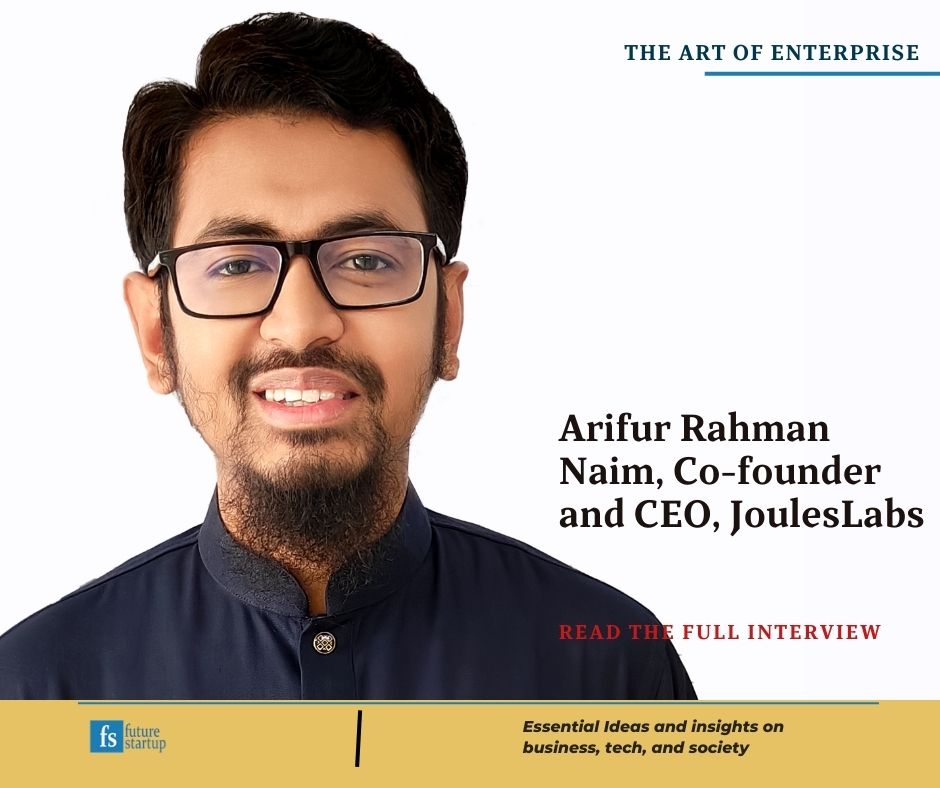
Arifur Rahman Naim didn’t follow a traditional path to entrepreneurship. Growing up in a village near Kuakata in Bangladesh's Barishal division, he experienced a childhood immersed in nature, rivers, canals, and wetlands, far removed from the digital world that would later become his profession. From studying at a madrasa that produced exceptional results to dropping out of university, from working freelance jobs to founding JoulesLabs in 2017, Naim’s journey has been marked by intentional learning, strategic networking, and a commitment to building something meaningful.
Today, JoulesLabs is a 25-30-person engineering agency that has worked with clients ranging from FundedNext and the Bangladesh Navy to Europe-based EV companies. But more than the client list, what makes Naim’s story compelling is his thoughtful approach to partnership, his clear-eyed assessment of mistakes, and his vision for scaling impact while maintaining quality.
In this conversation, Naim opens up about his path to entrepreneurship and building JoulesLabs, the institutional lessons from his madrasa, the reality of building a services business in Bangladesh, the hard-earned wisdom of finding the right co-founder, and what it takes to transition from coding to leading. This is a story about the importance of surrounding yourself with the right people, the power of commitment in partnerships, and the ongoing challenge of building sustainable organizations.
Mohammad Ruhul Kader: Naim Bhai, thank you so much for agreeing to this. I think we can start by getting to know you. Tell us about your background—where you studied, and your path to entrepreneurship, to founding JoulesLabs.
Arifur Rahman Naim: Thank you, Bhai. I’m Naim, Co-founder of JoulesLabs. My educational background is in Computer Science and Engineering from Dhaka International University. We started our agency in 2017.
Ruhul: Did you start right after graduation?
Naim: Not right after graduation. I started university quite a bit earlier than that. After university, I worked in various jobs and then in contractual marketplaces. I spent a good amount of time working before eventually forming the agency.
Ruhul: Tell us about your early life. Where did you grow up? What was your early life like? Any formative experiences that shaped today's Naim Bhai?
Naim: I grew up in a village near Kuakata. Our Upazila is Kalapara, in the Barishal division. I was there until Class 8, then moved to Jhalakathi for Classes 9 and 10. I spent my life until SSC in the village.
Looking back now, considering the lifestyle in Dhaka and how our children are growing up, it feels very good to think about our own childhood. That was a blessing from Allah—we grew up close to nature. Our region has plenty of rivers, canals, wetlands, and ponds. Mud, soil, water, trees—I grew up immersed in all of that. At that time, there were no digital devices. Thinking about that childhood compared to how we’re living in this digitalized world now, the memories feel very precious. For those of us from the 90s and before, it was an amazing time, by the grace of Allah.
Ruhul: After Jhalakathi, what happened next?
Naim: I came to Dhaka for HSC and attended Dhaka Science College. Then, for university, I attended Dhaka International University, a private university in Dhaka.
While I was still in college—my batch was 2008-10 for HSC—something interesting was happening in Bangladesh. People working with computers, specifically those in CSE, doing well in their careers, were creating quite a stir. There were many training centers teaching outsourcing and computer skills. I remember seeing posters on the back of local buses: Learn Outsourcing. Bangladesh had a good start in the space back then; many of us got to know about this industry in detail.
At the same time, alongside my college studies, I had been thinking I would become a Textile Engineer. But at that point, the transition happened, and I decided to pursue CSE. My cousin and older brother inspired me, saying, " You could study CSE. So, before university, starting from college, I began tinkering with computers and learning. That’s how it started.
Ruhul Kader: This is very interesting. I think we often don't realize the fact that the kind of exposure we get eventually shapes our choices. We'll come to your university in a moment. Before that, tell us about your Madrasa years. You went to Alim Madrasa until your SSC?
Naim: Until Class 8, I studied in my local area. For Classes 9 and 10, I studied at Jhalakathi N.S. Kamil Madrasa—an Alia Madrasa. That was, and still is, one of the top three ranking institutions for SSC, HSC, and beyond. It was a remarkable institution that had a significant impact on my career.
For context: we passed Matric in 2008. We were perhaps 153 students, and among them, 103 received Golden GPAs—almost everyone else got A+ or A grades. That institution always ranked exceptionally well. The education was top-notch. Beyond the results, they had mechanisms you generally don’t see in Alia Madrasas. There was a student parliament, and elections took place regularly; it was a huge hive of activity. To give you context, Shaheed Osman Bin Hadi, who was brutally assassinated last year, was one batch senior to me. His brother was my batchmate. That institution helped create many leaders.
The institution handpicked teachers and ran curated programs. At that time, there were around 5,000 students, with 3,500 to 4,000 residing on campus. It was a massive operation. My friends from there mostly went to BUET, Dhaka Medical, or became cadres. I still respect those teachers, the institution, and my friends very much. They were talented people selected from across the country who sacrificed a lot, staying away from family on campus. We used to say it was almost like a Cadet College environment. I think that helped me tremendously in disciplining my life for the future.
Ruhul: This is a very important point. When we have these conversations with many people who are doing important work across sectors, one common pattern we see is the school or college they studied at. You can correlate it, though I wouldn’t say causation, since obviously not everyone from these schools does something substantial. But, for example, in a week, we talk to five people, a significant portion of whom come from places like St. Joseph’s, Notre Dame, or similar top-ranking institutions. Institutions are actually very important. I often ask this question: What does it actually take to build exceptional institutions from which exceptional people graduate or come out? You’re building an institution now, too. What are some of the institution-building lessons that you think, if you look back today, we can learn from your madrasa? This is lacking in Bangladesh. There are no studies on how these consequential institutions are built. We probably don't think much about these things as a nation. But this is a fascinating thing. You said 95-96% of students getting Golden/ A+—that’s almost unreal. Notre Dame is another example. From your observation of your Madrasa, what are the features of these institutions? If you generalize, what do you think was the secret of your madrasa?
Naim: That’s an excellent question. From the top level, it’s about giving responsibility to the right people in the right places. When someone who is very passionate about something is given that responsibility, they will figure things out on their own: Do I need to study the Cambridge curriculum? Where do I need to bring the curriculum from? Where do I need to bring the process from? They become passionate and do those things. To that end, our task, if we are the ones making the decision, is to connect the right people with the right positions and causes. In specific institutions, if you put the right passionate people, the results follow. If you and I are in decision-making positions, it’s about connecting the right passionate people with the right cause.
Regarding the institution I spoke of, I feel tremendous gratitude when I remember it. Back in 2008, A+ wasn’t as widely common as it is now. We still did exceptionally well. I remember we studied so much that perhaps only 20% of it we could even write in the exams. Back then, we felt offended: why make us study so much? Later, we realized it was good.
What they did was handpick the very best teachers from different places. Maybe someone with double titles, triple titles—like someone who stood first in the board in Arabic and at the same time stood first in English. They brought these types of teachers. And they gave them a lot of space: Implement whatever innovative ideas you have regarding education. And there was accountability to it.
The management—our Principal at the time was an amazing, talented man. He himself wasn’t a lot of a titleholder, but he managed teachers who were far more qualified than he was exceptionally well. In general, from the top level, that’s what I think: if we can place someone who is passionate about something in the right position and give them responsibility correctly, good results are possible at any scale.
Ruhul Kader: That’s great. Also, I think your Principal was clearly very entrepreneurial. Do you have any reflections on him as an individual? It’s hard to find people like that. I sometimes think about people building groundbreaking, path-breaking organizations—we have cultural challenges, of course, we don’t culturally recognize these people enough. We struggle to recognize when others are doing well. Because of this, these people don’t multiply. If you don’t properly recognize them, you won’t get more people like that. Do you have any reflections on him—his personality or skills?
Naim: Yes. Our Principal was a very charismatic character. In any situation, he could keep everyone motivated—talented teachers, thousands of students, and local people. That campus has become huge now. They had to acquire land to expand. These things are generally tough. But with his vocal power and motivation, he could do these things wonderfully.
His leadership skills were remarkable—not just for me, but for that entire institution at that time. Now the Principal has changed, things have changed; this is roughly a story from 17-20 years ago. But at that time, for all my friends, seniors, and alumni, this sentiment was very common: we were all heavily inspired by his leadership skills.
Ruhul: This is very interesting. So you studied at Science College, then went to university. All these experiences shaped you in a particular way—perhaps developing a mindset of I have to do something substantial. That's my takeaway from this. I think you went to university with that mindset. What happened after that?
Naim: True. Even before going to university, I got introduced to coding and started doing some work on my own. I started reaching out to some senior brothers who were doing well in the industry, who came back from abroad to learn from them and seek their guidance about how to build a career in tech. I spent the bulk of my time after the HSC exam doing this instead of preparing for university admission.
Ruhul: Were you doing any training at the time?
Naim: There were very few training institutes and programs. I used to collect tutorials from seniors and learn from them. I think by that time, I also started working with some of them on small projects on a contractual basis.
Ruhul: Where did you find these seniors?
Naim: This was purely through references. For instance, I am looking for something, I shared it with you, and you connected me with someone. For instance, I shared it with a cousin. He knew someone in his area who was a programmer, and he connected me with that person. It was purely from one person to another.
Ruhul: You basically applied your agency, reaching and seeking out. I ask this because most people usually don't do this. We usually wait for things to happen.
Naim: Around this time, there was a growing culture where people used to volunteer in different zones. People shared tutorials and so on with others. People used to keep this in their hard disk or pen drive and would share it with others in the same zone. We would go to Keraniganj, Kamrangichar, where some seniors had tutorials. There was a time when I went to see a senior older brother, reached there during lunch time, had lunch with them, and became like a family member. There were different forums and online groups where you could get this information, such as which tutorial has what tutorial in various zones. This was common in those days. Things are much easier to access these days. But it was not that easy. But I tried to take advantage of the available opportunities.
Ruhul: Please continue. What happened then?
Naim: So I took a bit of time before starting university to learn programming and do a bit of work. Technically, my programming career began outside of university. Eventually—and I don't feel proud of this, I don't want to highlight it too much—I dropped out. I couldn't continue at university. It's not that I feel proud about it; I just couldn't do it.
By then, I had already entered the job market. I worked in some small local companies as a web developer, making websites for people using PHP. After that, I did contractual work and then worked in marketplaces for some time. Salaries for normal jobs were very modest. When I was working in marketplaces, the money was significantly more, like getting rich overnight.
During this time—buying computers, learning computers—my older brother inspired me tremendously throughout this whole journey. His support was always there. At that time, many things wouldn't have happened without him; he was a blessing from Allah for me. When I came to the marketplace and earned good money, my brother suggested, " Maybe you can form an agency.
My older brother is a true entrepreneur—someone with that mindset, a hustler. Compared to him, I am nothing. He is a huge hustler and very knowledgeable, Mashallah. He can do versatile business. He is five years my senior. He inspired me back then: since you can take work and do work, why not form an agency?;
This was quite early. But inside me, that realization came later. What happens in the marketplace, you get many different works. I pursued the job I was good at. I didn't need to do any additional research or studies. I could earn money simply by delivering the work. I was making good money compared to where I came from and compared to my previous jobs. However, after a while, I came to realize that I shouldn't continue this since I am not learning anything new. I don't know how I came to that conclusion, but it was a mercy from Allah that I realized that. I didn't form an agency yet, and I came to the realization that I need to learn more instead of trying to make easy money. Rather than earning money, learning became more important to me. So I focused on learning again, almost like hitting a full stop on everything else.
I worked in marketplaces, but work comes and goes—it's not always consistent, not sustainable. I couldn't figure out the sustainability part. Then came the issue of skill development. I realized those seemingly unrelated jobs I did—making websites with PHP—actually helped me. I worked extensively with coding. That helped me improve my skills.
Mizan Bhai started a training center called TechMaster around 2014. He had a remarkable career. There are a few senior brothers toward whom our respect is different—they have significant contributions to Bangladesh's IT industry. There, Hasin Hayder Bhai taught a course.
Now, as we speak in 2025, Hasin Bhai is involved with many initiatives and contributing in many ways. But in 2014-15, these brothers were like celebrities; we grew up watching them. Going to various programs in the digital world, seeing them, they heavily inspired us. Seeing them physically, knowing them, was amazing to me.
Hasin Bhai taught a course at TechMaster on PHP and WordPress. I enrolled in the second batch. It ran three batches back then. To enroll, you had to give an interview. Everyone wanted to get in—there were maybe 18 to 20 seats. Luckily, I got a chance in the second batch. I started the course with a clear goal: Bhai will know me through this course. That was the main objective. And learning was already a priority.
Interestingly, even before finishing the course, an opportunity came. Hasin Bhai was then—and still is—a co-founder at the company ThemeBucket. From there came a knock: There is an opportunity, will you join us? From the first batch, they recruited one person to ThemeBucket. From the second batch, the offer came for me. That was a very remarkable opportunity.
Getting introduced to Bhai was the main goal, and there came an opportunity to work with them. In 2015, I joined ThemeBucket before finishing the course. I used to do classes with Mizan Bhai, classes with Hasin Bhai, and then I got the opportunity to work with Hasin Bhai. During 2015-16, I worked at ThemeBucket, and that was a wonderful experience.
If you allow, there are three co-founders—such amazing people. So down-to-earth. They respect people so much. I was a young man with little knowledge. They had significant experience, much more senior than us. Working with them created tremendous confidence. I enjoyed and learned so much from them. Very few people can treat people that way. That was a wonderful opportunity for me to grow—seeing how such people behave, how they operate, how they give full ownership. That was, I think, almost my last job.
Ruhul: That's very interesting. Then what happened? Your last job—then you started JoulesLabs?
Naim: There's another episode in between. At the end of 2016, I took leave from ThemeBucket. At that time, I was working as a programmer. The bosses and my colleagues observed me closely, and their realization was that I could do better in managerial things than in programming. After observing me closely, that was their conclusion. I also felt that maybe a career transition could happen there.
At that same time, through a previous reference, I got a job offer from a company in Thailand. The offer was that I had to join in Bangkok. Conversations were ongoing. I took a break for a few days and flew to Bangkok for what was meant to be a 15-day trip to finalize pre-joining things—work permit, ministry processing, and so on.
The connection was through my Singaporean friend. My friend and I went to Thailand and saw that tech was not their main product. Tech was a support function. They were making brain supplements. Now in our country, we see many brain supplements, but as I recall, around 2017, there wasn't much of this in pharmacies. They were creating innovative supplements to improve memory in aging people. They manufactured these themselves. The mobile apps and websites for this business were needed to develop and maintain, which I would operate as a manager and CTO-type role with a small team.
But after going there, I became a bit homesick. Plus, the work wasn't purely IT—it wasn't a pure engineering environment. I was coming from an engineering background and considering moving to a managerial role. So I approached them—my friend and I—if you need to do these tasks, we can work contractually, and I will do it from Bangladesh. Somehow they agreed, by the grace of Allah.
So actually, the job opportunity in Thailand became the first contract for JoulesLabs. I came back to the country, got a trade license almost immediately, and we started delivering that work to them. That is how JoulesLabs began.
Ruhul: So the company name was JoulesLabs from the beginning?
Naim: Yes, JoulesLabs. Exactly—October 3rd, 2017. I took the trade license in the name of JoulesLabs.
Ruhul: Was it a sole proprietorship trade license, or did you do a partnership?
Naim: At that time, it was a sole proprietorship. My partner was onboarded in 2021. For the three years before that, I ran it alone.
Ruhul: So you got a contract, the trade license, and the company started. What happened next?
Naim: Once an official institution was ready, I formed the agency, which gave me more confidence. With previous connections in Thailand and Singapore, I could tell them more confidently: Look, I have this capacity. Tell me what you need.
In October, we got the trade license. We took an office in November. In November, I flew to Singapore. Through that friend, I entered the network of his Malaysian and Singaporean connections. I told them about starting the business, and I started to get some business through them. They helped me tremendously. I connected with them about five years before that when I was working on the marketplaces. I used to maintain professionalism, timely delivery, and so on. So they used to trust me. Even today, if they are doing something big, they know who to rely on. At that time, we got a significant advantage—getting work through the network. So I went to Singapore in November 2017, met some Malaysian friends through my Singaporean friend, and closed deals worth almost $100k.
In fact, around this time, my Singaporean friend, his Malaysian friend, and I jointly created a company based in Singapore. I worked as the CTO of the company for a long time. They could rely on tech for us. I worked closely with them for a significant time. I was part of the company, which was registered in Singapore. And JoulesLabs did its tech development. We were more like another vendor. But I was also part of both companies. They could trust us. We made sure to provide excellent service consistently. During COVID, that Singaporean company shut down. By then, the company had invested heavily in the business. We were close to raising capital then. Everything collapsed almost overnight. We had to shut down that company. Until then, we had worked very closely with them. My Singaporean friend visited our office in Bangladesh at least five times. My Malaysian friend also visited multiple times. We traveled to Singapore even more times. The relationship was very close. During our early days, we had the opportunity to work very closely with foreign clients, which helped us tremendously to develop a greater aptitude to deliver high-quality services to our clients. We have built a working model that allows us to work in sync with our clients. For instance, we send weekly updates to our clients via Loom videos. A three-month project, we don't surprise our clients. Instead, we give the client constant updates on the project as we go. It makes development more effective. Working closely with international clients in those years has helped us develop these processes.
Ruhul: You started Jouls in 2017, registered it, and gained international clients. How big was your team then? And tell me about the journey of the first three years—establishing a new organization, building a team, forming a structure. Working individually versus building an organization are two different things with different challenges. Ensuring sustainability so the company can continue—you probably had to do these things in those initial years. Tell us about that time—any particular challenges that come to mind, or what helped you achieve a stronger footing?
Naim: Excellent question. When I was at ThemeBucket, which I shared earlier, my understanding and feedback from colleagues was that I fit more in management than coding. At that time, we created a travel group with developers called DevTravelers. We did roughly 25-30 trips from that group till now. We organize various events. Before starting JoulesLabs, we used to organize something like that every few months. Through this, I had an opportunity to meet a lot of people in the developer community. There were regular events in the IT industry in Bangladesh until COVID. My colleagues and I actively volunteered and attended these events. We were quite active faces in the communities in those days. We met many people through these meetups, attending seminars, and being active in the community.
Because of this active presence, hiring, recruiting, and managing became easier for us compared to a completely new agency. I could post a job circular, or even before getting an office, we managed to hire people. People were like Bhai, you started this, we are with you. Community engagement helped us tremendously in initial team building, which was perhaps smoother for us than for better-established agencies at that time. I would like to emphasize that community engagement is very important, and it played a critical role in our journey.
The first three years were very focused. We worked with limited clients on projects, but we worked dedicatedly. So our cash flow came from similar places similarly. We started with probably four members. At the end of three years, we had grown to a range of 14-15 people. We were at Mirpur DOHS from the beginning, growing steadily.
In three years, what happened for us was: team building, agency initial branding, and establishing client relationships. These were the basic foundations. Now it seems like a small thing—what we achieved in nine years isn't anything remarkable, we have a long way to go—but we're getting started. I don't think we did much. We just survived for nine years.
After three years, COVID came. COVID was a serious shock for us. Since we're a service agency, we had some limited main contracts that fell through overnight. We had to pass through a very difficult time and then make a comeback.
By 2021, we had become a team of 10-15 people with local and international networks. Business possibilities were created—kind of a warm-up situation. COVID had also become somewhat normal by then. Then I realized that I'm not actually a huge engineer myself. Business-wise, I should focus more on our international network and business development.
Then came a realization: as an engineering house, engineers want to learn from seniors. This learning aspect, quality of work, keeping things accountable—for that, a dedicated person is needed. I didn't want this problem to be solved just through recruitment. Rather, I wanted a full partner—a passionate person like me—who would take care of this.
That's when the co-founder idea came in. My dear friend Nahid Bhai, who is four years my senior in age, became my partner, Mehedi Hasan Nahid, known as Nahid Bin Azhar on social media. We were colleagues at ThemeBucket in Hasin Bhai's office until 2016. After that, I ran the agency, and Bhai went to Pathao. He was there for about three and a half years—one of the very first recruitments, like the 12th person at Pathao. Very talented engineer.
After Pathao, he went to Telegram, then Portonics. Even now, even back then, he is, in open-source contribution ranking by star rating on GitHub, the number one PHP developer in Bangladesh. In PHP, Laravel, and Go, in various categories, he's highly ranked. There are lots of open-source-minded people he inspires. He's a work-crazy person in terms of engineering. He does these things out of passion.
Since Bhai is my senior by four years and we were close for a long time, and we were both admins of DevTravelers, we knew each other well. We had both work, business, and personal relationships. We once went on a tour to Cox's Bazar with family and sat down to talk. Bhai, how long will you do a job? He's also a person with an entrepreneurial mindset. He was probably waiting for the right timing, partner, etc. The timing was right—for various reasons, it hadn't happened before.
For me, I needed someone who looks at the tech side so I can focus on the business. I needed someone I could rely on completely. For Bhai, he needed a place where he could focus on what he loves—he hates the parts I'm good at, like talking to people, business development, etc. He wants to code, do engineering, contribute to open source, and teach people. He loves teaching, sessions, and organizing events. He loves tech stuff. He doesn't like the other part of the business that I like to do.
We thought this would be a very beautiful combination. We literally sat in Cox's Bazar, sat in Dhaka. Now that we are no longer university freshers, we're mature enough, and we realized that doing a partnership without proper planning won't work. Pros, cons, where, what will happen—let's sit and discuss everything. We literally listed it out.
In Management 3.0, there's a framework with seven styles—tell, sell, delegate, etc. So we sat down: Bhai, okay. What are the pros and cons of this partnership? And if we start, how can we divide our work better?
By Allah's infinite mercy, we finished our homework in December 2020. Exactly on January 1st, 2021, we entered the partnership. We continued the agency with a new trade license. So to this day—we're in 2025—literally five years are ending. We have a wonderful combination. What Bhai oversees, he still oversees. What I oversee, Bhai doesn't. Surprisingly, our partnership is going extremely well so far.
This has been a significant breakthrough. I don't have to worry about tech. And the community respects Bhai tremendously. People want to learn from Bhai. Until now, recruitment has been much easier for us compared to others because Nahid Bhai is there. This is a huge relief for me.
Ruhul: That's very interesting. I see a lot of stories where partnership played a significant role in growth. Maybe the company plateaued, growth became challenging after a certain scale, and then a new partner came on board, resulting in a new growth path. But partnership isn't easy. What's your experience? How do you make partnership work?
Naim: The good thing is, by the time I got into a partnership, the agency had already been running for three years. So I had seen real-life challenges. I knew exactly which problems my partner needed to solve.
Nahid Bhai is four years my senior. From 2010-11 to 2014, he ran an agency partnership, which later shut down, and he went back to a job. At that time, Bhai also saw the challenges of partnership and understood his own capacity. In business, he learned how much execution he can do, what's good, and what's not. So one thing that worked for us is that we both come with our prior experience. We saw the challenges and benefits of partnerships. We entered the partnership with a better understanding. And before getting into the partnership, I reached out to some of my seniors and people I know who run partnership businesses to learn from them. I tried to learn as much as I could. So I did some homework. Before entering the partnership, I had a clear understanding of what I wanted from a partnership. I wanted to alleviate our limitations and multiply our advantages. I wanted to increase our strength dramatically. I started this with a clear understanding. And the way it has turned out, we are very happy.
Managing partnerships is definitely a difficult topic. But when I have a vision that I want to reach that place, the question becomes: how much will I sacrifice? How will I approach things? This is very important. When the vision is bigger, small things can be purposefully evaluated—where should I react, where shouldn't I? When I have a bigger vision, it is easier to overlook a lot of other things intentionally. So you have to have this lens for interpreting things and overlooking things.
Mutual respect is very important. I have thousands of reasons to respect Nahid Bhai. Bhai has thousands of reasons to respect me. I hope he shares the same sentiment.
The other exception is complementary skills. We saw that in Bangladesh, mostly what happens is tech people start tech businesses—two tech people or two business people. In our case, our complementary skills, somehow, the fact that I'm not a good engineer, became a blessing for us. The fact that Bhai doesn't enjoy communication became good for us. Coming from our experience, we can say that maturity in dealing with differences is working, Alhamdulillah. Since we come with some working experience, we can say we have that maturity in dealing with it, Alhamdulillah.
Ruhul: In partnership, you also have to deal with the questions of finance and so on. How were your discussions regarding these things? How did you come to an agreement that this structure is right? You had been running the company for almost three years, and now a new person was coming. How was the arrangement in your case? How should others think about bringing a new partner on board?
Naim: I think it depends a lot on the situation and person. In our case, it was very straightforward. I saw that Bhai was working at Portonics after working at Pathao and Deligram, and bKash was pursuing him, offering a huge salary. It was late 2020.
As an agency back then, I couldn't even give myself a salary, nor could I give Bhai one anywhere near that. That kind of situation. So for him, that was the investment—getting the same full effort without having to take that salary amount.
From bhai's perspective, since I had already run the agency to this point, the numbers could have been different. In general, we didn't go into serious things like I sold some shares or Bhai bought them. We didn't go into those things.
Now, if someone else tries to onboard a partner halfway through, they might not be able to follow this formula. Because we know each other, we know our rhythm. We understand where actual numbers matter versus where effort matters. We realized that if we leave everything and focus on one thing, that matters. For us, it was a straightforward issue. It didn't become an issue. But I can't tell whether this would work for others.
Ruhul: I agree, bhai. It depends on many different things. But it is ideal if you could start a partnership with a solid agreement and understanding. A challenge in our context is that people tend to avoid direct communication when it comes to difficult topics. We expect many things without expressing them directly or putting things in writing, which creates a lot of challenges. What are some mistakes and things people should be conscious of when entering a partnership? You mentioned being frank and honest about expectations. From your experience, what are the essential things to keep in mind when having serious partnership conversations? What should be done or avoided?
Naim: This is a big topic. Everyone should maintain a framework when engaging in a partnership. From our positive experience, I can share a few key points.
What we experienced positively—and over the next five years, we saw many similar scenarios where things didn't—what I feel is very important and which I feel works for us is commitment. What commitment? I was all in, already running an agency for three years. My partner, whom I was bringing in—if he's not all in, not focusing on this one thing like me, suppose he's investing somewhere else alongside, consulting somewhere, maybe keeping a 5% stake somewhere else—this leads to a disaster. Even if initially it seems to let him do it, no problem, I can accept it. In practical terms, I think this becomes an issue eventually.
We made sure we discussed this. We even had things written down that neither of us will affiliate with anything else outside of our main business within a certain number of years. Not even advice or consultation. These things helped us a lot.
I think—we've seen many other experiences—if there is shared attention, this is purely a red flag. It can be roughly said that it won't work. So to take a partner, other terms aside, this full focus of attention—whether he has any other things on the side—these things are very, very important. It's like an investor vetting a founder.
Another wonderful thing for us has been that, whatever the situation, we can talk. If there's a tough situation, if there's disagreement—and we have tremendous disagreement sometimes—it's always respectful, and we discuss it with an open mind. I know the partner I brought in has a reason behind his disagreement. Not liking it is one thing, but I have to listen to it. If there's good in it, we'll take it. We have a separate framework for that.
Alhamdulillah, somehow we have that synchronization—we can deal with disagreements respectfully and talk a lot. Whether it's a comfortable or uncomfortable discussion, we can talk hour after hour. I think this is very important—being able to talk to your partner. And that attention thing is a must.
Ruhul: This is very interesting. I think all relationships—being monogamous helps.
Naim: Yes, exactly.
Ruhul: In January 2021, you entered this partnership. It's been five years now. Tell me the story of this period.
Naim: This has been a wonderful journey. I became mentally very relieved that tech, recruitment, hiring, training, SOPs, and project delivery—I don't have to worry about anything. There's a respected person for that.
The shifting market situation after COVID wasn't easy. In some places, maybe we could have done dramatically better, but in general, from then on, we started with renewed enthusiasm. In January 2021, we onboarded the co-founder. In June, we changed the entire branding of our company—logo, tagline. We tried to bring a new vibe and started with new initiatives.
Soon after, we boarded FundedNext. I assume you know FundedNext. At that time, it was called Jayed Corp under Abdullah Jayed Bhai, now rebranded as Next Ventures. FundedNext, which is huge today, is famously doing well globally from Bangladesh—a business of this scale doing impossible things in such a short period—the initial main backend of the platform was built by us.
That was roughly a one-and-a-half-year contract. We gave them a managed team—staff augmentation model, managed by us. We did the initial development. They had a tech team, which was doing integration and other things. Now their team is bigger than several of our companies put together. Initially, we worked with them. It was an excellent experience for us.
For me, working with Jayed Bhai, learning from his vision, was an amazing opportunity. We got to work closely with him. I'm going to his office, discussing product, and brainstorming. That energy level was incredible. One of the reasons I still feel good about that collaboration is that one of the tech tools we developed, they still use it. The reason this is more important for us is that without Nahid bhai, we would not have been able to pull it off. Nahid bhai had experience working for Telenor Myanmar when he was at Portonics. He worked at Pathao on a product that millions of people use at once. He had experience working on large projects. Working on FundedNext/Next Venture was another project for Nahid bhai. For us, it was a significant project.
In our agency, we worked with many big founders. We learned a lot from them directly. This helped us tremendously.
Ruhul: So working with FundedNext was a big break.
Naim: Yes, absolutely.
Ruhul Kader: Any other milestones or turning points in the last five years?
Naim: Another interesting project was working with a UK-based company doing EV battery stations and swapping stations. This was another remarkably technical challenge—connecting with IoT, taking data from EV batteries and swapping stations, then serving that data. After 2021, there was actually a major change in our engineering deliverables. We continuously kept delivering at that level.
Later, we worked with the Bangladesh Navy. Eventually, last year, with BIDA, the current website of BIDA was made on Webflow. Before, people wouldn't have seen government websites at this level of beauty or modernness. We worked as a sub-vendor, not the direct tender holder, doing 100% of the Webflow development. Another agency did the designs, another did content, but we handled all the Webflow development.
Although Webflow or low-code/no-code is a very small portion of our capacity, building solutions for platforms like Bangladesh Navy, BIDA, FundedNext, and international fintech platforms—dominating that category—has become our capacity. We're continuously doing that.
And I think you'll be happy to know—very recently, we signed a service agreement with Moar, the pioneering working space in Dhaka, to digitize their entire system. We're already starting work. Hopefully, this will also be great, impactful work, Inshallah.
Ruhul: How big is the company now? What services are you offering? How big is the team? Which markets are you serving? Can you give a sense of the business scale to help people understand the size of the organization? A state of the union of JoulesLabs today.
Naim: We're now an engineering team of 25 to 30 people.
Regarding business focus—throughout the journey, you might already feel from my words that FundedNext and GovTech are not in the same category. Coming to this year, 2025, we're re-evaluating all the work we've done. Which industries have we worked in? It became very necessary to understand what our brand positioning should be now as a service agency.
In between, we worked in e-commerce, LegalTech, EdTech, AdTech, government work, and various other tech sectors. But coming to 2025, we realized deeply that we aren't growing enough. We should grow much more. Because Alhamdulillah, we now have fulfillment capacity. Once a project enters, my work as the sales team is done—Nahid Bhai's entire team can satisfy the client and deliver. We have capabilities.
So we need to grow significantly. The question became: to grow, what should be our positioning? When we worked on positioning, it became clear: we're working in all niches. I have a mentor, Bhai told me: if you work with the Bangladesh Navy, then go approach the Indonesian Navy. Approach the Bangladesh Police. Your only job should be to market in this niche. How will it work if you go around doing everything?;
So we sat for serious homework, evaluating all old projects to see which sector we worked in most and where we could serve confidently. Our findings for now, this year, involve SaaS and AI development. We work mostly in this niche. We also have some previous experience ourselves. We felt we would pick that niche and try to expand in it. So we have since changed our website and other communication around SaaS and AI development. We now say we are a SaaS and AI development agency. Your tech partner, development partner, and engineering partner. We want to work with SaaS related companies. Our current approach is around this. We are very hopeful that this new trajectory will help further accelerate our growth.
Ruhul: This is a very interesting move. I think there is value in focus. Focusing on a few things instead of doing too many things can be very helpful in many ways. I want to ask two questions here. When we speak with companies, we see two kinds of challenges and two trajectories. One is zero to one, by which I mean, you started a company, and then you took it to an operationally sustainable company. You have a consistent revenue, and you come to a place where you know the business will survive. The business has a strong foundation. The second phase is one to ten, when you are trying to take the company to a mid-sized company. We have seen that these two phases come with different needs and challenges. The decision-making and strategic thinking you need in the former phase are not the same as what you need in the latter phase. The question is, what are your lessons from the first three years of JoulesLabs when you took the company from zero to an operationally viable position? What are some things that have worked for you? What are the lessons from that point? Many companies come and go. It is no small matter to survive 9-10 years. What did you do in the early days that helped the company build a foundation? And what helped the company grow further after 2021?
Naim: In the initial three years, we didn't develop processes and things like that which would help us to streamline our operation. As a result, many things happened in a reactive model. There was a lot of friction. I was young, working with other young people. But experience was missing. As a result, SoP and other similar things were missing in our fulfillment process. After doing it for three years, we realized it was hindering our growth. And we focused on it after 2021 that we have to build processes first. This was sort of correcting the mistakes of our early years. In fact, we had to do these things even after 2021. Now, we are working to scale the business. We are now facing the challenges of scale. If you now challenge me on how we would become 30 to 300 people, I think we have figured that out. We don't think that is a challenge for us now. For us, the challenge now is business development and marketing. We have built an organization that can deliver at scale. The question now is to bring business. We must be able to build trust in the market. Build a network. Build attention so that large-scale enterprise work comes to us. We have passed that stage of challenges of fulfillment, and we believe we are at the early stage of serious growth. We have been around for nine years. But we think this is not that long a time, and in terms of business, as well, we have a long way to go. We are just getting started. Our challenge now is growing the business. If we can market well, attract more clients, we should be able to build a better culture, hire better people, and do even better. We have built systems for our fulfillment. Now our challenge is to build systems for sales and marketing.
Ruhul: Tell me a bit more about your organization—how the company is designed organizationally. What are the different departments? Engineering is obviously a major function. Sales and business development are probably another function. And tell me about the organization's culture. How do you think about culture at JoulesLabs? What is the DNA of your culture? How do people work in the company, interact with each other, and work with clients and external partners? How have you thought about or designed this?
Naim: Wonderful question. Regarding the DNA of our culture, we went through various experiments over time and eventually arrived at a place that works. However, I won't say all our experiments were good.
Our motto is building an engineering house. An environment that's better for engineers. We try to build that because we ourselves come from an engineering background. We have a sense of what engineers like and what they don't.
Based on that, we tried different experiments. For example, with office hours, we tried many experiments: morning, afternoon, night, various shifts. Now we maintain fully open/flexible office hours. You have a productive hour requirement, but when you enter the office, someone might enter early in the morning, or someone might enter after finishing a task. This works for us because we realized this is actually what works best. When engineers feel entitled, they work better. They don't like strict barriers. We realized that allowing this flexibility works.
Another finding regarding projects and finance: usually, engineers don't see how much financial benefit a project brings. They look at whether they can do something impactful, whether they can learn something from this task. So we try to take projects keeping this in mind. Even if the money is low, if the engineering challenge is significant, we might take it. Or if an early-stage founder has money but it's clear it won't work, or he isn't well prepared, we might pass.
We have a small background in product. We spent three years on product development, developing multiple brands. I intentionally skipped that discussion. From that, we have some product experience, and we have a sense about product development, like SaaS, Micro-SaaS. That sense has grown. When we interview a client, we have a step where we interview our client before onboarding a project. If we feel their idea won't work because their distribution plan isn't good, we know they'll later blame the tech team if it doesn't work, so we try to communicate our concern. Otherwise, he'll come and say, " You didn't deliver on time, or you didn't give that feature, that's why the product didn't do well. We try to take these interviews.
Similarly, we try to ensure engineers can learn from projects and enjoy them. If I can sell the project to the engineers, we proceed. If not, we stay away.
Most importantly, we assign a Project Manager for small and big projects. In some cases, creating credentials for the sandbox or doing R&D doesn't feel good for an engineer. If a Project Manager prepares everything and provides it, he can work much more efficiently. We try to make it comfortable for the engineers—keeping POCs with one person, Technical Research, and QA with separate people. Sometimes, for solo development projects, we might just provide a developer, but we're trying to work in a slightly better-organized way.
We usually have monthly all-hands meetings where we discuss our culture, reinforce values that are important for us, and discourage values that are not important for us. For instance, when someone contributes to open source or shares lessons, we encourage that with a badge and a gift. We try to maintain an alive culture instead of a dead one.
There is an active feedback mechanism in place where we encourage good work and values while discouraging values that we don't want in the company.
Ruhul: You run a B2B service business where revenue is not always predictable in the sense that you need to do business development regularly. This is one significant difference between a product and a service. I'm not saying the product is any easier. I'm saying these are two different businesses. In service, business development is different and constant. How does your business development work?
Naim: To give you some context, I was a partner at Easyjobs, where I took an exit. I am a partner at Crowdfundly. We also have two micro-saas. Your point about the product is spot on. But a service business can also have predictability if you have sales, marketing, and positioning in place. For instance, Musemind is a Bangladeshi design-focused agency, and they are doing very well. They are doing very well within a very short time. Among many things, they have a solid client acquisition and marketing engine ready that allows them to acquire customers predictably. This is true of all large software services companies. They have established processes and systems. So there are some companies that are doing very well in service, and the same in product as well. The opposite is true as well. Now, how did we decide to focus on service instead of product, whereas we have some footprint in product? Two things. One, our ambition, which we borrowed partly from Raisul bhai of Brain Station 23, where he says he wants to create employment opportunities and bring foreign currency for the country. Our ambition is similar. We feel you can create greater opportunities by doing service. At the same time, we felt that the kind of marketing and other requirements a product has makes it more difficult for us, given our background and strengths. Service marketing and sales are simple. You take your skill and go and tell people you did this for FundedNext, and you can do the same for them as well. The product is much more complex. So we feel more comfortable doing service.
Ruhul: I can see what I mean. We had a similar discussion with Raisul bhai a few years back and we had a similar discussion. Product failure is much more prevalent, and the product in many ways is more challenging. All kinds of businesses are challenging. But what I was trying to get at: do you have any B2B business development playbook? You mentioned MuseMind. Do you use any particular strategy for business development? Your point does clear something out.
Naim: We have an operational playbook that includes client fulfillment to operations and everything. However, everything must evolve continuously. So we are working on it constantly to improve it. We try to constantly learn from other seniors in the industry. For business development, I feel that it is important to have a proper marketing strategy in place and be able to execute it. It could be that we are more focused on this area, so we are thinking that it is the main challenge. But it is also true that we have come this far by figuring out other problems. So we feel that if we can solve this, it will unlock new growth for us.
Ruhul: Lessons from your journey so far. How much have you evolved as a founder?
Naim: It is hard to notice your own change. However, one change may be that I tend to think from an impact perspective now. Doing things that are of higher positive impact. I try to be responsible with the blessings Allah has given me. Be mindful of my position and do things with a sense of responsibility about how I can use this gift better.
Ruhul: What are some of the things you found most helpful in building JoulesLabs?
Naim: The network helped me tremendously. At different stages, I sat with different kinds of people—sometimes with engineers, sometimes with founders, sometimes with product founders, sometimes with service people. I wouldn't say I did it very well, but since you asked what helped, this was impactful for me. I would recommend this to others, too—doing this in a more planned way can bring even better results.
Ruhul: Do you have an approach or playbook for networking and building connections?
Naim: [Laughs] If I feel I need to talk to Ruhul Kader Bhai, I'm ready to go sit under his building. Shameless. One way or another, I'll get him.
Ruhul: [Laughs] This is very good.
Ruhul: You seem to be someone who is always trying to learn new things. How do you learn as a founder? For me, particularly, it seems our organization will only be as big as we are individually. The growth of the organization is correlated with the growth of the founders. How do you think about learning and growing individually as a founder? Do you have any process?
Naim: Wonderful question. For networking, suppose I have a marketing challenge. I'll try to find the right person within the network whom I respect for that subject. Sit one-on-one with them, or find multiple people and talk to them, then figure it out. Finding out where I'm lacking or what I want to learn—who is the expert in that already? Someone in my close vicinity. Maybe I'm running a 30-person agency, someone is running a 100-person agency. Someone with whom I can relate. I try to learn from them by asking questions. That's one approach.
Second is taking it from life—doing this exact work, I'm noticing things. So, going to experienced people, gathering insights from them at a high level, converting it into a syllabus, taking notes by talking to them, and figuring it out. Then, if there's any book, podcast, or course material on that topic, now, because of AI, many things are much easier—taking that, learning to gain skills, learning continuously, implementing it, and bringing results.
Ruhul: Common mistakes that you think founders should try to avoid.
Naim: Excellent question. I would share some of the mistakes we made.
First, marketing. We realized the importance of marketing very late. Being an agency from a third-world country serving first-world countries, but establishing the company first and then understanding marketing—this was a major mistake. If we had solved this problem first, moving forward would have been much easier and sustainable. Maybe what took us nine years could have been achieved in nine months. There are, of course, other imperatives. But we feel this was one of the major mistakes we made in the early days. Not taking marketing seriously. In a product or service, people often start based on gut feeling without product validation. We did this too. Without validating the idea, we started based on just a deal or two.
Second is not being able to differentiate between importance and urgency. As young founders, we often mix up what is important and what is urgent. We ran after urgent matters and neglected important ones. Or we micro-managed things. This mismatch leads to inefficiency.
Third, process and SOPs. We brought in many SOPs and processes very late. We relied on run-time decisions. If we had established processes earlier—since this is a service business—it would have been much smoother.
Ruhul: As a Co-founder and CEO, how do you operate? How do you stay productive? What does a typical day look like for you? Do you have unusual productivity practices?
Naim: I think that to stay motivated, vision is most important. If you have a vision and believe in it, staying motivated is easier. For me, spirituality is intricately related to how I operate. We are here for a limited time. Within this time, we have to figure out how to create impact for both worlds. From there, I think about how I can use the opportunity I'm given in the best way. To that end, your vision is something that should drive you. This is where I want to reach. And that our task is to try, Allah ultimately gives. We must not lack effort so that we can be clear about our responsibility.
Usually, I try to start the day with Fajr prayer—waking up before Fajr. Based on the season, sleep at night varies. If I need more sleep after Fajr, I take a nap after Fajr prayer. If I wake up after Fajr, usually I take a little walk, then drop my kid at school, family engagement—these things are done. Then, if needed, rest a bit or come to the office.
We try to end early—and I struggle with this too—but we try not to end the day late. It's a trap. If you finish late, the next day starts late. So I try to organize it as much as possible. But often it takes longer than I want.
Ruhul: We're nearing the end. Final question regarding the future. You mentioned growing the company and increasing business size is a major priority. Apart from that, in the short term and long term, what are some of your plans and goals? Say, a five-year plan and a 15-year plan. Where do you want to go?
Naim: We actually borrowed this vision from Raisul Bhai of Brain Station 23. He wants to create jobs for thousands. Our ambition is similar.
In the short term—say three to five years—within this period, we want to accommodate 500 to 1,000 engineers in our company. Additionally, we want to expand to a few more countries.
Ruhul Kader: Often, companies lose focus because maintaining focus is difficult. Your clarity about what needs to be done is remarkable. I think this is a good place to end this conversation. Thank you for your time. This has been an enlightening conversation for me.
Naim: Thank you so much. It was great talking to you.
This interview has been edited for clarity.
• • •
Notes: Thank you for reading.
Every week, we pour hundreds of hours into Future Startup — researching, writing, and bringing you stories that matter. For years, this platform has remained independent, thoughtful, and committed to substance over clickbait.
If these stories have added value to your week, if they've sparked an idea, opened a door, or simply made you think differently, please consider supporting our work by buying our paid services.
You can sponsor our weekly newsletter, explore our narrative building services, or engage our research and consulting expertise. Your support helps it grow into something even more valuable for our entire community.