
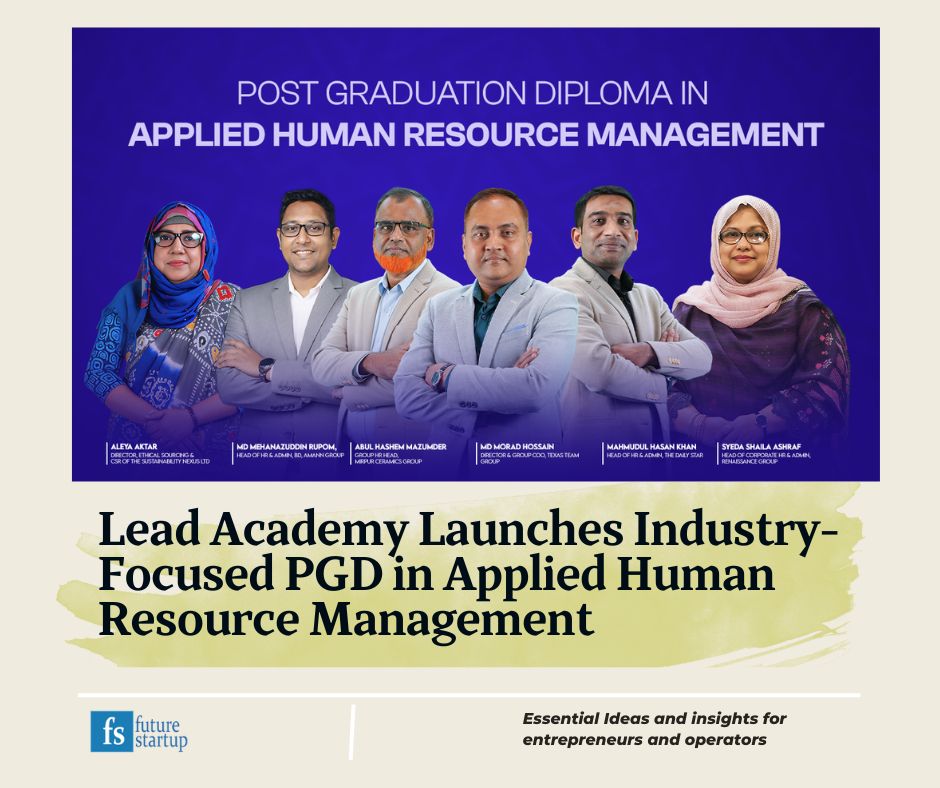
LEAD Academy, a Dhaka-based skills and career-focused edtech startup, has launched a Post Graduate Diploma in Applied Human Resource Management (PGD-AHRM), a practitioner-led program designed to bridge the gap between academic HR training and the strategic, compliance-heavy realities of modern corporate practice.
The program is delivered by senior HR executives from leading organizations, emphasizing applied learning through documentation, policy development, and execution-focused training that prepares professionals for strategic business partnership roles. The aim, the Academy says, is to prepare HR professionals with the practical expertise and strategic capability required in today’s corporate environment.
The evolution of HR from administrative support to a strategic business function has created new demands for professional capability. Organizations now expect HR teams to contribute meaningfully to business strategy, navigate complex compliance environments, leverage data for decision-making, and design systems that drive organizational performance.
LEAD Academy's PGD-AHRM addresses these demands through an applied learning model that treats HR work as what it truly is: a discipline requiring both technical expertise and strategic thinking. The program emphasizes real-world HR practices, case-based learning, documentation, policy development, and strategic execution aligned with organizational objectives, rather than traditional theory-heavy instruction.
Before launching the program, the Lead Academy team spent months asking senior HR professionals across industries the same question: What do fresh HR graduates lack that prevents them from contributing effectively in their first roles?
The responses followed a pattern.
Many HR professionals and graduates with degrees in HRM enter the workforce with solid theoretical foundations but without hands-on experience in critical areas that define effective HR practice. Technical knowledge gaps around labor law application. Inability to design performance management systems that managers will actually use. Lack of practical experience with compliance documentation. No exposure to HR analytics beyond basic Excel.
Understanding recruitment theory differs fundamentally from building competency-based interview frameworks. Studying motivation concepts doesn't automatically translate into designing performance management systems that managers actually use and that employees find meaningful.
This gap led LEAD Academy to launch the PGD-AHRM, a program delivered entirely by practitioners who are currently doing the work they teach. The program focuses specifically on areas where practical application matters most: labour law application in specific organizational contexts, industrial relations management, performance management systems implementation, HR analytics for strategic decision-making, and compliance-driven decision-making that balances legal requirements with business objectives.
"Our focus is not on certificates alone, explains Lead Academy Founder and CEO Ashfaq Zaman. We are committed to developing HR professionals who can contribute effectively to strategic business decisions. This is why the program is delivered by experienced HR leaders who understand the realities of corporate leadership."
This emphasis on applied capability development runs through the entire PGD-AHRM structure—from case-based learning methods to the composition of the faculty panel.
The PGD-AHRM faculty consists of senior HR executives actively working in their respective fields, bringing current organizational experience into every session.
Md. Mahmudul Hasan Khan, Head of HR & Admin at The Daily Star and Lead Consultant & CEO at ENSDI, brings extensive experience from both media and consulting environments. His dual role provides perspective on both in-house HR leadership and advisory work across multiple organizations.
Mohammad Morad Hossain serves as Director & Group COO at TEXAS TEAM GROUP, offering insights into HR's role at the executive level and how people strategy connects to broader operational objectives.
Abul Hashem Mazumder, Former Member of the Labor Court in Dhaka and current Group Head of HR at Mirpur Ceramic & Khadim Ceramics, brings unique legal expertise combined with hands-on HR leadership experience. His background in labor court proceedings provides invaluable practical knowledge for navigating industrial relations and compliance matters.
Syeda Shaila Ashraf, Corporate HR, Admin & IT Head at Renaissance Group, represents the integration of HR with administrative and technology functions, reflecting the increasingly cross-functional nature of modern HR leadership.
Md Mehanazuddin Rupom, Country Head of HR & Admin at AMANN Group, offers a perspective from multinational operations, bringing insights into how global HR standards translate into local practice.
Aleya Aktar, Director of Ethical Sourcing & CSR at SusNex Ltd., provides specialized knowledge in ethical compliance and corporate social responsibility, areas of growing importance in HR practice.
What unites these instructors is current engagement with the challenges they teach. Labor law changes affecting their companies last quarter inform what they teach about compliance. Digital transformation initiatives they're currently leading shape their instruction on HR technology and analytics.
The PGD-AHRM delivers value through its structure, content depth, and practical orientation.
The program spans 7.5 months with 72 live classes conducted on Saturdays, Mondays, and Wednesdays from 8:30 PM to 10:30 PM. This schedule accommodates working professionals while maintaining the intensive engagement needed for meaningful skill development.
Students don't passively absorb concepts. They design performance management systems from scratch, work through labor law compliance scenarios with proper documentation, and analyze HR data sets to present findings as they would to a CFO.
The curriculum spans six domains:
Applied Human Resource Management modules cover policy and procedure development, talent acquisition and management, performance management systems including KPI, BSC, and OKR frameworks, total rewards management with focus on compensation and benefits, and HR analytics for data-driven decision making.
Organizational Development and Culture sessions explore fundamental organizational development principles, OD intervention strategies, culture assessment and development, appreciative inquiry methods, and applied behavioral science.
Learning and Development training addresses training needs analysis and development needs analysis, objective setting for learning programs, instructional methods and aids selection, curriculum development, facilitation skills, and evaluation frameworks.
Labor and Industrial Law provides comprehensive coverage spanning the historical background of Bangladesh Labour Act and Bangladesh Labour Rules, conditions of employment, different modes of separation, disciplinary procedure and domestic inquiry, maternity benefits and leave, working hours and leave provisions, trade unions and collective bargaining agreements, workers' participation in management, workers' participation in companies' profit, stages of dispute resolution, and employee welfare requirements.
Strategic Human Resource Management modules examine fundamentals of strategic HRM, environment analysis for HR planning, non-violent communication, leadership and team inclusion, and conflict management with retention strategies.
Organizational Compliance training covers occupational health, safety, and welfare requirements, plus HR audit processes.
AI in HR and Capstone Project introduces the new role of HR in the age of AI, AI applications across the HR value chain, AI governance and ethics with practical readiness, culminating in a capstone project where students apply their learning to comprehensive assignments.
This curriculum structure moves systematically from foundational HR functions through strategic capability development to emerging technologies, with the capstone project integrating knowledge across all areas.
What distinguishes the PGD-AHRM is its emphasis on doing rather than merely knowing.
Students don't just study performance management systems; they design them, considering organizational context, manager capability, and employee engagement.
They don't simply review labour law provisions; they work through actual compliance scenarios, draft necessary documentation, and develop responses to complex industrial relations situations.
The case-based learning method ensures students grapple with the kind of ambiguous, multi-stakeholder situations that characterize real HR work. There's rarely one right answer when managing organizational change or resolving workplace conflicts. Learning to navigate this ambiguity, make informed decisions, and justify those decisions with both data and judgment represents critical capability development.
Faculty members bring actual cases from their organizations, exposing students to realistic complexity: incomplete information, competing priorities, stakeholder resistance, resource constraints, and time pressure. Learning to navigate this ambiguity and make informed decisions represents critical capability development.
The PGD-AHRM targets three groups with distinct needs:
Individuals seeking to start an HR career gain structured, comprehensive training in HR fundamentals combined with practical application skills. Rather than learning through trial and error in their first jobs, they develop capabilities systematically and can contribute more quickly once hired.
Professionals transitioning from other functions receive the specialized knowledge needed to shift successfully into HR roles. Moving from finance, operations, sales, or other areas into people management requires more than general business acumen; it demands specific expertise in areas like labour law, talent systems, and organizational development that this program provides.
Working HR practitioners aiming for career advancement strengthen their strategic capabilities and broaden their functional expertise. Many HR professionals excel in specific areas, such as recruitment, training, or compensation, but lack the comprehensive knowledge needed for senior leadership roles. The program builds this breadth while deepening strategic thinking skills essential for HR Business Partner, HR Director, or CHRO positions.
The PGD-AHRM creates specific value through several mechanisms.
Deeper functional expertise across all major HR domains enables professionals to operate effectively in generalist roles or provide more strategic contributions in specialist positions. Understanding how talent acquisition, performance management, compensation, learning and development, and compliance functions interconnect improves decision-making quality.
Strategic decision-making capability develops through repeated practice on business-aligned HR challenges. Students learn to frame people's issues in business terms, quantify impacts, consider trade-offs, and present recommendations that executives find credible and actionable.
Enhanced professional credibility comes from holding a postgraduate diploma that signals serious investment in professional development. This credential differentiates candidates in competitive job markets and demonstrates commitment to the HR profession.
Industry connections develop naturally through cohort-based learning with other HR professionals and interaction with faculty who are active industry leaders. These relationships often prove valuable for career opportunities, mentorship, and professional support throughout one's career.
Practical readiness for higher responsibilities results from the applied learning approach. Graduates don't just understand what HR Business Partners or HR Directors do; they've practiced many of those responsibilities during the program through case work and projects.
Upon completion, graduates receive a Post Graduate Diploma in Applied Human Resource Management from LEAD Academy, recognized by the institution's reputation as a trusted professional learning platform, and through the endorsement of senior HR professionals from leading industries who have reviewed and supported the program.
The diploma represents completion of 72 live classes, comprehensive modules across six major HR domains, case-based learning assignments, and a capstone project demonstrating integrated application of program learning.
Moreover, LEAD Academy says that the program has been endorsed by over 40 senior HR professionals from leading industries, active corporate HR leaders vouching for the program's structure, faculty composition, and curriculum relevance. In an education market flooded with generic diplomas, this endorsement carries weight.
The program begins February 23, 2026, with classes scheduled for Saturday, Monday, and Wednesday evenings from 8:30 PM to 10:30 PM. This timing allows working professionals to participate without disrupting their current roles.
All sessions are conducted live online through LEAD Academy's integrated learning platform, which combines live classes, recorded lectures for review, study materials, online assessments, results tracking, live support, and notifications—everything accessible from desktop or mobile devices.
The course fee is BDT 40,000, with 30 seats available in this cohort.
HR's transformation from administrative support to strategic partnership is now a baseline expectation. Organizations seek HR professionals who combine technical expertise with business acumen, who can design systems aligned with organizational objectives, and who can use data and judgment to inform strategic decisions.
The PGD-AHRM provides a structured path to develop these capabilities through practitioner-led instruction, applied learning methods, and comprehensive coverage of both foundational and advanced HR domains. The program emphasizes skills that distinguish strategic HR professionals: conducting environment analysis and connecting HR strategy to business objectives, framing recommendations in terms executives care about, using data and analytics to inform decisions, designing integrated talent systems, and managing complex compliance and industrial relations matters.
For professionals serious about advancing in HR, the program offers systematic capability development taught by industry leaders who understand what actually works in organizational settings. The combination of current practitioner faculty, applied learning methodology, comprehensive curriculum, and focused attention to strategic HR capability makes this program worth exploring for anyone committed to building meaningful career progression in human resource management.