
Every day, businesses lose qualified leads not because their product isn't good enough or their team isn't skilled, but because they weren't fast enough.
The statistics are brutal. Average lead response time is 47 hours. Yet businesses responding within an hour are seven times more likely to have meaningful conversations with decision-makers. Respond in 5 minutes or less, and you're 100x more likely to connect and convert. Yet just 27% of leads get contacted at all. By the time most companies respond, prospects have gone cold or moved to competitors.
The problem isn't a lack of effort; it's the fundamental limitation of manual sales. Sales professionals spend less than 30% of their time actually selling, the rest consumed by data entry, research, and follow-up management. Traditional CRM systems organize this work but still require constant human input.
How do you respond in under five minutes when your team is in meetings or offline? How do you maintain personalized follow-up across email, phone, and social media for thousands of leads simultaneously? How do you operate 24/7 across multiple time zones and languages?
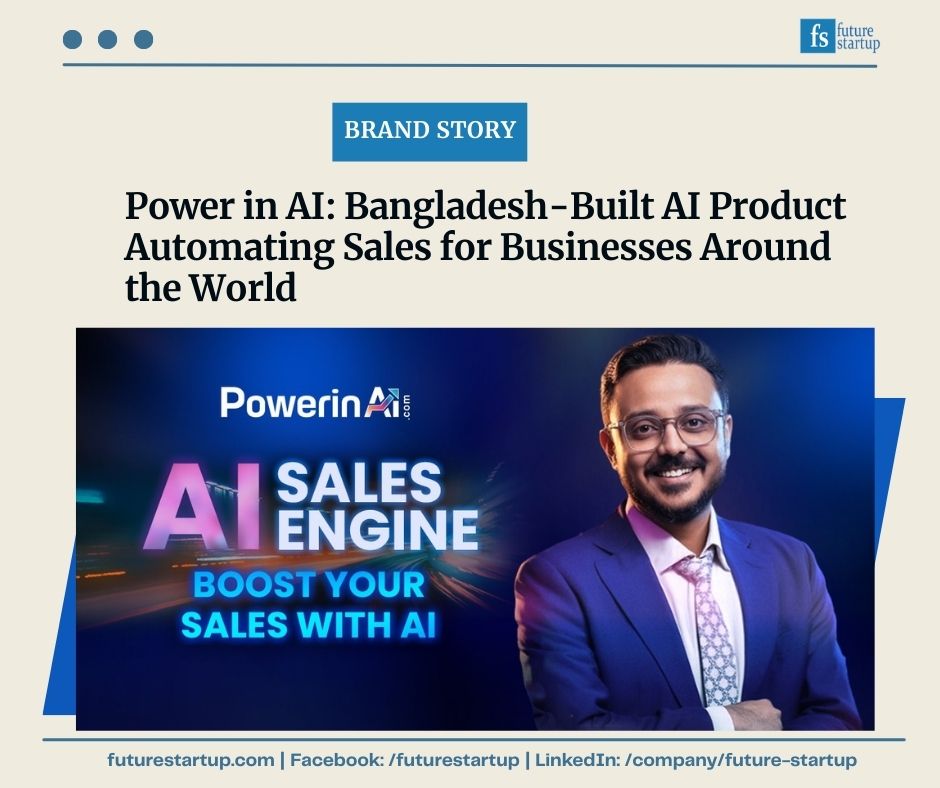
This is where Power in AI, a Bangladesh-built technology company with offices and customers across Bangladesh, the Middle East, and the UK, comes in. The company claims its Sales Engine represents a different approach to sales operations. Rather than simply organizing and facilitating human sales work, it performs the sales work autonomously—from initial contact through multi-channel nurturing to appointment booking.
The company positions itself as an AI Sales Engine rather than a CRM because it operates as an autonomous AI sales agent that handles complete sales cycles without constant human oversight. “You can think of it as hiring an entire sales development team that never sleeps, never takes breaks, and responds to every lead in seconds,” explains Nusrat Akhter, Co-Founder of Power in AI.
Registered in Dubai, the company is backed by Comjagat Technologies, a Dhaka-based technology company with 15 years of experience serving over 1,000 businesses globally. Like many successful tech products, Power in AI emerged from solving an internal challenge.
"We have our global operations—companies in the UK, then Dubai, and we are operating from Bangladesh," explains Md. Abdul Wahed Tomal, Founder and CEO of Comjagat Technologies. "To run operations in these three countries, we thought that reducing our cost was very important. So, we first started this to do our own work—to empower our sales team with AI tools."
After successfully running operations across three countries with the AI Sales Engine, the team recognized broader market potential. "We developed an AI Sales Engine, and we thought that it could be helpful for everyone, we can now sell this solution globally," Tomal notes. "We have been developing this product for more than a year."
The client portfolio demonstrates breadth: financial institutions (IBBL, Bank Asia, BRAC Bank, EBL), telecommunications companies (Robi, Grameenphone), multinational corporations (Acer, Dell, Gigabyte), educational institutions, and government agencies.
Power in AI says it currently operates in three key markets: the United Kingdom, the UAE, and Bangladesh. The geographic distribution and client base indicate both technical maturity and understanding of different market dynamics.
Power in AI says it solves the challenges of sales and sales management through five integrated capabilities that save time, improve efficiency, and accelerate sales growth.
1. Automated data collection and validation: Power in AI’s sales engine continuously collects leads from multiple sources—website forms, social media, partner integrations—and immediately validates the data. It removes bad emails, verifies phone numbers, and enriches lead profiles automatically.
2. Instant personalized outreach: Within seconds of a lead entry, Power in AI's conversational AI chatbot creates personalized sales pitches tailored to the prospect's needs, industry, and behavior. The AI creates personalized video sales pitches, adding visual elements that stand out.
3. Multi-channel engagement orchestration: Power in AI doesn't just send emails; it manages engagement across website chat and social media channels. It follows up across multiple channels with intelligent conditional logic: if an email isn't opened, it automatically sends a WhatsApp message. If that goes unanswered, it initiates a phone call.
4. AI-Powered voice calling: AI-powered voice assistant handles outbound calls, conducting actual conversations, answering questions, handling objections, and booking appointments directly into calendars. According to a testimonial by Atiqur Rahman, from AM: 365 Group AB, reports their AI employee answers in Swedish and English, handles logistics inquiries, and books transport slots with response times under 20 minutes.
5. Intelligent lead scoring and handoff: After each interaction, the AI listens, records calls, creates summaries, and updates lead scores. When leads reach hot status, they're automatically assigned to human sales representatives who can focus exclusively on closing rather than prospecting and qualification.
Human sales teams only get involved when the lead is genuinely ready to buy.
As you can see, what makes Power in AI's approach complete automation is that it handles the entire top and mid-funnel sales process autonomously.
Power in AI says its AI chatbot for customer support handles both pre-sales and post-sales interactions. This has been possible because AI technology has matured significantly over the recent years. 74% of businesses using chatbots report satisfaction, and 62% of consumers prefer chatbots over waiting for human agents. The economic case is compelling as well. Human customer service conversations average cost $8, while chatbot interactions cost 10 cents.
That said, a chatbot needs to be powerful and complete meaningful work to be useful. Merely completing rudimentary tasks wouldn’t cut it.
Power in AI says its system goes beyond simple FAQ bots. Its conversational AI chatbot handles complex sales conversations, qualifying leads through multi-turn dialogues that adapt based on responses.
Let’s take a closer look at some of the key features of Power in AI’s sales engine and how it solves challenges across the entire sales cycle.
AI lead nurturing that never stops: Traditional sales teams struggle with consistent follow-up. 50% of all B2B sales happen only after the fifth follow-up, yet most reps stop after just two touches. This is where AI lead nurturing creates measurable advantages.
Power in AI says its system never forgets to follow up, never gets discouraged by rejection, and maintains consistent quality across thousands of simultaneous conversations. Sequences adapt based on engagement: high-engagement leads receive sales-focused outreach, medium-engagement prospects get educational content, and low-engagement leads enter longer-term nurturing.
This is meaningful because companies implementing automated lead nurturing report a 451% increase in qualified leads, and automated email outreach initiatives claim to result in a 250% increase in response rates compared to manual outreach.
Multi-channel campaign management: Most sales automation tools focus on email. Power in AI says it manages multi-channel sales across websites, Facebook, Instagram, and WhatsApp, managing and replying to inbox messages across all platforms.
For businesses managing leads from diverse sources—trade shows, content marketing, paid ads, partnerships—this unified approach removes coordination headaches. You don't need separate tools for email sequences, social media management, SMS campaigns, and call tracking. Powerin AI’s Sales AI tools handle everything through one interface.
24/7 global operation: Perhaps the simplest yet most powerful advantage: Power in AI operates continuously. The system provides 24/7 global follow-up in any language, ensuring no lead goes cold due to time zone differences or after-hours inquiries.
Mohammad Mamun Akbar Chowdhury from XTREME INTELLIGENCE TECHNOLOGIES, a user of Power in AI’s sales engine, describes how this impacts operations: "Our business has seen a notable improvement in growth and operational efficiency since integrating Power in AI. The system handles follow-up calls, messages, and appointment reminders autonomously, which has freed up our team to concentrate on high-value activities."
Power in AI claims its implementation is easy, and it ensures great support. The company emphasizes that businesses "don't need any technical knowledge" to implement its system. Its technical team "handles the entire implementation," addressing one of the biggest barriers to AI adoption—complexity.
"We built our own AI prompt team; we have an expert prompt team who can do prompt engineering and write prompts for the business process transformation of organizations," Nusrat Akhter explains. This team handles the complex work of adapting the AI to different industries and business processes.
However, optimization requires iteration. Kawsar Ahmed from Western Consulting notes that reply time dropped from hours to minutes after implementing Power in AI, though "a week of script tuning made the AI sound natural," indicating conversational capabilities need customization for specific industries.
Power in AI handles technical implementation, but businesses must invest in strategy—defining ideal customer profiles, creating effective messaging, establishing lead scoring criteria, and determining when human sales reps should enter the conversation.
The sales automation market is crowded with solutions from email sequencers to enterprise CRM platforms. Power in AI's differentiation rests on several pillars.
First, most competitors automate specific tasks—email sequences, lead scoring, and calendar scheduling. Power in AI says it automates the entire process from initial contact through qualification to appointment booking.
"We are different from others because we are providing all-in-one, and this AI Sales Engine concept is a very complex workflow which others in the market do not offer like this," says Tomal. The platform's unique approach includes creating customized videos for prospects, having AI automatically follow up with video demonstrations, and then providing detailed demos as interest develops—a multi-touch strategy competitors haven't replicated.
The second important distinction is: while many platforms focus on text, Power in AI emphasizes AI-powered voice assistants that conduct actual phone conversations. The AI for sales and marketing market is projected to grow from $57.99 billion in 2025 to $240.58 billion by 2030, with chatbots and conversational tools driving significant growth.
Third, Power in AI's starting price of $49 positions it in the sweet spot between basic email tools and enterprise platforms, making sophisticated AI sales automation accessible to growing businesses that can't afford enterprise teams.
Finally, the platform's intelligent channel switching, automatically moving from email to WhatsApp to calls based on engagement, represents more sophisticated orchestration than most competitors offer.
Apparently, Power in AI has quietly been building a loyal customer base. One of the ways to understand whether a product works is through customer feedback.
For Power in AI, some of its public customer reviews from across industries show its effectiveness. For instance, Mohammed Zaman (Dipu), Head of Operations for ABCCI, WaaqTech & AVS Plus, notes: "When you're handling more than one company, things can get messy fast. Power in AI has made life so much easier. Now the updates, the automation, the coordination… it all just happens, and my team can finally focus on what matters."
Mohammed Marbin, CEO of Vibrant Software Ltd (UK), emphasizes financial results: "By leveraging Power in AI's automation expertise, we reduced inefficiencies, optimized costs, and redirected our energy towards high-growth opportunities."
These testimonials show consistent themes: dramatic improvements in response time, elimination of coordination overhead, and the ability to redirect human talent toward strategic activities rather than repetitive outreach.
While Power in AI has been seeing consistent growth and has a small but growing loyal customer base, it also faces challenges and certain limitations.
No technology is universally optimal. Power in AI's AI sales engine approach faces several inherent challenges.
The first challenge comes from the customer acceptance of chatbots. While 87.2% of consumers report neutral or positive chatbot experiences, over 77% of adults find customer service chatbots frustrating, and 85% believe their problems need human resolution. It means customer acceptance varies. One of the ways to address this challenge may be matching automation to use cases. For instance, transactional sales with clear qualification criteria work well, whereas complex, consultative sales benefit less.
The second challenge comes from industry-specific customization requirements. AI voice conversations need refinement for different industries, customer bases, and product types. Achieving natural, effective conversations requires investment in customization.
Integration complexity also poses certain challenges. Businesses with established tech stacks may face integration challenges connecting to existing CRMs, marketing automation platforms, and analytics systems.
Finally, automation handles volume brilliantly but struggles with edge cases. When prospects ask unusual questions, need custom solutions, or experience emotional frustration, human judgment remains superior.
Power in AI says it has developed solutions to address some of these challenges. For instance, it automates lead qualification and nurturing, then hands it over to humans.
Power in AI operates in a market experiencing explosive growth. The global sales automation market is expected to grow from $7.8 billion in 2019 to $16 billion by 2025, and 74% of sales professionals expect AI to redefine their roles.
The company says it is seeing a strong market response. "We are getting very good responses from different markets and different countries," says Tomal. He anticipates accelerating adoption: "It is our belief that we will get much more response in 2026 because this AI is still now to many markets; the Sales Engine subject is also still new. But when businesses use it, they can understand that their cost is decreasing and their ROI, return on investment, is much higher."
Going forward, PowerinAI's roadmap extends beyond its current offering. "Alongside our AI Sales Engine, we are creating some more things. For example, AI Marketing Engine. We are working on different products," Tomal reveals. The company is also developing enterprise-level AI solutions and focusing on Bengali language capabilities—"especially we are working in Bengali."
The vision is global scale with localized impact. "Everyone is now going for business transformation as a result of AI worldwide, our plan is to tap into that opportunity," explains Tomal. The company aims to create employment and train young entrepreneurs in Bangladesh for prompt engineering, workflow creation, and automation—skills expected to be in high demand globally.
Power in AI exists within a broader transformation of how businesses approach sales. Revenue increases resulting from AI use are most commonly reported in use cases within marketing and sales.
The shift is redefining sales roles. Instead of spending time on prospecting, data entry, and initial qualification, salespeople increasingly focus on relationship building, strategic thinking, and complex problem-solving. Sales reps using automation save an average of 6 hours per week, and that time gets redirected toward activities where human judgment creates the most value.
Power in AI's model—AI sales agents handling volume work and routing qualified opportunities to human closers—embodies this emerging division of labor. The technology handles consistency, speed, and scale. Humans handle nuance, creativity, and relationship depth.
This isn't replacing salespeople; it's elevating what salespeople do. Power in AI claims it simply removes the administrative burden that prevented them from doing more of this high-value work.
Several trends create opportunities for platforms like Power in AI.
Distributed teams make coordinated sales operations harder. AI systems that operate independently of geography and time zones solve coordination problems that remote-first organizations face. Digital channels are expected to represent 80% of all B2B sales engagements by 2025.
Current AI-powered voice assistants can sound robotic or struggle with accents and interruptions. As natural language processing improves, these limitations will fade. Power in AI's investment in voice calling positions it well for this evolution.
90% of customers consider personalization a key factor in purchasing decisions. Yet delivering true personalization at scale remains difficult. AI systems that can analyze individual prospect behavior and customize messaging automatically will increasingly dominate over one-size-fits-all approaches.
Small and medium businesses historically couldn't afford sophisticated sales development teams. Power in AI's mid-market pricing ($49 entry point) taps into a massive market of growing companies that need enterprise-caliber sales automation but can't pay enterprise prices.
For Power in AI, built in Bangladesh and now serving businesses from London to Dubai, the opportunity is substantial. The real question will be how well it executes as it scales and grows in an increasingly competitive market.
Correction on December 27, 2025: the article has been updated with new information.