
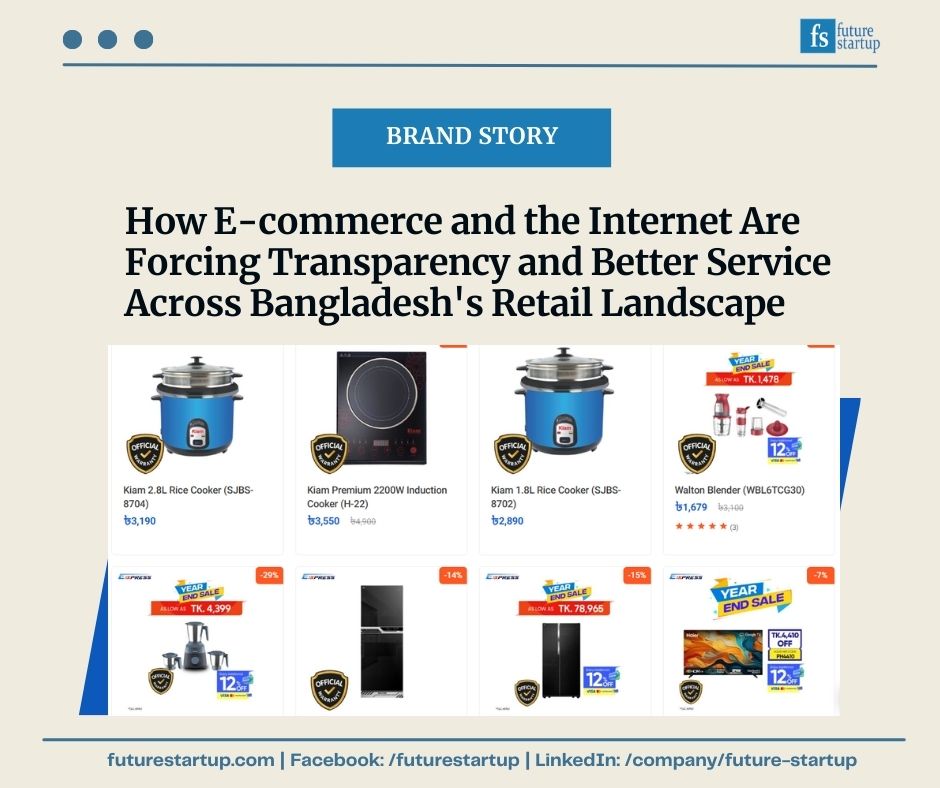
In Bangladesh's fast-growing retail landscape, e-commerce platforms have fundamentally changed how millions shop, forcing an entire industry to rethink its relationship with customers.
What started as convenience has evolved into a force for transformation in transparency, accountability, and customer service standards—one that's now reshaping brick-and-mortar retail as well.
E-commerce made transparency and customer service non-negotiable through the simple mechanics of how online commerce works. When customers can compare prices across platforms with a few clicks, complain publicly on social media, and take their business elsewhere without leaving home, retailers must compete on transparency and service.
This culture is now spreading beyond online commerce as customers increasingly demand the same standards from offline retailers, often using online information to check prices and details before making offline purchases.
However, the path hasn't been smooth. E-commerce went through a crisis in 2021, when several platforms failed customers through inauthentic products, delayed deliveries, and outright scams. But these companies collapsed and couldn't sustain operations.
The structure of online commerce—transparent pricing, public reviews, social media complaints, easy comparison—makes it fundamentally customer-first. Companies that prioritize authentic products, transparent pricing, and superior customer service gain advantages while those that don't eventually fail.
In today’s article, our goal is to understand this subtle change online commerce is ushering in— forcing transparency and better service across Bangladesh's retail landscape.
E-commerce operates in an environment where information asymmetry collapses. A customer shopping in New Market might visit five shops and still wonder if they got a fair price. Traditional retail operated in an environment where sellers controlled information. Product specifications were vague. Pricing was opaque. Comparisons were difficult.
This wasn't necessarily malicious; it was simply how retail worked. This knowledge gap translated into pricing power and negotiating advantage.
E-commerce dismantled this structure completely. Online marketplaces give customers access to information about product quality, availability, specifications, and prices, and comparisons to competitors.
When every platform displays detailed specs, when customers read reviews from other buyers, and when competitors are a click away, hiding information becomes impossible.
More critically, e-commerce platforms that adopt clear communication regarding pricing, product details, and shipping policies set benchmarks that others must match. This isn't about altruism. It's about survival. While trust issues from fake reviews, misleading product descriptions, and poor customer service once plagued the sector, platforms that prioritize transparency create a competitive dynamic where others must follow or lose customers.
Within minutes, a shopper now compares prices, reads specifications, checks reviews, and makes informed decisions.
The pressure this creates on all retail—online and offline—is immense and unavoidable.
If transparency is e-commerce's first structural advantage, customer service is the second. Online retailers can't rely on location, relationships, or the hassle of going elsewhere. They win on product, price, and service—and when products and prices can be matched, service becomes the deciding factor.
Traditional retail in Bangladesh rarely prioritized post-purchase support. Returns were complicated. Complaints went unaddressed. Customer satisfaction was an afterthought. This made sense in an environment where customers had limited alternatives and switching costs were high.
E-commerce changed the equation. When customers can leave reviews, post complaints on social media, and switch to competitors instantly, poor service becomes immediately costly. In a market where more than 90 percent of eCommerce users prefer cash-on-delivery payment, reflecting lingering trust concerns, service becomes the mechanism through which trust is earned.
Pickaboo's rise offers a concrete example. Excellent customer service, authentic products, and effective marketing helped the company quickly rise in the ranks of ecommerce competition in Dhaka.
The company says it has built systematic approaches around reliability and responsiveness: approximately 95% of orders delivered on time, customer contact after every delivery for feedback, reduced customer service wait times to 20 seconds (under 5 seconds for club members), and direct relationships with brands ensuring product authenticity.
This customer-first positioning helped Pickaboo attract and retain customers without heavy discounting, demonstrating that trust built through transparency and service creates sustainable competitive advantages that temporary promotions can't replicate.
This is where the story becomes broader than e-commerce and the internet. When customers experience transparent pricing and reliable service online, they start expecting it everywhere. When they can check prices on their phones while shopping in a physical store, traditional retailers lose their information advantage. A customer in Bashundhara City can now check prices on Pickaboo or another online shop and ask shopkeepers why there's a difference. That changes the negotiation entirely.
This dynamic is forcing traditional retailers to adapt. Clear pricing, return policies, customer feedback mechanisms, and responsive support—once rare in Bangladesh retail—are increasingly becoming standard expectations. Government regulations now require pricing transparency and clear terms, but regulations followed market dynamics. The real pressure comes from customers with alternatives and information.
A traditional retailer competing against e-commerce platforms can't simply offer lower prices. They need to match the transparency and service standards customers experience online. The smartphone in every pocket is a price comparison tool, a review platform, and a direct line to competitors.
However, the transformation is incomplete, and challenges remain. Complaints around fraud, misleading advertisements, unreliable deliveries, and subpar service have left consumers sceptical and e-commerce businesses struggling to build credibility.
Many e-commerce businesses in Bangladesh do engage in deceptive marketing tactics, such as fake discounts, misleading product descriptions, and manipulated customer reviews. Regulatory enforcement remains inconsistent, and consumers still face challenges with product authenticity and service.
Despite these challenges, the trajectory is clear. E-commerce has permanently altered customer expectations in Bangladesh. Transparency and responsive customer service are now baseline requirements.
For all retailers, the implications are straightforward: adapting isn't optional. Customers who experience transparent pricing and reliable service online demand the same offline. They expect clear return policies and responsive support. They'll share bad experiences on social media and switch to alternatives when disappointed.
The future of retail in Bangladesh will be defined not by who offers the lowest price but by who serves customers best. Price competition has a floor—at some point, prices can't go lower without sacrificing quality or viability. Service competition has no ceiling. There's always room to be more transparent, more responsive, more reliable.
As internet penetration grows and digital literacy improves, these expectations will only intensify. Retailers—whether online or offline—must recognize this reality and adapt accordingly.
The e-commerce revolution is fundamentally about power shifting from sellers to customers, about information flowing more freely, about customers having alternatives and using them.
As we mentioned earlier, companies like Pickaboo have shown that succeeding in this environment requires building operations around customer needs rather than seller convenience. The transparency revolution that started online is now slowly reshaping all retail, one transaction at a time.