
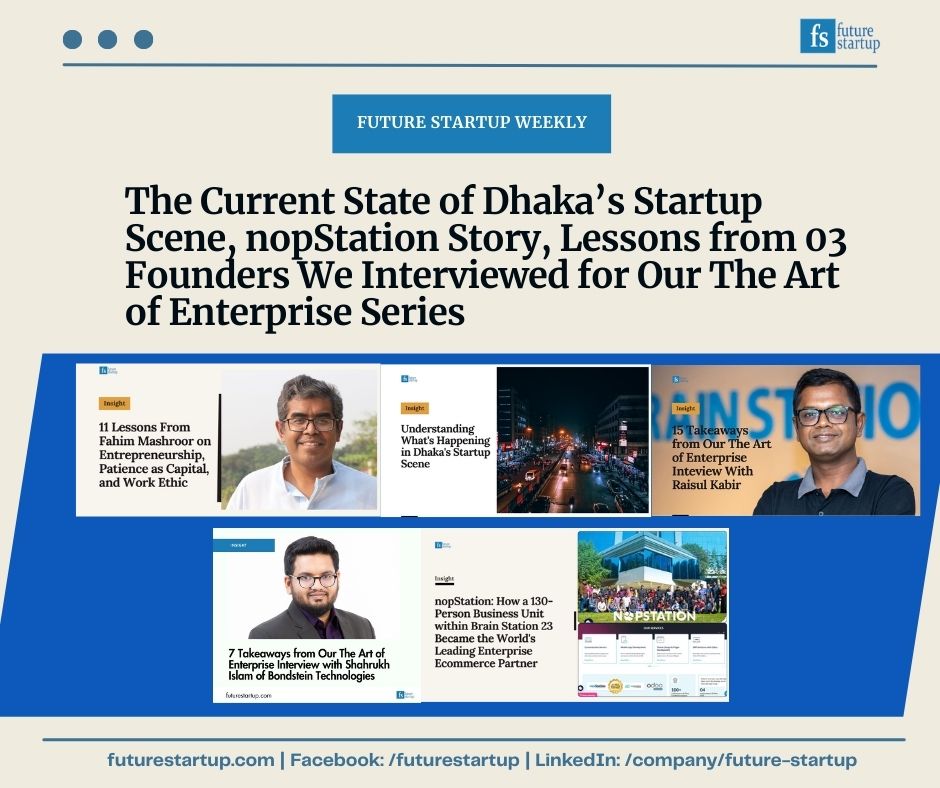
5 Future Startup articles for your weekly reading.
The past roughly two and a half years have been remarkably quiet for Dhaka's startup ecosystem. Funding has become sporadic. New companies entering the scene have dwindled to a trickle. Ecosystem activities have dimmed considerably. If you were tracking the scene through press releases alone, you might conclude the party is over.
Many have reached exactly this conclusion. The cynics—and Dhaka has plenty—have announced the death of the startup dream with a mixture of vindication and relief. The startup scene was always a bubble, they say, selling air to gullible investors.
Others believe this is merely a temporary setback tied to politics. Once a new government comes and certainty returns, funding will flow again, and everything will normalize.
Both readings are wrong.
What's happening in Dhaka is neither a uniquely Bangladeshi failure nor a temporary political hiccup. The reality is shaped by two forces: one global, one local.
Building a company is hard. That part we all know. But that hard comes in stages. Going from zero to one is one kind of hard—you are striving and struggling to ensure your survival. Once a company passes that stage, then comes a different kind of hard: scaling successfully. Most companies die in the process of going from zero to one. Some people estimate the failure rate of early-stage companies at over 95%. Out of the small minority that survives, most never find meaningful scale, living in a perpetual plateau.
Both of these journeys, bringing an idea into existence and transforming a small business into an organization that scales, are different and come with their own distinct challenges.
In a recent conversation with Future Startup, Shahrukh shared his lessons and insights about building a business from scratch that has grown revenue 15 times over while navigating the challenges of building in a difficult market. One of our key takeaways from the interview is that transforming an organization from an early-stage company to a scalable organization takes a different order of thinking and comes with different sets of challenges. The interview is a fascinating read in its entirety.
In this article, we pull out 7 key takeaways from the conversation on growth, scale, and building consequential organizations for your quick consumption. For more details and fascinating nuggets of insight, read the entire interview here.
In our recent interview with Raisul Kabir, founder and CEO of Brain Station 23, we explored one of the most challenging aspects of building a business: growth and scaling. When we last spoke with Mr. Raisul in 2019, Brain Station 23 was a 185-person company. Today, it's a nearly 1000-person organization—one of the largest software services companies in Bangladesh.
Scale is where most companies stumble. Many promising ventures plateau after reaching a certain size. Others collapse under the weight of their complexity. Understanding how to navigate growth—from small team to medium-sized company to large organization—is an existential question for any business with ambition.
The conversation, like several of our previous conversations with Mr. Raisul, offers rare insights into the mechanics of growth and scaling. Mr. Raisul doesn't deal in abstract theories. He walks us through the concrete, messy realities of growth: bringing in partners and making partnerships work, implementing organizational structure, hiring a CFO, learning to believe that bigger things are possible, and building systems that allow an organization to scale without falling apart.
Here are 15 key lessons from our conversation on growth, scale, and building consequential organizations.
There are very few people in Dhaka's internet entrepreneurship space quite as important—or as influential—as Fahim Mashroor, the Founder and CEO of Bdjobs.com, the country's first online job portal, and several other companies. He has built one of the first successful local internet technology companies in Bangladesh. On top of that, Mr. Fahim continues to influence the tech ecosystem with his critical opinions, pro-bono support to founders in the form of mentorship, angel investments in early-stage companies, and now increasingly active citizen activism.
Fahim started Bdjobs in 2000 when the internet was barely a household thing in Bangladesh. His journey offers profound insights into what it takes to build a sustainable technology venture in a challenging market. From facing unending challenges for 2-3 years straight to building one of Bangladesh's first successful internet companies, his experience shows the necessity of patience, passion, and principled persistence in building successful businesses.
In conversations with Future Startup over the years (these takeaways are taken from this and this interview with Fahim), Fahim has shared invaluable lessons about entrepreneurship, strategy, and life—insights drawn from nearly three decades of building businesses in one of the world's most challenging yet promising markets.
Here are 10 key lessons from his journey.
When Comalytics decided to reduce its technical staff in Johannesburg and made a team in Bangladesh its technology department, they needed something the playbook says emerging market firms can't provide: deep expertise, long-term thinking, and partners who would optimize its business instead of their own billable hours. The company found it in nopStation, now a 130-person enterprise e-commerce unit within Bangladesh’s software services giant Brain Station 23. Today, a small team at nopStation in Dhaka manages Comalytics' entire marketplace platform serving 300+ e-commerce sites across South Africa.